Executive Intelligence. Industrial Risk. Geopolitics.
Strategic Sparring
for Decision-Makers
Risk intelligence across technology, law, markets and power dynamics.

Verdeckte Geschäftsrisiken, strategische Widersprüche und kritische Abhängigkeiten frühzeitig erkennen.
Kostenlose Analyse starten →
Verdeckte Machtstrukturen, Führungsrisiken und organisatorische Blockaden frühzeitig erkennen.
Kostenlose Analyse starten →
Geopolitische Risiken, globale Abhängigkeiten und kritische Lieferkettenrisiken frühzeitig erkennen.
Kostenlose Analyse starten →
Identify hidden business risks, strategic contradictions and critical dependencies at an early stage.
Start Free Analysis →
Identify hidden power structures, leadership risks and organizational blockers at an early stage.
Start Free Analysis →
Identify geopolitical risks, global dependencies and critical supply-chain vulnerabilities at an early stage.
Start Free Analysis →
Verdeckte Geschäftsrisiken, strategische Widersprüche und kritische Abhängigkeiten frühzeitig erkennen.
Kostenlose Analyse starten →
Verdeckte Machtstrukturen, Führungsrisiken und organisatorische Blockaden frühzeitig erkennen.
Kostenlose Analyse starten →
Geopolitische Risiken, globale Abhängigkeiten und kritische Lieferkettenrisiken frühzeitig erkennen.
Kostenlose Analyse starten →
Identify hidden business risks, strategic contradictions and critical dependencies at an early stage.
Start Free Analysis →
Identify hidden power structures, leadership risks and organizational blockers at an early stage.
Start Free Analysis →
Identify geopolitical risks, global dependencies and critical supply-chain vulnerabilities at an early stage.
Start Free Analysis →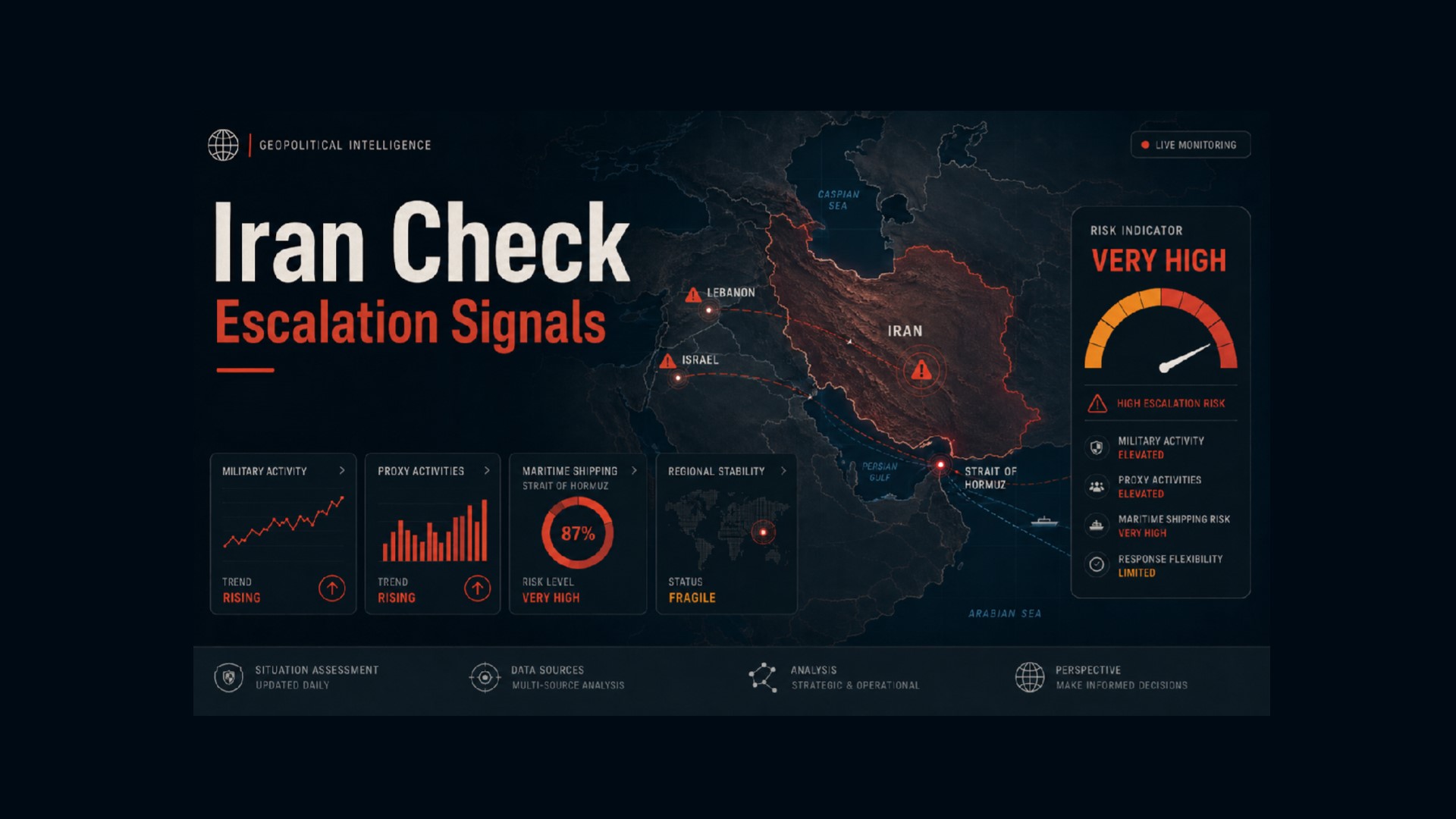
This escalation radar summarizes five relevant signals from June 14, 2026. The focus is on verifiable official statements and events with potential impact on energy prices, supply chains, markets, and regional security.
Trump is pointing to a possible signing, while Iranian officials continue to use more cautious language.
The possible reopening of the Strait of Hormuz is a core element of the draft deal and remains decisive for energy and supply-chain risks.
Hezbollah projectiles, Israeli strikes on Beirut, and Iranian warnings show that the Lebanon complex can still burden the deal.
| Actor | Type | Severity | Status | Source / Verification status | Business impact |
|---|---|---|---|---|---|
| Iran / senior Iranian official / Foreign Ministry | Draft memorandum covering sanctions, nuclear framework, and Hormuz reopening | High to critical · Level 4/5 | A senior Iranian official told Reuters that the draft memorandum with the United States includes the reopening of the Strait of Hormuz to commercial vessels, US waivers on oil sanctions, the release of frozen Iranian assets, and nuclear limitations. Iran would commit not to develop or acquire nuclear weapons and to maintain its current level of nuclear activity until a final deal is reached. | Partially confirmed by Reuters, June 14, 2026 and additionally reported by The Guardian, June 14, 2026. Verification status: confirmed for Iran’s description of the draft; unclear whether and when the agreement will be formally signed. | High relevance for oil prices, sanctions, payment flows, Iran exposure, energy supply, maritime security, commodity markets, and companies with Middle East or energy exposure. |
| USA / Donald Trump / US administration | De-escalation signal under political time pressure | High to critical · Level 4/5 | Trump said the deal with Iran would be signed on Sunday and that the Strait of Hormuz would then be opened to all. At the same time, the timing remains uncertain: Pakistan reported preparations for an electronic signing, while Iranian officials remained more cautious and said that no final decision had been made. | Confirmed by Reuters, June 14, 2026 and additionally reported by The Guardian, June 14, 2026. Verification status: confirmed for Trump’s announcement; unclear whether Iran will actually confirm the timeline in final form. | Short-term calming signal for markets and energy prices, but continued high risk of volatility, political setbacks, renewed threat postures, risk premiums, and corporate planning uncertainty. |
| Israel / IDF / Netanyahu / Israel Katz | Military response to Hezbollah fire in Beirut | High to critical · Level 4/5 | The Israeli military said Hezbollah launched three projectiles toward northern Israeli communities and described the incident as a clear violation of the ceasefire. Israel then said it struck Hezbollah targets in the Dahiyeh district in Beirut’s southern suburbs. | Confirmed by Associated Press, June 14, 2026 and Reuters, June 14, 2026. Verification status: confirmed for the Israeli account and reported strikes; independent detail checks on damage and military effects remain necessary. | Increased risk for Lebanon exposure, northern Israel, evacuations, infrastructure, insurance, air traffic, banks, regional supply chains, and investment decisions. |
| Lebanon / Hezbollah / Iranian warnings | Projectiles, drones, and risk to the US-Iran deal | High · Level 3/5 | According to Reuters, there was initially no immediate Hezbollah comment on the Israeli account. The group later said it had launched rockets and drones toward Israeli troops in southern Lebanon. At the same time, Iran warned, according to Axios, that the Israeli Beirut strike could jeopardize the expected US-Iran deal. | Partially confirmed by Reuters, June 14, 2026 and additionally reported by Axios, June 14, 2026. Verification status: confirmed for reported Hezbollah activity and the Israeli response; Iranian warnings and consequences for the deal remain politically sensitive and require monitoring. | High risk for Lebanon, northern Israel, the humanitarian situation, evacuations, infrastructure, banks, insurance, transport routes, and companies with regional exposure. |
| Hormuz / USA / Iran / energy and financial markets | Shipping, sanctions, oil price, and transit risk | Critical · Level 5/5 | The Strait of Hormuz remains the central leverage point of the possible US-Iran deal. According to Reuters, the draft provides for Iran to immediately reopen the Strait of Hormuz to all commercial vessels, while the United States would lift its naval blockade on Iranian ports. Oil sanctions would also be waived temporarily and frozen Iranian assets would be released. AP additionally notes that the closure of the Strait of Hormuz continues to place significant pressure on global markets. | Confirmed by Reuters, June 14, 2026 and additionally reported by Associated Press, June 14, 2026. Verification status: confirmed for the draft conditions; unclear whether the reopening will be implemented immediately, fully, and sustainably in practice. | Direct business impact on oil, LNG, tanker routing, marine insurance, Gulf markets, supply-chain costs, inflation risks, freight rates, commodity prices, and risk premiums. |
You are currently viewing a placeholder content from X. To access the actual content, click the button below. Please note that doing so will share data with third-party providers.
More Information