Executive Intelligence. Industrial Risk. Geopolitics.
Strategic Sparring
for Decision-Makers
Risk intelligence across technology, law, markets and power dynamics.


Verdeckte Geschäftsrisiken, strategische Widersprüche und kritische Abhängigkeiten frühzeitig erkennen.
Kostenlose Analyse starten →
Verdeckte Machtstrukturen, Führungsrisiken und organisatorische Blockaden frühzeitig erkennen.
Kostenlose Analyse starten →
Geopolitische Risiken, globale Abhängigkeiten und kritische Lieferkettenrisiken frühzeitig erkennen.
Kostenlose Analyse starten →
Identify hidden business risks, strategic contradictions and critical dependencies at an early stage.
Start Free Analysis →
Identify hidden power structures, leadership risks and organizational blockers at an early stage.
Start Free Analysis →
Identify geopolitical risks, global dependencies and critical supply-chain vulnerabilities at an early stage.
Start Free Analysis →
Verdeckte Geschäftsrisiken, strategische Widersprüche und kritische Abhängigkeiten frühzeitig erkennen.
Kostenlose Analyse starten →
Verdeckte Machtstrukturen, Führungsrisiken und organisatorische Blockaden frühzeitig erkennen.
Kostenlose Analyse starten →
Geopolitische Risiken, globale Abhängigkeiten und kritische Lieferkettenrisiken frühzeitig erkennen.
Kostenlose Analyse starten →
Identify hidden business risks, strategic contradictions and critical dependencies at an early stage.
Start Free Analysis →
Identify hidden power structures, leadership risks and organizational blockers at an early stage.
Start Free Analysis →
Identify geopolitical risks, global dependencies and critical supply-chain vulnerabilities at an early stage.
Start Free Analysis →
Strategic Risk Intelligence Brief by Global Insight Group.
This analysis is based on the GFDD Framework™ developed by Michaela Schaaf-Hoffelner and is designed for executives, investors and strategic decision-makers.
Updated on: June 15, 2026
A woman works in a technical team with 20 men.
She is controlled, belittled, isolated and framed as “difficult”.
Is this discrimination – or simply a normal workplace conflict?
The uncomfortable answer is: It does not only depend on what happens. It also depends on why it happens to HER in particular.
Being the only woman in a male-dominated team is not a legal violation in itself. Workplace conflicts are not automatically discrimination. Not every case of poor leadership is sexism. Not every case of bossing is gender-based discrimination.
But this is exactly where the problem begins.
Because in technical professions, female competence is still often read differently. A woman who thinks clearly, sets clear boundaries, quickly understands technical contexts or points out leadership failures is often assessed differently than a man behaving in exactly the same way.
For him, it is called: assertive.
For her, it is called: difficult.
For him, it is called: analytical.
For her, it is called: know-it-all.
For him, it is called: ambitious.
For her, it is called: overestimating herself.
And this is precisely where an allegedly normal workplace conflict can turn into a potential pattern of discrimination.
One woman among 20 men does not prove anything by itself. It does not automatically prove sexism, workplace discrimination or toxic leadership. But it changes the starting position.
Being outnumbered often means less social mirroring, fewer informal allies, less initial trust and greater visibility for every mistake. Anyone standing alone in a group can quickly become a projection surface.
That is why the decisive question is not:
“Was there a conflict?”
The decisive question is:
Is this woman being assessed by the same standards as her male colleagues?
Is her competence evaluated differently? Is she controlled more closely? Is she labelled “not a team player” more quickly? Is her clarity perceived as an attack? Is she socially isolated while comparable male behaviour is tolerated?
If these questions are answered with yes, then this is no longer just a personal conflict. It becomes a question of power, status and gender-based disadvantage.
The official narrative rarely sounds as brutal as: “Women are too stupid for technology.”
It sounds more professional.
“She does not fit into the team.”
“She is too complicated.”
“She communicates in a difficult way.”
“She overestimates herself.”
“She needs to learn how to fit in.”
“She may be technically good, but personally she is difficult.”
That sounds harmless. But this is exactly where the danger lies.
Because this language shifts the focus. Suddenly, the question is no longer why a group devalues, isolates or keeps a woman small. The question becomes why she “does not fit into the team”.
This is victim-offender reversal in the workplace.
Discrimination often does not begin with an explicit statement such as: “Women do not belong here.” It begins more subtly: with a higher burden of proof, less initial trust, social coldness, competence devaluation and the framing: “She is difficult.”
And that is precisely why it is so difficult to grasp.
The fact that women in technical professions are not only underrepresented, but also experience gender-based disadvantage more frequently in male-dominated work environments, is empirically supported. The Pew Research Center: Women and Men in STEM Often at Odds Over Workplace Equity shows that 50% of women in STEM jobs report having experienced at least one form of gender-based discrimination at work – compared with 19% of men in STEM jobs. The pattern becomes particularly clear where women work mostly with men: 78% of these women report gender-based discrimination, and 48% say their gender has made it harder for them to succeed in their job.
This is the decisive point: Being outnumbered is not automatically discrimination. But being outnumbered increases the likelihood that competence devaluation, isolation, a higher burden of proof and bossing must be examined through a gender-based lens.
Beneath the official narrative, there is often a hidden conflict logic.
Then it is no longer about performance. It is about status.
A competent woman in a technical male team can disturb an unspoken order. Especially when she is not grateful, compliant or quiet. When she does not take on the less attractive tasks. When she does not silently stabilize the room while others profile themselves.
Then she becomes a threat.
Not because she is too weak. But because she becomes too visible.
In such systems, parasitic interests can emerge: individuals benefit from women being artificially kept small. Women are assigned the thankless tasks, carry emotional extra work and stabilize poor processes, while being blocked from career development, visibility and recognition.
This is not harmless team dynamics. It is organizational failure.
The Austrian study LEA – Watch Out for Drop-Out! Die Studienergebnisse shows exactly this structure in the STEM field: Only 31% of women with a formal STEM qualification actually work in a STEM profession. The drop-out rate is 69% for women and 43% for men. The study identifies unfavorable working conditions, a lack of development opportunities and deeply rooted gender-based inequalities as central reasons, which are linked to male-dominated organizational cultures.
In other words: Many women do not leave technology because they lack competence. They leave technical fields because the systems are unable to retain them.
Cross-country data also shows that discrimination is not evenly distributed. The OECD/Eurobarometer analysis on discrimination in the EU shows that self-reported discrimination in the EU averages slightly above 21%, ranging from 10% in Portugal to 38% in Belgium. Austria and Germany are not at the lower end: In the OECD/Eurobarometer 2023 analysis, around 29% of respondents in Austria and around 25% in Germany report discrimination or harassment experiences in the previous twelve months – compared with an EU average of slightly above 21%. For Switzerland, data from the Federal Statistical Office: Discrimination in Switzerland shows that discrimination is also frequently visible in the context of work and job search.
This is exactly why bossing against a woman in a technical male team should not be dismissed too quickly as a “personal conflict”.
The decisive question is:
Is performance being assessed here – or is female competence being sanctioned within a male-dominated status order?
Because when a woman is systematically controlled, devalued, isolated and then presented as the problem, this is not just a women’s issue. It is a governance risk.
Companies lose precisely those people who identify problems, take responsibility and speak uncomfortable truths.
When a woman fails in a male team, the woman is not automatically the problem. Sometimes her failure only reveals how poorly the system can deal with female competence.
Maybe this article made you think about your own situation.
About a boss who keeps you small.
About a team where you never truly felt included.
About tasks that always end up with you, while others receive the more visible projects.
Or about that persistent doubt: Am I really being too sensitive – or is something wrong here?
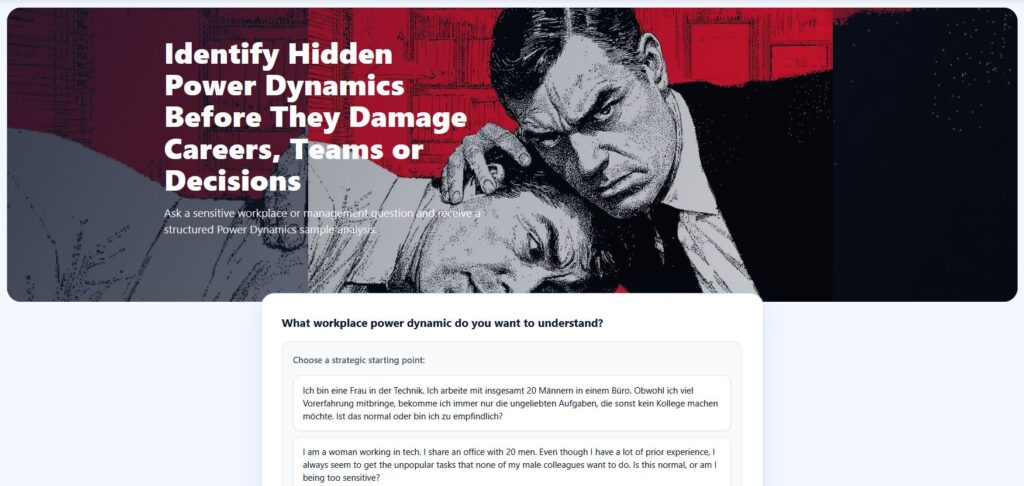
Ask your question directly to our GFDD Power Dynamics AI.
The analysis is anonymous and does not require registration.
Our AI was trained on the insights of GFDD Diagnostics™ into workplace dynamics and organizational environments. It does not respond with generic coaching advice, but with a structured perspective on power, status, hidden conflict logic, victim-offender reversal and organizational risk patterns.
This knowledge has grown over more than 35 years and has been tested across different professional contexts.
Still, AI can make mistakes. The response does not replace legal, psychological or medical advice. However, it can help you recognize patterns more clearly, better understand your situation and ask the right next questions.
Ask the GFDD Power Dynamics AI now – anonymously, directly and without registration.
Is bossing against a woman automatically discrimination?
No. But if bossing is linked to gender-based patterns — such as competence devaluation, social isolation, a higher burden of proof or the framing as “difficult” — discrimination must be examined.
Why is discrimination in technical professions so difficult to prove?
Because it is rarely expressed openly. It often appears indirectly: in task allocation, career blocking, lack of initial trust, social coldness and victim-offender reversal.
Why is this a business risk?
Because toxic leadership and psychological unsafety drive high-performing women out of organizations, weaken innovation and stabilize poor decision-making.
Author of Global Insight Group Intelligence:
Michaela Schaaf-Hoffelner has more than 35 years of experience in strategic and technical project and product management, particularly in IT, control systems and intralogistics. Through her long-standing work with complex systems, she identifies structural risks and dynamic misalignments at an early stage – risks that are often overlooked in conventional analysis.
Her focus is on making causal relationships and systemic dependencies visible and translating them into concrete strategic advantages for investors and decision-makers. Her analyses combine deep technical systems understanding with geopolitical and economic developments.
GFDD Framework™ and GFDD Diagnostics™ are proprietary analytical concepts developed by Michaela Schaaf-Hoffelner. © 2026 Global Insight Group LLC. All rights reserved.
You are currently viewing a placeholder content from X. To access the actual content, click the button below. Please note that doing so will share data with third-party providers.
More Information