Executive Intelligence. Industrial Risk. Geopolitics.
Strategic Sparring
for Decision-Makers
Risk intelligence across technology, law, markets and power dynamics.

Verdeckte Geschäftsrisiken, strategische Widersprüche und kritische Abhängigkeiten frühzeitig erkennen.
Kostenlose Analyse starten →
Verdeckte Machtstrukturen, Führungsrisiken und organisatorische Blockaden frühzeitig erkennen.
Kostenlose Analyse starten →
Geopolitische Risiken, globale Abhängigkeiten und kritische Lieferkettenrisiken frühzeitig erkennen.
Kostenlose Analyse starten →
Identify hidden business risks, strategic contradictions and critical dependencies at an early stage.
Start Free Analysis →
Identify hidden power structures, leadership risks and organizational blockers at an early stage.
Start Free Analysis →
Identify geopolitical risks, global dependencies and critical supply-chain vulnerabilities at an early stage.
Start Free Analysis →
Verdeckte Geschäftsrisiken, strategische Widersprüche und kritische Abhängigkeiten frühzeitig erkennen.
Kostenlose Analyse starten →
Verdeckte Machtstrukturen, Führungsrisiken und organisatorische Blockaden frühzeitig erkennen.
Kostenlose Analyse starten →
Geopolitische Risiken, globale Abhängigkeiten und kritische Lieferkettenrisiken frühzeitig erkennen.
Kostenlose Analyse starten →
Identify hidden business risks, strategic contradictions and critical dependencies at an early stage.
Start Free Analysis →
Identify hidden power structures, leadership risks and organizational blockers at an early stage.
Start Free Analysis →
Identify geopolitical risks, global dependencies and critical supply-chain vulnerabilities at an early stage.
Start Free Analysis →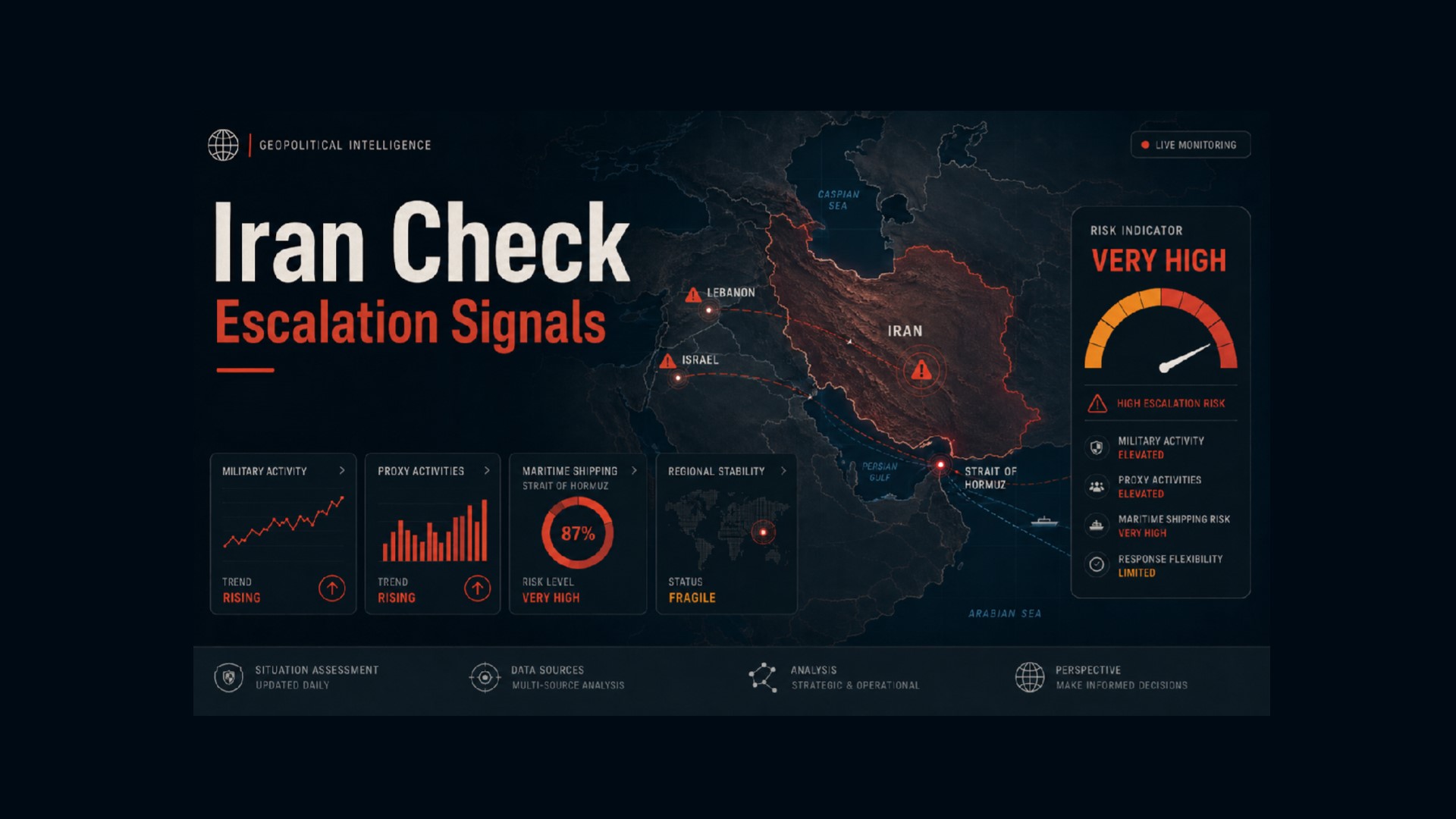
This escalation radar summarizes five relevant signals from June 16, 2026. The focus is on verifiable official statements and events with potential impact on energy prices, supply chains, markets, and regional security.
US officials report that a memorandum with Iran has been signed. The deal is now moving into a second phase, but key details remain open.
Iran, Hezbollah, and Lebanon insist on an Israeli withdrawal, while Israel says it will remain in security zones.
The reopening of the Strait of Hormuz has been initiated, but according to US officials, normalization will not happen immediately.
| Actor | Type | Severity | Status | Source / Verification status | Business impact |
|---|---|---|---|---|---|
| Iran / Abbas Araghchi / Iranian diplomacy | Lebanon condition in the US-Iran MOU | High to critical · Level 4/5 | According to AP, Iranian Foreign Minister Abbas Araghchi stated that an end to the war would not be complete without the withdrawal of Israeli forces from territories occupied during the war. This turns the Lebanon complex into a central fault line of the US-Iran MOU. While US officials say Israel’s withdrawal is not a condition of the agreement, Iran is politically placing this issue at the center of the next phase. | Confirmed by Associated Press, June 16, 2026, additionally validated by Reuters, June 16, 2026 and further reported by The Guardian, June 16, 2026. Verification status: confirmed for Araghchi’s statement and Iran’s position; unclear whether this position is legally binding in the unpublished MOU. | High risk for regional stability, sanctions, oil prices, supply chains, insurance, Lebanon exposure, Middle East investments, and companies with energy or Gulf exposure. |
| USA / Donald Trump / JD Vance / US administration | MOU, second negotiation phase, and nuclear red line | High to critical · Level 4/5 | According to Reuters, US officials said the United States and Iran had signed a memorandum of understanding to end the nearly four-month war. On June 16, 2026, Trump said the deal was now entering a second phase and that Iran would never obtain a nuclear weapon. At the same time, he warned that massive consequences would follow if Iran attempted to obtain one. | Confirmed by Reuters, June 15, 2026, additionally validated by Associated Press, June 16, 2026 and further reported by The Guardian, June 16, 2026. Verification status: confirmed for the US account and Trump’s statements; unclear how robust the nuclear commitments are without the full text and verification mechanism. | Short-term calming signal for markets and energy prices, but continued high risk of volatility, political setbacks, sanctions uncertainty, new red lines, and risk premiums. |
| Israel / Benjamin Netanyahu / Israeli government | Maintaining security zones in Lebanon, Gaza, and Syria | High to critical · Level 4/5 | After the US-Iran MOU, Netanyahu said Israel would remain in the security zones in Lebanon, Gaza, and Syria for as long as necessary to protect the country. This effectively contradicts Iran’s demand for a full Israeli withdrawal from Lebanon. At the same time, US officials emphasize that Israel still has the right to defend itself against Hezbollah attacks. | Confirmed by The Guardian, June 15, 2026, additionally validated by NDTV / AFP, June 16, 2026 and by Reuters, June 15, 2026. Verification status: confirmed for Netanyahu’s public statement and the US position; open whether Israel will practically adjust its conduct in Lebanon to the US-Iran negotiations. | Increased risk for Lebanon, northern Israel, air traffic, infrastructure, insurance, evacuations, banks, regional supply chains, and companies with Israel or Levant exposure. |
| Lebanon / Hezbollah / President Joseph Aoun / Prime Minister Nawaf Salam | Ceasefire expectations, withdrawal demand, and sovereignty warning | High · Level 3/5 | Hezbollah welcomed the US-Iran MOU but said Israel must fully withdraw from Lebanese territory. The group warned that it would not accept any violation of Lebanese sovereignty. At the same time, according to The Guardian, Lebanon’s President Joseph Aoun and Prime Minister Nawaf Salam stressed the need for a permanent ceasefire, full Israeli withdrawal, the return of Lebanese prisoners, and the deployment of the Lebanese army along internationally recognized borders. | Partially confirmed by Anadolu Agency, June 15, 2026, additionally validated by Reuters, June 16, 2026 and further reported by The Guardian, June 16, 2026. Verification status: confirmed for Hezbollah’s public position and Lebanese withdrawal demands; operational situation and future implementation remain unclear. | High risk for Lebanon, reconstruction, banks, insurance, humanitarian conditions, transport routes, energy supply, political stability, and regional investment decisions. |
| Hormuz / USA / Iran / energy and financial markets | Gradual reopening, shipping, and oil price risk | Critical · Level 5/5 | The Strait of Hormuz remains the central economic leverage point of the US-Iran MOU. According to Reuters, US officials said traffic through the Strait of Hormuz would increase significantly, but would not return to normal immediately. According to The Guardian, Iranian state media reported that Iranian oil tankers and other vessels were moving again after the deal. AP additionally reported that the agreement provides for the immediate opening of the Strait of Hormuz and the lifting of the blockade. | Confirmed by Reuters, June 15, 2026, additionally validated by Associated Press, June 16, 2026 and further reported by The Guardian, June 16, 2026. Verification status: confirmed for the reported reopening and rising vessel traffic; unclear how quickly, fully, and sustainably the maritime situation will normalize. | Direct business impact on oil, LNG, tanker routing, marine insurance, Gulf markets, supply-chain costs, inflation risks, freight rates, commodity prices, and risk premiums. |
You are currently viewing a placeholder content from X. To access the actual content, click the button below. Please note that doing so will share data with third-party providers.
More Information