Executive Intelligence. Industrial Risk. Geopolitics.
Strategic Sparring
for Decision-Makers
Risk intelligence across technology, law, markets and power dynamics.


Verdeckte Geschäftsrisiken, strategische Widersprüche und kritische Abhängigkeiten frühzeitig erkennen.
Kostenlose Analyse starten →
Verdeckte Machtstrukturen, Führungsrisiken und organisatorische Blockaden frühzeitig erkennen.
Kostenlose Analyse starten →
Geopolitische Risiken, globale Abhängigkeiten und kritische Lieferkettenrisiken frühzeitig erkennen.
Kostenlose Analyse starten →
Identify hidden business risks, strategic contradictions and critical dependencies at an early stage.
Start Free Analysis →
Identify hidden power structures, leadership risks and organizational blockers at an early stage.
Start Free Analysis →
Identify geopolitical risks, global dependencies and critical supply-chain vulnerabilities at an early stage.
Start Free Analysis →
Verdeckte Geschäftsrisiken, strategische Widersprüche und kritische Abhängigkeiten frühzeitig erkennen.
Kostenlose Analyse starten →
Verdeckte Machtstrukturen, Führungsrisiken und organisatorische Blockaden frühzeitig erkennen.
Kostenlose Analyse starten →
Geopolitische Risiken, globale Abhängigkeiten und kritische Lieferkettenrisiken frühzeitig erkennen.
Kostenlose Analyse starten →
Identify hidden business risks, strategic contradictions and critical dependencies at an early stage.
Start Free Analysis →
Identify hidden power structures, leadership risks and organizational blockers at an early stage.
Start Free Analysis →
Identify geopolitical risks, global dependencies and critical supply-chain vulnerabilities at an early stage.
Start Free Analysis →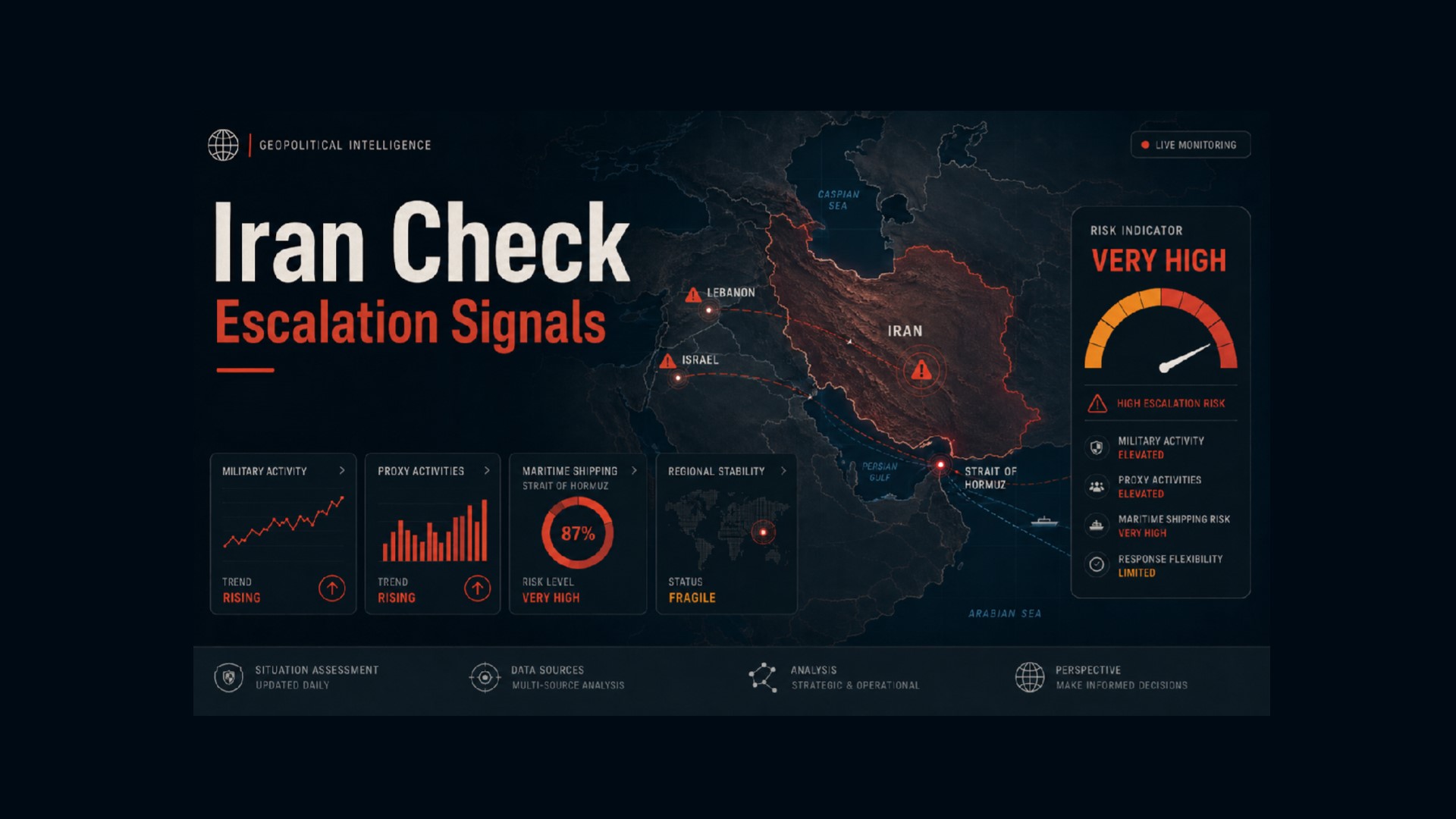
This escalation radar summarizes five relevant signals as of July 2, 2026. The focus is on verifiable statements by official actors, confirmed events and monitoring sources with potential impact on energy prices, supply chains, markets, maritime security, aviation and regional stability.
The U.S.-Iran talks are not centered on a stable peace order, but primarily on shipping, routes, Iranian control, fee questions and frozen funds. This is exactly where the operational risk for energy and supply chains lies.
Oil prices are falling after signals from Doha and partially resumed tanker traffic. This indicates relief at market level, but not a full normalization of the security situation in the Gulf.
Iran’s foreign minister threatens an immediate response to threats against Iran’s leadership and population. Israel, meanwhile, continues to maintain military security zones and deterrence. The escalation language remains sharp.
| Actor | Type | Severity | Status | Source / verification status | Business impact |
|---|---|---|---|---|---|
| United States / Iran / Qatar / Pakistan / Hormuz | Indirect technical talks, but no reliable peace solution | High to critical · Level 4/5 | Reuters reports that the United States and Iran have completed a round of indirect talks in Doha. However, the focus was not on the major strategic disputes, but on technical issues: maritime passage through the Strait of Hormuz and frozen Iranian funds. Qatar officially describes the talks as positive progress, while Reuters also reports that no clear breakthrough toward a lasting peace is visible. According to sources, the nuclear dispute was also not addressed substantively. The power dynamic: Washington wants to signal progress and control, while Tehran is focusing on concrete levers such as Hormuz and access to assets. This reduces short-term escalation pressure, but it does not resolve the core conflict. | Confirmed by Reuters, July 1/2, 2026. Verification status: confirmed for indirect talks, the Hormuz focus, frozen funds and the lack of a strategic breakthrough; the quality of de-escalation remains partly open. | High relevance for oil, LNG, tanker routing, energy procurement, sanctions assumptions, working capital, freight costs, inflation scenarios and short-term risk hedging. |
| Iran / Hormuz / Oman / United States / international shipping | Claim to control, route management and possible fees in the Hormuz area | Critical · Level 5/5 | Reuters reports, citing senior Iranian sources, that Iran is seeking international recognition of its control over the Strait of Hormuz. This includes route management, approval of passages and possible fees after the free transition period expires in mid-August. Particularly sensitive: according to Reuters, Iran reportedly fired on four vessels over the weekend that attempted to pass through the Omani side of the waterway without Iranian approval. The power logic is clear: Tehran is trying to turn the military confrontation into a lasting maritime control gain. For companies, this is the hardest operational point in the situation. | Confirmed by Reuters, July 1, 2026. Verification status: confirmed for Iranian control claims, possible fees, route questions and reported shots fired at vessels; concrete fee models and international acceptance remain open. | Critical business impact on ocean freight, tanker insurance, war-risk premiums, oil and LNG supply, delivery times, port planning, security costs and companies with exposure to the Gulf, energy or raw materials. |
| Iran / Israel / United States | Official Iranian threat and red line against attacks on leadership and population | High to critical · Level 4/5 | Reuters reports that Iran’s foreign minister Abbas Araghchi announced in an X post an immediate and powerful response to any threat against Iran’s population or leadership. The statement referred to comments by Israeli Defense Minister Israel Katz, according to which Iran’s Supreme Leader Mojtaba Khamenei was “marked for death”. Araghchi also referred to an alleged U.S. commitment to restrain Israel. The power dynamic: Iran is not only addressing Israel, but is demonstratively shifting responsibility to Washington. This turns every Israeli threat against Iranian leadership figures into a test of U.S. control over Israel. | Confirmed by Reuters, July 1, 2026. Verification status: confirmed for Araghchi’s threat, the reference to Katz and the U.S. commitment logic; it remains open whether Iran will derive short-term operational steps from this. | High relevance for market volatility, geopolitical risk premiums, sanctions risks, security planning, crisis communication, regional presence decisions and escalation scenarios. |
| Israel / Lebanon / Hezbollah / Iran | Security zones, disarmament demand and Israeli deterrence line | High to critical · Level 4/5 | The Jerusalem Post reports that Israeli Defense Minister Israel Katz stated that the IDF would not withdraw from security zones in Lebanon, Syria and Gaza. For southern Lebanon, Katz formulated a clear condition: no Israeli redeployment and no withdrawal as long as Hezbollah is not disarmed throughout Lebanon and the security of northern Israel is not guaranteed. Katz also said that Israel had already struck Iran twice with preemptive attacks and would strike a third time if necessary. The power dynamic: Israel makes withdrawal conditional on Hezbollah’s disarmament, while Iran and Hezbollah are likely to read this logic as a loss of power. This keeps Lebanon as the political stress test for any U.S.-Iran de-escalation. | Confirmed by The Jerusalem Post, July 1, 2026. Verification status: confirmed for Katz’s statements on security zones, Hezbollah disarmament and possible renewed Iran-strike logic; the source is Israeli, but the statements reflect official Israeli positions. | High relevance for Lebanon and northern Israel exposure, evacuation planning, aviation, insurance, security services, regional supply chains and political risk premiums. |
| EASA / Iran / Iraq / Lebanon / Gulf region | Updated aviation warning and operational restrictions for aviation and air freight | High to critical · Level 4/5 | EASA updated its conflict zone warning for the Middle East and the Persian Gulf on July 1, 2026 to revision R14 and extended it until July 8, 2026. The recommendations remain unchanged in substance: aircraft operators should avoid the airspace of Iran, Iraq and Lebanon at all flight levels. For Bahrain, Kuwait, Israel, Jordan, Qatar, Oman, the UAE and Saudi Arabia, EASA recommends increased caution, current risk assessments and contingency planning. Particularly important: EASA notes that short-notice violations of the U.S.-Iran ceasefire remain possible, especially in and around the Strait of Hormuz and in the adjacent airspace. This is the clearest operational supply chain point in the radar. | Confirmed by EASA Conflict Zone Information Bulletin 2026-03-R14, revision dated July 1, 2026. Verification status: official EU aviation source; active and valid until July 8, 2026, unless reviewed earlier. | High relevance for air freight, airlines, rerouting, spare parts chains, insurance, business travel, crisis logistics, airport risk and companies with exposure to the Middle East or the Gulf. |
The central escalation knot on July 2, 2026 is not a new major offensive, but the shift of the conflict toward technical power questions. The United States and Iran continue indirect talks, but the discussions focus on Hormuz, shipping, funds and control – not on a comprehensive political solution. This is why the situation appears calmer from the outside, while remaining operationally sensitive.
For companies, the most important change is this: the risk is less about the headline “war or peace” and more about who controls passage, routes, fees, security and airspace in the Gulf region. Hormuz remains the central chokepoint for energy and ocean freight. At the same time, Israel’s security-zone logic in Lebanon keeps the political flank open, while the EASA warning shows that aviation and air freight must continue to expect short-term restrictions.
The five most important signals for a German business risk picture are: indirect U.S.-Iran talks without a clear peace breakthrough, Iran’s claim to lasting control over Hormuz routes and possible fees, Araghchi’s threat of an immediate response to threats against Iran’s leadership, Israel’s insistence on security zones until Hezbollah is disarmed, and the extended EASA warning for Iran, Iraq, Lebanon and the Gulf region until July 8, 2026.
Note: This assessment was created with support from our Geo-AI. AI can make mistakes. The analysis is intended as a radar for potential escalation signals and does not replace a fully verified situation assessment.
Identify where the new energy reality may already be eroding margin, liquidity, working capital and ROCE.
Energy costs, maritime chokepoints, compliance pressure and supply-chain fragility are no longer isolated operational issues. They are becoming balance-sheet variables. This board-level intelligence report translates geopolitical energy fragmentation into concrete C-level risk questions, financial exposure logic, 2026–2028 scenarios and immediate action steps.
Spot hidden margin pressure from LNG volatility, infrastructure lock-in and energy cost instability
Assess chokepoint exposure, war-risk premiums, insurability and supply-chain interruption risk
Use the Executive Audit Matrix to challenge blind spots before they become financial damage
Strategic information only. Not financial, legal, tax, energy or investment advice.
You are currently viewing a placeholder content from X. To access the actual content, click the button below. Please note that doing so will share data with third-party providers.
More Information