Executive Intelligence. Industrial Risk. Geopolitics.
Strategic Sparring
for Decision-Makers
Risk intelligence across technology, law, markets and power dynamics.

Verdeckte Geschäftsrisiken, strategische Widersprüche und kritische Abhängigkeiten frühzeitig erkennen.
Kostenlose Analyse starten →
Verdeckte Machtstrukturen, Führungsrisiken und organisatorische Blockaden frühzeitig erkennen.
Kostenlose Analyse starten →
Geopolitische Risiken, globale Abhängigkeiten und kritische Lieferkettenrisiken frühzeitig erkennen.
Kostenlose Analyse starten →
Identify hidden business risks, strategic contradictions and critical dependencies at an early stage.
Start Free Analysis →
Identify hidden power structures, leadership risks and organizational blockers at an early stage.
Start Free Analysis →
Identify geopolitical risks, global dependencies and critical supply-chain vulnerabilities at an early stage.
Start Free Analysis →
Verdeckte Geschäftsrisiken, strategische Widersprüche und kritische Abhängigkeiten frühzeitig erkennen.
Kostenlose Analyse starten →
Verdeckte Machtstrukturen, Führungsrisiken und organisatorische Blockaden frühzeitig erkennen.
Kostenlose Analyse starten →
Geopolitische Risiken, globale Abhängigkeiten und kritische Lieferkettenrisiken frühzeitig erkennen.
Kostenlose Analyse starten →
Identify hidden business risks, strategic contradictions and critical dependencies at an early stage.
Start Free Analysis →
Identify hidden power structures, leadership risks and organizational blockers at an early stage.
Start Free Analysis →
Identify geopolitical risks, global dependencies and critical supply-chain vulnerabilities at an early stage.
Start Free Analysis →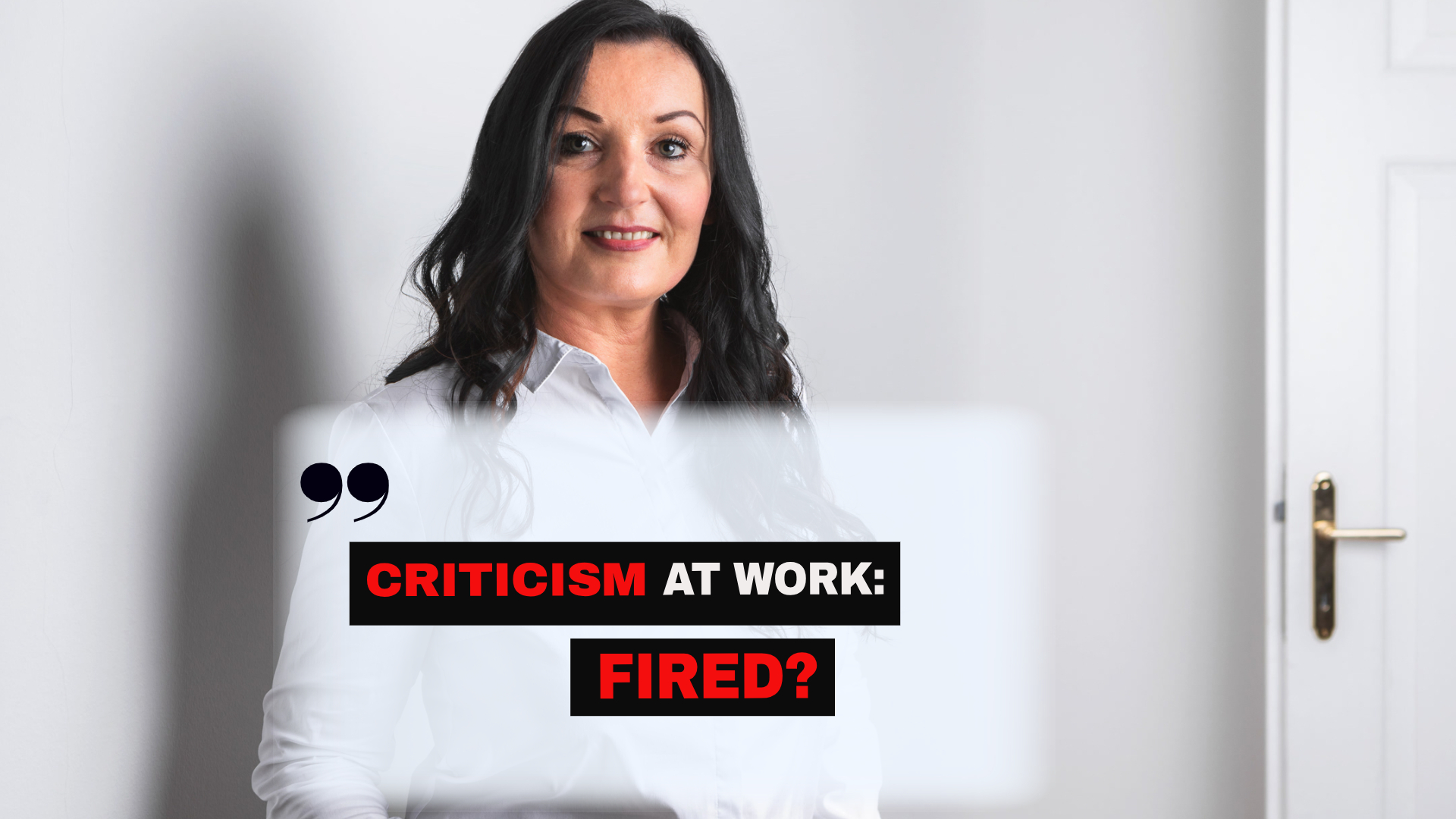
Strategic Risk Intelligence Brief by Global Insight Group.
This analysis is based on the GFDD Framework™ developed by Michaela Schaaf-Hoffelner and is designed for executives, investors and strategic decision-makers.
Updated: November 9, 2025
Employee criticism on social media is no longer a marginal phenomenon. It has become part of today’s public workplace culture.
According to a 2024 study by the German Economic Institute, 38% of employees in Germany occasionally or regularly criticize their employers, primarily on LinkedIn, X or TikTok.
What was once regarded as a sign of engagement is now often interpreted as disloyalty.
And in many cases, honest criticism can have serious consequences: formal warnings, dismissal or social isolation.
But why?
Why are the very people who try to make problems visible so often punished?
And was it really different in the past?
Many people who were already working in the 1980s or 1990s remember a workplace environment that felt more human and direct.
Criticism was usually expressed behind closed doors, but personal relationships and trust between employees and managers were often stronger.
Teams were smaller, communication channels were shorter and decisions were closer to operational reality.
Those who raised concerns usually did so in direct conversations rather than through digital channels.
This reduced misunderstandings and made responses to criticism more personal.
Today, many companies are larger, more anonymous and more heavily focused on image, efficiency and KPI control.
Digitalization and globalization have increased the distance between people.
The human buffer has disappeared.
What remains is a system that listens closely to processes but often barely hears the voices of the people inside it.
Many employees turn to the public only after internal channels have failed.
Complaints are ignored. Managers are unavailable, dismissive or unwilling to act.
The feeling of not being heard is one of the most common triggers for public criticism.
In Germany and Austria, many companies still operate with strongly hierarchical leadership cultures.
Criticism is interpreted as an attack rather than a contribution.
Those who openly point out problems are quickly labelled “difficult” or “disloyal”.
The result is predictable:
Many employees remain silent because they fear the consequences.
Read more:
🧩 How to Become a Good Leader: 5 Hidden Mistakes Almost Everyone Makes and How to Avoid Them
The line between loyalty and responsibility has become blurred.
Companies expect loyalty, even when internal structures make people ill or undermine their ability to perform.
But loyalty without the freedom to speak openly is not loyalty.
It is fear.
This dynamic becomes particularly visible when employees are punished for speaking up.
The message is simple:
Those who speak up take a risk. Those who remain silent remain safe.
Many companies point to their internal complaint channels.
In practice, however, these mechanisms often function more like fig leaves than genuine corrective systems.
HR departments are rarely completely neutral because they ultimately operate within and for the organization.
Employees know this.
That is why many hesitate to raise concerns internally.
The result is a familiar pattern:
Problems continue beneath the surface.
Trust declines.
Frustration grows.
And when criticism finally becomes public, it is not the beginning of the problem.
It is the visible endpoint of a much longer internal failure.
Read more:
In countries such as Scandinavia or the Netherlands, criticism is often interpreted as a sign of engagement.
In Germany and Austria, by contrast, many organizations still operate within a culture of fear.
Managers are trained to make decisions.
Far fewer are trained to understand criticism as an opportunity for development.
This mindset originates from a time when hierarchies were considered untouchable.
Today, companies risk losing precisely those employees who are most courageous, independent and willing to challenge weak structures.
Formal consequences are only one part of the problem.
There is often a second form of punishment:
Social isolation.
Employees who raise criticism may be branded as disloyal, difficult or disruptive.
Colleagues begin to distance themselves.
People stop including them.
Their reputation gradually changes.
This pattern is especially visible in traditional industries and large corporations.
Yet the irony is obvious:
The people who openly identify dysfunction may be exactly the people capable of helping the company avoid greater damage later.
If only someone were willing to listen.
Read more:
Why Am I Not Progressing Even Though I’m Good? How to Avoid Career Stagnation
Criticism on social media is not necessarily a sign of disloyalty.
It is often a symptom of missing psychological safety.
It shows that trust has already broken down.
If companies want to prevent public criticism, they need to build internal structures based on genuine listening, reflection and a healthy learning culture.
As long as organizations respond faster to public outrage than to internal warnings, nothing fundamental will change.
The stronger a company markets itself as “value-driven” or “socially responsible”, the greater the risk of an authenticity gap between the brand promise and employees’ daily reality.
In research and practice, this gap is often associated with cynicism, higher turnover intentions and silence instead of employee voice.
Mechanisms, simplified:
Warning signs in practice:
Countermeasures, short and practical:
Bottom line: Employer branding is not inherently problematic. Inconsistent employer branding is. When the external promise and internal reality diverge, silence and conformity can spread quickly.
Core expectations of Gen Z in Germany and Austria:
| Need | What Gen Z Actually Expects | Status Quo (Common Gaps) | What Companies Need to Change |
|---|---|---|---|
| Work-Life Balance & Flexibility |
Hybrid working, genuine control over working time, option of a four-day workweek |
Mandatory office presence, rigid core hours, meeting overload |
Flexible working models, better meeting discipline, measure output instead of presence |
| Purpose & Values |
Visible impact, credible values (climate action, fairness) |
“Purpose slogans” without substance (authenticity gap) |
Link values to actual decisions (e.g. supplier selection, bonus structures) |
| Learning & Development |
Continuous upskilling, coaching-based leadership, internal mobility |
Ad hoc training, career progression only through hierarchy |
Learning pathways, mentoring, project rotation, skills transparency |
| Health & Safety |
Psychological safety, fair workloads, mental wellbeing |
Culture of fear, silencing, KPI pressure |
Speak-up protection, workload management, resource reviews, measure leaders on employee voice |
| Compensation & Transparency |
Fair pay, salary transparency, clear and understandable criteria |
Opaque salary bands, gender and age pay gaps |
Publish salary bands, conduct equal-pay audits, introduce objective promotion criteria |
| Technology & Efficiency |
Modern tools, AI enablement, less bureaucracy |
Tool sprawl, processes without user focus |
AI guidelines, automation, redesign processes with teams |
Why Companies Can No Longer Ignore This
Practical consequence: Companies that tolerate discrimination, weak equal-pay structures or poor equal-opportunity practices increasingly risk visible negative indicators in sustainability reporting, weaker ESG ratings and, potentially, more difficult access to financing, higher borrowing costs and disadvantages in public funding and procurement.
When employees take their concerns outside the company, the organization has usually stopped listening long before.
Breaking the silence is not necessarily an attack.
It is often a cry for help.
Companies that punish employees for criticism ultimately punish their own future.
Without honest voices, only silence remains.
And silence is often the beginning of the end of a healthy corporate culture.
Perhaps this article made you think about your own situation.
A manager who constantly holds you back.
A team in which you never really felt you belonged.
Tasks that always end up with you while other employees receive the more visible projects.
Or that persistent question:
Am I really being too sensitive, or is something fundamentally wrong here?
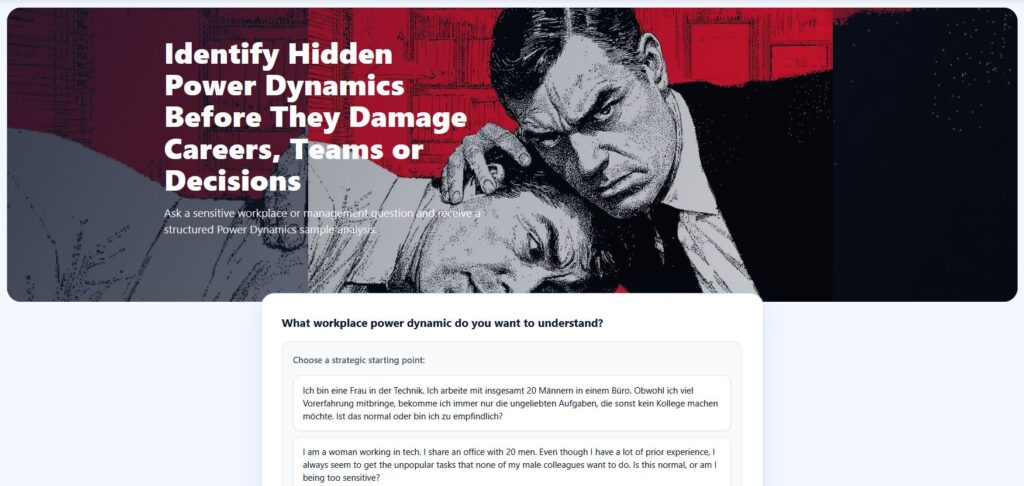
You can ask your question directly to our GFDD Power Dynamics AI.
The analysis is anonymous and requires no registration.
Our AI was developed using the insights and analytical structures behind GFDD Diagnostics™ for organizational and workplace dynamics. Instead of generic coaching advice, it examines power, status, hidden conflict logic, victim-offender reversal and organizational risk patterns in a structured way.
The underlying knowledge has developed over more than 35 years across different professional contexts.
AI can still make mistakes. The response does not replace employment-law, psychological or medical advice. It can, however, help you identify patterns more clearly, better understand the situation and determine which questions you should ask next.
Ask the GFDD Power Dynamics AI now. Anonymous, direct and without registration.
Author of Global Insight Group Intelligence:
Michaela Schaaf-Hoffelner has more than 35 years of experience in strategic and technical project and product management, particularly in IT, control systems and intralogistics. Through her long-standing work with complex systems, she identifies structural risks and dynamic misalignments at an early stage – risks that are often overlooked in conventional analysis.
Her focus is on making causal relationships and systemic dependencies visible and translating them into concrete strategic advantages for investors and decision-makers. Her analyses combine deep technical systems understanding with geopolitical and economic developments.
GFDD Framework™ and GFDD Diagnostics™ are proprietary analytical concepts developed by Michaela Schaaf-Hoffelner. © 2026 Global Insight Group LLC. All rights reserved.
You are currently viewing a placeholder content from X. To access the actual content, click the button below. Please note that doing so will share data with third-party providers.
More Information