Executive Intelligence. Industrial Risk. Geopolitics.
Strategic Sparring
for Decision-Makers
Risk intelligence across technology, law, markets and power dynamics.

Verdeckte Geschäftsrisiken, strategische Widersprüche und kritische Abhängigkeiten frühzeitig erkennen.
Kostenlose Analyse starten →
Verdeckte Machtstrukturen, Führungsrisiken und organisatorische Blockaden frühzeitig erkennen.
Kostenlose Analyse starten →
Geopolitische Risiken, globale Abhängigkeiten und kritische Lieferkettenrisiken frühzeitig erkennen.
Kostenlose Analyse starten →
Identify hidden business risks, strategic contradictions and critical dependencies at an early stage.
Start Free Analysis →
Identify hidden power structures, leadership risks and organizational blockers at an early stage.
Start Free Analysis →
Identify geopolitical risks, global dependencies and critical supply-chain vulnerabilities at an early stage.
Start Free Analysis →
Verdeckte Geschäftsrisiken, strategische Widersprüche und kritische Abhängigkeiten frühzeitig erkennen.
Kostenlose Analyse starten →
Verdeckte Machtstrukturen, Führungsrisiken und organisatorische Blockaden frühzeitig erkennen.
Kostenlose Analyse starten →
Geopolitische Risiken, globale Abhängigkeiten und kritische Lieferkettenrisiken frühzeitig erkennen.
Kostenlose Analyse starten →
Identify hidden business risks, strategic contradictions and critical dependencies at an early stage.
Start Free Analysis →
Identify hidden power structures, leadership risks and organizational blockers at an early stage.
Start Free Analysis →
Identify geopolitical risks, global dependencies and critical supply-chain vulnerabilities at an early stage.
Start Free Analysis →
Strategic Risk Intelligence Brief von Global Insight Group.
Diese Analyse basiert auf dem von Michaela Schaaf-Hoffelner entwickelten GFDD Framework™ und wurde für Führungskräfte, Investoren und strategische Entscheider erstellt.
Updated: March 26, 2026
A toxic corporate culture rarely emerges overnight.
A manager asks one employee to monitor another. Two managers attend what is supposed to be a routine employee meeting. A senior leader does not merely block an employee’s internal career progression but actively destroys it.
All of these examples are based on real events.
They demonstrate how deeply toxic corporate cultures can become embedded in modern organizations, often hidden behind a polished façade of professionalism, collaboration and supposed team spirit.
A toxic corporate culture creates a complex psychological power dynamic.
Employees can find themselves facing a constellation of authority that feels less like a conversation and more like a tribunal. Managers talk about them rather than with them. Every look, every phrase and every seemingly casual comment becomes a signal.
And the employee knows that every reaction may later be interpreted, repeated or used against them.
From the outside, the situation may appear calm, controlled and almost professional. Beneath the surface, however, there is a persistent sense of threat.
These conversations are not genuine dialogues. They are social tests.
They operate through implicit messages of power:
Who controls the room?
Who decides what is considered factual or professional?
Who controls the narrative?
The most dangerous part is that subordination does not necessarily arise through open aggression. It is produced by the invisible structure of the system itself.
Conformity becomes the safest behavior.
Authenticity becomes a risk.
This psychological mechanism forms the foundation of many toxic corporate cultures.
Read more:
Great Job or Hidden Career Killer?
Many companies contain informal networks of power and communication that become the silent backbone of a toxic corporate culture.
Information about employees is circulated through these networks. Not officially, but highly effectively.
A short comment such as “he is difficult to work with” may be enough to influence an entire career.
These networks can extend across departments and even locations.
Once someone appears on the unofficial list, isolation begins quietly.
Conversations stop.
Projects are reassigned.
Invitations disappear.
Nobody says anything openly, yet everybody seems to know.
The individual is not openly attacked. They are gradually silenced.
Power does not reveal itself through volume. It operates through silent agreement.
This form of modern workplace bullying is particularly dangerous because it is difficult to prove. Precisely for that reason, its psychological impact can be profound.
The individual is not openly confronted but systematically disconnected from their professional and social environment.
These processes are characteristic symptoms of toxic corporate culture.
Toxic corporate culture is rarely created by a single individual.
It develops through a system of mutual protection.
Managers form alliances that can influence careers before an employee has even submitted an internal application.
One real example:
During a business trip, colleagues I had never even met made it unmistakably clear that “my colleague would be better suited for the leadership position.”
This was not casual conversation.
It was a warning:
If you get the job, you will fail because of us.
At that point, the CEO’s formal authority over the appointment had already been undermined before the recruitment process had even taken place.
That is how toxic power structures reveal themselves.
Belonging matters more than competence.
Silence is rewarded.
Integrity is punished.
Even employee representative bodies can become part of a toxic organizational culture.
This does not necessarily happen because of malicious intent.
Long-standing relationships, loyalties and informal alliances can make genuinely neutral decision-making increasingly difficult.
Employee representation then becomes ineffective, and those affected may discover that the institution designed to protect them can no longer provide meaningful support.
In a toxic corporate culture, even internal safeguards can become compromised.
Toxic systems frequently create gatekeepers.
These are individuals or groups who control access to information, projects, influential people or decision-making levels.
The particularly dangerous aspect is that these informal networks can create entirely different realities within the same company.
HR, for example, may experience a culture of openness and team spirit because critical information never reaches the department.
Senior management may genuinely believe the organization has a strong and healthy corporate culture.
Meanwhile, employee representatives may recognize parts of the problem but themselves remain embedded in the same power structures.
The result is a disturbing double reality.
Externally, the organization presents a polished culture.
Internally, employees experience control, fear and informal power.
These structures do not develop randomly. Over time, organizational systems often begin to reflect the personalities and incentives of the people who created them.
The result can be a system in which status and control consistently outweigh empathy, competence and transparency.
Toxic corporate culture therefore becomes a mirror of its own power architecture.
While control dominates internally, the external message may communicate the exact opposite.
Companies with highly polished employer branding can still contain severe internal dysfunction.
Management may insist that leaders are responsible for maintaining a “positive atmosphere.”
But that positive atmosphere can become enforced conformity.
Employees learn that agreement is safe.
Silence is safe.
Challenging the system is dangerous.
People stop raising concerns because they fear damaging the façade or becoming a target themselves.
Employer reviews on platforms such as Kununu and internal employee surveys may also be monitored closely.
Dissenting voices are not necessarily treated as valuable feedback. Instead, the organization may begin trying to identify or control them.
That is not a healthy corporate culture.
It is surveillance presented as concern for employees.
Over time, this destroys credibility.
And this observation is also based on situations I have directly encountered through my social engagement within companies.
The consequences of these structures are profound.
Trust disappears.
Innovation slows.
Employees stop taking interpersonal and professional risks.
Most dangerously, C-level executives may never fully understand what is happening.
From their perspective, the organization appears calm, stable and efficient.
In reality, that stability may be based on fear, manipulation and informal control.
This is one of the defining characteristics of toxic corporate culture:
It mistakes compliance for efficiency.
Employees who remain in a toxic corporate culture for prolonged periods often experience chronic psychological tension.
Possible consequences include sleep problems, difficulty concentrating, anxiety, depressive symptoms and psychosomatic complaints.
Long-term uncertainty about who can be trusted and where loyalties lie can cause emotional exhaustion and alienation.
Eventually, many employees disengage psychologically.
They continue functioning because they need to survive professionally, not because they still believe they can contribute meaningfully.
This withdrawal represents one of the most visible costs of toxic organizational culture.
In severe cases, the consequences can include prolonged absence, incapacity for work or complete withdrawal from professional life.
From an organizational perspective, these outcomes should not simply be interpreted as individual failure.
They may represent the accumulated consequences of a dysfunctional system.
What initially looks like an internal power struggle can quickly become a legal and governance issue.
If nobody openly discusses informal power structures, there is no effective corrective mechanism.
Control over interpretation remains with the informal network, which can influence internal discussions, projects and careers.
Companies may then enter legally sensitive territory involving privacy violations, psychological workplace risks and failures in their duty of care.
These risks are particularly difficult to identify because affected employees often do not have a clear vocabulary for describing the underlying mechanisms.
In many cases, they do not fully understand the system themselves until considerable damage has already occurred.
These are direct organizational consequences of toxic corporate culture.
Corporate culture is increasingly relevant to governance and sustainability risk.
The Corporate Sustainability Reporting Directive, or CSRD, and Corporate Sustainability Due Diligence Directive, or CSDDD, increase expectations around transparency and corporate responsibility.
Poor governance, weak internal controls and unresolved organizational risks can contribute to reputational damage, weaker ESG assessments and potentially restricted access to capital.
Sustainability is therefore not limited to environmental performance.
It also concerns how organizations govern people, power, responsibility and risk.
Informal gatekeeper networks can create several categories of legal exposure:
Toxic corporate cultures are not simply created by “bad people.”
They emerge when systems consistently place power and control above responsibility, transparency and competence.
The quiet forms of abuse of power are often the most dangerous:
Looking away.
Silent alliances.
Gatekeeping.
Informal blacklists.
Career decisions made outside formal processes.
These mechanisms can cause more lasting damage than open aggression because they become embedded in the normal functioning of the organization.
Change becomes possible only when these dynamics are made visible and explicitly named.
A healthy corporate culture begins when trust gradually replaces excessive control and when legitimate authority is no longer undermined by invisible power structures.
Because I could not reliably verify separate English URLs for these articles, I have retained the existing links and translated the article titles into Business English.
Society for Human Resource Management (SHRM): The High Cost of a Toxic Workplace Culture
SHRM reported that workplace culture issues were associated with substantial employee turnover costs for US employers.
SHRM: Toxic Workplace Cultures Cost Billions
Harvard Business School: Toxic Workers
Research from Harvard Business School examines the organizational cost of toxic employees and shows why avoiding destructive behavior can produce substantial economic value for companies.
Harvard Business School: Toxic Workers
Cornerstone / Fama: Economic Costs of Toxic Employees
Research and industry analysis also highlight the costs created through absenteeism, employee turnover and the wider performance effects of toxic workplace behavior.
Fama: Toxic Employees and Enterprise Costs
Scientific research
Academic research has examined relationships between toxic workplace environments, psychological safety, employee wellbeing and organizational performance.
Clear warning signs include communication dominated by fear, control and silence, as well as decision-making that depends more heavily on personal loyalties than on performance.
High employee turnover and elevated sickness absence may provide additional warning signals.
Toxic behavior can broadly appear in two forms.
The first is openly aggressive and confrontational.
The second is quieter, disguised and often passive-aggressive. Externally, the organization appears highly professional. Internally, people are systematically excluded, controlled or silenced.
The second form is particularly difficult to identify because it can remain invisible to senior management for years.
Leaders should obtain genuinely anonymous feedback, establish clear boundaries against abuse of power and actively strengthen psychological safety.
Transparency and self-reflection are among the most important countermeasures.
However, this requires leaders to be willing to examine not only employee behavior but also their own management systems, incentives and informal networks.
Potential risks include GDPR violations, employment-law disputes, liability exposure and reputational damage.
Governance and sustainability frameworks can add another layer of scrutiny.
Poor transparency, unresolved workforce risks and weak governance can increasingly affect corporate reputation, stakeholder confidence and ESG assessments.
Sustainable change requires more than workshops and culture slogans.
Companies need transparency, independent examination and a willingness to dismantle informal power structures.
Real cultural transformation begins when organizations make psychological and political dynamics visible and deliberately decide that those mechanisms will no longer be tolerated.
Perhaps this article made you think about your own situation.
A manager who constantly holds you back.
A team in which you never really felt you belonged.
Tasks that always end up with you while other employees receive the more visible projects.
Or that persistent question:
Am I really being too sensitive, or is something fundamentally wrong here?
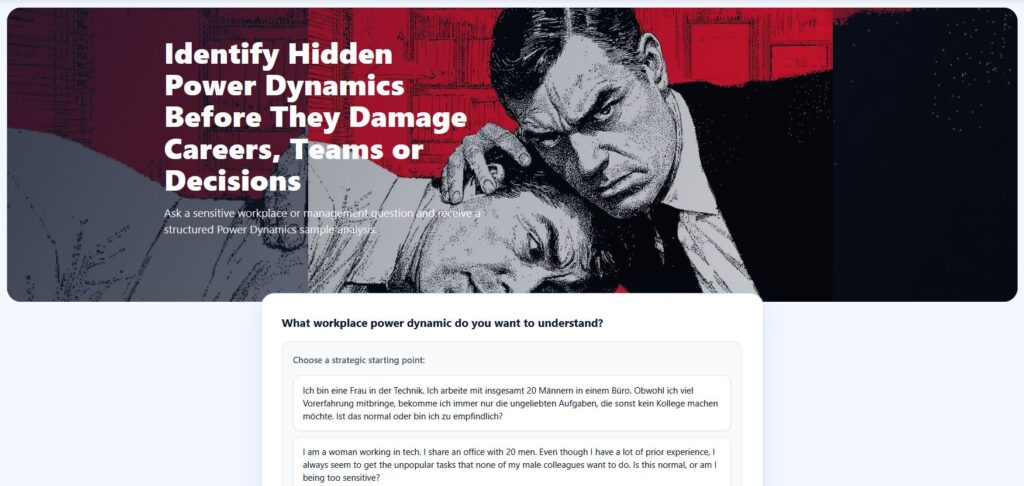
You can ask your question directly to our GFDD Power Dynamics AI.
The analysis is anonymous and requires no registration.
Our AI was developed using the insights and analytical structures behind GFDD Diagnostics™ for organizational and workplace dynamics. Instead of generic coaching advice, it examines power, status, hidden conflict logic, victim-offender reversal and organizational risk patterns in a structured way.
The underlying knowledge has developed over more than 35 years across different professional contexts.
AI can still make mistakes. The response does not replace employment-law, psychological or medical advice. It can, however, help you identify patterns more clearly, better understand the situation and determine which questions you should ask next.
Ask the GFDD Power Dynamics AI now. Anonymous, direct and without registration.
Author of Global Insight Group Intelligence:
Michaela Schaaf-Hoffelner has more than 35 years of experience in strategic and technical project and product management, particularly in IT, control systems and intralogistics. Through her long-standing work with complex systems, she identifies structural risks and dynamic misalignments at an early stage – risks that are often overlooked in conventional analysis.
Her focus is on making causal relationships and systemic dependencies visible and translating them into concrete strategic advantages for investors and decision-makers. Her analyses combine deep technical systems understanding with geopolitical and economic developments.
GFDD Framework™ and GFDD Diagnostics™ are proprietary analytical concepts developed by Michaela Schaaf-Hoffelner. © 2026 Global Insight Group LLC. All rights reserved.
You are currently viewing a placeholder content from X. To access the actual content, click the button below. Please note that doing so will share data with third-party providers.
More Information