Executive Intelligence. Industrial Risk. Geopolitics.
Strategic Sparring
for Decision-Makers
Risk intelligence across technology, law, markets and power dynamics.


Verdeckte Geschäftsrisiken, strategische Widersprüche und kritische Abhängigkeiten frühzeitig erkennen.
Kostenlose Analyse starten →
Verdeckte Machtstrukturen, Führungsrisiken und organisatorische Blockaden frühzeitig erkennen.
Kostenlose Analyse starten →
Geopolitische Risiken, globale Abhängigkeiten und kritische Lieferkettenrisiken frühzeitig erkennen.
Kostenlose Analyse starten →
Identify hidden business risks, strategic contradictions and critical dependencies at an early stage.
Start Free Analysis →
Identify hidden power structures, leadership risks and organizational blockers at an early stage.
Start Free Analysis →
Identify geopolitical risks, global dependencies and critical supply-chain vulnerabilities at an early stage.
Start Free Analysis →
Verdeckte Geschäftsrisiken, strategische Widersprüche und kritische Abhängigkeiten frühzeitig erkennen.
Kostenlose Analyse starten →
Verdeckte Machtstrukturen, Führungsrisiken und organisatorische Blockaden frühzeitig erkennen.
Kostenlose Analyse starten →
Geopolitische Risiken, globale Abhängigkeiten und kritische Lieferkettenrisiken frühzeitig erkennen.
Kostenlose Analyse starten →
Identify hidden business risks, strategic contradictions and critical dependencies at an early stage.
Start Free Analysis →
Identify hidden power structures, leadership risks and organizational blockers at an early stage.
Start Free Analysis →
Identify geopolitical risks, global dependencies and critical supply-chain vulnerabilities at an early stage.
Start Free Analysis →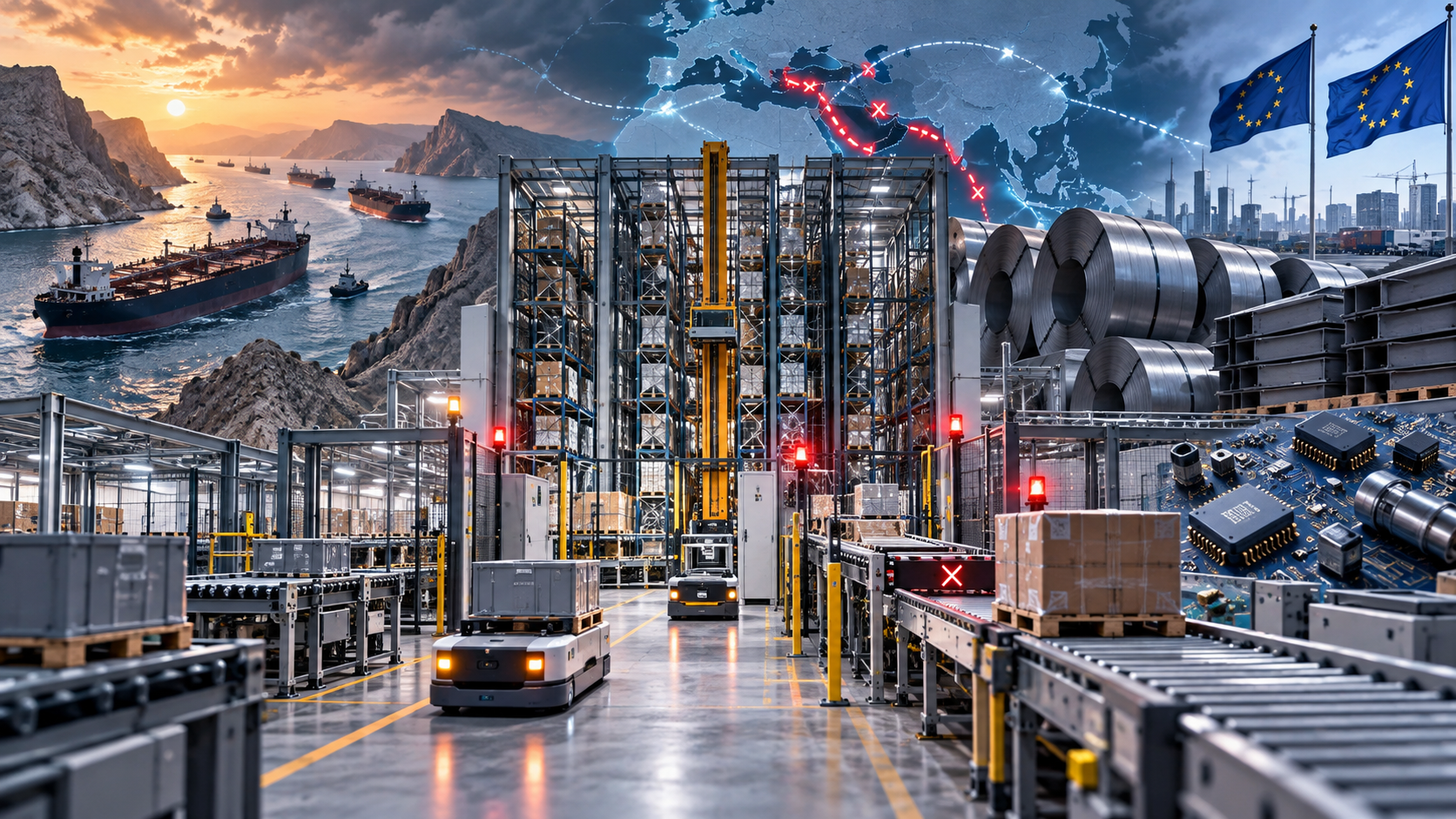
Strategic Risk Intelligence Brief by Global Insight Group.
This analysis is based on the GFDD Framework™ developed by Michaela Schaaf-Hoffelner and is designed for executives, investors and strategic decision-makers.
Updated: September 10, 2026
The geopolitical landscape in September 2026 is turning into a resilience stress test for Europe’s intralogistics and industrial automation sector. Escalation around the Strait of Hormuz, new EU steel import requirements, and the accelerating fragmentation of global supply chains are hitting an industry whose projects depend on precisely timed flows of materials, components and logistics.
For European manufacturers of conveyor systems, automated storage and retrieval systems (AS/RS), AGVs and AMRs, robotics, control systems and warehouse automation, three critical risk channels are emerging:
The real risk, however, lies in the interaction between these factors: geopolitical shocks are colliding with rising costs, regulatory pressure and, in some companies, slow internal decision-making structures.
The military escalation in the Middle East has crossed a critical threshold. Following reciprocal strikes involving US forces and Iran’s Islamic Revolutionary Guard Corps (IRGC) – including Iranian missile attacks and US strikes on Iranian oil tankers – Tehran has also announced an expansion of maritime restricted and exclusion zones around the Strait of Hormuz.
Current data from Reuters illustrates the scale of the disruption: while approximately 125 commercial vessels per day passed through the Strait of Hormuz before the escalation, only a small number of daily transits have recently been recorded.
Shipping through the Strait of Hormuz has been severely disrupted. Oil prices have risen sharply – with Brent crude temporarily moving above USD 100 per barrel – while risks surrounding freight rates, marine insurance and alternative shipping routes are increasing.
For European industrial companies, this is therefore no longer merely an energy-price issue.
It is becoming a global logistics and supply chain risk.
Delays in critical components
Electronic components, power semiconductors, sensors and actuators originating from Asian manufacturing hubs may arrive late as a result of disrupted or rerouted maritime transport.
This can extend lead times for control cabinets, machinery and final system assembly.
Major logistics providers are already responding to the situation. Maersk has highlighted restrictions and changes affecting transport solutions across several Gulf countries in its latest Middle East operational update.
Project delays and contractual penalties
Intralogistics projects – including automated high-bay warehouses, sorting systems and complex conveyor installations – are tightly scheduled large-scale projects.
Delays in the delivery of system components can result in:
The risk is particularly acute for major customers in e-commerce, automotive, manufacturing and distribution, where the commissioning of an entire operation may depend on the completion date of the automation system.
While the global logistics environment is deteriorating, regulatory pressure within Europe is increasing at the same time.
From 1 October 2026, new EU requirements will apply to affected steel imports, requiring traceable documentation showing where the steel was originally melted and poured – the so-called “melt and pour” principle.
The relevant implementing regulation was adopted on 28 August 2026 and applies from 1 October 2026. According to EUR-Lex – Official Journal of the European Union, importers of the affected product categories must provide evidence of the country of melt and pour as well as the relevant heat number. Where adequate verifiable documentation is unavailable, imports may be rejected.
Industrial automation and intralogistics providers are highly steel-intensive businesses.
Steel structures form an essential part of many systems, including:
A regulatory change affecting steel imports can therefore become an immediate project, cost and supply chain risk for intralogistics companies.
Suppliers that cannot provide the required documentation in time may face import problems or rejection at the EU border.
For international supply chains involving multiple intermediaries and processing stages, documenting the actual origin of the steel can become highly complex.
The consequence is straightforward:
A missing compliance document may ultimately prevent a critical component from reaching the project site on time.
If companies are forced to switch at short notice to certified suppliers or exclusively European steel sources, procurement prices may rise.
That additional cost pressure would hit businesses whose margins are already being squeezed by:
At the same time, the geoeconomic fragmentation of the global economy is accelerating.
Trade conflicts, geopolitical tensions, tariffs, sanctions and export controls are forcing companies to reassess their global sourcing networks.
The International Monetary Fund – IMF describes precisely this development: economic policy, security of supply and national security interests are becoming increasingly intertwined.
Strategic dependencies are consequently becoming geopolitical instruments of power in their own right, increasing the risk of further fragmentation across global trade and supply chain structures.
The highly optimised global just-in-time model that dominated industrial supply chains for decades is increasingly being supplemented – and in some cases replaced – by regional supply corridors, nearshoring and larger safety stocks.
Many industrial customers – particularly in sectors such as automotive and mechanical engineering – are responding to geopolitical uncertainty by delaying investment decisions.
Major investments in new factory automation, logistics centres and distribution facilities may be postponed or reassessed.
For European automation suppliers, this can translate into weaker order intake.
At the same time, companies need to protect their own ability to deliver.
Critical components such as:
may need to be held in larger inventories.
This creates a paradox:
Companies need more liquidity to make their supply chains more resilient – while geopolitical risks are simultaneously putting margins and order volumes under pressure.
Capital tied up in safety stock may no longer be available for urgently needed R&D investment and technological development.
The critical development is not any single risk.
These risks are occurring simultaneously – and reinforcing one another.
Physical disruption to major transport routes is hitting European manufacturers at a time when they are already dealing with regulatory requirements, rising procurement costs and the need to restructure their supply chains.
The result is a classic systemic risk cascade:
Geopolitical escalation → logistics disruption → component shortages → project delays → cost increases → margin pressure → working-capital constraints → weaker investment
This is precisely why supply chain risks can no longer be assessed in isolation.
The interaction between global events, economic dependencies and internal organisational structures is increasingly determining the actual level of business exposure.
One of the largest blind spots for executive teams may not be the external logistics disruption itself.
It is internal organisational resilience.
When geopolitical risks collide with rigid, slow or heavily politicised decision-making processes inside established European industrial companies, crisis response can become paralysed.
Companies that fail to manage their informal power structures and formal governance effectively may react too slowly to:
An external supply chain crisis can therefore become an internal competitive disadvantage.
More agile competitors may approve alternative suppliers faster, restructure sourcing strategies, adapt contractual terms or reprioritise projects before slower organisations have even completed their internal approval process.
Geopolitical risk is therefore increasingly becoming a question of organisational decision-making speed.
Suppliers of fabricated steel components and sheet-metal parts should be reviewed immediately for compliance with the new EU requirements taking effect on 1 October 2026.
Key areas include:
The objective is to identify potential disruptions to large ongoing projects before they become operational bottlenecks.
Contracts for new projects should be reviewed from a legal and commercial perspective to determine how extraordinary geopolitical disruptions are allocated.
Key areas include:
Companies need to avoid a situation in which risks outside their direct control are absorbed entirely by their own project margins.
Supply chains should not be the only systems undergoing stress testing.
Companies should also review their decision architecture.
One possible approach is to establish a geopolitical fast-track task force reporting directly to the executive board.
Operational decisions involving:
must be possible within hours or a few days during a crisis – not after weeks of internal coordination.
The current supply chain crisis demonstrates how quickly risks that initially appear unrelated can develop into a combined business threat.
The Strait of Hormuz, higher energy and transport costs, new EU steel requirements, geoeconomic fragmentation and the restructuring of global supply chains are all hitting a European intralogistics and automation industry that depends heavily on globally available components, predictable project schedules and stable investment conditions.
But external risks alone will not determine which companies emerge successfully from this environment.
What matters is how quickly organisations identify dependencies, make decisions and adapt their supply chains and internal structures.
The decisive question is therefore no longer simply:
How resilient is the supply chain?
It is:
How resilient is the company responsible for managing it?
Disruption in the Strait of Hormuz affects energy prices, shipping routes, freight costs and global delivery times. For industrial automation companies, this can delay electronic components, sensors, actuators and other critical parts, potentially disrupting ongoing projects.
Intralogistics systems contain substantial quantities of steel. If suppliers cannot provide the required origin documentation, imports into the EU may face delays or rejection. Switching to alternative steel sources may also increase procurement costs.
Key risks include longer lead times, component shortages, rising transport costs, project delays, higher safety stocks, increased working-capital requirements and potential contractual penalties.
The faster geopolitical conditions change, the faster companies must respond to supplier failures, price increases and alternative sourcing opportunities.
Slow, bureaucratic or politicised decision-making structures can therefore become a business risk in their own right.
Priority areas include supply chain mapping, steel origin and compliance, single-source dependencies, contractual protection against geopolitical disruptions, and the speed of internal escalation and decision-making processes.
A current assessment of escalation signals affecting the Strait of Hormuz, Bab al-Mandab, Gulf infrastructure, shipping routes and global supply chain exposure.
Five key indicators tracking the Iran conflict, energy markets, maritime chokepoints and the growing implications for international supply chains and business risk.
Author of Global Insight Group Intelligence:
Michaela Schaaf-Hoffelner has more than 35 years of experience in strategic and technical project and product management, particularly in IT, control systems and intralogistics. Through her long-standing work with complex systems, she identifies structural risks and dynamic misalignments at an early stage – risks that are often overlooked in conventional analysis.
Her focus is on making causal relationships and systemic dependencies visible and translating them into concrete strategic advantages for investors and decision-makers. Her analyses combine deep technical systems understanding with geopolitical and economic developments.
GFDD Framework™ and GFDD Diagnostics™ are proprietary analytical concepts developed by Michaela Schaaf-Hoffelner. © 2026 Global Insight Group LLC. All rights reserved.
You are currently viewing a placeholder content from X. To access the actual content, click the button below. Please note that doing so will share data with third-party providers.
More Information