Executive Intelligence. Industrial Risk. Geopolitics.
Strategic Sparring
for Decision-Makers
Risk intelligence across technology, law, markets and power dynamics.


Verdeckte Geschäftsrisiken, strategische Widersprüche und kritische Abhängigkeiten frühzeitig erkennen.
Kostenlose Analyse starten →
Verdeckte Machtstrukturen, Führungsrisiken und organisatorische Blockaden frühzeitig erkennen.
Kostenlose Analyse starten →
Geopolitische Risiken, globale Abhängigkeiten und kritische Lieferkettenrisiken frühzeitig erkennen.
Kostenlose Analyse starten →
Identify hidden business risks, strategic contradictions and critical dependencies at an early stage.
Start Free Analysis →
Identify hidden power structures, leadership risks and organizational blockers at an early stage.
Start Free Analysis →
Identify geopolitical risks, global dependencies and critical supply-chain vulnerabilities at an early stage.
Start Free Analysis →
Verdeckte Geschäftsrisiken, strategische Widersprüche und kritische Abhängigkeiten frühzeitig erkennen.
Kostenlose Analyse starten →
Verdeckte Machtstrukturen, Führungsrisiken und organisatorische Blockaden frühzeitig erkennen.
Kostenlose Analyse starten →
Geopolitische Risiken, globale Abhängigkeiten und kritische Lieferkettenrisiken frühzeitig erkennen.
Kostenlose Analyse starten →
Identify hidden business risks, strategic contradictions and critical dependencies at an early stage.
Start Free Analysis →
Identify hidden power structures, leadership risks and organizational blockers at an early stage.
Start Free Analysis →
Identify geopolitical risks, global dependencies and critical supply-chain vulnerabilities at an early stage.
Start Free Analysis →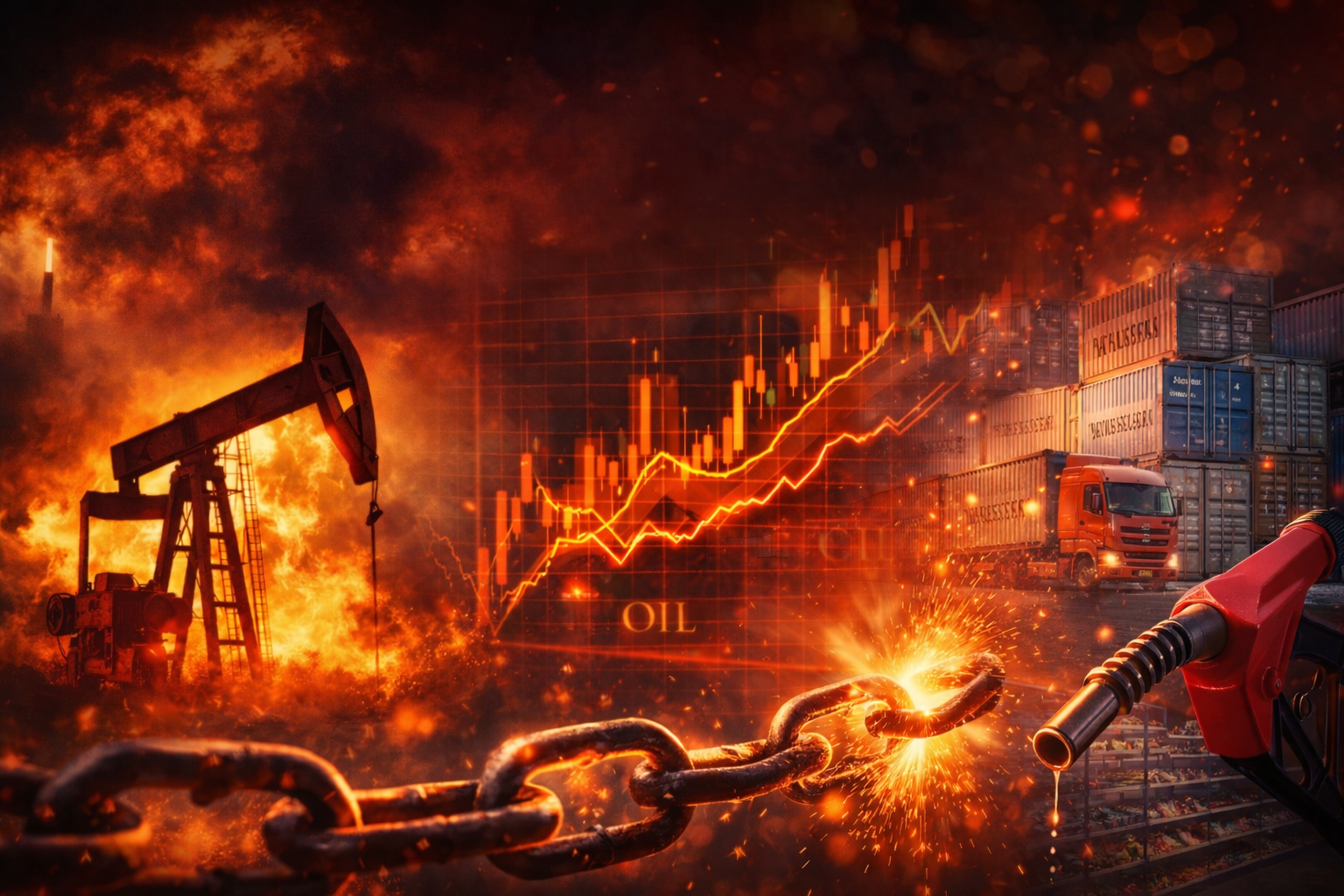
Updated: April 3, 2026
Most companies are currently underestimating a risk that could reshape their cost structures and investment decisions faster than they can react.
When energy suddenly becomes scarce or extremely expensive, the impact goes far beyond petrol stations or households.
👉 What is emerging is not simply a price movement. It is a chain reaction that can spread through entire economic and industrial systems.
And this is exactly where companies lose valuable time, because they often recognise the problem only when it is no longer fully controllable.
The problem:
The first warning signs often look harmless.
That is precisely why they are ignored until the consequences become difficult to contain.
👉 This is why the oil price is not a minor detail. It can become the starting point of a systemic breakdown.
This article explains clearly and practically how an energy shock develops, which signals indicate that the situation is escalating, and how likely an Energy Lockdown in 2026 actually is.
A sudden rise in oil prices is rarely an isolated event.
It is usually the result of specific global developments.
The decisive factor is therefore not the price alone, but the warning signals that point towards potential escalation.
Typical early-warning indicators include:
This was already observed in early March and indicates that the risk is being treated as real.
Oil can therefore become effectively less available even when a route remains technically open.
When several of these factors occur at the same time, the situation changes qualitatively.
Companies stop merely recalculating costs and begin questioning the security of their entire supply base.
This is the point at which a price shock becomes a systemic risk.
From the outside, this phase may still appear manageable.
In reality, it is already the beginning of a chain reaction that can quickly develop its own momentum.
The first real structural fractures become visible very quickly in industrial production.
Energy-intensive sectors are not designed to shut down their processes flexibly.
The industries most exposed include:
In the chemical industry, natural gas and oil are not merely sources of energy.
They are basic feedstocks.
If supply is interrupted, key processes such as ammonia synthesis cannot simply be stopped without consequences.
Deposits can form in pipelines, and equipment may suffer permanent damage.
The steel industry faces a similarly critical situation.
Blast furnaces operate continuously at temperatures above 1,500 degrees Celsius.
If the energy supply fails, molten material cools and solidifies.
This causes not only production losses but can render entire installations unusable.
The glass and ceramics industries are also dependent on continuous heat.
A significant temperature drop can destroy production lines that need to operate continuously for months.
Consequences:
For companies, this means production cannot simply be scaled down flexibly. In extreme cases, the physical process itself collapses.
Once industrial production comes under pressure, the next shockwave hits logistics.
Rising diesel prices make transport economically unattractive or force operators to reduce capacity significantly.
Freight companies cut journeys, while air freight becomes unaffordable for many businesses.
Critical factors in this phase include:
At the same time, the modern economy relies heavily on just-in-time supply chains.
Companies deliberately hold only minimal inventories.
In the automotive industry, available materials may support production for only a few hours.
Once delays occur, production lines can come to a standstill almost immediately.
Important point:
Supply chains therefore do not always fail gradually.
They can break abruptly and at very high speed.
One of the most underestimated areas is intralogistics, meaning the movement of materials inside large warehouses and production facilities.
This is often where the system either continues to function or becomes completely blocked.
Key intralogistics risks include:
Modern warehouses are highly electrified.
Forklifts, conveyors and automated systems depend on a stable electricity supply.
If load shedding or electricity rationing occurs, the entire operation can stop because batteries can no longer be charged and automated systems often cannot simply be replaced manually.
Where diesel- or gas-powered vehicles are still used, the situation becomes even more difficult.
Rising prices or rationing can mean that goods are physically available but can no longer be moved.
The situation is particularly critical in cold-chain and pharmaceutical logistics.
Here, energy is essential not only for transport but also for preserving the goods themselves.
Emergency-power solutions usually last only for limited periods.
In practice, this may mean approximately 24 to a maximum of 72 hours depending on diesel stocks and infrastructure.
After that, major losses become possible.
Typical consequences include:
Another factor is the so-called bullwhip effect.
If external deliveries fail, warehouse inventories may initially rise until storage systems become overloaded.
At the same time, internal handling requirements increase, routes become longer and processes become less efficient.
Intralogistics then becomes a bottleneck itself and can eventually turn into a system blocker.
👉 Most companies believe they have time to react.
In reality, escalation often moves faster than corporate decision-making.
With a delay, the energy crisis eventually reaches households and everyday life.
Rising energy costs force consumers to reprioritise spending.
Mobility becomes more restricted, particularly for commuters who depend on private vehicles.
Direct effects on everyday life include:
Public infrastructure also comes under pressure.
Municipalities may begin cutting services, for example public transport, lighting or infrastructure maintenance.
Measures such as reduced street lighting or restricted public services can quickly become realistic.
Possible social effects include:
The energy crisis therefore evolves from an economic problem into a broader social issue.
An energy shock does not unfold in isolation.
Its effects spread in a series of connected waves.
First, prices rise.
Then industrial processes come under pressure.
Logistics begins to break down.
Internal systems such as intralogistics become blocked.
Eventually, the consequences reach households and wider society.
This is therefore not a collection of separate problems. It is a systemic domino effect.
To assess the risk properly, it is important to distinguish between the current environment and a genuine escalation scenario.
In this phase, energy remains available.
It is simply more expensive and less predictable.
The system is under pressure but still operating.
Only when several of these factors occur simultaneously does the system begin to tip.
A stressed environment then becomes an actual supply crisis.
Possible triggers include:
These trade routes do not operate independently.
They form an interconnected global system.
In practice, this means that if one major route is disrupted, for example because of military escalation, shipping is immediately diverted to alternative routes.
Those routes are not designed to absorb dramatically higher volumes.
The result is congestion, delays and higher costs.
At the same time, risk increases in other regions because conflicts can spread and insurers or shipping companies may begin classifying several routes as unsafe at once.
The result is that even if only one route is directly affected, several major trade corridors can come under pressure within a short period.
This can destabilise the entire global supply system.
A realistic scenario assessment helps put the current situation into perspective.
Highly likely, 70 to 85%:
Rising energy prices and localised shortages are already visible and could intensify further in the short term.
Medium probability, 40 to 60%:
Regional restrictions or indirect lockdown effects caused by extreme prices or reduced availability are realistic during severe crises.
Unlikely but strategically relevant, 10 to 30%:
A full government-controlled Energy Lockdown remains less likely at present but is still a serious scenario that companies should increasingly prepare for.
The key conclusion is clear:
The risks are real even if the most extreme scenarios do not materialise immediately.
An Energy Lockdown does not necessarily mean that the electricity suddenly goes off completely.
More often, it develops gradually.
Energy becomes extremely expensive or is available only in limited quantities.
One practical example would be governments beginning to ration energy, for instance by allowing industrial companies to operate only during certain hours or limiting fuel-station availability.
Extremely high prices can have the same effect.
If households or companies can no longer afford the energy they need, the situation functions like a lockdown even without a formal shutdown.
Industry is one of the largest energy consumers and at the same time one of the least flexible.
A steel plant, for example, cannot simply switch off a blast furnace in the same way an office turns off a machine.
If the energy supply is interrupted, the entire installation may suffer damage. This is why companies respond early when energy becomes uncertain or too expensive.
They reduce production or stop it entirely. That often happens before households notice any direct effects.
Intralogistics refers to the movement of goods inside a company, for example by forklifts or automated conveyor systems.
Imagine a large warehouse in which thousands of products arrive every day. If electricity fails or forklifts can no longer be charged, those goods simply stop moving.
Even if trucks are still operating outside, the goods cannot enter or move through the internal system. The result is that shelves may remain empty even though the products technically exist.
This analysis shows how an energy crisis develops.
The key question is now: What can you actually do?
The most important point is this:
Most problems do not arise because nothing was foreseeable. They arise because warning signs were ignored. Once you begin monitoring the signals described above, you gain time.
And in a serious crisis, that time can make the difference.
We can see how quickly an Energy Lockdown in 2026 could develop and how severe the consequences for manufacturing could become, from supply-chain collapse and production shutdowns to dramatically rising costs. With the right intelligence, these risks can be identified earlier and managed far more effectively.
Intelligence on Demand
Experience the analytical power of GFDD Diagnostics™ through a concrete business case.
Our proprietary AI was developed around the methodology, knowledge structures and analytical patterns of GFDD Diagnostics™.
Test whether this approach can reveal hidden dependencies, leadership risks and strategic blind spots within your organization.
Test GFDD Diagnostics™
An energy shock is not an isolated event.
It is a system test.
And the decisive question is not whether there will be consequences.
It is how quickly those consequences move through the system.
Author of Global Insight Group Intelligence:
Michaela Schaaf-Hoffelner has more than 35 years of experience in strategic and technical project and product management, particularly in IT, control systems and intralogistics. Through her long-standing work with complex systems, she identifies structural risks and dynamic misalignments at an early stage – risks that are often overlooked in conventional analysis.
Her focus is on making causal relationships and systemic dependencies visible and translating them into concrete strategic advantages for investors and decision-makers. Her analyses combine deep technical systems understanding with geopolitical and economic developments.
GFDD Framework™ and GFDD Diagnostics™ are proprietary analytical concepts developed by Michaela Schaaf-Hoffelner. © 2026 Global Insight Group LLC. All rights reserved.
You are currently viewing a placeholder content from X. To access the actual content, click the button below. Please note that doing so will share data with third-party providers.
More Information