Executive Intelligence. Industrial Risk. Geopolitics.
Strategic Sparring
for Decision-Makers
Risk intelligence across technology, law, markets and power dynamics.

Verdeckte Geschäftsrisiken, strategische Widersprüche und kritische Abhängigkeiten frühzeitig erkennen.
Kostenlose Analyse starten →
Verdeckte Machtstrukturen, Führungsrisiken und organisatorische Blockaden frühzeitig erkennen.
Kostenlose Analyse starten →
Geopolitische Risiken, globale Abhängigkeiten und kritische Lieferkettenrisiken frühzeitig erkennen.
Kostenlose Analyse starten →
Identify hidden business risks, strategic contradictions and critical dependencies at an early stage.
Start Free Analysis →
Identify hidden power structures, leadership risks and organizational blockers at an early stage.
Start Free Analysis →
Identify geopolitical risks, global dependencies and critical supply-chain vulnerabilities at an early stage.
Start Free Analysis →
Verdeckte Geschäftsrisiken, strategische Widersprüche und kritische Abhängigkeiten frühzeitig erkennen.
Kostenlose Analyse starten →
Verdeckte Machtstrukturen, Führungsrisiken und organisatorische Blockaden frühzeitig erkennen.
Kostenlose Analyse starten →
Geopolitische Risiken, globale Abhängigkeiten und kritische Lieferkettenrisiken frühzeitig erkennen.
Kostenlose Analyse starten →
Identify hidden business risks, strategic contradictions and critical dependencies at an early stage.
Start Free Analysis →
Identify hidden power structures, leadership risks and organizational blockers at an early stage.
Start Free Analysis →
Identify geopolitical risks, global dependencies and critical supply-chain vulnerabilities at an early stage.
Start Free Analysis →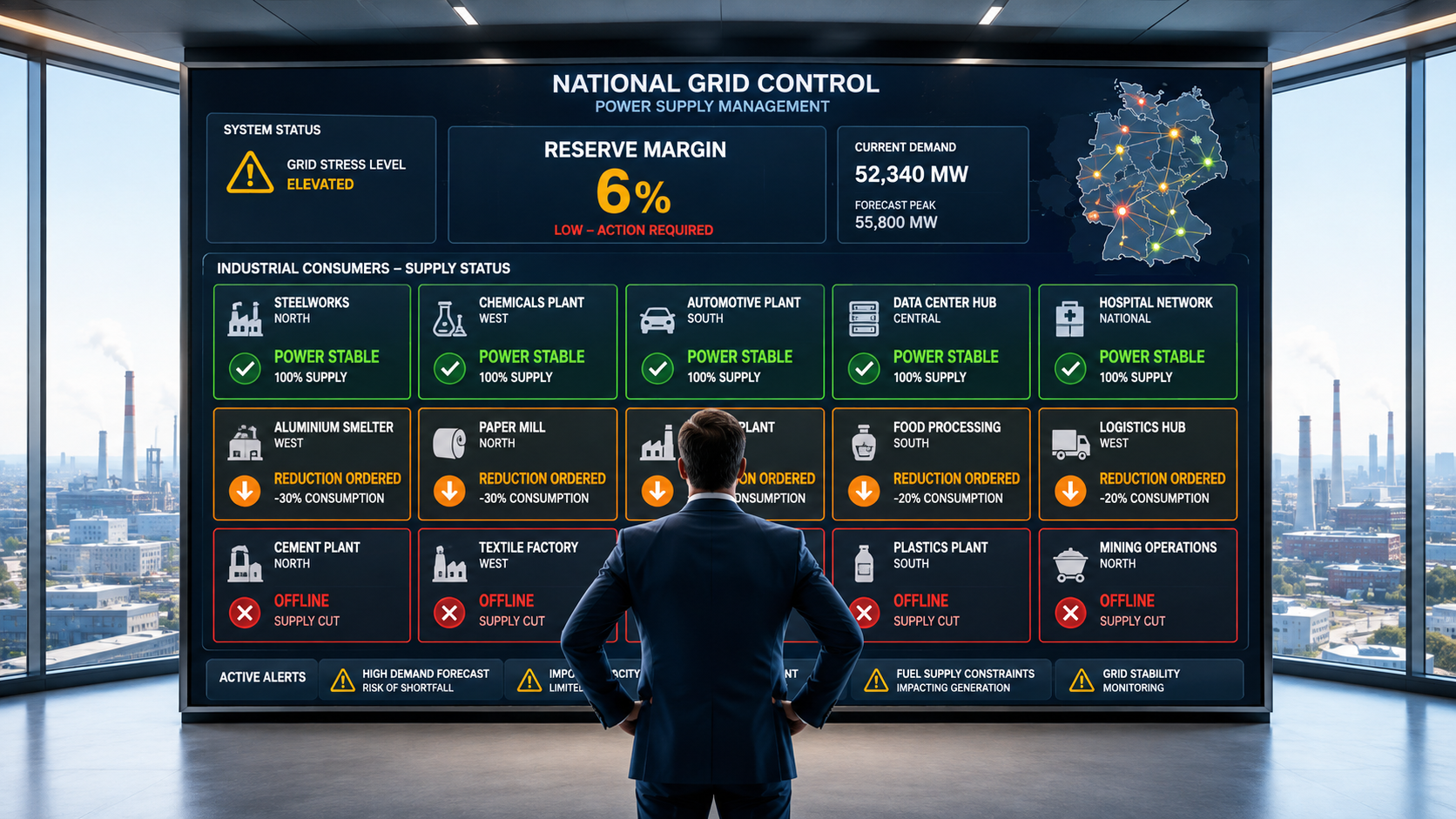
Strategic Risk Intelligence Brief by Global Insight Group.
This analysis is based on the GFDD Framework™ developed by Michaela Schaaf-Hoffelner and is designed for executives, investors and strategic decision-makers.
Updated: August 01, 2026
Germany’s Federal Network Agency is developing SiPlaS, the Security Platform for Electricity, as a new crisis-management instrument. The platform is intended to identify major electricity consumers and enable authorities to contact and coordinate them directly during an emergency.
If Germany faces a severe and prolonged electricity shortage, the Federal Network Agency could order companies to reduce consumption or shut down production. If such instructions were ignored, the electricity supply could ultimately be disconnected by the responsible grid operator.
Public debate often blames Germany’s green energy transition. The nuclear and coal phase-outs, the growing share of weather-dependent electricity generation and the lack of dispatchable power plants could indeed contribute to supply problems.
But this explanation is too narrow.
The Security Platform for Electricity is not being developed in isolation. At the same time, Germany is modernising its emergency legislation, strengthening the protection of critical infrastructure, tightening cybersecurity requirements for the energy sector and preparing to supply both the civilian population and the armed forces in scenarios extending to a national defence emergency.
The more important question is therefore:
Is Germany merely preparing for electricity shortages – or for a national emergency in which the power grid is deliberately attacked or damaged by war?
SiPlaS is the planned Security Platform for Electricity operated by Germany’s Federal Network Agency. It is intended to support communication, data collection and coordination during a severe energy shortage.
According to the information available so far, the platform has been under development since 2024. It is not primarily aimed at ordinary households, but at major industrial electricity consumers and grid operators.
The platform is expected to collect information such as:
This would allow the Federal Network Agency to avoid indiscriminate shutdowns across entire industries. Instead, it could use operational data to determine where electricity consumption can be reduced and which businesses must continue to receive power.
One important limitation remains: detailed information about SiPlaS currently comes largely from documents linked to a non-public information event reported by Apollo News. The Federal Network Agency confirmed to the publication that a platform for coordinating an energy shortage is being developed, but it has not yet released complete public documentation.
Source: Apollo News – Federal Network Agency prepares for a prolonged electricity shortage
A blackout is a large-scale, unexpected and uncontrolled collapse of the electricity supply.
A targeted power cut, by contrast, is a controlled measure. Grid operators or public authorities temporarily disconnect selected consumers or regions to prevent a much larger network failure.
The Federal Network Agency refers to this kind of controlled interruption as a brownout. Electricity supply is deliberately reduced to keep the wider grid stable.
SiPlaS appears to go further. It is not merely intended for emergency interventions made within minutes. The platform is reportedly designed to support shortages that can be anticipated hours or days in advance and may continue for several days or even weeks.
At that point, the issue is no longer purely technical. It becomes a question of allocation:
Who continues to receive electricity – and who must stop production?
The Federal Network Agency nevertheless states that it still considers both a large-scale blackout and controlled brownouts highly unlikely.
Source: Federal Network Agency – FAQ on blackouts, brownouts and the electricity grid
Germany’s energy transition undoubtedly increases the operational demands placed on the electricity system.
Wind and solar installations do not generate power continuously. At the same time, conventional power stations are being removed from the system. Germany therefore needs sufficient storage capacity, grid infrastructure, flexible demand, electricity imports and dispatchable replacement generation.
The Federal Network Agency itself states that the energy system is undergoing a fundamental transformation. Conventional power plants are gradually disappearing while wind and solar capacity expands. This creates new requirements for system stability and security of supply.
An electricity shortage caused partly by energy policy is therefore not an unrealistic scenario.
But it does not explain why Germany is simultaneously implementing so many measures relating to crisis preparedness, protection against sabotage and national defence.
Source: Federal Network Agency – System stability in a changing electricity system
An electricity outage does not have to be caused by insufficient generation capacity.
Modern electricity grids are digitally controlled. Power plants, substations, control centres and distribution networks depend on software, data connections and industrial control systems.
If attackers gain access to these systems, they may do more than steal data. They can prepare the ground for later sabotage.
Germany’s Federal Office of Civil Protection and Disaster Assistance points to Ukraine, where cyberattacks in 2015 and 2016 caused confirmed power outages. German security authorities also warn that foreign actors could deploy similar cyber capabilities against German infrastructure.
The Federal Network Agency has therefore tightened cybersecurity requirements for electricity and gas networks. It explicitly cited the changing geopolitical threat environment as the reason.
Sources: BBK – Cyberattacks against critical infrastructure · Federal Network Agency – Cybersecurity in the energy sector
Electricity networks are also physically vulnerable.
High-voltage lines, substations, power plants, data cables and communications hubs cannot be protected completely. An attack on a small number of critical facilities could have major regional consequences.
This is not limited to conventional terrorism. Hybrid warfare combines cyberattacks, sabotage, espionage, disinformation and physical attacks.
The BBK explicitly identifies critical infrastructure, businesses, the defence industry and German military locations as possible targets of hybrid operations. Russia and China, as well as Iran and North Korea, are named as relevant actors.
Source: BBK – Protective measures against hybrid threats
An electromagnetic pulse, or EMP, can disrupt or destroy electronic systems and communications infrastructure.
A particularly powerful EMP could result from a nuclear detonation at high altitude. Non-nuclear high-powered microwave and directed-energy weapons also exist and may be capable of attacking electronic systems within a more limited area.
So-called graphite bombs can also disable electricity infrastructure. They disperse electrically conductive fibres over substations, causing short circuits.
There is no public evidence that SiPlaS is being developed specifically in response to EMP weapons. However, the scenario demonstrates why a state needs to know which electricity capacity remains available after an attack and which consumers must receive priority.
Further reading: Blackout Bombs and EMP Weapons: How China, Russia and Others Turn Power Grids into Weapons (schaaf-media.com)
The clearest indication is not SiPlaS alone, but the parallel decisions being taken by the German government.
On 1 July 2026, the federal cabinet decided to modernise Germany’s security-of-supply and emergency preparedness legislation. Many of these laws date back to the Cold War.
The government explicitly justified the reform by referring to the changing threat environment and new technological developments.
The legislation is intended to ensure that, during severe crises, both the civilian population and German and allied armed forces can be supplied – including during a national defence emergency.
The government was even more explicit during its press conference. Civilian and military defence must be planned together. Public authorities, municipalities, businesses and social organisations should cooperate during peacetime so that national supply systems continue to function during an emergency.
This creates a clear overall picture:
Sources: German Government – Emergency preparedness and security-of-supply laws to be updated · German Government – Press conference of 1 July 2026
From a GFDD perspective, SiPlaS is best understood as a broader crisis-management instrument rather than a response to one isolated risk.
It could be used during an electricity shortage caused by political, technical or energy-market failures. But it would also be suitable for managing the consequences of cyberattacks, coordinated sabotage, terrorist attacks or a military conflict.
That is its real strategic significance.
Germany is not merely preparing for the possibility that too little electricity may be generated. It is preparing for a severe crisis in which energy must be centrally allocated and prioritised.
In such a situation, the market would no longer decide by itself who can buy electricity.
The state would decide which infrastructure, which companies and which forms of production must continue operating.
Companies should not reduce the issue to emergency generators.
A business could be severely affected even if its own site has not been attacked. Its electricity supply could be reduced because hospitals, water utilities, telecommunications networks, food production, logistics or defence-related manufacturing are given priority.
CEOs should therefore establish:
The most important question is not simply:
Do we have access to electricity?
It is:
Would our company be among those still receiving power during a national emergency?
SiPlaS refers to the planned Security Platform for Electricity. It is intended to support the Federal Network Agency with communication, data collection and coordination during a severe electricity shortage.
During a severe supply crisis, the Federal Network Agency can act as the federal load distributor and issue binding orders to reduce electricity consumption. As a last resort, the responsible grid operator could be instructed to disconnect a business. This is not an instrument used during normal grid operations.
No. The platform does not prove that a blackout is imminent or that the government expects a specific war scenario. It does show that the state is building the capacity to manage a prolonged electricity shortage centrally.
It may be part of the risk environment. The transformation of the electricity system increases the need for dispatchable generation, storage and grid capacity. SiPlaS is nevertheless cause-neutral and could also be used following cyberattacks, sabotage, import disruption or military attacks.
A blackout is an uncontrolled, large-scale collapse of the electricity grid. A power cut is a controlled measure in which selected consumers or areas are temporarily disconnected to prevent a wider failure.
Based on current information, SiPlaS is initially aimed mainly at major electricity consumers. Smaller businesses could still be affected indirectly through regional outages, supplier shutdowns, transport disruption or missing components.
According to the information currently available, compensation under Germany’s Energy Security Act is not automatically guaranteed. Businesses should therefore review contracts, insurance coverage and documentation requirements in advance.
The central message is not that Germany is definitely facing an imminent blackout.
The real message is:
Germany is creating the legal, digital and organisational infrastructure required to allocate electricity centrally during a national emergency.
The green energy transition may play a role. But cyberattacks, sabotage, terrorism, EMP or graphite weapons and a military conflict fit the same planning scenario.
The parallel modernisation of Germany’s crisis and defence legislation shows that the country is not preparing solely for technical grid failures.
It is preparing for a national emergency in which electricity becomes a strategic resource—and companies can no longer assume that a physical connection to the grid guarantees continued supply.
How EMP weapons, graphite bombs and electronic warfare can deliberately disable energy and communications networks. (schaaf-media.com)
Why energy, fuel, transport routes and critical infrastructure cannot be considered separately—and how multiple small disruptions can develop into an operational system shock. (schaaf-media.com)
An analysis of Germany’s debate on a state of tension, mobilisation and growing security preparations for a possible escalation. (schaaf-media.com)
How raw-material controls, energy security, defence production and geopolitical bloc formation are connected. (schaaf-media.com)
Background on directed-energy weapons and their significance for modern warfare, electronic systems and critical infrastructure. (schaaf-media.com)
Author of Global Insight Group Intelligence:
Michaela Schaaf-Hoffelner has more than 35 years of experience in strategic and technical project and product management, particularly in IT, control systems and intralogistics. Through her long-standing work with complex systems, she identifies structural risks and dynamic misalignments at an early stage – risks that are often overlooked in conventional analysis.
Her focus is on making causal relationships and systemic dependencies visible and translating them into concrete strategic advantages for investors and decision-makers. Her analyses combine deep technical systems understanding with geopolitical and economic developments.
GFDD Framework™ and GFDD Diagnostics™ are proprietary analytical concepts developed by Michaela Schaaf-Hoffelner. © 2026 Global Insight Group LLC. All rights reserved.
You are currently viewing a placeholder content from X. To access the actual content, click the button below. Please note that doing so will share data with third-party providers.
More Information