Executive Intelligence. Industrial Risk. Geopolitics.
Strategic Sparring
for Decision-Makers
Risk intelligence across technology, law, markets and power dynamics.


Verdeckte Geschäftsrisiken, strategische Widersprüche und kritische Abhängigkeiten frühzeitig erkennen.
Kostenlose Analyse starten →
Verdeckte Machtstrukturen, Führungsrisiken und organisatorische Blockaden frühzeitig erkennen.
Kostenlose Analyse starten →
Geopolitische Risiken, globale Abhängigkeiten und kritische Lieferkettenrisiken frühzeitig erkennen.
Kostenlose Analyse starten →
Identify hidden business risks, strategic contradictions and critical dependencies at an early stage.
Start Free Analysis →
Identify hidden power structures, leadership risks and organizational blockers at an early stage.
Start Free Analysis →
Identify geopolitical risks, global dependencies and critical supply-chain vulnerabilities at an early stage.
Start Free Analysis →
Verdeckte Geschäftsrisiken, strategische Widersprüche und kritische Abhängigkeiten frühzeitig erkennen.
Kostenlose Analyse starten →
Verdeckte Machtstrukturen, Führungsrisiken und organisatorische Blockaden frühzeitig erkennen.
Kostenlose Analyse starten →
Geopolitische Risiken, globale Abhängigkeiten und kritische Lieferkettenrisiken frühzeitig erkennen.
Kostenlose Analyse starten →
Identify hidden business risks, strategic contradictions and critical dependencies at an early stage.
Start Free Analysis →
Identify hidden power structures, leadership risks and organizational blockers at an early stage.
Start Free Analysis →
Identify geopolitical risks, global dependencies and critical supply-chain vulnerabilities at an early stage.
Start Free Analysis →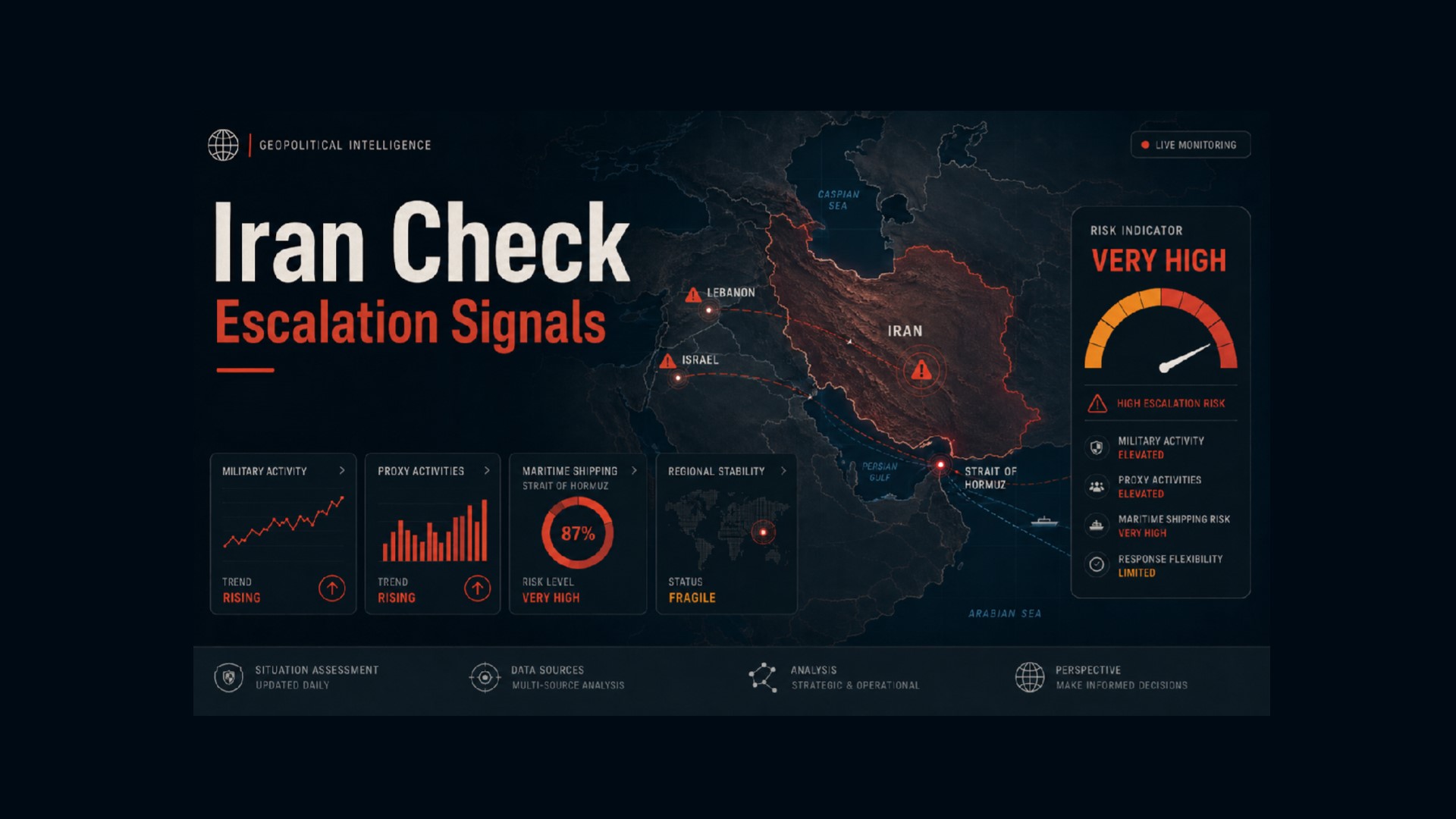
This escalation radar summarizes five relevant signals from June 12, 2026. The focus is on verifiable official statements and events with potential impact on energy prices, supply chains, markets, and regional security.
Trump claims a settlement is close, while Iran has not confirmed a final decision and continues to refer to its red lines.
Despite possible de-escalation, drone, tanker, and transit incidents around the Strait of Hormuz remain a major concern.
Iran and Hezbollah insist that any broader US-Iran deal must also address the fighting in Lebanon.
| Actor | Type | Severity | Status | Source / Verification status | Business impact |
|---|---|---|---|---|---|
| Iran / Foreign Ministry / Esmaeil Baghaei | Red lines and no final approval | High to critical · Level 4/5 | Iran is pushing back against the claim that a final deal with the United States has already been concluded. Foreign Ministry spokesperson Esmaeil Baghaei said, according to reports, that large parts of the text had been finalized, but that no final decision had been made. Tehran also stressed that it would not compromise on its own red lines. | Partially confirmed by Reuters, June 11/12, 2026 and additionally reported by The Guardian, June 12, 2026. Verification status: confirmed for Iran’s reluctance; concrete final agreement terms remain unclear. | High uncertainty for oil prices, sanctions, Iran exposure, payment flows, energy supply, maritime security, and companies with Middle East or commodity exposure. |
| USA / Donald Trump / US administration | De-escalation signal with residual military threat | High to critical · Level 4/5 | Trump said he had canceled new strikes on Iran because an agreement was allegedly largely ready. He described it as a major settlement and suggested that it could be signed over the weekend in Europe. At the same time, the military situation remains tense, as the previous US-Iran strikes have not yet been fully politically resolved. | Confirmed by Reuters, June 12, 2026 and additionally reported by The Guardian, 12.06.2026. Verification status: confirmed for Trump’s statement; unclear whether Iran will actually accept the agreement in final form. | Short-term calming signal for markets and energy prices, but continued high risk of setbacks, renewed military strikes, volatility, risk premiums, and corporate planning uncertainty. |
| Israel / Netanyahu / Israeli government | Not party to the US-Iran memorandum and hard Iran line | High · Level 3/5 | Israel is reportedly not a party to a potential US-Iran memorandum. Netanyahu also stressed that Iran must not obtain nuclear weapons. This creates a risk that Israel may not fully support individual parts of a US-Iran deal, especially regarding Lebanon, Hezbollah, and Iranian support for regional groups. | Partially confirmed by Reuters, June 12, 2026 and The Guardian, 12.06.2026. Verification status: confirmed for Israel not being part of the memorandum; further Israeli operational steps remain open. | Risk of renewed military action, Lebanon exposure, defense-sector volatility, air traffic disruption, insurance pressure, regional supply-chain stress, and investment uncertainty in Israel- and Middle East-linked markets. |
| Lebanon / Hezbollah / Hassan Fadlallah | Lebanon as a condition in the US-Iran deal | High · Level 3/5 | A senior Hezbollah politician said he was confident that Iran would insist on including Lebanon in any possible agreement with the United States. At the same time, Lebanon’s state news agency reported new Israeli airstrikes in several locations in the south of the country. | Confirmed by Reuters, June 12, 2026. Verification status: confirmed for the Hezbollah statement; concrete effects on a possible agreement remain unclear. | Increased risk for Lebanon, northern Israel, the humanitarian situation, evacuations, infrastructure, insurance, banks, transport routes, and companies with regional exposure. |
| Hormuz / USA / Iran / energy and financial markets | Shipping, drone, tanker, and oil price risk | Critical · Level 5/5 | The Strait of Hormuz remains the central risk point despite possible de-escalation. US forces reportedly shot down two Iranian attack drones after Iranian forces allegedly attempted to attack commercial vessels near the Strait of Hormuz. Iranian media also reported that Iranian forces had reacted to a tanker attempting to transit without authorization. | Partially confirmed by Reuters, June 12, 2026 and additionally reported by RFE/RL, June 12, 2026 and The Guardian, June 12, 2026. Verification status: confirmed for ongoing tensions; details of individual maritime incidents require further verification. | Direct business impact on oil, LNG, tanker routing, marine insurance, Gulf markets, supply-chain costs, inflation risks, freight rates, and risk premiums. |
You are currently viewing a placeholder content from X. To access the actual content, click the button below. Please note that doing so will share data with third-party providers.
More Information