Executive Intelligence. Industrial Risk. Geopolitics.
Strategic Sparring
for Decision-Makers
Risk intelligence across technology, law, markets and power dynamics.

Verdeckte Geschäftsrisiken, strategische Widersprüche und kritische Abhängigkeiten frühzeitig erkennen.
Kostenlose Analyse starten →
Verdeckte Machtstrukturen, Führungsrisiken und organisatorische Blockaden frühzeitig erkennen.
Kostenlose Analyse starten →
Geopolitische Risiken, globale Abhängigkeiten und kritische Lieferkettenrisiken frühzeitig erkennen.
Kostenlose Analyse starten →
Identify hidden business risks, strategic contradictions and critical dependencies at an early stage.
Start Free Analysis →
Identify hidden power structures, leadership risks and organizational blockers at an early stage.
Start Free Analysis →
Identify geopolitical risks, global dependencies and critical supply-chain vulnerabilities at an early stage.
Start Free Analysis →
Verdeckte Geschäftsrisiken, strategische Widersprüche und kritische Abhängigkeiten frühzeitig erkennen.
Kostenlose Analyse starten →
Verdeckte Machtstrukturen, Führungsrisiken und organisatorische Blockaden frühzeitig erkennen.
Kostenlose Analyse starten →
Geopolitische Risiken, globale Abhängigkeiten und kritische Lieferkettenrisiken frühzeitig erkennen.
Kostenlose Analyse starten →
Identify hidden business risks, strategic contradictions and critical dependencies at an early stage.
Start Free Analysis →
Identify hidden power structures, leadership risks and organizational blockers at an early stage.
Start Free Analysis →
Identify geopolitical risks, global dependencies and critical supply-chain vulnerabilities at an early stage.
Start Free Analysis →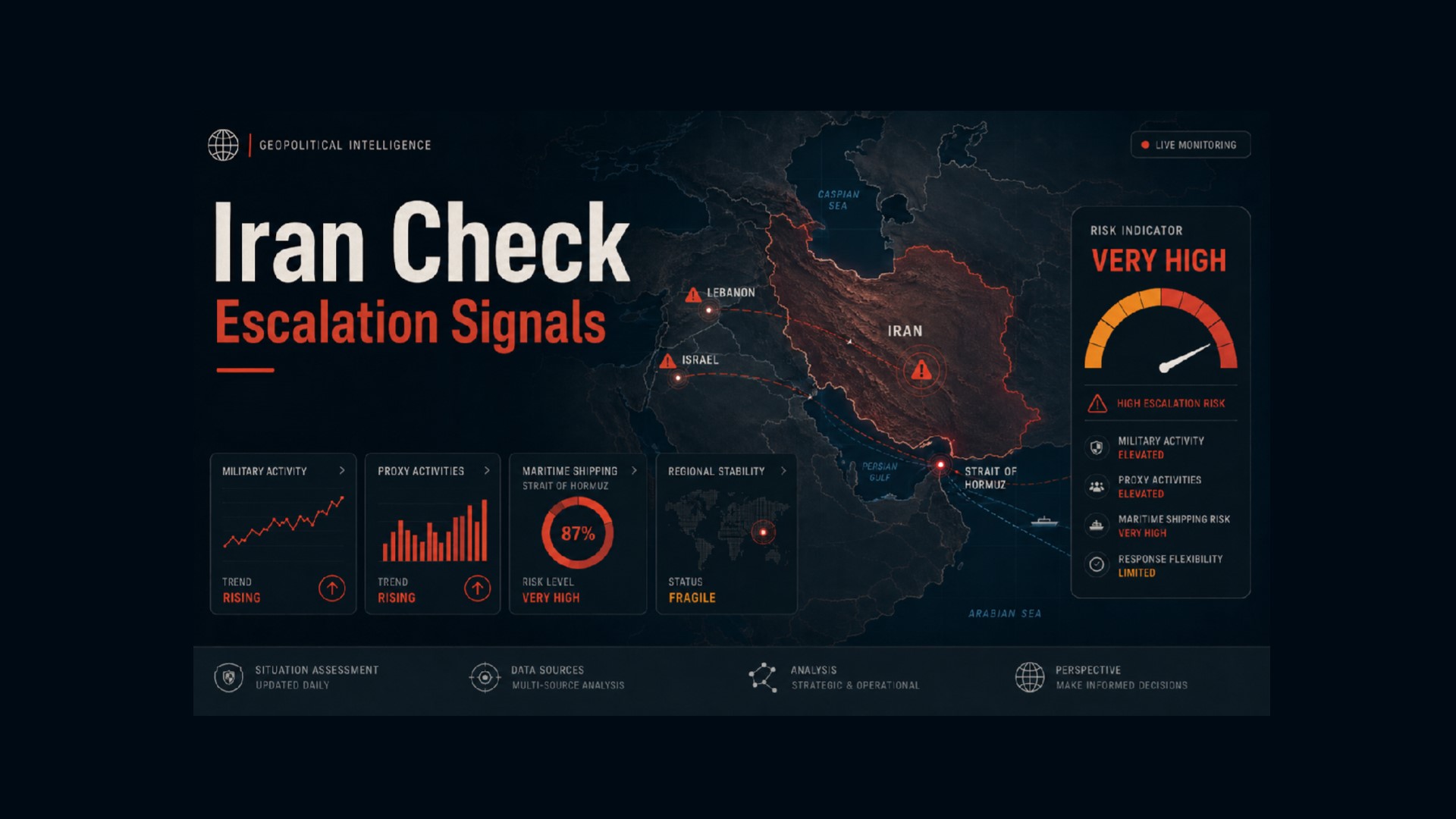
This escalation radar summarizes five relevant signals as of October 18, 2026. The focus is on verifiable statements by official sources, confirmed events and monitoring data with potential implications for energy prices, supply chains, markets, maritime security, aviation and regional stability.
Mehrdad Akhlaqi Ketabchi takes over the Defence Ministry. The missile and defence-industry specialist warns that renewed U.S. attacks would trigger a broad and forceful Iranian response.
Kpler records only five commodity vessels on Saturday and initially no transit at all for Sunday. A week earlier, the figure was still 31 vessels.
President Sisi is seeking parliamentary authorization for defensive military assistance to Riyadh. This could bring another major regional power directly into the Saudi-Houthi confrontation.
| Actor | Type | Severity | Status | Source / Verification | Business Impact |
|---|---|---|---|---|---|
| Iran / United States / Defence Ministry / missile programme | New Iranian defence minister warns of broad retaliation | Critical · Level 5/5 | Iran is sharpening its military deterrence message. Parliament confirms on October 18 Mehrdad Akhlaqi Ketabchi as the new defence minister. Akhlaqi is a long-standing figure in Iran’s defence industry with a focus on aerospace and missile technology. He is subject to U.S. and EU sanctions. Addressing parliament, he says he intends to rebuild Iran’s military-industrial base and further develop defence technologies. At the same time, he directly warns Washington: any renewed attack on Iranian infrastructure would trigger a forceful and comprehensive response. Power dynamics: Tehran is combining a leadership reshuffle with a clear retaliation doctrine. | Confirmed by Reuters, October 18, 2026 . Verification status: confirmed for the appointment, Akhlaqi’s defence-industry background and his warning of Iranian retaliation. No new U.S. strike order has been issued. Background: Schaaf Media · Iran Check: 5 Escalation Signals – October 16, 2026 . | Critical business impact on Iran, energy, Gulf states, aviation, shipping, insurance and investment risk. The combination of missile expertise and explicit retaliation threats raises the risk of rapid escalation if the United States launches new strikes. |
| Iran / Hormuz / Oman / international shipping | Shipping traffic through Hormuz falls sharply over the weekend | Critical · Level 5/5 | Operational traffic through Hormuz has fallen sharply again. According to Kpler data, only five commodity vessels pass through the strait on Saturday. For Sunday, initially no corresponding transit is recorded. The previous weekend still saw 31 vessels. The decline follows repeated attacks on tankers and other commercial vessels. At the same time, Iran says it has submitted a seven-day plan through Qatar for reopening the strait. Washington has not yet agreed to the proposal. Power dynamics: Iran is keeping operational pressure on the chokepoint while also using its reopening as a political negotiating instrument. | Current regional reporting: Gulf Times / Reuters, October 18, 2026 . Verification status: confirmed for the sharp decline in recorded transits. The data may not capture every transit that actually occurred. Further analysis: Schaaf Media · Strait of Hormuz Blockade 2026: Protecting Margins and Supply Chains in the Chokepoint Shock . | Critical business impact on crude oil, LNG, tankers, freight rates, war-risk insurance and delivery times. A nearly inactive chokepoint increases the risk of supply disruptions, rerouting and further energy-price spikes. |
| Houthis / Saudi Arabia / Riyadh / Khamis Mushait | Saudi Arabia intercepts new drones and ballistic missiles | Critical · Level 5/5 | The Houthi attack wave against Saudi Arabia continues on October 18. The Saudi-led coalition says it intercepted several drones over Riyadh, the Eastern Province and the south. In addition, two ballistic missiles heading toward Khamis Mushait are destroyed. Riyadh temporarily activates another alert for a hostile aerial threat. The latest interceptions follow attacks on Riyadh Airport and Saudi Aramco. Power dynamics: The Houthis are maintaining military pressure on civilian, military and economic targets simultaneously. | Current regional source: Gulf News, October 18, 2026 . Verification status: confirmed for Saudi reports of the intercepted drones and missiles. No strikes on the named targets were reported. Further analysis: Schaaf Media · Middle East Escalation Check – October 17, 2026 . | Critical business impact on Saudi Arabia, aviation, energy, logistics, insurance and site continuity. Repeated alerts and interception operations increase the risk of short-term operational and transport disruptions even without successful strikes. |
| Egypt / Saudi Arabia / Houthis / Red Sea | Egypt prepares parliamentary authorization for Saudi defence | Critical · Level 5/5 | Another major regional power is moving closer to the Saudi-Houthi confrontation. President Abdel Fattah al-Sisi says Egypt is prepared to defend Saudi Arabia militarily if requested. Sisi is seeking parliamentary authorization for such action. Egypt’s parliament meets on October 18 for an extraordinary session. Sisi stresses that any assistance would be defensive and not aimed at launching an offensive war. Politically, Cairo explicitly links Saudi security with Egyptian and broader Arab national security. Power dynamics: Political solidarity could for the first time develop into a formalized Egyptian military role. | Current reporting: Dawn / AFP / Reuters, October 18, 2026 . Verification status: confirmed for Sisi’s willingness to defend Saudi Arabia and the parliamentary deliberations. A Saudi request for Egyptian forces or any concrete troop deployment has not yet been confirmed. Background: Schaaf Media · Middle East Escalation Check – October 17, 2026 . | Critical business impact on Saudi Arabia, Egypt, Yemen, Red Sea, Bab el-Mandeb, military logistics and investment. Actual Egyptian involvement would significantly broaden the regional conflict architecture. |
| United States / Russia / Ukraine / Iran / global energy supply | Iran energy crisis reshapes U.S. sanctions policy toward Russia | High to Critical · Level 4/5 | The Iran conflict is increasingly spilling over into Russia and Ukraine policy. U.S. Secretary of State Rubio says on October 18 that President Trump will take up to 60 days to decide on new Russia sanctions and tariffs. Washington has temporarily suspended corresponding measures. Rubio cites the economic impact of high energy prices resulting from the Iran war as one reason. At the same time, the United States agrees to additional diesel imports from Russia. More than 300,000 tonnes are initially expected to be delivered. Power dynamics: The Iran war is now directly influencing Western pressure instruments in the Russia-Ukraine conflict. | Confirmed by Reuters, October 18, 2026 . Verification status: confirmed for the 60-day review period, the temporary suspension of measures and the planned Russian diesel imports. Long-term U.S. sanctions policy toward Russia remains open. Further analysis: Schaaf Media · Ukraine War, Diesel Prices and Trump: How Energy Policy Is Reshaping the Midterms . | High to critical business impact on energy, diesel, Russia sanctions, Ukraine, Europe, transport costs and compliance. For European companies, this creates an unusual cross-theatre effect: the Iran war is indirectly reshaping Russia-related risks, energy flows and sanctions planning. |
The most strategically important development on October 18, 2026 is Iran’s military leadership reshuffle. With Mehrdad Akhlaqi Ketabchi, a prominent missile and defence-industry specialist takes over the Defence Ministry. His first message to Washington is clear: renewed attacks are intended to trigger a broad Iranian retaliatory response.
Operationally, Hormuz remains the most important global risk factor. Kpler records only five commodity vessels on Saturday. For Sunday, initially no transit is reported. Traffic is therefore far below the level seen a week earlier. At the same time, Tehran is trying to use the possible reopening of the strait as leverage in negotiations with Washington.
The Saudi-Houthi front is also continuing to deteriorate. Saudi Arabia again intercepts drones and ballistic missiles. At the same time, Egypt is preparing a parliamentary framework that could allow it to defend Saudi Arabia militarily if requested. This could significantly broaden the regional security architecture.
Particularly striking is the cross-theatre effect on Russia and Ukraine. Washington is temporarily holding back additional Russia sanctions and increasing Russian diesel imports to mitigate the impact of the global energy shock. The Iran conflict is therefore now directly influencing policy instruments in a second major war theatre. The mandatory alliance review shows no new Iranian membership, partner or observer status as of October 18. What is newly relevant instead is the possibility of a direct Egyptian defensive role for Saudi Arabia. EASA continues to maintain active advisories for Iran, Saudi Arabia, the Persian Gulf/Gulf of Oman, Iraq, Lebanon and Yemen; no new revision was identified on October 18.
The five most important signals for a European risk assessment are: the appointment of missile and defence-industry specialist Mehrdad Akhlaqi Ketabchi as Iran’s defence minister together with his warning of comprehensive retaliation, the renewed collapse in Hormuz shipping traffic to temporarily almost zero recorded commodity transits, continued Houthi attacks with new Saudi interceptions over Riyadh, the Eastern Province and Khamis Mushait, Egypt’s preparation of parliamentary authorization for possible military defence assistance to Saudi Arabia, and the direct impact of the Iran energy shock on U.S. Russia sanctions policy and new Russian diesel imports.
Note: This assessment was prepared with support from our Geo-AI. AI can make mistakes. The analysis is intended as a radar for potential escalation signals and does not replace a fully verified intelligence assessment.
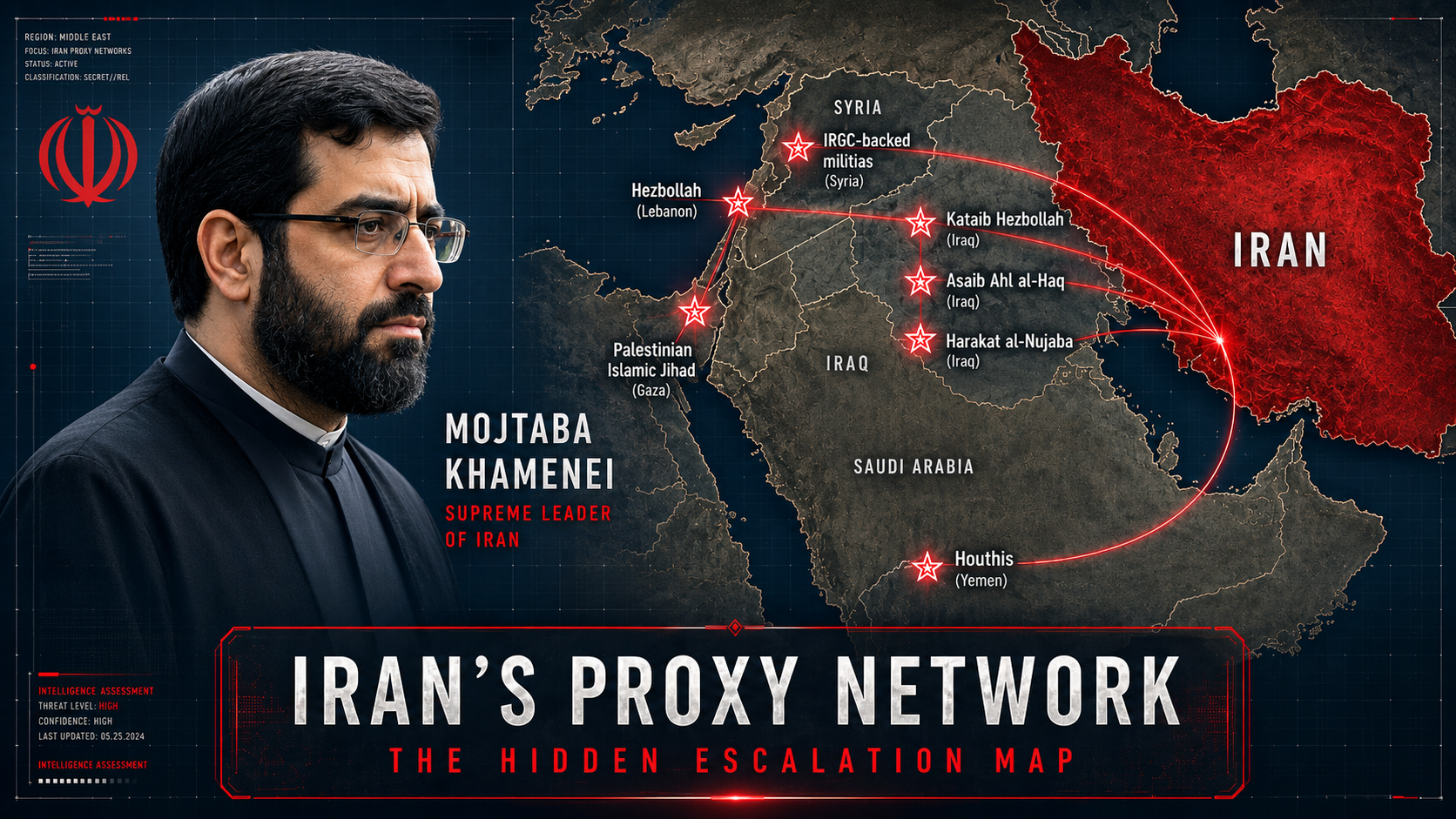
What decision-makers should watch now — before proxy escalation becomes a cost, compliance or supply-chain shock.
This 17-page executive briefing translates Iran’s proxy network into concrete business risks: energy price exposure, maritime chokepoints, war-risk premiums, sanctions, shadow fleets, supply-chain disruption and early-warning indicators for board-level decisions.
You are currently viewing a placeholder content from X. To access the actual content, click the button below. Please note that doing so will share data with third-party providers.
More Information