Executive Intelligence. Industrial Risk. Geopolitics.
Strategic Sparring
for Decision-Makers
Risk intelligence across technology, law, markets and power dynamics.

Verdeckte Geschäftsrisiken, strategische Widersprüche und kritische Abhängigkeiten frühzeitig erkennen.
Kostenlose Analyse starten →
Verdeckte Machtstrukturen, Führungsrisiken und organisatorische Blockaden frühzeitig erkennen.
Kostenlose Analyse starten →
Geopolitische Risiken, globale Abhängigkeiten und kritische Lieferkettenrisiken frühzeitig erkennen.
Kostenlose Analyse starten →
Identify hidden business risks, strategic contradictions and critical dependencies at an early stage.
Start Free Analysis →
Identify hidden power structures, leadership risks and organizational blockers at an early stage.
Start Free Analysis →
Identify geopolitical risks, global dependencies and critical supply-chain vulnerabilities at an early stage.
Start Free Analysis →
Verdeckte Geschäftsrisiken, strategische Widersprüche und kritische Abhängigkeiten frühzeitig erkennen.
Kostenlose Analyse starten →
Verdeckte Machtstrukturen, Führungsrisiken und organisatorische Blockaden frühzeitig erkennen.
Kostenlose Analyse starten →
Geopolitische Risiken, globale Abhängigkeiten und kritische Lieferkettenrisiken frühzeitig erkennen.
Kostenlose Analyse starten →
Identify hidden business risks, strategic contradictions and critical dependencies at an early stage.
Start Free Analysis →
Identify hidden power structures, leadership risks and organizational blockers at an early stage.
Start Free Analysis →
Identify geopolitical risks, global dependencies and critical supply-chain vulnerabilities at an early stage.
Start Free Analysis →
Strategic Risk Intelligence Brief by Global Insight Group.
This analysis is based on the GFDD Framework™ developed by Michaela Schaaf-Hoffelner and is designed for executives, investors and strategic decision-makers.
GFDD Framework™ and GFDD Diagnostics™ are methodological analytical concepts developed by Michaela Schaaf-Hoffelner. © 2026. All rights reserved.
Strategic Note: This update builds on the relationships outlined in the initial briefing. To fully understand the implications of the current developments, we recommend reading the original briefing first.
For: Executive Management
Date: 2026-04-16
Time Horizon
Strategic context: Now → 4 weeks
Structural context: Now → 2-3 years
An essential update for decision-makers who want to look beyond the headlines.
A short-term forecast, an investment recommendation, financial advice or a news or opinion article.
With the activation of Scenario C, the “Chokepoint Shock,” on April 13, 2026, companies face a fundamental recalibration of their risk models.
This briefing addresses the critical questions facing executive management across four core areas:
The current pricing dynamics extend far beyond crude oil prices above USD 102.
The decisive cost driver is the sharp increase in war-risk insurance premiums.
Companies therefore need to recalculate their logistics costs for Q2 2026 immediately if they want to protect profitability.
The massive increase in Ghost Traffic, vessels operating without AIS signals, in the Strait of Malacca is creating unpredictable Black Swan exposure.
An accident involving these frequently uninsured vessels could severely disrupt global supply chains.
This briefing assesses the resulting physical disruption risks.
The United States is positioning itself as an energy fortress and safe haven.
The update provides a strategic basis for evaluating whether supply contracts should be shifted toward US LNG and crude oil in order to reduce dependence on increasingly unstable Asian maritime routes.
Geopolitical systemic risks must be incorporated proactively into corporate planning.
This analysis can support risk-management documentation relating to Germany’s Supply Chain Due Diligence Act, or LkSG, and CSRD reporting requirements in global crisis scenarios.
“Scenario C activated: when a forecast becomes market reality.”
On April 13, 2026, the US naval blockade of the Strait of Hormuz triggered the Chokepoint Shock outlined in our January briefing.
While markets responded with oil prices rising above USD 102, our systemic early warning indicators, ranging from war-risk premiums to AIS tracking, confirmed the deeper geopolitical logic behind the escalation.
In this Executive Update, we analyse why the current volatility is not random, how the Trump ultimatum is reshaping global supply chains, and which asset classes are now under immediate stress.
This is an essential update for decision-makers who need to look beyond the headlines.
The ceasefire agreed on April 8 has effectively collapsed.
After negotiations broke down overnight, the United States announced the beginning of a naval blockade of Iranian ports and the Strait of Hormuz for Monday, April 13, 2026.
1. Oil Front-Month Prices
Status: CRITICAL, April 13, 2026
Brent crude opened approximately 5% higher at USD 102.50.2. Futures Curves
Status: ACTIVE, April 13, 2026
Severe backwardation, with spot prices trading significantly above futures prices.3. War-Risk Premiums
Status: EXTREME, April 13, 2026
Insurers sharply increased premiums for Gulf-region routes following the blockade announcement.4. Shipping Logistics
Status: HALTED, April 13, 2026
Tanker traffic through Hormuz has nearly come to a standstill, with shipping companies avoiding the passage.11. Rhetoric Shift
Status: COMPLETED, April 13, 2026
The United States has moved from threats to a time-bound ultimatum, with the blockade beginning today.
With the US naval blockade of the Strait of Hormuz beginning on April 13, exactly the development described in January under Scenario C, Low Probability / High Impact, has materialised.
The forecast has become market reality.
The following analysis validates the original early warning indicators and examines the systemic consequences.
Our original briefing warned of a global repricing wave.
That repricing is now unfolding through several channels.
Price dynamics: Before the conflict, oil traded at approximately USD 70. During the first escalation wave, prices reached peaks of USD 119. Analysts now warn that a prolonged blockade could push prices towards USD 150 to USD 200, potentially exceeding the severity of the oil shocks of the 1970s.
Asia exposure: Around 80% of the region’s oil exports are destined for Asian markets, particularly China. This creates the maximum stress scenario described in our earlier analysis.
European inflation: Heating-oil prices in Germany have already reached record highs, increasing pressure on both the European Central Bank and national governments.
We are now moving from risk pricing into implementation.
The naval blockade represents the hard step beyond a simple geopolitical risk premium.
The United States is acting as the safe haven, while energy-importing economies in Europe and Asia bear the full economic cost, precisely as anticipated in Chapter 4 of the original briefing.
While mainstream reporting focuses on the US naval blockade, Indicator 4, shipping logistics, reveals a significant shift into less visible channels.
Since the escalation began, we have observed a sharp increase in so-called Ghost Traffic across the Indian Ocean and the Strait of Malacca.
Ghost Traffic refers to international shipping activity in which tankers deliberately deactivate their AIS transponders to conceal their positions and circumvent sanctions.
For businesses, this creates an immediate insurance vacuum and unpredictable supply-chain risks because these vessels frequently operate without valid P&I cover.
China is the central actor behind this strategy.
Because Beijing sources around 70 to 80% of its oil via maritime routes involving Hormuz and Malacca, the US blockade in April 2026 effectively triggers a Code Red for Chinese energy security.
India is pursuing an opportunistic strategy in 2026.
To limit domestic inflation ahead of elections, India is purchasing substantial quantities of oil that have effectively “disappeared from radar.”
These areas function as transit zones for Ghost Traffic.
Oil is frequently relabelled in Malaysian waters.
Through falsified documentation, Iranian oil can suddenly become “Malaysian blend” before being transported onward across Asia.
Signal spoofing: We are also observing more vessels transmitting false GPS coordinates in 2026.
Ships may appear to be anchored off Singapore while actually loading cargo in Iranian waters.
Ghost Traffic is creating a two-tier oil market.
For corporate risk management, this trend is highly concerning.
Ghost Traffic vessels often operate without conventional P&I insurance and frequently use ageing equipment.
1. Insurance vacuum:
These ships may lack valid P&I protection. An accident in the Strait of Malacca could trigger both an environmental and logistics disaster and potentially add another USD 20 to oil prices.
2. Data blindness:
Official global oil-supply statistics become less reliable.
If a significant share of Asian demand is met through shadow fleets, markets may underestimate actual supply, increasing the risk of extreme volatility.
Conclusion for decision-makers: Ghost Traffic acts as Asia’s safety valve against the US ultimatum.
Anyone seeking to understand pricing dynamics cannot focus only on market tickers. The movement of the shadow fleet must also be monitored.
While Ghost Traffic gives Asia a temporary safety valve, the US side is pursuing precisely the strategic logic identified in our January analysis: using energy not simply as a commodity, but as a weapon.
The Trump administration is accepting short-term increases in energy prices because the blockade of the Strait of Hormuz sends a deliberate pricing signal to global markets.
Countries that want continued access to inexpensive Gulf oil must either make diplomatic concessions or shift toward American alternatives.
This is where the “Buy American or Pay the Price” logic becomes relevant.
Higher spot prices, surging freight rates and war-risk premiums effectively push European and Asian importers toward long-term LNG and crude-oil contracts with the United States.
Those contracts are highly profitable for US producers in the Permian Basin and for American LNG terminals.
The blockade is therefore not simply an end in itself.
It functions as leverage for a strategic restructuring of global energy markets: short-term pain in exchange for longer-term US export dominance.
China faces maximum systemic pressure.
The blockade not only interrupts physical flows. It also undermines the cost advantage on which Chinese energy supply has relied.
Beijing must either:
All three options place pressure on Chinese industry and strategic energy security.
At the same time, previously reliable maritime supply routes are becoming structurally less predictable.
Insurance costs are rising and China is being forced to accelerate expensive diversification projects, including pipelines and strategic reserves.
The US calculation is clear:
China is not being pushed onto the defensive primarily through military confrontation, but through one of its greatest economic vulnerabilities, its dependence on imported energy.
The blockade creates not only geopolitical pressure, but also a dangerous feedback loop inside the United States.
This is where the Trump administration’s tactical manoeuvre becomes relevant.
Washington is attempting to balance geopolitical dominance with domestic voter support ahead of the 2026 midterm elections.
Historically, gasoline prices at the pump, often referred to as “pain at the pump,” are among the most politically sensitive economic indicators for US presidents.
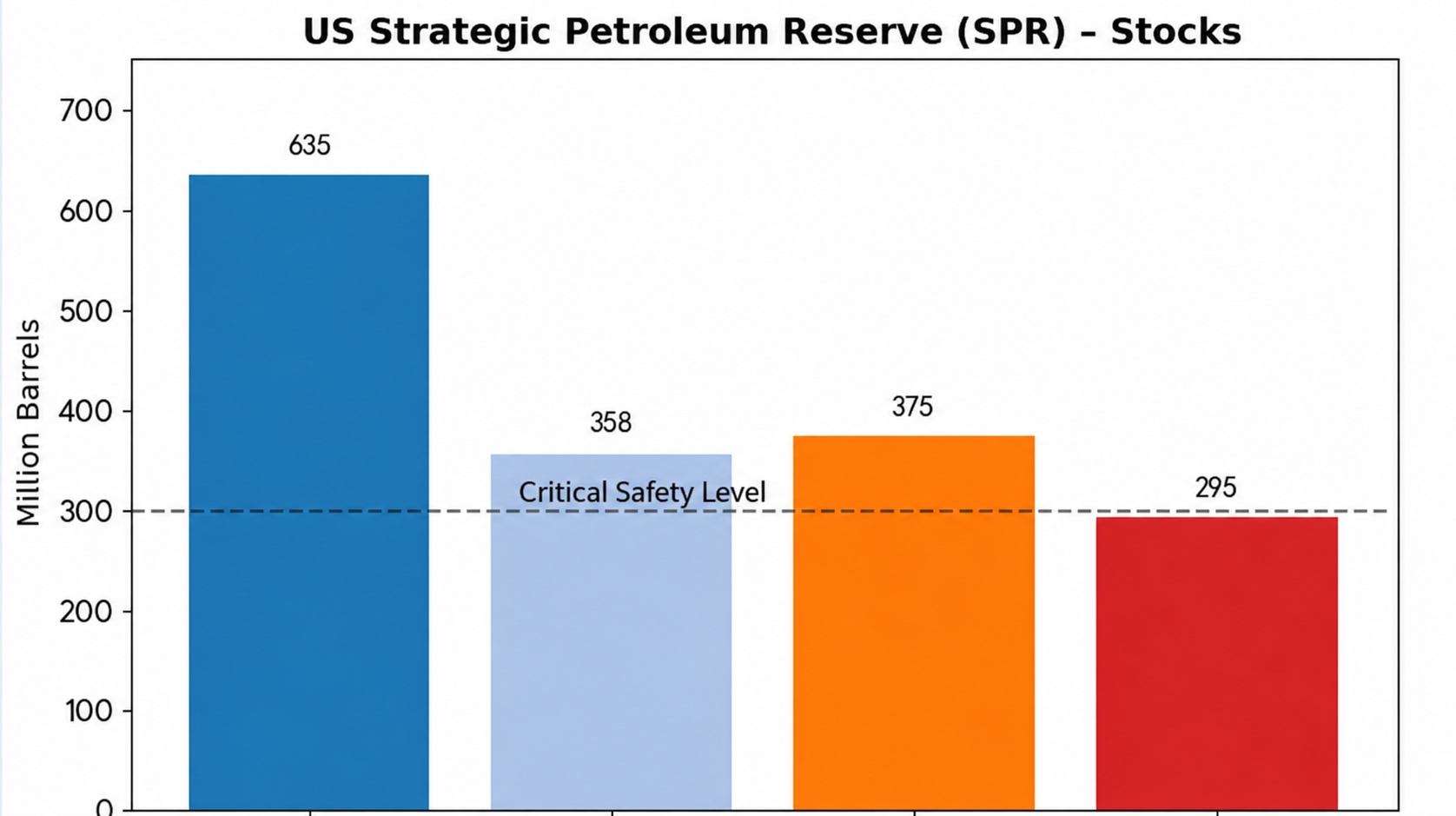
To neutralise this political risk without lifting the Gulf blockade, a significant release from the Strategic Petroleum Reserve, or SPR, becomes increasingly likely.
This is a short-term manoeuvre that could push the SPR toward historically low levels and weaken long-term national security.
OPEC+, led by Saudi Arabia, is currently waiting.
Pricing power could then shift away from Washington and back toward Riyadh and Moscow.
This represents a major strategic risk for the period after 2026.
Can the Trump administration keep the Strait of Hormuz closed longer than US commuters are willing to tolerate high gasoline prices?
Original GFDD Analysis by Michaela Schaaf-Hoffelner / Global Insight Group.
To minimise the impact of a Strait of Hormuz blockade, decision-makers should consider four immediate measures:
Intelligence on Demand
Experience the analytical power of GFDD Diagnostics™ through a concrete business case.
Our proprietary AI was developed around the methodology, knowledge structures and analytical patterns of GFDD Diagnostics™.
Test whether this approach can reveal hidden dependencies, leadership risks and strategic blind spots within your organization.
Test GFDD Diagnostics™
The following capital-market shifts serve as indicators of the relative competitiveness of global operating locations and the stability of corporate funding chains.
The activation of Scenario C, the Strait of Hormuz blockade, fundamentally changes the risk matrix for global portfolios.
Because Brent volatility, around USD 103 on April 13, 2026, is being driven by geopolitical premiums, asset managers need to look beyond commodity futures alone.
US Upstream and LNG Infrastructure:
Companies focused on Permian Basin production and US LNG export capacity are emerging as systemic beneficiaries.
They offer not only exposure to higher energy prices but also benefit directly from the Trump ultimatum, which pushes European and Asian buyers toward US supply contracts.
Defense and Maritime Security:
With the expansion of Operation Epic Fury and increasing demand for private security convoys in the Gulf, specialised defence and maritime logistics providers are becoming strategically relevant.
Asian Net Importers:
Industrial companies in China, India and Japan face substantial margin pressure.
With a large share of Gulf oil flowing toward Asia, prolonged underperformance becomes a significant risk.
European Chemicals and Heavy Industry:
Despite strategic reserves, oil prices above USD 100 are reviving concerns about European deindustrialisation.
Energy-cost hedging therefore becomes increasingly important for limiting downside risk.
1. Liquidity audit:
Review USD funding exposure. During Gulf crises, dollar liquidity often tightens in emerging markets.
2. Tail-risk protection:
Extreme oil-price scenarios need to be incorporated into corporate stress testing if the blockade persists beyond short periods.
3. Gold as a volatility anchor:
Gold remains relevant as a hedge against broader Middle East escalation and systemic financial stress beyond the oil market.
In the current market environment, April 2026, we are observing a monetisation of oil that shows striking parallels with the gold market.
To minimise the impact of a Strait of Hormuz blockade, decision-makers should consider:
This Executive Update is provided solely as an analytical scenario and risk assessment.
It expressly does not constitute asset-management advice, investment advice, financial analysis or an investment recommendation.
All assessments, market observations and strategic considerations are provided exclusively for strategic orientation and to support understanding of geopolitical and macroeconomic relationships.
Global Insight Group Strategic Risk Intelligence accepts no liability for direct or indirect financial losses resulting from the use or interpretation of this document.
Any investment decision remains solely the responsibility of the reader and should be based on individual, qualified advice from a licensed financial or investment adviser.
Author of Global Insight Group Intelligence:
Michaela Schaaf-Hoffelner has more than 35 years of experience in strategic and technical project and product management, particularly in IT, control systems and intralogistics. Through her long-standing work with complex systems, she identifies structural risks and dynamic misalignments at an early stage – risks that are often overlooked in conventional analysis.
Her focus is on making causal relationships and systemic dependencies visible and translating them into concrete strategic advantages for investors and decision-makers. Her analyses combine deep technical systems understanding with geopolitical and economic developments.
GFDD Framework™ and GFDD Diagnostics™ are proprietary analytical concepts developed by Michaela Schaaf-Hoffelner. © 2026 Global Insight Group LLC. All rights reserved.
You are currently viewing a placeholder content from X. To access the actual content, click the button below. Please note that doing so will share data with third-party providers.
More Information