Executive Intelligence. Industrial Risk. Geopolitics.
Strategic Sparring
for Decision-Makers
Risk intelligence across technology, law, markets and power dynamics.

Verdeckte Geschäftsrisiken, strategische Widersprüche und kritische Abhängigkeiten frühzeitig erkennen.
Kostenlose Analyse starten →
Verdeckte Machtstrukturen, Führungsrisiken und organisatorische Blockaden frühzeitig erkennen.
Kostenlose Analyse starten →
Geopolitische Risiken, globale Abhängigkeiten und kritische Lieferkettenrisiken frühzeitig erkennen.
Kostenlose Analyse starten →
Identify hidden business risks, strategic contradictions and critical dependencies at an early stage.
Start Free Analysis →
Identify hidden power structures, leadership risks and organizational blockers at an early stage.
Start Free Analysis →
Identify geopolitical risks, global dependencies and critical supply-chain vulnerabilities at an early stage.
Start Free Analysis →
Verdeckte Geschäftsrisiken, strategische Widersprüche und kritische Abhängigkeiten frühzeitig erkennen.
Kostenlose Analyse starten →
Verdeckte Machtstrukturen, Führungsrisiken und organisatorische Blockaden frühzeitig erkennen.
Kostenlose Analyse starten →
Geopolitische Risiken, globale Abhängigkeiten und kritische Lieferkettenrisiken frühzeitig erkennen.
Kostenlose Analyse starten →
Identify hidden business risks, strategic contradictions and critical dependencies at an early stage.
Start Free Analysis →
Identify hidden power structures, leadership risks and organizational blockers at an early stage.
Start Free Analysis →
Identify geopolitical risks, global dependencies and critical supply-chain vulnerabilities at an early stage.
Start Free Analysis →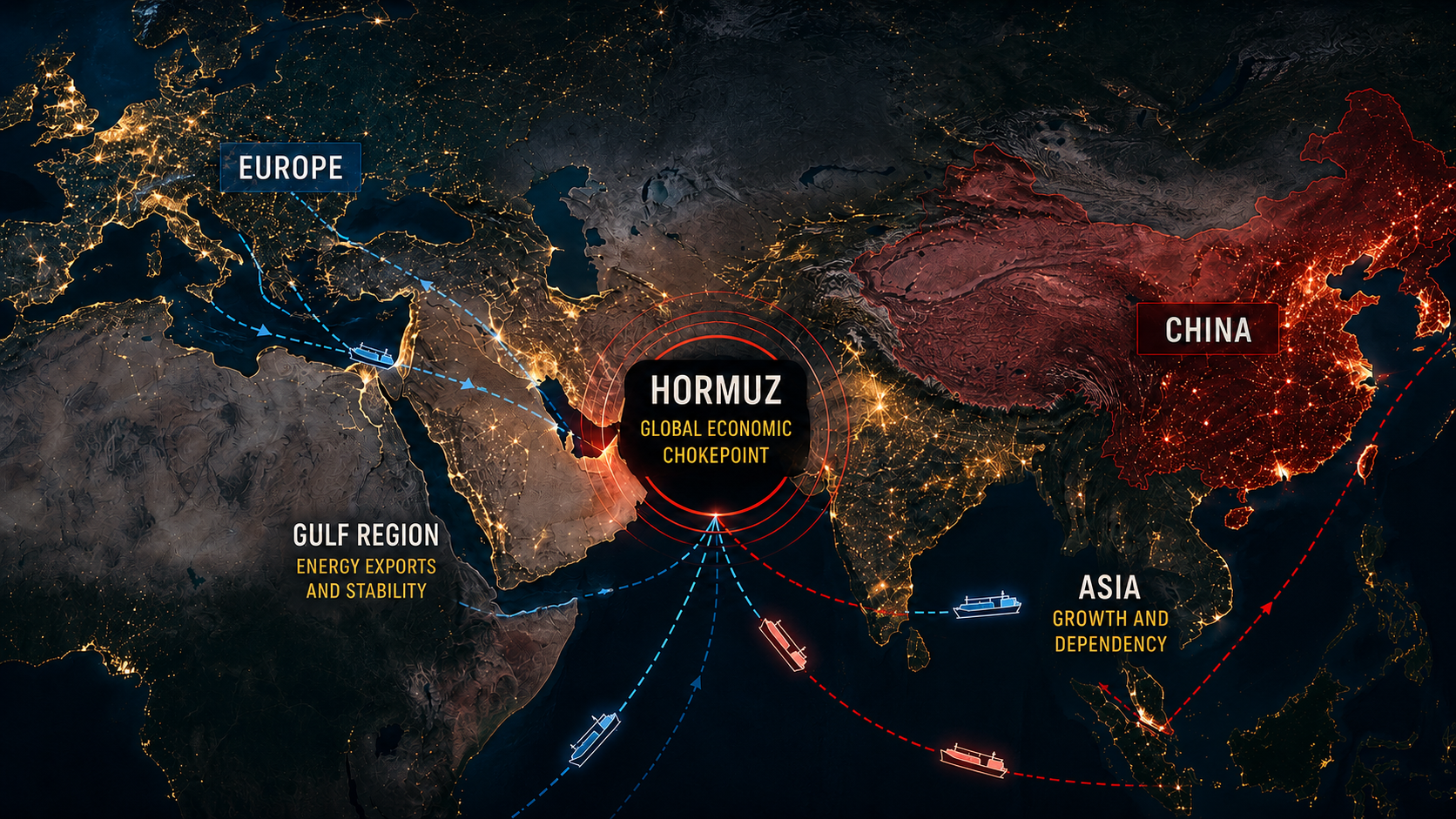
This Chokepoint Check assesses current pressure on the Strait of Hormuz, Bab al-Mandab and critical water, power, port and energy infrastructure across the Gulf region. The key question is not simply whether a route remains geographically open, but whether shipping, insurance, energy supply and site operations remain operationally viable.
A tanker was struck by two projectiles near Oman on November 3, hitting its engine room. On November 4, Iran also claimed that four tankers had been destroyed by naval mines.
UKMTO confirms the projectile strike. The Iranian claims of mine strikes and destroyed vessels have not been independently verified. Safe commercial transit remains seriously threatened.
A maritime security report dated November 3 documented suspicious activity directly in the Bab al-Mandab Strait.
This does not establish that a new attack on a commercial vessel has occurred. However, continued Houthi escalation against Saudi Arabia keeps the wider security risk elevated.
The Houthis claimed on November 4 to have attacked Riyadh airport and military facilities in southern Saudi Arabia.
Saudi authorities reported air alerts for Riyadh, Jazan and Najran. The alleged extensive damage to the airport has not been independently confirmed.
UKMTO reported two projectiles striking a tanker’s engine room at approximately 19:00 UTC on November 3, around 14 nautical miles northeast of Lima, Oman. On November 4, Iran’s Revolutionary Guards claimed that four additional tankers had been destroyed by naval mines south of Hormuz. Two further vessels were also reportedly detained.
The projectile strike is documented, with no initial reports of injuries or environmental damage. However, Iran’s claims that four tankers were destroyed have not been independently confirmed. The combination of actual attacks and potential mine threats keeps the chokepoint at risk level 4/5.
Strikes on a vessel’s engine room can directly compromise its ability to manoeuvre. Shipping operators must therefore account for additional security measures, transit delays and significant insurance exposure. The actual impact on trade volumes and export capacity still requires separate verification.
Verification status: partially confirmed. UKMTO confirms the tanker attack; Iran’s claims of four destroyed vessels, mine strikes and detentions remain unverified. SAFETY4SEA, November 4, 2026 · SchaafMedia: Iran Check – 5 Escalation Signals from November 3, 2026
US officials confirmed limited airstrikes on Iran’s Qeshm Island on November 3. The targets were surface-to-air missile systems that Washington said posed a threat to American forces. US officials described the strikes as defensive.
Unlike a verbal threat, this was a confirmed military action against Iranian positions. US officials nevertheless stated that the operation did not represent a return to large-scale hostilities. Iran warned that it would respond decisively to further US strikes.
Qeshm Island lies directly alongside the strategically important Hormuz corridor. Direct US-Iran hostilities could affect commercial shipping, regional military bases and the operational security of nearby ports. Businesses should monitor the risk of retaliatory strikes and sudden security restrictions.
Verification status: confirmed for the limited US strikes by American government officials. The full operational impact and possible Iranian responses remain uncertain. Reuters / MarketScreener, November 3, 2026 · SchaafMedia: Iran Check – 5 Escalation Signals from November 3, 2026
On November 4, an Israeli drone struck a motorcycle in Qabrikha, southern Lebanon. According to Lebanon’s Health Ministry, one person was killed and another injured. Israel confirmed the strike, stating that two individuals had been observing Israeli soldiers.
The strike marks a renewed fatal military operation after several weeks without comparable drone attacks. Israel described the action as a response to an immediate threat and reaffirmed its commitment to the agreement with Lebanon. Nevertheless, the risk of renewed pressure on the fragile ceasefire has increased.
Renewed escalation in southern Lebanon could disrupt regional transport links and business operations near the border. International companies must consider possible security restrictions and the potential expansion of hostilities. Such an expansion has not yet been confirmed.
Verification status: confirmed. Lebanon’s Health Ministry confirms the casualty figures, while Israel confirms the military operation. Jordan News Agency / Petra, November 4, 2026 · SchaafMedia: Middle East Escalation Check from November 2, 2026
On November 4, the Houthis claimed to have attacked King Khalid International Airport in Riyadh with a ballistic missile. Further drone and missile strikes reportedly targeted military facilities in Jazan. Saudi authorities issued alerts across several regions.
The Houthis claim to have caused substantial damage at the airport but have provided no independently verifiable evidence. The air alerts are documented, while a successful strike on airport infrastructure remains unconfirmed. Despite the potentially critical target, this signal therefore remains at 2/5.
A confirmed airport strike could directly disrupt passenger flights, cargo handling and international business travel. Even the warnings increase security requirements and operational planning costs. However, actual damage or operational shutdowns cannot currently be treated as confirmed.
Verification status: partially confirmed. Saudi air alerts are documented. The claimed Houthi strikes and airport damage remain independently unverified. Associated Press, November 4, 2026 · SchaafMedia: Middle East Escalation Check from November 2, 2026
Türkiye’s parliament is expected to vote on November 4 on ratifying the Mecca Joint Defence Agreement concluded in August. The agreement establishes a collective-defence framework between Türkiye, Saudi Arabia and Pakistan. An attack on one partner would be treated as an attack on all three.
A final parliamentary decision had not been confirmed at the time of assessment. Ratification would establish new formal mutual-defence obligations, but would not automatically trigger the deployment of Turkish troops. Such deployment would require separate parliamentary authorisation.
The agreement could strengthen coordination on military intelligence, air defence and defence-industrial cooperation. This may increase Saudi Arabia’s protective capabilities, while also creating new regional security commitments. Direct operational consequences for trade, energy supply or logistics have not yet been confirmed.
Verification status: partially confirmed. The agreement, parliamentary process and mutual-defence provisions are documented. The final voting outcome remains unconfirmed. Reuters, November 4, 2026 · SchaafMedia: Middle East Escalation Check from November 2, 2026
A tanker is struck near Oman. At the same time, US strikes hit Qeshm and new military operations take place in southern Lebanon.
Vessels require enhanced security precautions. Gulf states maintain air-defence readiness, while additional defence cooperation is under consideration.
Transit planning, vessel crews, military protection capabilities and security logistics remain under pressure. No new aggregate capacity loss has been quantified.
Insurability, energy exports and international supply chains remain vulnerable to disruption. Differing Hormuz transit permissions add further uncertainty.
A new projectile strike damages a tanker near Oman. Iran also reports mine strikes, whose scale remains unverified.
Repeated physical attacks continue to seriously threaten the safe commercial use of HormuzThe Houthis claim new attacks on Riyadh airport. Saudi air alerts are confirmed, but major infrastructure damage is not.
A concrete military threat remains · no new critical infrastructure failure has been establishedHormuz attacks, US strikes on Qeshm, Israel-Lebanon hostilities and potential new mutual-defence obligations are unfolding in parallel.
Multiple military and geopolitical risk channels are interconnected · a comprehensive regional systemic disruption remains unconfirmedOverall risk remains high to critical (4/5). The maritime 4/5 signal dominates due to the confirmed tanker strike and persistent threats in Hormuz. Two 3/5 signals concern the confirmed US strikes on Qeshm and the Israeli attack in Lebanon. Two 2/5 signals involve the partially unverified Houthi attacks and Türkiye’s pending alliance decision. Diplomatic engagement does not yet justify operational reassurance.
Note: This assessment was prepared with support from our Geo AI. AI can make mistakes. This overview serves as a source-based radar for potential escalation signals and does not constitute fully verified intelligence, security, insurance or investment advice. In rapidly evolving situations, operational status, source availability and risk assessments may change at short notice.
Independent of the subject covered in this article, this separate Executive Briefing provides an in-depth analysis of another critical risk domain affecting European companies.
The 27-page Executive Briefing “Black Swan Risk Mapping for Europe’s Next Mobility and Infrastructure Shock” examines how geopolitical, infrastructural and administrative developments that are currently viewed in isolation could reinforce one another.
Based on the GFDD Framework™, the report shows how these dynamics could affect operational continuity, access to critical resources and the strategic resilience of companies.
The briefing includes a structured systemic-shock analysis and a directly applicable Business Exposure Checklist for CEOs, CFOs, COOs, investors and strategy teams.
You are currently viewing a placeholder content from X. To access the actual content, click the button below. Please note that doing so will share data with third-party providers.
More Information