Executive Intelligence. Industrial Risk. Geopolitics.
Strategic Sparring
for Decision-Makers
Risk intelligence across technology, law, markets and power dynamics.


Verdeckte Geschäftsrisiken, strategische Widersprüche und kritische Abhängigkeiten frühzeitig erkennen.
Kostenlose Analyse starten →
Verdeckte Machtstrukturen, Führungsrisiken und organisatorische Blockaden frühzeitig erkennen.
Kostenlose Analyse starten →
Geopolitische Risiken, globale Abhängigkeiten und kritische Lieferkettenrisiken frühzeitig erkennen.
Kostenlose Analyse starten →
Identify hidden business risks, strategic contradictions and critical dependencies at an early stage.
Start Free Analysis →
Identify hidden power structures, leadership risks and organizational blockers at an early stage.
Start Free Analysis →
Identify geopolitical risks, global dependencies and critical supply-chain vulnerabilities at an early stage.
Start Free Analysis →
Verdeckte Geschäftsrisiken, strategische Widersprüche und kritische Abhängigkeiten frühzeitig erkennen.
Kostenlose Analyse starten →
Verdeckte Machtstrukturen, Führungsrisiken und organisatorische Blockaden frühzeitig erkennen.
Kostenlose Analyse starten →
Geopolitische Risiken, globale Abhängigkeiten und kritische Lieferkettenrisiken frühzeitig erkennen.
Kostenlose Analyse starten →
Identify hidden business risks, strategic contradictions and critical dependencies at an early stage.
Start Free Analysis →
Identify hidden power structures, leadership risks and organizational blockers at an early stage.
Start Free Analysis →
Identify geopolitical risks, global dependencies and critical supply-chain vulnerabilities at an early stage.
Start Free Analysis →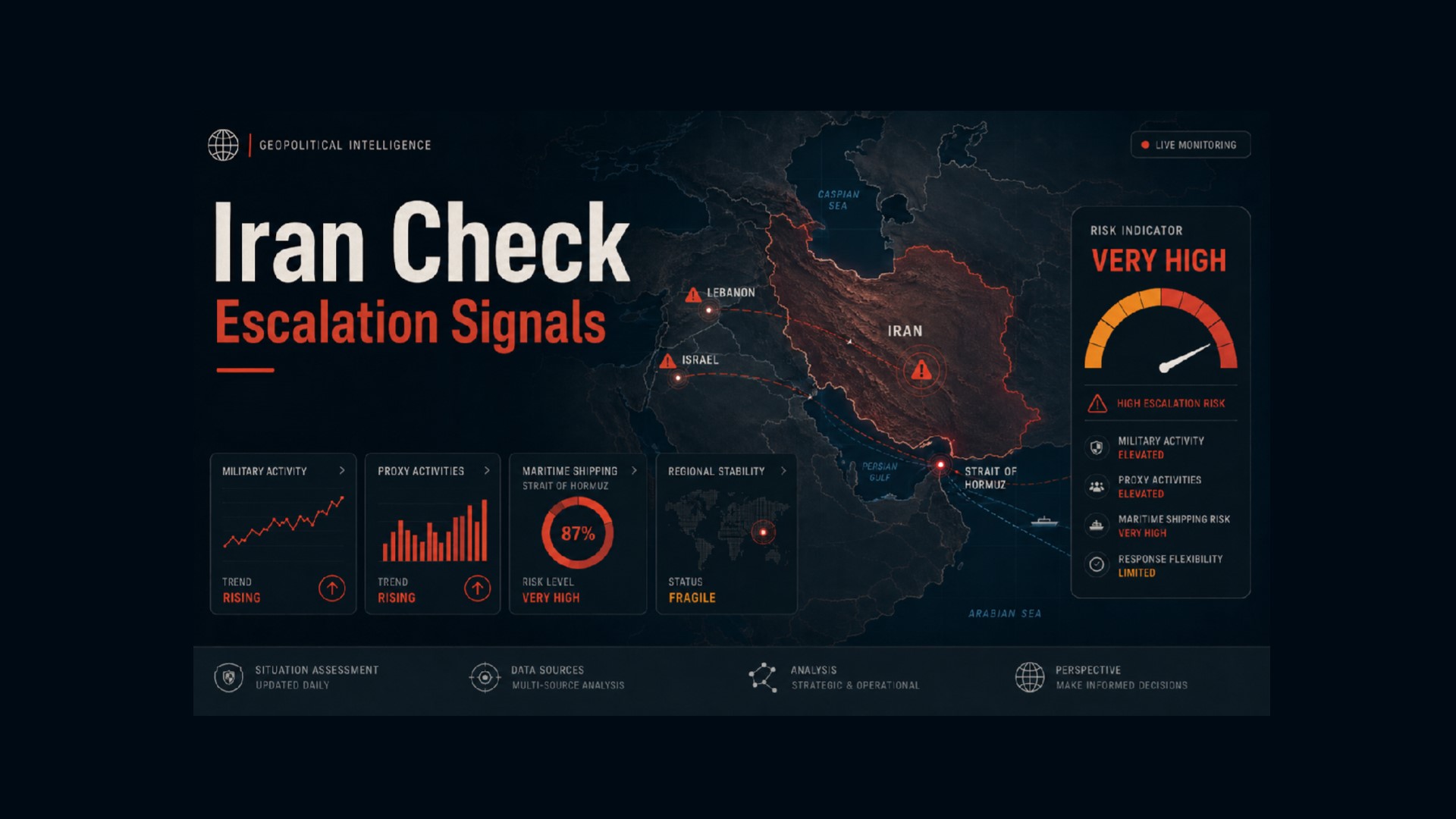
This escalation radar summarizes five relevant signals as of November 13, 2026. The focus is on verifiable statements by official sources, confirmed events and monitoring sources with potential implications for energy prices, supply chains, markets, maritime security, aviation and regional stability.
The US military reports intercepting two Iranian attack drones. Tehran simultaneously claims to have struck a US early-warning radar installation in Bahrain.
Iran reports an explosion aboard an LNG tanker after it allegedly struck a sea mine. The strategic energy corridor therefore remains operationally high-risk despite significantly higher shipping volumes.
The US blockade continues to prevent Iranian crude oil exports. Tehran is therefore losing its most important external source of revenue while war, energy supply and government spending increase funding needs.
| Actor | Type | Severity | Status | Source / Verification | Business Impact |
|---|---|---|---|---|---|
| Iran / USA / Bahrain | USA intercepts Iranian drones as Iran claims strike on US radar | Critical · Level 5/5 | The US military says on November 13 that it intercepted two Iranian attack drones heading towards Bahrain. No injuries or damage are reported. The Revolutionary Guards simultaneously claim to have struck a US early-warning radar installation in Bahrain. Tehran describes the strike as retaliation for a US attack on a telecommunications facility in southern Iran. Washington denies that the radar installation was hit. Power dynamics: Iran and the USA are once again engaging in direct military interaction outside Iranian territory. | Reported by AP, November 13, 2026 . Verification status: partially confirmed. The interception of the two drones is confirmed by the US military. The claimed strike on the US radar has not been independently verified. Background: Schaaf Media · Iran Check: 5 Escalation Signals from November 11, 2026 . | Critical business impact on Bahrain, US bases, Gulf states, aviation, energy infrastructure and insurance. Particularly relevant: A direct Iran-USA incident increases the risk of a rapid military retaliation cycle. |
| Iran / Hormuz / LNG | LNG tanker suffers explosion after reported mine strike | Critical · Level 5/5 | The Revolutionary Guards report on November 13 that an LNG tanker struck a sea mine in the Strait of Hormuz. The vessel subsequently suffered an explosion. According to the Iranian account, the tanker was using an unauthorized and dangerous route. Initial information on injuries, cargo or damage is not available. Four additional tankers were reportedly involved in explosions in Hormuz the previous day. Power dynamics: The passage remains physically high-risk despite increasing shipping volumes. | Reported by Reuters, November 13, 2026 . Verification status: partially confirmed. The maritime incident has been reported and confirmed. The alleged mine strike comes from Iranian authorities and has not been independently verified. Further reading: Schaaf Media · Middle East Escalation Check from November 12, 2026 . | Critical business impact on LNG, tankers, Hormuz, charter rates, insurance, energy prices and supply chains. Particularly relevant: LNG shipments remain directly exposed despite increasing use of the route. |
| Iran / Oil / US Blockade / State Budget | Iran remains effectively without crude oil exports as fiscal pressure intensifies | High to Critical · Level 4/5 | The US blockade of Iranian crude oil exports remains effective. A current Reuters analysis states that Iran has exported virtually no crude oil since August. This confirms the earlier collapse in tanker loadings documented by Bloomberg. Before the war, China was Iran’s most important buyer. At the same time, Iran must finance war costs, damaged infrastructure and growing energy shortages. Power dynamics: Washington is increasingly relying on economic exhaustion rather than a new large-scale offensive. | Current analysis: Reuters, November 12, 2026 . Verification status: confirmed for the continuing collapse in crude oil exports. The economic damage is directly affecting public finances and foreign-currency availability. Background: Schaaf Media · Iran Check: 5 Escalation Signals from November 11, 2026 . | High to critical business impact on Iranian public finances, the rial, inflation, energy trade, sanctions and social stability. Particularly relevant: A central source of revenue has almost disappeared, while the costs of the conflict continue. |
| USA / Iran / Gulf States | Trump says Iran deal is no longer necessary as Gulf states restrain new major strikes | High to Critical · Level 4/5 | Trump says the USA no longer needs a deal with Iran. At the same time, he removes Vice President JD Vance from his previous Iran-focused role. The diplomatic channel that had recently been visible therefore loses political weight. Trump also says, however, that Saudi Arabia, Qatar, Kuwait, the United Arab Emirates and Bahrain asked him to hold off on further major attacks. He adds that without those requests he would have ordered additional strikes. Power dynamics: Diplomacy is weakening, while Gulf states currently act as a key brake on further escalation. | Confirmed by AP, November 13, 2026 . Verification status: confirmed for Trump’s shift in position. Further US strikes remain possible. Further reading: Schaaf Media · Iran Check: 5 Escalation Signals from November 11, 2026 . | High to critical business impact on Iran, Gulf states, Hormuz, oil, LNG, markets and investment planning. The short-term risk of a major offensive is being reduced by pressure from Gulf states, but remains politically reversible at any time. |
| Israel / IDF / Eisenkot / Netanyahu | IDF sees no immediate need for new strike on Iran | Elevated · Level 3/5 | Israel’s security leadership is signaling a surprisingly cautious position towards Iran. During a security briefing for Netanyahu and Eisenkot, the IDF reportedly said there is currently no development requiring an immediate Israeli strike. Netanyahu continues to push for a harder line. However, if Washington launches renewed attacks, Israel is expected to participate, according to the security assessment. Power dynamics: Israel’s military is restraining an independent escalation, but is effectively tying the next step to Washington. | Current regional source: Times of Israel, November 12, 2026 . Verification status: partially confirmed. The assessment is based on reporting about the confidential briefing. No new Israeli strike order has been issued. Background: Schaaf Media · Middle East Escalation Check from November 12, 2026 . | Elevated business impact on Israel, Iran, aviation, defense, energy and regional investment. In the short term, the IDF position is de-escalatory. The risk would rise again immediately if Washington resumed major strikes. |
The most important operational development on November 13, 2026 is the renewed direct Iran-USA confrontation. The USA reports intercepting two Iranian attack drones heading towards Bahrain. Tehran simultaneously claims to have struck a US early-warning radar. The claimed hit has not been confirmed, but the military interaction is real.
At the same time, the Strait of Hormuz remains at a critical risk level. An LNG tanker suffers an explosion after allegedly striking a sea mine, according to Iran. Four additional tanker incidents were reported the previous day. For LNG, tanker operators, insurers and supply chains, the corridor therefore remains operationally high-risk.
Economically, Iran’s strategic problem is intensifying. The US blockade continues to prevent virtually all crude oil exports. This confirms the collapse in tanker loadings previously documented by Bloomberg. At the same time, war, energy and infrastructure costs continue to rise. Pressure on the state budget, the currency and the population is therefore increasing further.
Politically, the situation is becoming more contradictory. Trump says an Iran deal is no longer necessary and removes JD Vance from the Iran-focused role. At the same time, Saudi Arabia, Qatar, Kuwait, the UAE and Bahrain are, according to Trump’s own account, restraining Washington from launching new major attacks. In Israel, the security leadership currently sees no immediate need for another strike on Iran, but would participate in a renewed US offensive. EASA continues to maintain active warnings for Iran, Saudi Arabia, the Persian Gulf/Gulf of Oman, Iraq, Jordan and Lebanon; no new revision was identified on November 13.
The five most important signals for a German and European risk assessment are: the renewed direct Iran-USA confrontation involving Iranian attack drones heading towards Bahrain and Tehran’s claimed retaliatory strike against a US radar installation, the new LNG tanker incident involving a reported mine strike in the Strait of Hormuz, the continuing collapse of Iranian crude oil exports and the resulting increase in fiscal pressure on Tehran, Trump’s shift away from the need for an Iran deal while Gulf states simultaneously pressure Washington against another major offensive, and the Israeli security assessment that no immediate independent strike on Iran is currently necessary, while Israel would still participate in a renewed US offensive.
Note: This assessment was prepared with the support of our Geo-AI. AI can make mistakes. The analysis is intended as a radar for potential escalation signals and does not replace a fully verified intelligence assessment.
You are currently viewing a placeholder content from X. To access the actual content, click the button below. Please note that doing so will share data with third-party providers.
More Information