Executive Intelligence. Industrial Risk. Geopolitics.
Strategic Sparring
for Decision-Makers
Risk intelligence across technology, law, markets and power dynamics.

Verdeckte Geschäftsrisiken, strategische Widersprüche und kritische Abhängigkeiten frühzeitig erkennen.
Kostenlose Analyse starten →
Verdeckte Machtstrukturen, Führungsrisiken und organisatorische Blockaden frühzeitig erkennen.
Kostenlose Analyse starten →
Geopolitische Risiken, globale Abhängigkeiten und kritische Lieferkettenrisiken frühzeitig erkennen.
Kostenlose Analyse starten →
Identify hidden business risks, strategic contradictions and critical dependencies at an early stage.
Start Free Analysis →
Identify hidden power structures, leadership risks and organizational blockers at an early stage.
Start Free Analysis →
Identify geopolitical risks, global dependencies and critical supply-chain vulnerabilities at an early stage.
Start Free Analysis →
Verdeckte Geschäftsrisiken, strategische Widersprüche und kritische Abhängigkeiten frühzeitig erkennen.
Kostenlose Analyse starten →
Verdeckte Machtstrukturen, Führungsrisiken und organisatorische Blockaden frühzeitig erkennen.
Kostenlose Analyse starten →
Geopolitische Risiken, globale Abhängigkeiten und kritische Lieferkettenrisiken frühzeitig erkennen.
Kostenlose Analyse starten →
Identify hidden business risks, strategic contradictions and critical dependencies at an early stage.
Start Free Analysis →
Identify hidden power structures, leadership risks and organizational blockers at an early stage.
Start Free Analysis →
Identify geopolitical risks, global dependencies and critical supply-chain vulnerabilities at an early stage.
Start Free Analysis →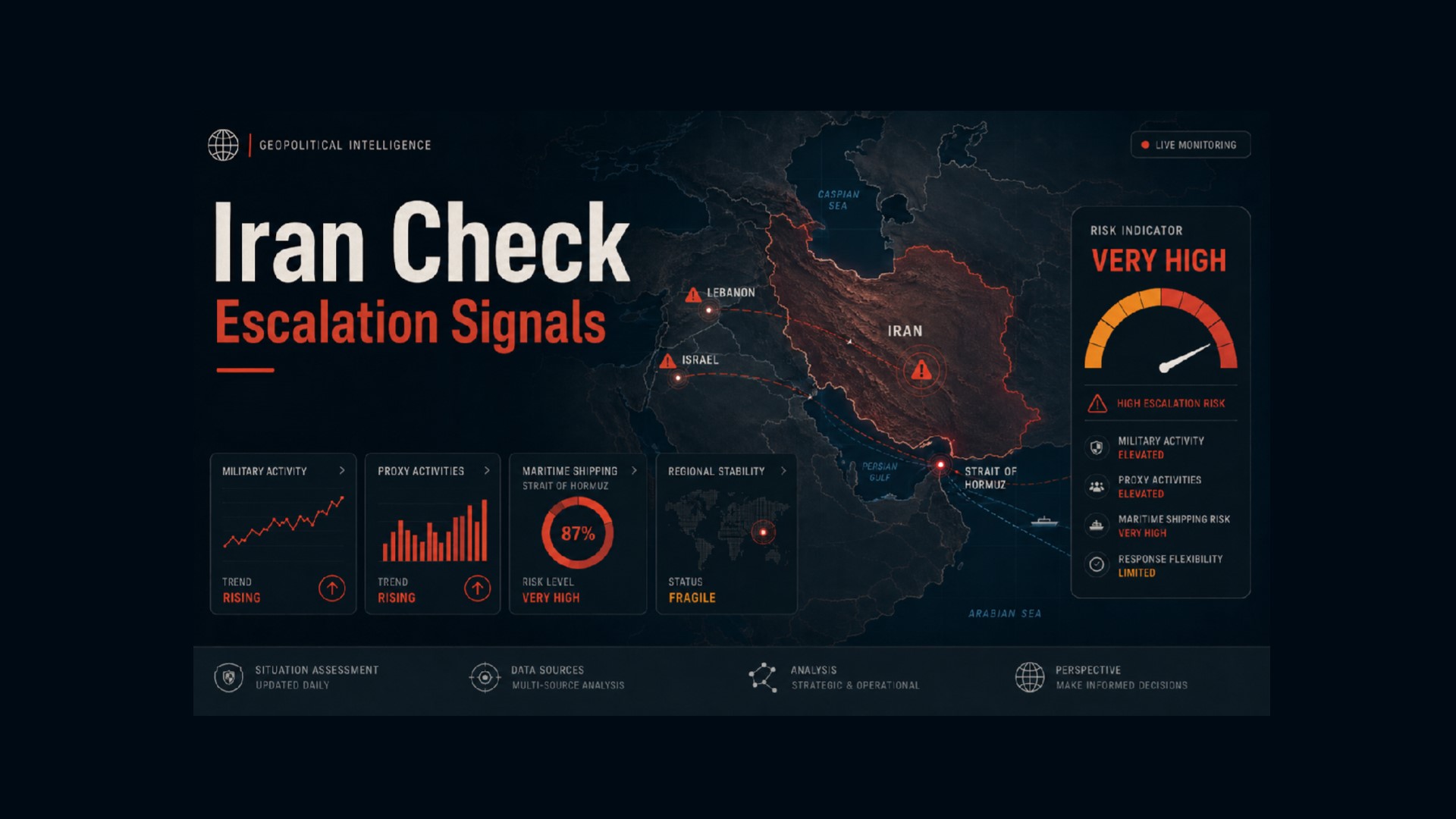
This escalation radar summarizes five relevant signals from June 28, 2026. The focus is on verifiable official statements, confirmed events, and monitoring sources with potential impact on energy prices, supply chains, markets, maritime security, and regional stability.
Both sides accuse each other of violating the transitional agreement. Attacks in the Gulf show that de-escalation is not yet stable.
Hezbollah declares the agreement null and void while Israel continues military operations. Lebanon remains a political relapse risk.
Gulf states fear that Iran may continue using regional proxies as pressure instruments. Trust therefore remains limited.
| Actor | Type | Severity | Status | Source / Verification status | Business impact |
|---|---|---|---|---|---|
| USA / Iran / Gulf region / Hormuz | Mutual attacks, accusations and fragile transitional agreement | Critical · Level 5/5 | Reuters reports that Iran and the United States are continuing attacks in the Gulf while accusing each other of violating the transitional agreement intended to end the war. Iran reports attacks on US military targets in Bahrain and Kuwait, while the United States keeps further military options open. The signal is clear: formal de-escalation exists, but operationally the Gulf region has returned to an acute escalation logic. | Confirmed by Reuters, June 28, 2026. Verification status: confirmed for mutual attacks, accusations of violating the transitional agreement, and acute escalation in the Gulf region; individual tactical details remain subject to further verification. | Direct business impact on oil, LNG, tanker routing, port planning, war-risk premiums, marine insurance, freight costs, delivery times, and companies with Gulf or energy exposure. |
| Israel / Lebanon / Hezbollah / USA | Israel-Lebanon agreement, Hezbollah rejection and withdrawal issue | High to critical · Level 4/5 | Al Jazeera reports that President Joseph Aoun has called on Washington to ensure Israel complies with the agreement and withdraws its forces from southern Lebanon. At the same time, Hezbollah has declared the Israel-Lebanon agreement “null and void.” The underlying power dynamic remains highly unstable: Israel seeks to maintain security control, Hezbollah can hardly accept a permanent Israeli military presence in southern Lebanon without risking a loss of credibility among its own supporters, and the United States must preserve its credibility as a mediator. | Confirmed by Al Jazeera, June 28, 2026. Verification status: confirmed for Aoun’s request to Washington, Hezbollah’s rejection, and the unresolved Lebanon file; the power-dynamics layer is an analytical interpretation based on the reported statements. | Increased risk for Lebanon, northern Israel, evacuations, air traffic, regional supply chains, political predictability, insurance, and companies with Levant or Middle East exposure. |
| Iran / Gulf states / USA / regional proxies | Proxy pressure, Gulf security interests and regional spheres of influence | High to critical · Level 4/5 | The Guardian reports that Gulf states continue to raise concerns with the United States about Iran’s regional influence networks. The focus is on Hezbollah, Hamas, Iraqi militias and the Houthi movement. The core power question is: does Iran actually give up control after the agreement, or does Tehran shift pressure more strongly to proxy actors? For companies, this means that the diplomatic layer may ease while operational risks continue through proxies, militias and local escalation channels. | Confirmed by The Guardian, June 28, 2026. Verification status: confirmed for Gulf states’ concerns, Iran’s proxy network, and strategic uncertainty after the US-Iran agreement; open how strongly Iran may activate these networks in the short term. | High relevance for Gulf investments, energy prices, supply-chain planning, security services, crisis logistics, insurance, and political risk premiums. |
| USA / Trump / Iran | Military threat rhetoric and escalation threshold | High to critical · Level 4/5 | Sky News reports that the United States has again struck Iranian targets after further accusations of ceasefire violations. President Trump said the United States could be forced to “finish the job” militarily. This is a central power signal: Washington wants to demonstrate deterrence, but every hard threat increases pressure on Iran not to appear weak or defeated. | Confirmed by Sky News, June 27/28, 2026. Verification status: confirmed for US strikes, Trump’s threat rhetoric, and the link to alleged violations of the agreement; live reporting source, details may change during the day. | High relevance for market volatility, oil-price hedging, sanctions risk, investment decisions, management communication, and short-term scenario planning. |
| EASA / Iran / Iraq / Lebanon / Gulf region | Airspace risk and operational supply-chain restrictions | High to critical · Level 4/5 | The EASA conflict-zone warning for the Middle East and the Persian Gulf remains active and was last extended until July 1, 2026. Affected areas include Iran, Iraq, Israel, Jordan, Lebanon, Oman, Qatar, the UAE, Saudi Arabia, Kuwait and Bahrain. This clearly separates the operational picture from political messaging: even where diplomatic formulas exist, aviation, air cargo, spare-parts chains and crisis logistics must still plan for rerouting, restrictions and sudden airspace closures. | Confirmed by EASA Conflict Zone Information Bulletin, revision June 24, 2026. Verification status: not from June 28, 2026, but still valid until July 1, 2026 and therefore operationally relevant for June 28; official EU aviation source. | High relevance for air cargo, airlines, insurance, rerouting, delivery times, spare-parts chains, crisis logistics, business travel, and companies with Middle East or Gulf exposure. |
The central escalation node on June 28, 2026 lies in the gap between diplomatic façade and operational reality. The United States and Iran refer to agreements and transitional logic, but continue to attack each other in the Gulf. Lebanon remains a political stress test because Hezbollah rejects the Israel-Lebanon agreement. At the same time, Gulf states’ concerns about Iranian proxies show that the power logic has not disappeared, but is partly shifting into regional proxy networks and spheres of influence.
The five most important signals for a German and European situation picture are: the renewed US-Iran escalation in the Gulf region, Hezbollah’s rejection of the Israel-Lebanon agreement, growing Gulf-state concern over Iranian proxy networks, Trump’s hard military threat rhetoric, and the still-active EASA warning for aviation, air cargo and crisis logistics across the Middle East and Gulf region.
Note: This assessment was created with support from our Geo-AI. AI can make mistakes. This overview is intended as a radar for possible escalation signals and does not replace a fully verified situation analysis.
You are currently viewing a placeholder content from X. To access the actual content, click the button below. Please note that doing so will share data with third-party providers.
More Information