Executive Intelligence. Industrial Risk. Geopolitics.
Strategic Sparring
for Decision-Makers
Risk intelligence across technology, law, markets and power dynamics.

Verdeckte Geschäftsrisiken, strategische Widersprüche und kritische Abhängigkeiten frühzeitig erkennen.
Kostenlose Analyse starten →
Verdeckte Machtstrukturen, Führungsrisiken und organisatorische Blockaden frühzeitig erkennen.
Kostenlose Analyse starten →
Geopolitische Risiken, globale Abhängigkeiten und kritische Lieferkettenrisiken frühzeitig erkennen.
Kostenlose Analyse starten →
Identify hidden business risks, strategic contradictions and critical dependencies at an early stage.
Start Free Analysis →
Identify hidden power structures, leadership risks and organizational blockers at an early stage.
Start Free Analysis →
Identify geopolitical risks, global dependencies and critical supply-chain vulnerabilities at an early stage.
Start Free Analysis →
Verdeckte Geschäftsrisiken, strategische Widersprüche und kritische Abhängigkeiten frühzeitig erkennen.
Kostenlose Analyse starten →
Verdeckte Machtstrukturen, Führungsrisiken und organisatorische Blockaden frühzeitig erkennen.
Kostenlose Analyse starten →
Geopolitische Risiken, globale Abhängigkeiten und kritische Lieferkettenrisiken frühzeitig erkennen.
Kostenlose Analyse starten →
Identify hidden business risks, strategic contradictions and critical dependencies at an early stage.
Start Free Analysis →
Identify hidden power structures, leadership risks and organizational blockers at an early stage.
Start Free Analysis →
Identify geopolitical risks, global dependencies and critical supply-chain vulnerabilities at an early stage.
Start Free Analysis →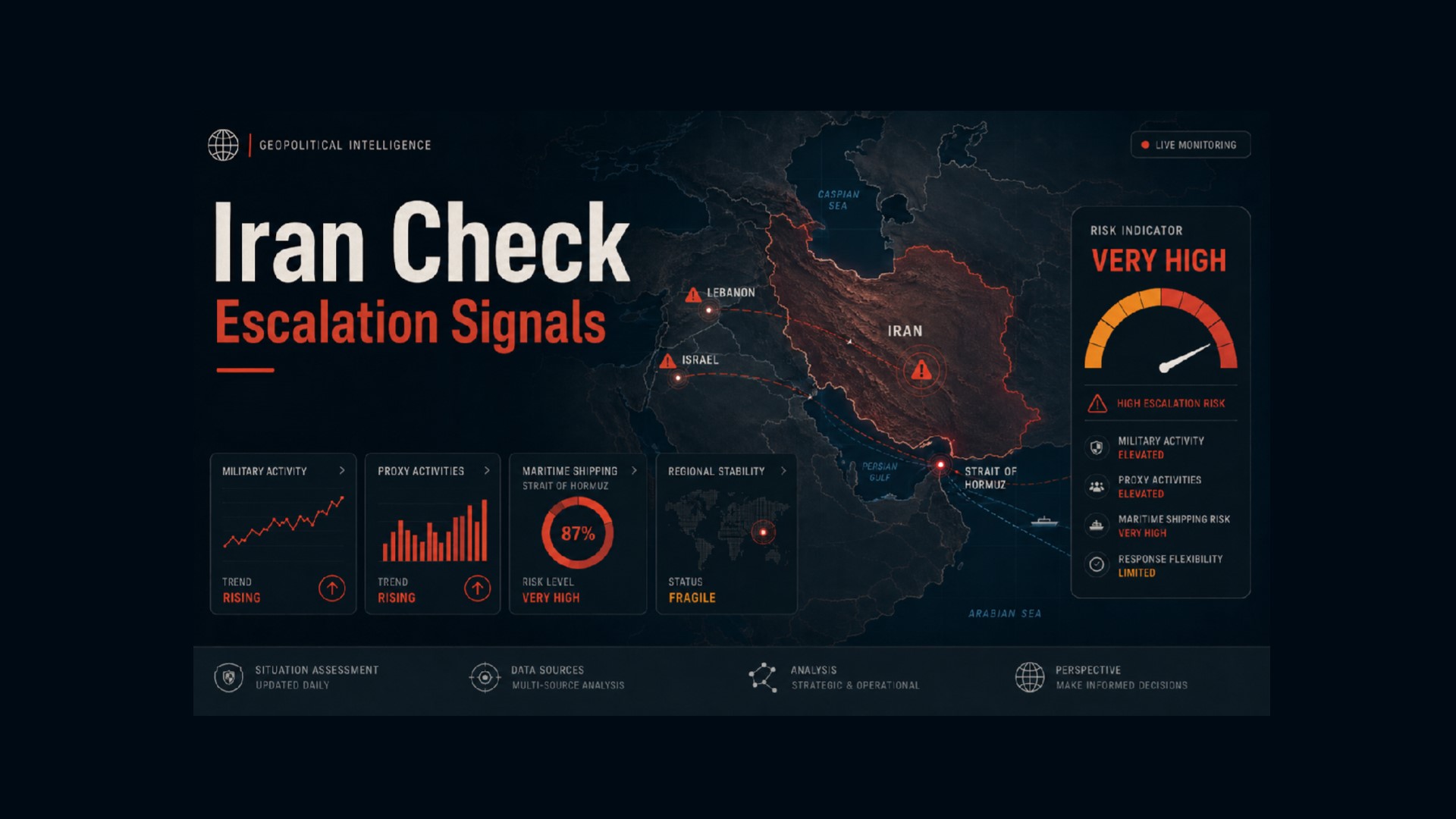
This escalation radar summarizes five relevant signals from June 26, 2026. The focus is on verifiable official statements, confirmed events, and monitoring sources with potential impact on energy prices, supply chains, markets, maritime security, and regional stability.
A cargo ship was hit by a projectile after Iranian passage warnings. The route is open, but not reliably normalized.
Israel is maintaining its presence in southern Lebanon while talks continue. This increases pressure on Hezbollah, Iran, and US mediators.
Vance and Rubio are signaling different lines from Washington. Regional actors read these signals as questions of power and reliability.
| Actor | Type | Severity | Status | Source / Verification status | Business impact |
|---|---|---|---|---|---|
| Iran / IRGC / Hormuz shipping | Cargo ship hit, passage warning, and operational escalation | Critical · Level 5/5 | A cargo ship was hit by a projectile in the Hormuz / Oman area after Iran again warned against unauthorized passages. The signal is operationally serious: the Strait of Hormuz is not closed, but safe passage now depends in practice on power projection, route selection, risk appetite, and Iran’s control logic. For shipowners and insurers, the key issue is therefore not only formal reopening, but the real risk on the waterway. | Confirmed by Euronews, June 25/26, 2026. Verification status: confirmed for the projectile strike, Iran’s passage warning, and the link to the new routing logic; responsibility and exact tactical details remain subject to further verification. | Direct business impact on tanker routing, LNG, oil, shipping companies, marine insurance, war-risk premiums, supply-chain costs, freight rates, port planning, and companies with Gulf or energy exposure. |
| Israel / Lebanon / Hezbollah | Israeli strikes, troop presence, and blocked withdrawal logic | High to critical · Level 4/5 | Israel is again striking in Lebanon while Netanyahu says troops will remain in occupied areas of southern Lebanon for as long as necessary. This is militarily and psychologically significant: Israel wants to signal operational capability, Hezbollah can hardly abandon its withdrawal demand without loss of credibility, and Iran loses room for maneuver if the Lebanon file remains visibly unresolved. Every side needs to show strength without openly breaking the US-Iran process. | Confirmed by Al Jazeera, June 26, 2026. Verification status: confirmed for Israeli strikes, Netanyahu’s troop statement, and the ongoing Lebanon tension; the power-dynamics layer is an analytical interpretation based on the reported statements. | Increased risk for Lebanon, northern Israel, evacuations, air traffic, regional supply chains, political predictability, insurance, and companies with Levant or Middle East exposure. |
| USA / Vance / Rubio / Trump administration | Diverging Iran-Israel signals within US leadership | High · Level 3/5 | Different tones are becoming visible inside the US administration: JD Vance signals greater interest in restraint and possible cooperation with Iran, while Marco Rubio more strongly defends Israel and argues more sharply against Iran. This matters for the radar because regional actors do not only read agreements; they read power centers, succession ambitions, and which US line is likely to hold over time. | Confirmed by Reuters, June 26, 2026. Verification status: confirmed for diverging tones and political emphasis; open whether this translates into concrete policy shifts or whether Trump stabilizes the line centrally. | High relevance for political risk premiums, sanctions risk, oil-price hedging, investment decisions, supply-chain timing, management communication, and scenario planning. |
| Iran / UN / IMO / Oman / Hormuz | Rejection of a UN-backed plan for ships in the Hormuz area | High to critical · Level 4/5 | Iran has rejected a UN-backed plan to free or evacuate ships trapped around Hormuz. This shows a central power dynamic: Tehran is not simply releasing the chokepoint as a neutral trade route, but continues to treat it as a control and negotiation lever. This creates tension between international freedom of navigation, Iranian sovereignty claims, Omani mediation logic, and US security guarantees. | Confirmed by The Guardian, June 25/26, 2026. Verification status: confirmed for Iran’s rejection of the UN-backed plan and the dispute over routing and control logic; source is from June 25, but remains relevant for June 26 because it continues to shape the operational picture. | High relevance for shipping companies, insurers, LNG, oil, port planning, charterers, seafarer safety, supply-chain continuity, and companies with Gulf exposure. |
| EASA / Iran / Iraq / Lebanon / Gulf region | Airspace risk despite diplomatic easing | High to critical · Level 4/5 | The EASA conflict-zone warning for the Middle East and the Persian Gulf remains active and was last extended until July 1, 2026. Affected areas include Iran, Iraq, Israel, Jordan, Lebanon, Oman, Qatar, the UAE, Saudi Arabia, Kuwait, and Bahrain. The signal: even if maritime transport partially resumes, the regional security architecture remains tense for aviation, air cargo, and crisis logistics. | Confirmed by EASA Conflict Zone Information Bulletin, revision June 24, 2026. Verification status: not from June 26, 2026, but still valid until July 1, 2026 and therefore operationally relevant for June 26; official EU aviation source. | High relevance for air cargo, airlines, insurance, rerouting, delivery times, spare-parts chains, crisis logistics, business travel, and companies with Middle East or Gulf exposure. |
You are currently viewing a placeholder content from X. To access the actual content, click the button below. Please note that doing so will share data with third-party providers.
More Information