Executive Intelligence. Industrial Risk. Geopolitics.
Strategic Sparring
for Decision-Makers
Risk intelligence across technology, law, markets and power dynamics.


Verdeckte Geschäftsrisiken, strategische Widersprüche und kritische Abhängigkeiten frühzeitig erkennen.
Kostenlose Analyse starten →
Verdeckte Machtstrukturen, Führungsrisiken und organisatorische Blockaden frühzeitig erkennen.
Kostenlose Analyse starten →
Geopolitische Risiken, globale Abhängigkeiten und kritische Lieferkettenrisiken frühzeitig erkennen.
Kostenlose Analyse starten →
Identify hidden business risks, strategic contradictions and critical dependencies at an early stage.
Start Free Analysis →
Identify hidden power structures, leadership risks and organizational blockers at an early stage.
Start Free Analysis →
Identify geopolitical risks, global dependencies and critical supply-chain vulnerabilities at an early stage.
Start Free Analysis →
Verdeckte Geschäftsrisiken, strategische Widersprüche und kritische Abhängigkeiten frühzeitig erkennen.
Kostenlose Analyse starten →
Verdeckte Machtstrukturen, Führungsrisiken und organisatorische Blockaden frühzeitig erkennen.
Kostenlose Analyse starten →
Geopolitische Risiken, globale Abhängigkeiten und kritische Lieferkettenrisiken frühzeitig erkennen.
Kostenlose Analyse starten →
Identify hidden business risks, strategic contradictions and critical dependencies at an early stage.
Start Free Analysis →
Identify hidden power structures, leadership risks and organizational blockers at an early stage.
Start Free Analysis →
Identify geopolitical risks, global dependencies and critical supply-chain vulnerabilities at an early stage.
Start Free Analysis →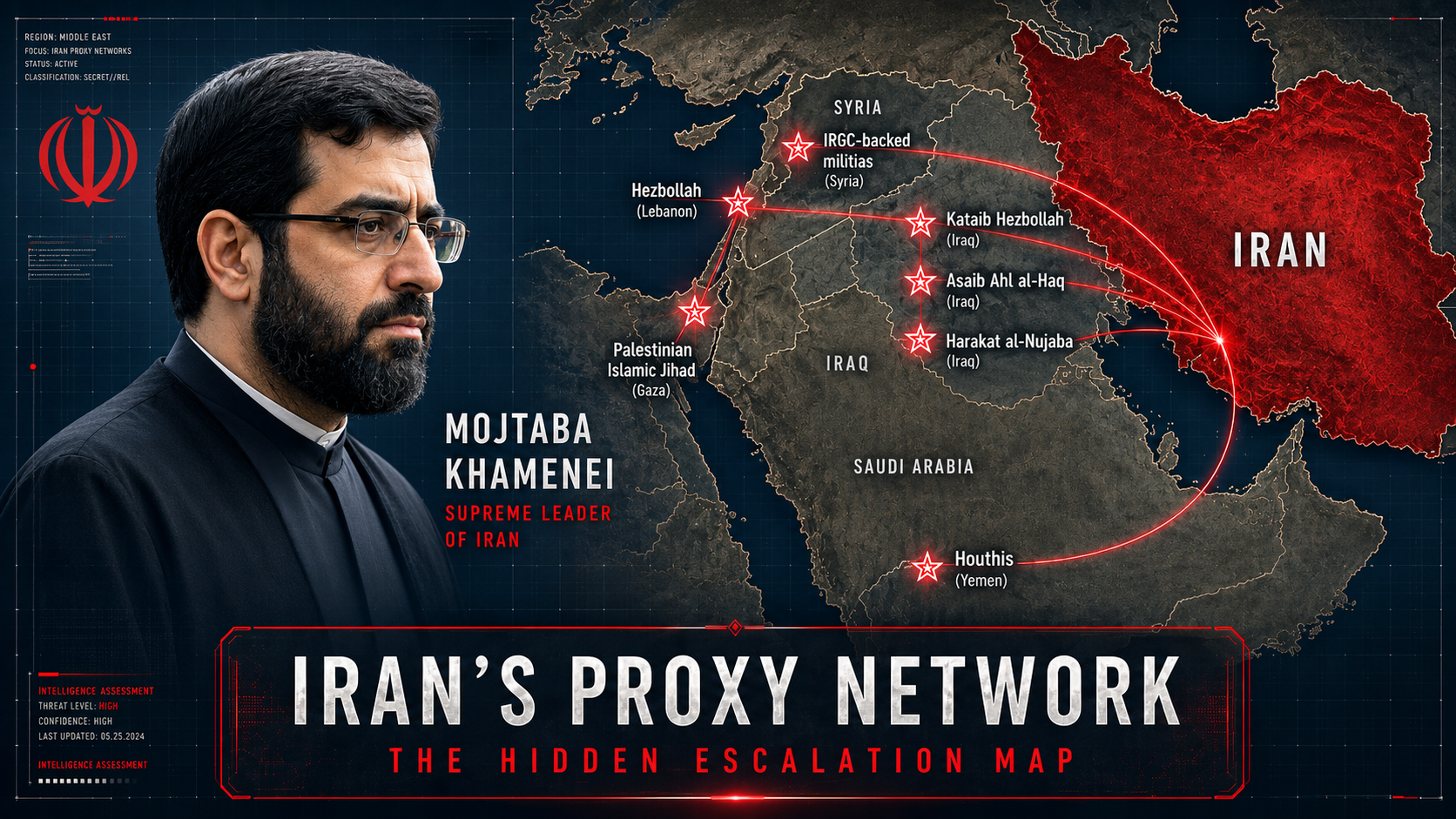
Strategic Risk Intelligence Brief by Global Insight Group.
This analysis is based on the GFDD Framework™ developed by Michaela Schaaf-Hoffelner and is designed for executives, investors and strategic decision-makers.
Updated: July 1, 2026
Anyone who looks at the Middle East only through the lens of official states sees only half the map. Iran, Israel, the United States, Turkey, Saudi Arabia and Russia may appear to be the main actors. Yet many escalations do not emerge directly between governments, but through armed networks, militias, religious movements, border routes and shadow financing. This is where the real analysis begins: Iran’s proxies are not merely military auxiliaries. They are political power instruments, regional pressure tools and early-warning signals for larger conflicts.
The term “proxy” may sound technical. It refers to armed groups that pursue their own interests while also being supported, trained, financed or strategically used by a state. In Iran’s case, many analysts refer to the “Axis of Resistance” — a network positioned against Israel, the United States and Western influence in the region. This network includes, among others, Lebanese Hezbollah, Iraqi militias, pro-Iranian groups in Syria and the Houthis in Yemen. Iran’s Islamic Revolutionary Guard Corps, especially the Quds Force, is widely seen as a central connection point for training, weapons, financing and strategic coordination.
Iran’s proxies serve several functions for Tehran at the same time. First, they extend Iran’s reach far beyond its own borders. Second, they create deterrence against Israel and the United States. Third, they allow escalation below the threshold of direct war. Iran can generate pressure without always appearing openly as the attacker.
This is strategically important. A rocket attack from Lebanon, a drone launched from Iraq, an attack on ships in the Red Sea or militia activity in Syria can shake regional markets without an official state-to-state war being declared. That is precisely why Iran’s proxies form a hidden escalation map: they show where conflicts can be prepared, outsourced or calibrated.
Hezbollah is Iran’s best-known and arguably most important partner. It is not merely a militia, but also a political party, social apparatus, security structure and military organization. For Iran, Hezbollah forms a direct front against Israel. For Lebanon, it is also a power factor the state can hardly control in full.
Its role is particularly dangerous because it combines military capability with political entrenchment. Even if Hezbollah has been weakened by Israeli strikes, it remains a central component of Iranian deterrence. For Israel, it is a permanent threat on the northern border. For Iran, it is a strategic lever to put Israel under pressure without necessarily attacking directly.
In Iraq, the picture is more complex. Various Iran-aligned militias operate there, including Kataib Hezbollah, Asaib Ahl al-Haq, Harakat al-Nujaba and other groups within or around the Popular Mobilization Forces. These militias are not simply fighters outside the state. Some are formally embedded in state structures, hold political connections, economic interests and influence over security apparatuses.
That is exactly what makes Iraq such an important early-warning space. Iran’s proxies in Iraq can threaten U.S. troops, exert domestic pressure on Baghdad, control border routes and benefit from state funding or institutional proximity at the same time. Iraq is therefore not only a theater of geopolitical competition, but a hybrid space where state, militia, party and business network increasingly overlap.
Syria was long the central land corridor between Iran, Iraq and Lebanon. Through Syria, weapons, fighters and equipment could be moved toward Hezbollah. But this corridor has become more unstable. After major political and military shifts in Syria, Iran’s influence there is no longer as self-evident as it once was. Reports indicate that the influence of Iran and Hezbollah in Syria has been significantly weakened after heavy Israeli strikes and the loss of power by the Assad camp.
Still, Syria has not disappeared from the escalation map. It remains a space for smuggling, local militias, border conflicts, weapons routes and covert networks. Precisely because state order there is fragile, small groups can create major effects.
Even though Yemen is not geographically part of Iraq, Syria or Lebanon, the role of the Houthis is central to the overall picture. Iranian support has helped the Houthis expand their military capabilities significantly, especially in drones, missiles and attacks on maritime targets. The Council on Foreign Relations describes the Houthis as an informal partner of Iran whose reach has grown through Iranian weapons, expertise and strategic alignment.
This creates a powerful lever: whoever exerts pressure on the Red Sea and Bab al-Mandab influences not only regional security, but also global supply chains, insurance costs and energy flows. Iran’s proxies are therefore not only a military problem. They can also become an economic risk.
No. And this is where the analysis becomes especially important. Iran’s proxies are not pure puppets. Many of these groups have their own motives: local power, religious ideology, economic interests, political control, protection of their own networks or rivalry with other groups. Iran provides direction, support and a strategic framework. But these groups do not always act as fully remote-controlled actors.
This makes the situation more dangerous, not less. If proxies have their own interests, they can trigger escalations that Tehran does not fully control. At the same time, Iran can benefit from this ambiguity because responsibility becomes harder to prove.
Israel does not have a proxy network comparable to Iran’s model. Israel relies more heavily on its own air power, intelligence services, cyber capabilities, precision strikes and close security cooperation with the United States. The United States, in turn, works with partner forces and governments, for example in Iraq or Syria, but usually in a more institutionalized way than Iran.
Turkey follows its own logic of influence, particularly in Syria and northern Iraq. It supports or influences local groups, especially where Kurdish forces, PKK-linked structures or its own security interests are involved. This creates a dense counter-network: Iran works through Shiite-oriented militia axes, Turkey through its own regional partners, Israel through direct military superiority, and the United States through security architectures, sanctions and military bases.
The real power map lies beneath the surface. This is not only about rockets. It is about oil sales despite sanctions, shadow fleets, front companies, money changers, gold, smuggling routes, religious foundations, border crossings and information warfare.
Oil plays a key role. Iran needs revenue to finance the state, the military and partner networks. At the same time, proxies can exert pressure on energy infrastructure, trade routes and maritime chokepoints. Hormuz, Bab al-Mandab, the Red Sea, Iraq and Syria are therefore not just places on a map. They are nodes of geopolitical risk transmission.
Iran’s proxies are the hidden escalation map of the Middle East because they connect political, military, economic and religious power lines. Anyone who only watches official statements from Tehran, Washington or Jerusalem misses the deeper movements.
The next crisis does not have to begin with a declaration of war. It can start with a militia attack, a drone strike, a blocked sea route, a new sanction, a damaged oil tanker or a local border conflict. That is why Iran’s proxies are not a side issue. They are an early-warning system for the next phase of regional instability.
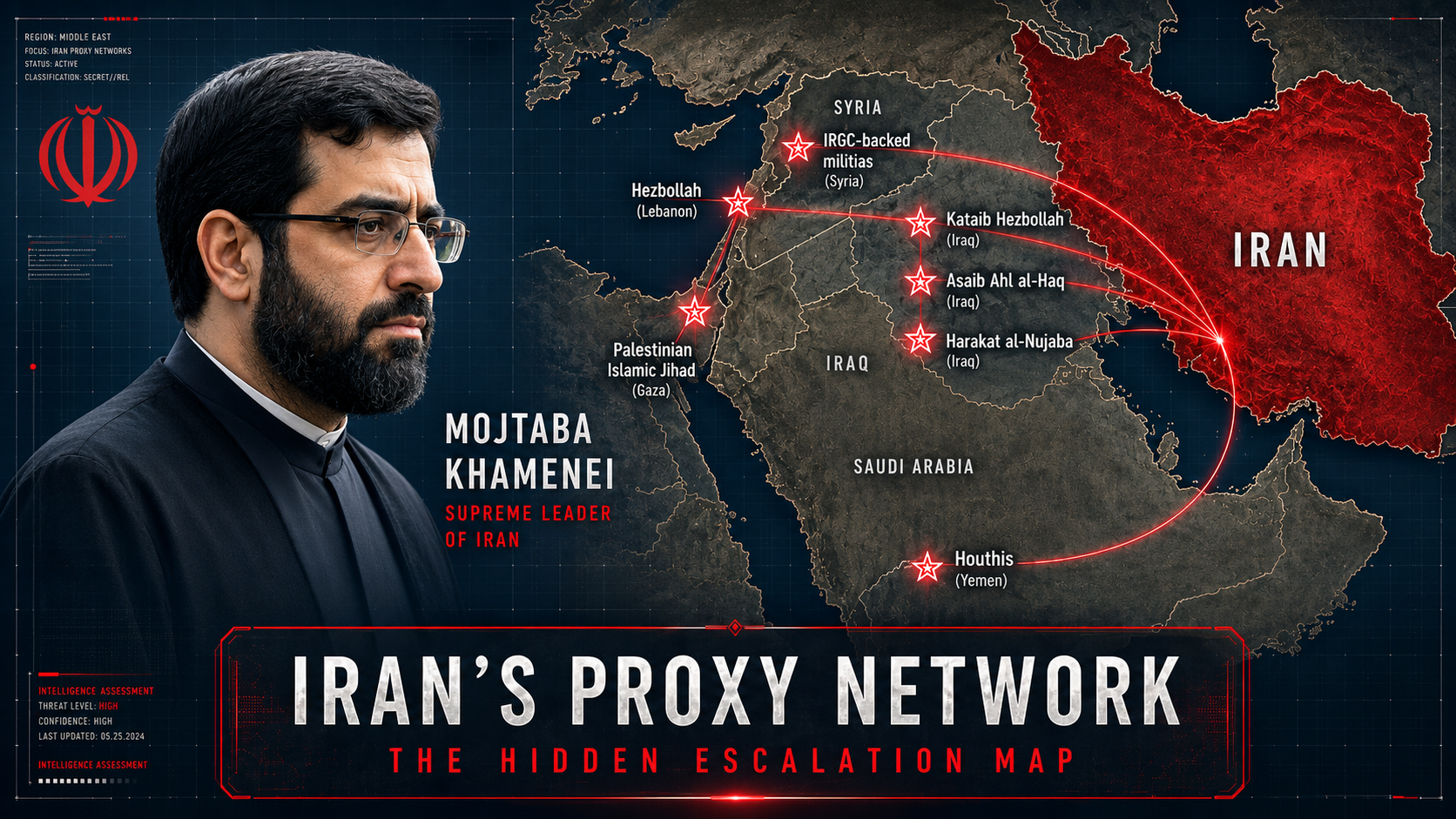
What decision-makers should watch now — before proxy escalation becomes a cost, compliance or supply-chain shock.
This 17-page executive briefing translates Iran’s proxy network into concrete business risks: energy price exposure, maritime chokepoints, war-risk premiums, sanctions, shadow fleets, supply-chain disruption and early-warning indicators for board-level decisions.
Iran’s proxies are armed groups and political networks supported by Iran while also pursuing their own regional interests. They include Hezbollah, Iraqi militias, pro-Iranian groups in Syria and the Houthis in Yemen.
Iran uses proxies to expand its influence, deter Israel and the United States, pressure regional opponents and outsource escalation without always having to act directly through its own military.
No. Many groups have their own interests. Iran provides support, strategy and resources, but the groups do not always act under full control.
Israel relies more on direct military power, intelligence operations, cyber capabilities and state alliances. It does not currently have a proxy network comparable to Iran’s model.
Because they can influence energy prices, supply chains, insurance premiums, sanctions exposure and maritime trade routes. Hormuz, Bab al-Mandab, Iraq, Syria and Lebanon are particularly important risk zones.
Iran-conflict-2026: Why the US-Iran Deal, not a real relaxation brings
An analysis of energy prices, maritime constraints and the economic consequences of regional escalation.
Lagarde gives the all-clear: Why Hormuz despite the ECB to Signal a risk for the company remains
Christine Lagarde sends a reassuring Signal that The European Central Bank currently sees clearly still not a hazardous wage-price spiral. The inflation shock is great, but from the point of view of the ECB’s not so big that long-term inflation expectations got out of control.
Geo-Radar: geo-political news analysis in the last 48 hours →
How corporate political escalations sooner you can recognize before in costs, delays in delivery or Compliance risks.
Gold is at a crossroads: Backs up the ‘Water-Oil-Clash’ their assets or threatens the Petro-dollar-shock?
Focus on Gold stands not only as a precious metal, but as a strategic trust Asset in the field of tension of Inflation, public debt, energy policy, sanctions regimes and global restructuring.
Iran Conflict 2026: Why the U.S.-Iran Deal Does Not Bring Real De-Escalation
An analysis of energy prices, maritime chokepoints and the economic consequences of regional escalation.
Lagarde Gives the All-Clear: Why Hormuz Remains a Risk for Companies Despite the ECB Signal
Christine Lagarde is sending a calming signal: the European Central Bank currently appears not to see a dangerous wage-price spiral. The inflation shock is significant, but from the ECB’s perspective not yet strong enough to send long-term inflation expectations out of control.
Geo-Radar: Geopolitical News Analysis of the Last 48 Hours →
How companies can detect political escalation earlier — before it turns into costs, delivery delays or compliance risks.
Gold at a Crossroads: Will the “Water-Oil Clash” Protect Your Wealth or Trigger a Petrodollar Shock?
This analysis looks at gold not only as a precious metal, but as a strategic trust asset in the tension field between inflation, public debt, energy policy, sanctions regimes and global realignment.
Author of Global Insight Group Intelligence:
Michaela Schaaf-Hoffelner has more than 35 years of experience in strategic and technical project and product management, particularly in IT, control systems and intralogistics. Through her long-standing work with complex systems, she identifies structural risks and dynamic misalignments at an early stage – risks that are often overlooked in conventional analysis.
Her focus is on making causal relationships and systemic dependencies visible and translating them into concrete strategic advantages for investors and decision-makers. Her analyses combine deep technical systems understanding with geopolitical and economic developments.
GFDD Framework™ and GFDD Diagnostics™ are proprietary analytical concepts developed by Michaela Schaaf-Hoffelner. © 2026 Global Insight Group LLC. All rights reserved.
You are currently viewing a placeholder content from X. To access the actual content, click the button below. Please note that doing so will share data with third-party providers.
More Information