Executive Intelligence. Industrial Risk. Geopolitics.
Strategic Sparring
for Decision-Makers
Risk intelligence across technology, law, markets and power dynamics.

Verdeckte Geschäftsrisiken, strategische Widersprüche und kritische Abhängigkeiten frühzeitig erkennen.
Kostenlose Analyse starten →
Verdeckte Machtstrukturen, Führungsrisiken und organisatorische Blockaden frühzeitig erkennen.
Kostenlose Analyse starten →
Geopolitische Risiken, globale Abhängigkeiten und kritische Lieferkettenrisiken frühzeitig erkennen.
Kostenlose Analyse starten →
Identify hidden business risks, strategic contradictions and critical dependencies at an early stage.
Start Free Analysis →
Identify hidden power structures, leadership risks and organizational blockers at an early stage.
Start Free Analysis →
Identify geopolitical risks, global dependencies and critical supply-chain vulnerabilities at an early stage.
Start Free Analysis →
Verdeckte Geschäftsrisiken, strategische Widersprüche und kritische Abhängigkeiten frühzeitig erkennen.
Kostenlose Analyse starten →
Verdeckte Machtstrukturen, Führungsrisiken und organisatorische Blockaden frühzeitig erkennen.
Kostenlose Analyse starten →
Geopolitische Risiken, globale Abhängigkeiten und kritische Lieferkettenrisiken frühzeitig erkennen.
Kostenlose Analyse starten →
Identify hidden business risks, strategic contradictions and critical dependencies at an early stage.
Start Free Analysis →
Identify hidden power structures, leadership risks and organizational blockers at an early stage.
Start Free Analysis →
Identify geopolitical risks, global dependencies and critical supply-chain vulnerabilities at an early stage.
Start Free Analysis →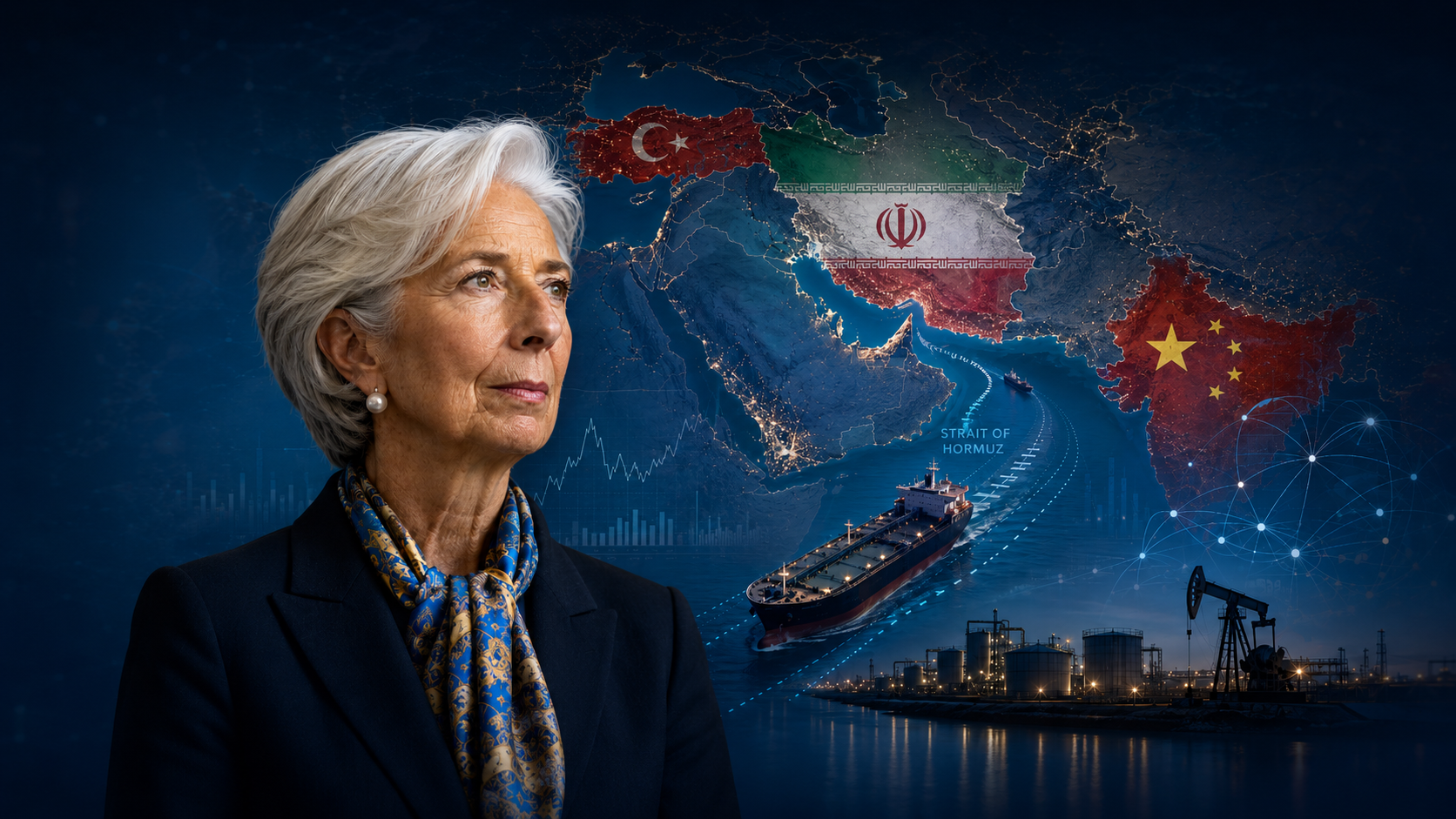
Updated: June 23, 2026
Christine Lagarde has sent a reassuring signal: the European Central Bank currently does not appear to see a dangerous wage-price spiral. The inflation shock is significant, but from the ECB’s perspective, not yet strong enough to push long-term inflation expectations out of control.
That sounds like relief.
But this is exactly where companies need to be careful.
A monetary policy reassurance is not the same as operational reassurance.
While the ECB focuses on inflation expectations, wages, price stability and the interest-rate path, companies experience geopolitical crises elsewhere: in delivery times, energy prices, insurance costs, transport costs and planning reliability.
The official message is essentially this: the situation is tense, but manageable.
Lagarde is signaling that the ECB does not currently see a dangerous wage-price spiral. Higher energy prices and geopolitical risks are weighing on the economy, but from the ECB’s perspective, they have not yet become permanently embedded in wages, prices and inflation expectations.
For markets, this matters. Central banks do not want to create panic. Even small shifts in wording can change expectations.
So the message is not: “Everything is fine.”
It is closer to this:
The situation remains difficult.
But from a monetary policy perspective, it is still under control.
Despite this calming communication, the ECB Governing Council decided on June 11 to raise interest rates by 25 basis points. The deposit facility rate was lifted to 2.25 percent.
That shows one thing clearly: the ECB does not see the situation as harmless.
The rate hike was a signal that higher energy prices and geopolitical shocks cannot simply be ignored. At the same time, Lagarde appears to be trying to prevent this from turning into a new wave of interest-rate panic.
The key point is this:
The ECB is responding to risks.
But it does not want to trigger an escalation of expectations.
Yes.
The Strait of Hormuz is one of the world’s most important maritime chokepoints. When traffic through this corridor is disrupted, the issue is not only oil prices. It is energy supply, liquefied natural gas, freight routes, insurance, geopolitical risk premiums and trust in global supply chains.
Even if the situation eases in the short term, the consequences do not disappear immediately.
A ship that is rerouted is missing somewhere else.
A delayed delivery creates follow-on costs.
More expensive insurance puts pressure on margins.
A company facing uncertainty may postpone investment.
The problem is not only the acute crisis.
The problem is the aftershock.
The official narrative is this: the situation remains tense, but the worst escalation may be avoided.
This narrative fits several signals: diplomatic talks, cautious easing in oil markets, partially increasing tanker traffic through Hormuz, and the ECB’s statement that no dangerous wage-price spiral has emerged so far.
For markets, this has a stabilizing effect.
No new panic.
No aggressive interest-rate shock messaging.
No direct statement that inflation is out of control.
But this narrative describes only one layer.
Beneath the official narrative lies another layer.
Geopolitical conflicts do not disappear just because markets react with short-term relief or central banks choose reassuring words.
Trump needs to save face.
Netanyahu needs political and military room for maneuver.
Iran needs to project strength without becoming fully isolated.
Hardliners on all sides can sabotage any compromise.
Lebanon remains a potential escalation space.
Hormuz remains a strategic pressure point.
While the official narrative focuses on inflation, interest rates and market reassurance, the real follow-on risks lie in a more complex power field: Iran, Hormuz, China, Turkey, energy flows and global supply chains.
That means:
The official narrative speaks of reassurance.
The hidden conflict logic speaks of unresolved power interests.
This is where the risk emerges.
Not because every reassurance is wrong. But because reassurance often describes only one part of reality.
If companies interpret official easing signals too early as operational normalization, it can become expensive.
Supply chain risks do not disappear because a central bank delivers a calming message. They often show up with a delay: in higher insurance costs, longer transport times, weaker planning reliability, more expensive security premiums and pressured margins.
Companies that only react once these effects become visible in quarterly results are reacting too late.
For companies, the decisive question is therefore not only whether the ECB sees a wage-price spiral.
The decisive questions are:
Will supply chains remain stable?
Will energy prices remain predictable?
Will transport routes remain insurable?
Will customer commitments remain reliable?
Will margins remain resilient?
These are operational questions. And they are not automatically answered simply because the monetary policy situation appears manageable.
Many economic damages do not become visible immediately.
At first, the message is: markets remain calm.
Then insurance premiums rise.
Then routes change.
Then inventories are adjusted.
Then margins come under pressure.
Then companies postpone investment.
And at some point, the question becomes:
Why did no one react earlier?
This is exactly why geopolitical signals matter. Not because every signal immediately means catastrophe. But because risks often build before they are officially recognized as a crisis.
Companies should not only watch the next ECB statement or the next oil-price ticker.
What matters more is the combination of several signals:
How is tanker traffic through Hormuz developing?
Do insurance costs for ships and freight remain elevated?
Are there new security warnings for maritime routes?
Are LNG and oil transports being rerouted on a lasting basis?
Are energy prices rising only temporarily, or structurally?
Do diplomatic talks remain stable?
Are new spoilers emerging in Lebanon, Iran or through regional proxies?
Only the combination of these signals creates a realistic picture.
More on the current geopolitical situation:
Lagarde has been no full economic all-clear. She has signaled that the ECB is still not a hazardous wage-price spiral, or permanently entankerte inflation expectations.
The ECB has, at 11. In June, the interest rates by 25 basis points raised, because energy prices and geopolitical risks weigh on Inflation. The increase in interest rates was a Signal that the ECB is ready before the price pressure on permanently.
The Deposit rate of 2.25 percent, the ECB ignored the situation. At the same time, the current communication acts as if she wanted to prevent that markets are pricing in a new aggressive interest rate increase phase.
The Strait of Hormuz is transport to a Central bottleneck for Oil and gas. Disturbances in energy prices, transport costs, insurance, and delivery can affect chains in the world, even in Europe.
No. Oil prices in the short term fall when markets react to diplomatic signals. This does not automatically mean that supply chains, insurance, and geopolitical risks are back to normal.
The official narrative is that The situation is tense, but controllable. Diplomatic signals, more stable markets and cautious statements of the ECB is to show that no panic is necessary.
The covert conflict logic describes the interests of power under the surface, Face, domestic political pressure, military scope, hardline, regional Deputy conflicts and strategic control of Hormuz.
Companies should not ignore the official all-clear messages, but also not blindly accept. The decisive factor is whether the operating risks such as delivery times, energy prices, insurances and transport costs actually normalize.
Lagarde’s message can be from the point of view of monetary policy in a comprehensible manner. If inflation expectations remain stable, and no wage-price spiral, do not need to respond to the ECB’s aggressive.
But it does not follow that all is well.
The real economy is not only then, if the ECB raises the Alarm. She suffers when supply chains are uncertain energy prices fluctuate and predictability is lost.
Therefore, the better question to ask is not:
Lagarde is right?
But:
What are the risks remain under the surface, although officially the all-clear is given?
That’s exactly where strategic risk analysis begins.
Author of Global Insight Group Intelligence:
Michaela Schaaf-Hoffelner has more than 35 years of experience in strategic and technical project and product management, particularly in IT, control systems and intralogistics. Through her long-standing work with complex systems, she identifies structural risks and dynamic misalignments at an early stage – risks that are often overlooked in conventional analysis.
Her focus is on making causal relationships and systemic dependencies visible and translating them into concrete strategic advantages for investors and decision-makers. Her analyses combine deep technical systems understanding with geopolitical and economic developments.
GFDD Framework™ and GFDD Diagnostics™ are proprietary analytical concepts developed by Michaela Schaaf-Hoffelner. © 2026 Global Insight Group LLC. All rights reserved.
You are currently viewing a placeholder content from X. To access the actual content, click the button below. Please note that doing so will share data with third-party providers.
More Information