Executive Intelligence. Industrial Risk. Geopolitics.
Strategic Sparring
for Decision-Makers
Risk intelligence across technology, law, markets and power dynamics.


Verdeckte Geschäftsrisiken, strategische Widersprüche und kritische Abhängigkeiten frühzeitig erkennen.
Kostenlose Analyse starten →
Verdeckte Machtstrukturen, Führungsrisiken und organisatorische Blockaden frühzeitig erkennen.
Kostenlose Analyse starten →
Geopolitische Risiken, globale Abhängigkeiten und kritische Lieferkettenrisiken frühzeitig erkennen.
Kostenlose Analyse starten →
Identify hidden business risks, strategic contradictions and critical dependencies at an early stage.
Start Free Analysis →
Identify hidden power structures, leadership risks and organizational blockers at an early stage.
Start Free Analysis →
Identify geopolitical risks, global dependencies and critical supply-chain vulnerabilities at an early stage.
Start Free Analysis →
Verdeckte Geschäftsrisiken, strategische Widersprüche und kritische Abhängigkeiten frühzeitig erkennen.
Kostenlose Analyse starten →
Verdeckte Machtstrukturen, Führungsrisiken und organisatorische Blockaden frühzeitig erkennen.
Kostenlose Analyse starten →
Geopolitische Risiken, globale Abhängigkeiten und kritische Lieferkettenrisiken frühzeitig erkennen.
Kostenlose Analyse starten →
Identify hidden business risks, strategic contradictions and critical dependencies at an early stage.
Start Free Analysis →
Identify hidden power structures, leadership risks and organizational blockers at an early stage.
Start Free Analysis →
Identify geopolitical risks, global dependencies and critical supply-chain vulnerabilities at an early stage.
Start Free Analysis →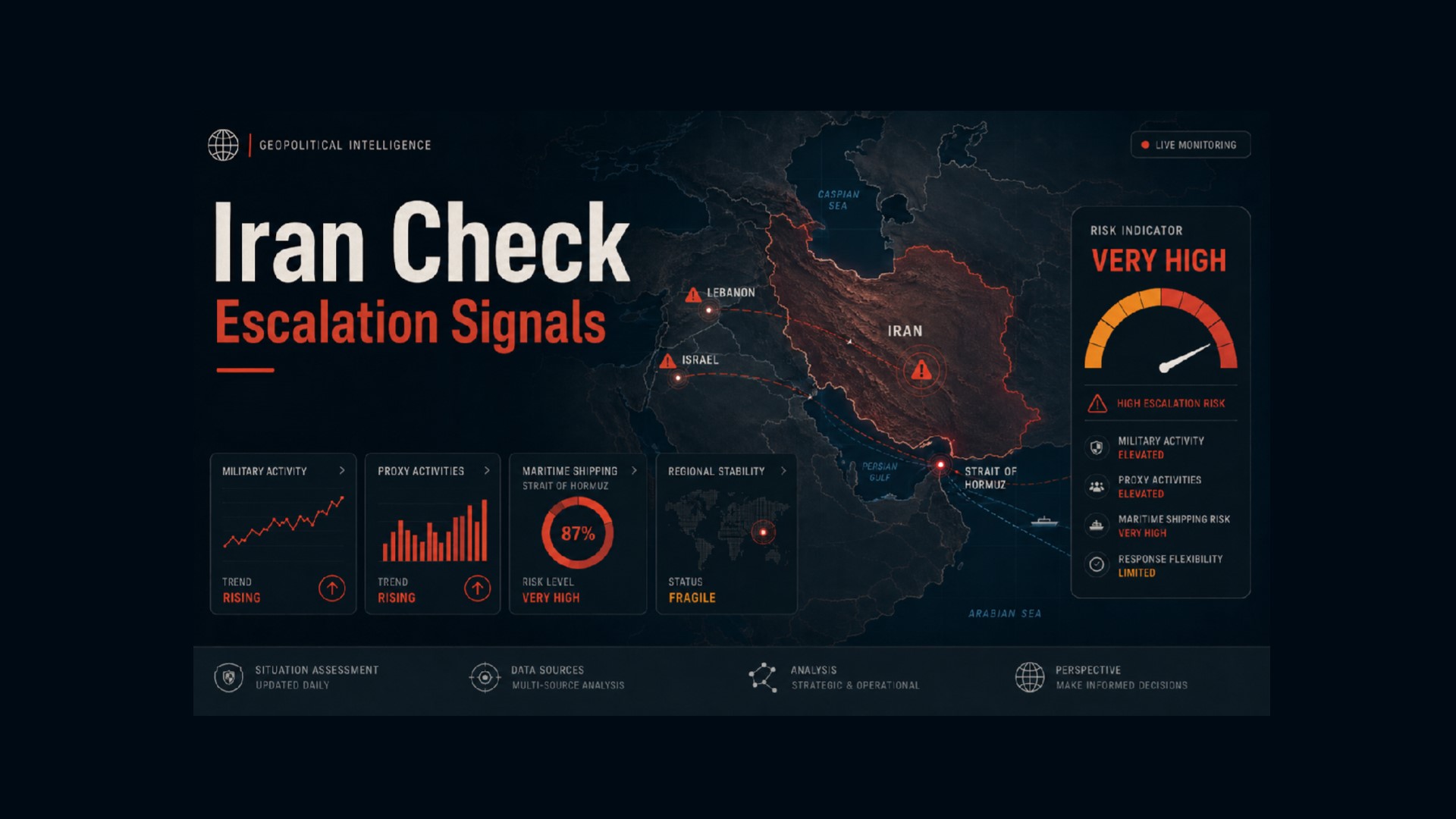
This escalation radar summarizes five relevant signals as of July 24, 2026. The focus is on verifiable statements by official actors, confirmed events and monitoring sources with potential impact on energy prices, supply chains, markets, maritime security, aviation and regional stability.
The key change: the escalation is no longer merely sustained, but is beginning to concentrate across several operational theatres at the same time. Reuters reports the 13th consecutive night of US strikes against Iran. AP additionally reports explosions near a US base in Erbil, northern Iraq. This brings the retaliation logic against regional US locations closer to operational reality again.
Reuters reports that on July 23, only one oil tanker passed through the Strait of Hormuz. This is the lowest level since early May and a clear operational stress signal. For companies, this means the crisis is no longer only a price or insurance risk. The most important oil and LNG corridor is physically barely planable as a reliable transit route.
Trump threatens Iran and the Houthis with major military punishment after attacks on Saudi oil tankers in the Red Sea. This places Bab el-Mandeb, alongside Hormuz, under direct pressure as a second energy and trade chokepoint. The chokepoint crisis is therefore no longer one-dimensional, but correlated across the Gulf, the Red Sea and Asia-Europe routes.
| Actor | Type | Severity | Status | Source / verification status | Business impact |
|---|---|---|---|---|---|
| United States / Iran / IRGC / regional US bases / Iraq | 13th night of US strikes, explosions near a US base and continued retaliation architecture | Critical · Level 5/5 | The military US-Iran situation remains critical on July 24, 2026 and gains new operational sharpness through the Iraq connection. Reuters reports that the US military completed the 13th consecutive night of strikes against Iran. AP additionally reports several explosions near a US military base in Erbil, northern Iraq, shortly after the 13th strike night. According to AP, the US strikes targeted Iranian military sites, including an IRGC naval base and drone storage facilities on Qeshm Island, as well as targets in Isfahan, Khuzestan and Fars. The power dynamic: Washington is trying to further weaken Iran’s ability to disrupt maritime traffic and regional deterrence. Tehran and Iran-aligned actors are maintaining pressure on regional US locations in response. This means the escalation is not limited to Iranian territory or Hormuz, but includes US bases, Gulf states and Iraq as direct pressure zones. | Confirmed by Reuters, 24.07.2026 and AP News, 24.07.2026. Verification status: confirmed for the 13th night of US strikes and explosions near a US base in northern Iraq; exact attribution, damage, military follow-on effects and whether the explosions point to a new Iranian or Iran-aligned attack pathway against US locations remain partly open. | Critical business impact on Iraq, Gulf and US-base exposure, energy prices, insurance, security costs, military risk premiums, expat safety, site continuity, banking and payment risks, crisis logistics, flight routes, business travel, air freight, spare-parts chains and companies with offices, suppliers or customers in Iraq, Kuwait, Bahrain, Jordan, Oman, Qatar, Saudi Arabia and the United Arab Emirates. |
| Hormuz / oil market / LNG / tankers / shipowners | Only one oil tanker through Hormuz and de facto narrowing of the most important oil and LNG corridor | Critical · Level 5/5 | The operational situation in the Strait of Hormuz deteriorates to a new extreme level on July 24. Reuters reports that on July 23, only one oil tanker passed through the Strait of Hormuz. The vessel was the New Giant, carrying around 2 million barrels of Iraqi Basrah crude oil on its way to Rizhao in China. According to Reuters, no other tanker entered the strait that day. For companies, Hormuz can therefore no longer be assessed as a normal transit corridor. The power dynamic: Iran does not need to formally close the corridor to create impact. Uncertainty, US strikes, retaliation risk, insurability and shipowner decisions are enough to push traffic down to a minimum level. The operational bottleneck itself is becoming a power instrument. | Confirmed by Reuters, 24.07.2026. Verification status: confirmed for the decline to only one oil tanker on July 23, the lowest level since May, and the absence of further tanker entries that day; it remains open whether this minimum level will continue in the short term or be temporarily stabilized by military protection measures. | Critical business impact on oil and LNG transport, tanker routing, container traffic, war-risk premiums, insurability, charter costs, spot rates, delivery times, port planning, energy procurement, hedging, raw material prices, Asia routes, refinery supply, air freight costs, diversions, just-in-time supply chains and companies with Gulf, energy, chemicals, fertilizer, air freight or heavy industry exposure. |
| Houthi / Saudi Arabia / United States / Iran / Bab el-Mandeb / Red Sea | US punishment threat after attacks on Saudi oil tankers and expansion of the chokepoint crisis | Critical · Level 5/5 | The operational energy and shipping situation expands decisively to Bab el-Mandeb and the Red Sea on July 24. Reuters reports that Trump threatened Iran and the Houthis with “major military punishment” after missile and drone attacks on two Saudi oil tankers in the Red Sea. According to Reuters, the Houthis claimed a blockade against Saudi Arabia and attacked the tankers Encelia and Layla. Brent rose above USD 100 per barrel according to Reuters. This creates a dual chokepoint crisis: Hormuz is operationally severely narrowed, while Bab el-Mandeb and the Red Sea are becoming a second energy trigger through Houthi threats and attacks. The power dynamic: Iran-aligned actors can expand the cost of the conflict onto Saudi oil, Red Sea routes and global energy prices. Washington is responding with punishment logic and signals that Red Sea attacks are not being assessed in isolation, but as part of the Iran architecture. | Confirmed by Reuters, 24.07.2026. Verification status: confirmed for Trump’s punishment threat, Houthi attacks on Saudi oil tankers, blockade threats against Saudi Arabia and the oil price reaction above USD 100; it remains open whether this will lead to direct US escalation against Houthi targets, Iran or both. | Critical business impact on oil and LNG transport, Saudi exposure, tanker routing, Red Sea routes, Bab el-Mandeb transits, Suez routes, diversions around Africa, war-risk premiums, insurability, charter costs, spot rates, delivery times, port planning, energy procurement, hedging, air-freight substitution costs, flight-route planning and companies with Asia-Europe, Gulf, energy, chemicals, fertilizer or heavy industry exposure. |
| Iran / United States / regional oil, gas, electricity and economic targets | Iranian threat against regional energy, electricity and economic infrastructure in case of further US escalation | High to critical · Level 4/5 | The political escalation logic shifts again toward infrastructure and supply on July 24. Reuters reports that Iran warned it would attack regional oil, gas, electricity and economic targets if further US threats are carried out. This is especially relevant for companies because the issue is no longer only military bases, ships or nuclear facilities. Energy assets, electricity supply, economic facilities and dual-use infrastructure are explicitly becoming part of deterrence. The power dynamic: Washington is threatening further attacks and seeks to pressure Iran militarily and financially. Tehran responds with a counter-logic that marks regional supply systems, energy exports and economic infrastructure as retaliation surfaces. Civilian or business-adjacent infrastructure is therefore becoming an escalation lever in its own right. | Confirmed by Reuters, 24.07.2026. Verification status: confirmed for the Iranian warning that regional oil, gas, electricity and economic targets could become retaliation targets; concrete target selection, attack capability, timing and whether the threat primarily signals deterrence or immediate operational preparation remain open. | High to critical business impact on energy supply, electricity supply, water and cooling chains, port operations, production, site continuity, evacuation, spare-parts chains, crisis logistics, insurance, security services, data centers, industrial facilities, aviation infrastructure, airport operations, business travel and companies with personnel, facilities, projects or supply chains in the Gulf region. |
| Lebanon / Israel / Hezbollah / United States | Pilot-zone reality, blocked return and fragile security architecture despite Israeli partial withdrawal | High to critical · Level 4/5 | The Lebanon situation remains a de-escalation project with a high relapse risk on July 23/24. The National reports from Zawtar al-Gharbiyeh that residents still cannot return despite the Israeli withdrawal from the first pilot zone. The reasons are continuing security risks, destroyed infrastructure, mine or unexploded ordnance risks and the still sensitive military situation in the south. This shows that withdrawal from a pilot zone is a political de-escalation signal, but not yet a reliable normalization. The power dynamic: Lebanon is trying to make sovereignty visible through state control and return to destroyed villages. Israel is testing whether security guarantees and border control are viable without its own presence. Hezbollah remains the structural conflict core as an armed actor because disarmament, state control and local return logic do not yet align. | Confirmed by The National, 23.07.2026. Verification status: confirmed for ongoing pilot-zone implementation problems, the blocked return of residents despite Israeli withdrawal from Zawtar al-Gharbiyeh and the continued fragile security situation in the south; it remains open whether the pilot zones will become viable beyond symbolic initial steps and whether Lebanon can actually enforce state control against Hezbollah structures. | High relevance for Lebanon and northern Israel exposure, security planning, evacuation, insurance, humanitarian logistics, regional supply chains, border risks, political risk premiums, flight routes over the Levant and companies with personnel, partners or projects in the Levant. |
The central escalation node on July 24, 2026 lies in the simultaneous concentration of military escalation, maritime narrowing, infrastructure threats and an active aviation warning situation. Compared with July 22, the situation has deteriorated again: the United States reports the 13th night of strikes against Iran, explosions occur near a US base in northern Iraq, and Hormuz falls to only one oil tanker in one day.
Operationally, the situation is now extremely tight for companies. Hormuz is barely planable as a normal transit corridor, Bab el-Mandeb and the Red Sea are under additional pressure due to Houthi attacks on Saudi oil tankers, and oil prices above USD 100 show that markets are already pricing in the dual burden. At the same time, the EASA warning situation for Iran, Iraq, Lebanon, the Persian Gulf and the Gulf of Oman remains active. The decisive issue is no longer only what oil costs, but whether several maritime corridors, insurance, passage, aviation, personnel movement and site operations remain reliably planable at the same time.
Politically, the situation remains especially dangerous because punishment, retaliation and negotiation logics are running in parallel. Trump threatens Iran and the Houthis with military punishment. Iran marks regional oil, gas, electricity and economic targets as possible retaliation surfaces. In Lebanon, the first pilot zone shows a political withdrawal step, but the blocked return of residents, destroyed infrastructure and the unresolved Hezbollah question show that de-escalation does not yet mean operational normalization.
The five most important signals for a European business risk picture are: the 13th night of US strikes against Iran, explosions near a US base in northern Iraq, only one oil tanker passing through Hormuz, Houthi attacks and US punishment threats in the Red Sea / Bab el-Mandeb complex, and Iran’s threat against regional oil, gas, electricity and economic targets while EASA warnings remain active for Iran, Iraq, Lebanon, the Persian Gulf, the Gulf of Oman and adjacent air corridors.
Note: This assessment was created with support from our Geo AI. AI can make mistakes. This document serves as a radar for potential escalation signals and does not replace a fully verified final intelligence assessment.
Independent of the subject covered in this article, this separate Executive Briefing provides an in-depth analysis of another critical risk domain affecting European companies.
The 27-page Executive Briefing “Black Swan Risk Mapping for Europe’s Next Mobility and Infrastructure Shock” examines how geopolitical, infrastructural and administrative developments that are currently viewed in isolation could reinforce one another.
Based on the GFDD Framework™, the report shows how these dynamics could affect operational continuity, access to critical resources and the strategic resilience of companies.
The briefing includes a structured systemic-shock analysis and a directly applicable Business Exposure Checklist for CEOs, CFOs, COOs, investors and strategy teams.
You are currently viewing a placeholder content from X. To access the actual content, click the button below. Please note that doing so will share data with third-party providers.
More Information