Executive Intelligence. Industrial Risk. Geopolitics.
Strategic Sparring
for Decision-Makers
Risk intelligence across technology, law, markets and power dynamics.


Verdeckte Geschäftsrisiken, strategische Widersprüche und kritische Abhängigkeiten frühzeitig erkennen.
Kostenlose Analyse starten →
Verdeckte Machtstrukturen, Führungsrisiken und organisatorische Blockaden frühzeitig erkennen.
Kostenlose Analyse starten →
Geopolitische Risiken, globale Abhängigkeiten und kritische Lieferkettenrisiken frühzeitig erkennen.
Kostenlose Analyse starten →
Identify hidden business risks, strategic contradictions and critical dependencies at an early stage.
Start Free Analysis →
Identify hidden power structures, leadership risks and organizational blockers at an early stage.
Start Free Analysis →
Identify geopolitical risks, global dependencies and critical supply-chain vulnerabilities at an early stage.
Start Free Analysis →
Verdeckte Geschäftsrisiken, strategische Widersprüche und kritische Abhängigkeiten frühzeitig erkennen.
Kostenlose Analyse starten →
Verdeckte Machtstrukturen, Führungsrisiken und organisatorische Blockaden frühzeitig erkennen.
Kostenlose Analyse starten →
Geopolitische Risiken, globale Abhängigkeiten und kritische Lieferkettenrisiken frühzeitig erkennen.
Kostenlose Analyse starten →
Identify hidden business risks, strategic contradictions and critical dependencies at an early stage.
Start Free Analysis →
Identify hidden power structures, leadership risks and organizational blockers at an early stage.
Start Free Analysis →
Identify geopolitical risks, global dependencies and critical supply-chain vulnerabilities at an early stage.
Start Free Analysis →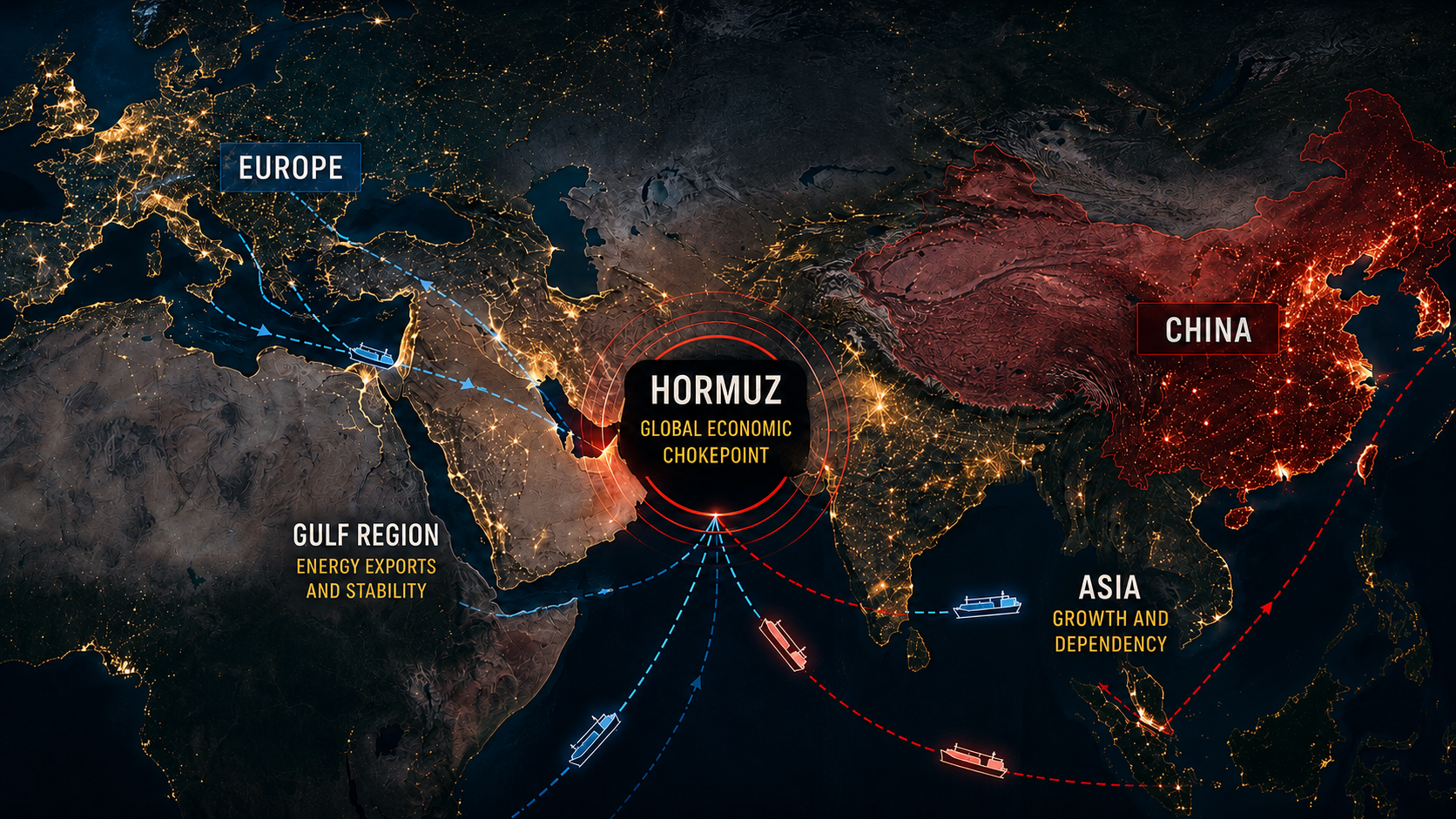
This Chokepoint Check assesses the current pressure on the Strait of Hormuz, the Bab al-Mandab, and critical water, power, port, and energy infrastructure across the Gulf region. The assessment focuses not only on whether a shipping route remains geographically open, but also on whether transport, supply, insurance coverage, and site operations remain operationally viable.
The corridor remains constrained by the blockade, military intervention, and stranded vessels.
US forces confirmed that they had fired on and disabled another commercial vessel after it allegedly attempted to breach the blockade of Iranian ports despite repeated warnings. At the same time, the International Maritime Organization reported that approximately 6,000 seafarers were stranded aboard around 400 vessels in the vicinity of the Strait of Hormuz. The disruption therefore affects not only transit, but also the availability of vessels, crews, and regional transport capacity.
The tanker attacks are developing into a direct Saudi-Houthi confrontation.
The Saudi-led coalition attacked Houthi military positions in Hodeidah and on Kamaran Island. Saudi Arabia stated that the targets had been used to threaten commercial shipping. The Houthis subsequently reported a retaliatory missile strike against the southern Saudi city of Jizan. The route remains geographically open, but attacks, counterstrikes, and confirmed vessel diversions are making it increasingly unreliable from an operational perspective.
Military operations are increasingly extending into transport, communications, and utility infrastructure.
The US air campaign against Iran was expanded to include roads, bridges, communications facilities, and water infrastructure, particularly around Bandar Abbas and in Iran’s coastal provinces. No sufficiently confirmed new report of a large-scale failure at a Gulf water, power, port, or energy facility was available for July 25. The operational threshold nevertheless remains crossed because the military target set now explicitly extends to civilian and economically relevant functional systems.
The Saudi-led coalition stated that it had attacked Houthi military targets in Hodeidah Governorate. Reports identified locations around the port city of Hodeidah and on Kamaran Island. Saudi Arabia justified the strikes by citing the threat to commercial shipping.
This represents a qualitative escalation compared with previous days. Saudi Arabia is no longer responding solely through protective measures and threats, but is intervening militarily in Yemen. This increases the risk of a renewed open war between Saudi Arabia and the Houthis.
The security environment around Hodeidah, Kamaran, and the southern entrance to the Red Sea is deteriorating. Vessels must prepare for additional military exclusion zones, navigation warnings, airstrikes, and short-notice route changes.
Verification status: confirmed for the strikes reported by the Saudi-led coalition and the identified target areas. Details regarding individual hits and damage had not been fully and independently verified at the time of reporting. Reuters via Internazionale, July 25, 2026 · Previous-day event with continuing impact on July 25
On July 25, the Houthis stated that they had carried out a missile attack against the southern Saudi city of Jizan. The attack was presented as retaliation for the Saudi airstrikes on Hodeidah and Kamaran. Independent confirmation of the specific impact was not initially available.
The escalation is no longer confined to commercial vessels and the Bab al-Mandab. Saudi territory is once again being identified as a target for retaliation. Jizan is particularly relevant because of its proximity to Yemen, its port function, and its regional energy and industrial infrastructure.
Companies operating in southwestern Saudi Arabia must prepare for increased air-defence activity, short-notice aviation and port disruptions, and heightened risks to personnel, logistics, and regional supply chains.
Verification status: confirmed for the Houthi claim and its stated connection to the Saudi strikes. A successful impact, specific damage, or operational disruption in Jizan had not been independently confirmed at the time of reporting. The Guardian, July 25, 2026
The Danish-flagged product tanker Torm Innovation, carrying approximately 500,000 barrels of naphtha from Yanbu to Japan, changed course. Instead of transiting the southern Bab al-Mandab, the vessel is travelling through the Suez Canal and then around the Cape of Good Hope to Asia.
The Houthi threat is now demonstrably changing real transport decisions. Although the corridor remains geographically open, it is no longer operationally acceptable for certain shipping companies and cargoes. The alternative route may extend the voyage by up to approximately 30 days.
Longer rotations tie up tanker capacity, increase bunker-fuel and personnel costs, and delay supplies to Asian refineries and chemical companies. Naphtha, fuels, petrochemicals, and time-sensitive industrial feedstocks are particularly exposed.
Verification status: confirmed by the vessel owner for the specific route change, cargo, and security rationale. The actual delay will depend on routing, vessel speed, and intermediate stops. Reuters, July 24, 2026 · Previous-day exception
The US military confirmed that it had fired on and disabled another commercial vessel after the ship allegedly ignored repeated warnings and attempted to breach the blockade of Iranian ports. At the same time, the International Maritime Organization reported that approximately 6,000 seafarers aboard around 400 vessels were stranded in the vicinity of Hormuz.
US enforcement of the blockade creates a second form of operational access control in addition to the Iranian attack risk. Commercial vessels must now consider not only Iranian permissions, mine risks, and missile threats, but also possible US interdiction.
Vessels and cargoes may remain tied up for extended periods. Crew changes, port calls, charter contracts, and delivery schedules are becoming more difficult to plan. Effective transport capacity is declining even without a complete geographical closure of the strait.
Verification status: confirmed for the US military account and the figures provided by the International Maritime Organization. The precise timing of the US attack on the vessel preceded the publication date; the new operational information was publicly confirmed on July 24 and 25. Associated Press via WTOP, July 24/25, 2026 · Substantive update
Prices for physical crude-oil cargoes from the Middle East, Europe, and Africa rose to two-month highs. Some grades available for prompt delivery approached USD 110 per barrel. Buyers increasingly sought immediately available alternatives outside the disrupted supply corridors.
Price pressure is shifting from futures markets to physical cargoes that can actually be delivered. This is a stronger indication of genuine supply scarcity than a temporary movement in Brent or WTI futures.
Refineries and energy buyers must accept higher procurement prices and quality premiums. This creates rising costs for diesel, aviation fuel, chemicals, plastics, fertilisers, transport, and industrial production.
Verification status: confirmed for the observed physical market prices and increased demand for alternatives available at short notice. Individual prices vary by crude grade, delivery location, and delivery date. Reuters, July 24, 2026 · Previous-day exception with continuing market impact
Saudi Arabia strikes Houthi positions; the Houthis report retaliation against Jizan.
Vessels avoid the Bab al-Mandab while blockade enforcement constrains Hormuz.
Voyages are extended by weeks while vessels and crews remain tied up.
Physical oil prices, freight costs, delivery times, and inflationary pressure increase.
A product tanker has taken an alternative route adding up to 30 days. Another commercial vessel was disabled by US forces. Approximately 400 vessels carrying around 6,000 seafarers are tied up in the vicinity of Hormuz.
Major Operational Transport Disruption ConfirmedHouthi positions near the port areas of Hodeidah and Kamaran were attacked. At the same time, the US air campaign has expanded its target set to include roads, bridges, communications, and water infrastructure in Iran.
Transport and Utility Infrastructure Included in Target SetDisruption at both chokepoints is generating multi-week diversions, tying up shipping capacity, and driving some physical crude-oil prices towards USD 110 per barrel.
Global Price and Capacity Transmission ConfirmedEscalation signals clearly outweigh de-escalation indicators. The decisive change today is that the Houthi threat to Red Sea shipping is once again developing into a direct military confrontation between Saudi Arabia and the Houthis. At the same time, confirmed vessel diversions, stranded ships, and physical oil prices approaching USD 110 demonstrate that the disruption is already being transmitted into transport capacity, procurement costs, and international supply chains.
Notice: This assessment was prepared with the support of our Geo AI. AI systems can make mistakes. This analysis serves as a source-based radar for potential escalation signals and does not replace comprehensively verified intelligence, security, insurance, or investment advice. In a dynamic environment, the status, source situation, and risk assessment may change at short notice.
Independent of the subject covered in this article, this separate Executive Briefing provides an in-depth analysis of another critical risk domain affecting European companies.
The 27-page Executive Briefing “Black Swan Risk Mapping for Europe’s Next Mobility and Infrastructure Shock” examines how geopolitical, infrastructural and administrative developments that are currently viewed in isolation could reinforce one another.
Based on the GFDD Framework™, the report shows how these dynamics could affect operational continuity, access to critical resources and the strategic resilience of companies.
The briefing includes a structured systemic-shock analysis and a directly applicable Business Exposure Checklist for CEOs, CFOs, COOs, investors and strategy teams.
You are currently viewing a placeholder content from X. To access the actual content, click the button below. Please note that doing so will share data with third-party providers.
More Information