Executive Intelligence. Industrial Risk. Geopolitics.
Strategic Sparring
for Decision-Makers
Risk intelligence across technology, law, markets and power dynamics.


Verdeckte Geschäftsrisiken, strategische Widersprüche und kritische Abhängigkeiten frühzeitig erkennen.
Kostenlose Analyse starten →
Verdeckte Machtstrukturen, Führungsrisiken und organisatorische Blockaden frühzeitig erkennen.
Kostenlose Analyse starten →
Geopolitische Risiken, globale Abhängigkeiten und kritische Lieferkettenrisiken frühzeitig erkennen.
Kostenlose Analyse starten →
Identify hidden business risks, strategic contradictions and critical dependencies at an early stage.
Start Free Analysis →
Identify hidden power structures, leadership risks and organizational blockers at an early stage.
Start Free Analysis →
Identify geopolitical risks, global dependencies and critical supply-chain vulnerabilities at an early stage.
Start Free Analysis →
Verdeckte Geschäftsrisiken, strategische Widersprüche und kritische Abhängigkeiten frühzeitig erkennen.
Kostenlose Analyse starten →
Verdeckte Machtstrukturen, Führungsrisiken und organisatorische Blockaden frühzeitig erkennen.
Kostenlose Analyse starten →
Geopolitische Risiken, globale Abhängigkeiten und kritische Lieferkettenrisiken frühzeitig erkennen.
Kostenlose Analyse starten →
Identify hidden business risks, strategic contradictions and critical dependencies at an early stage.
Start Free Analysis →
Identify hidden power structures, leadership risks and organizational blockers at an early stage.
Start Free Analysis →
Identify geopolitical risks, global dependencies and critical supply-chain vulnerabilities at an early stage.
Start Free Analysis →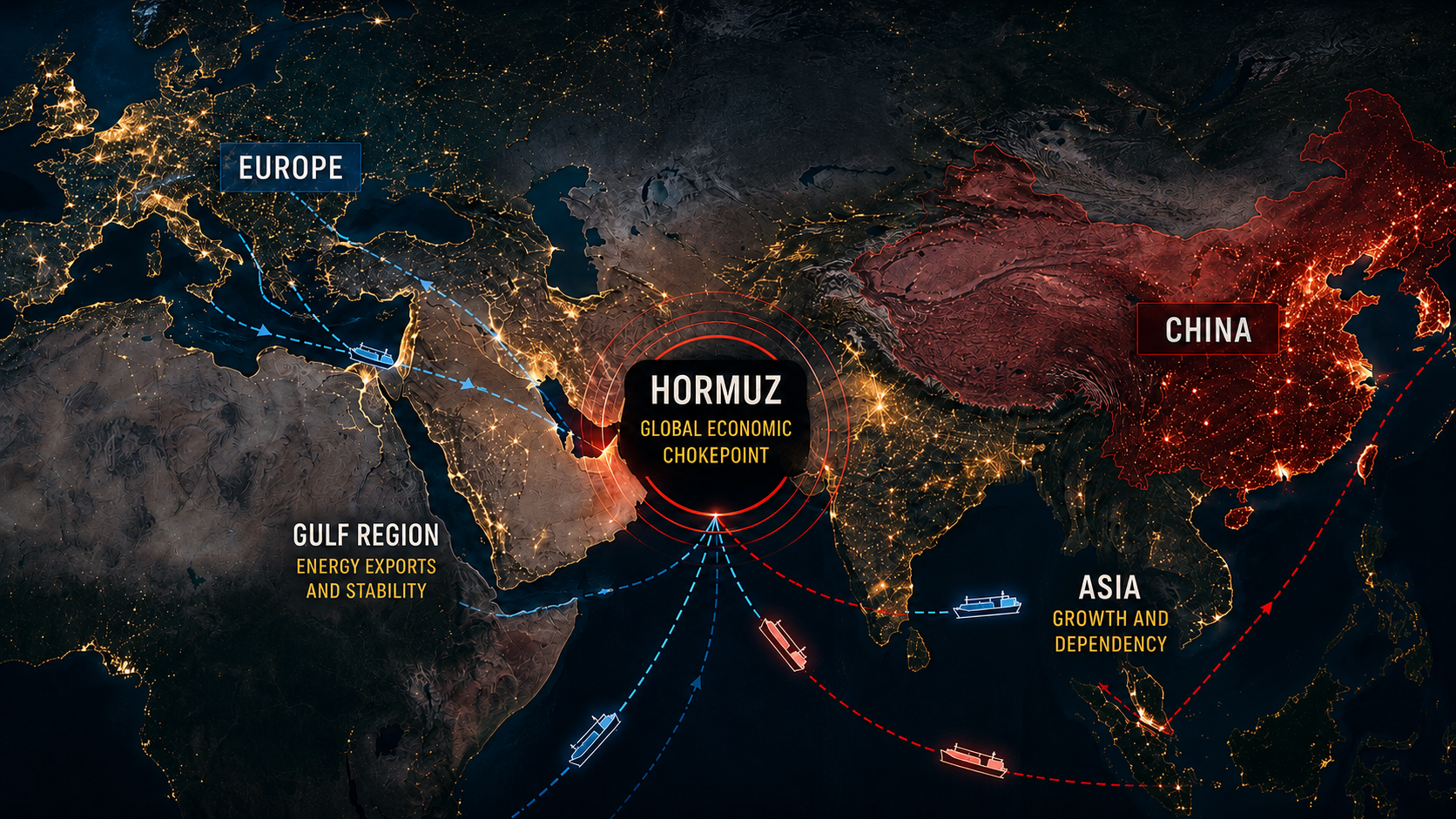
This Chokepoint Check assesses the current pressure on the Strait of Hormuz, the Bab al-Mandab, and critical water, power, port, and energy infrastructure across the Gulf region. The focus is not only on whether a shipping route remains geographically open, but also on whether transport, supply, insurance coverage, and site operations remain operationally viable.
Iran is asserting operational control and rejecting a joint regional management model.
Iran’s Revolutionary Guards stated on July 29 that they had attacked three oil tankers in the Strait of Hormuz and forced them to stop after the vessels allegedly ignored warnings. Reuters was initially unable to verify the claim independently. At the same time, Iran rejected Oman’s proposal for joint regional management of the strait and insisted on controlling the entire inbound route and part of the outbound route itself. Only eight commodity vessels were recorded on July 28, followed by just one initially recorded transit on July 29.
More vessels are transiting the route, but safe passage is increasingly negotiated on an individual basis.
On July 28, 39 commodity vessels passed through the Bab al-Mandab, the highest daily figure in one week. However, the short-term increase does not represent full normalisation. China is holding direct talks with the Houthis, and individual tankers are reportedly being cleared on a ship-by-ship basis. Other supertankers turned back for security reasons. Actual route access therefore increasingly depends on nationality, ownership structure, cargo destination, and political clearance.
Attacks on Saudi oil facilities are now triggering military counterstrikes in Iraq.
Saudi Arabia reported that drone attacks targeting oil facilities in the Eastern Province had been intercepted and blamed Iran-aligned militias operating from Iraq. US and Saudi forces subsequently attacked several locations in eastern Iraq. In parallel, Iran launched ballistic missiles at US military sites in Jordan; Jordan stated that it had intercepted five missiles. Energy facilities, militia sites, air-defence systems, and US bases are therefore now part of the same escalation chain.
The Revolutionary Guards stated that they had attacked and stopped three oil tankers in Hormuz because the vessels had allegedly used a route Iran considered unsafe and illegal. In parallel, Iran rejected Oman’s proposal for joint management of the strait.
Iran is directly linking its political demand for control with military enforcement. This reduces the likelihood of a rapid return to neutral and freely accessible shipping. A diplomatic agreement on fees alone will not be sufficient while control, routing, and military interdiction remain unresolved.
Shipowners, charterers, and insurers must continue to prepare for stoppages, route instructions, attacks, and conflicting Iranian and US requirements. Regular oil and LNG planning therefore remains severely constrained.
Verification status: confirmed for Iran’s rejection of the Omani proposal and the official attack claim issued by the Revolutionary Guards. The reported strikes and the stopping of the three tankers had not initially been independently verified. Reuters, July 29, 2026
On July 28, 39 commodity vessels passed through the Bab al-Mandab, the highest figure in one week. At the same time, only eight commodity vessels were recorded in Hormuz. By the morning of July 29, just one additional passage had initially been registered.
The opposing trend is systemically relevant: while Red Sea transit is recovering partially, the Gulf route remains close to blocked. However, the higher Bab al-Mandab figure does not represent a stable reopening because safe passage increasingly depends on individual political agreements.
Companies have more short-term transport options through the Red Sea, but cannot treat them as permanently available. Rerouting, waiting times, and political scrutiny of vessel origin remain part of operational planning.
Verification status: confirmed for the vessel movements recorded by Kpler. AIS and tracking data may not fully capture vessels operating with deactivated transponders or military activity. Reuters, July 29, 2026
The United States and Saudi Arabia attacked locations used by Iran-aligned militias in eastern Iraq. Saudi Arabia had previously reported drone attacks on its oil facilities. Iran, in turn, launched ballistic missiles at US military sites in Jordan. Jordan stated that it had intercepted and destroyed five missiles.
The limited pause in attacks has effectively ended. The conflict once again involves Iran, Iraq, Saudi Arabia, Jordan, and US forces. The widening geographical scope increases the risk of misattribution, retaliatory chains, and attacks on additional military or economic targets.
Aviation, project sites, personnel rotations, and overland transport between Iraq, Jordan, and the Gulf region are becoming more exposed. Companies must prepare for short-notice airspace warnings, border restrictions, and security disruptions.
Verification status: confirmed for Jordan’s interception measures and the US-Saudi attacks. Claims regarding responsibility, damage, and losses among the targeted militias remain partly disputed. AP News, July 29, 2026
Brent rose to approximately USD 87.13 per barrel on July 29, while WTI climbed to around USD 82.06. Both benchmarks gained more than three percent. The move was driven by renewed attacks in Iraq, Iranian missile launches, and the worsening situation in Hormuz.
The market is reversing some of the de-escalation optimism previously priced in. The increase demonstrates how quickly political and military developments are transmitted into energy prices. Prices nevertheless remain below the previous week’s peaks.
Energy procurement, diesel, aviation, chemicals, and transport remain exposed to high volatility. Companies cannot rely either on the previous price decline or on a permanently stable geopolitical risk premium.
Verification status: confirmed for the stated market prices and daily movements. Further developments will depend particularly on new attacks, vessel transits through Hormuz, and possible diplomatic responses. Reuters, July 29, 2026
Loadings at Egypt’s Mediterranean terminal of Sidi Kerir recently rose to around 1.3 million barrels per day, the highest level in 17 weeks. At the same time, Saudi crude exports through Yanbu fell to a 19-week low. Saudi Arabia is transporting oil from Ain Sukhna through the SUMED pipeline to the Mediterranean.
The export strategy is shifting from a direct Red Sea route to Asia towards a more complex route through Egypt and the Mediterranean. This is an operational response to simultaneous uncertainty in Hormuz and the Bab al-Mandab, but it does not provide a full-capacity alternative.
Additional transfer points, pipeline constraints, and longer sea routes increase cost and complexity. Asian buyers face longer lead times, higher charter costs, and additional risks in delivery and volume planning.
Verification status: confirmed for the loading and export data cited by Kpler. The publication was released on July 29, 2026, Vienna time, and therefore falls within the current reporting period. MarketWatch, July 29, 2026
Tankers, Saudi oil facilities, militia sites, and US bases are attacked.
Transit, port calls, aviation, and export planning are subject to political control.
More oil is routed through Egypt’s SUMED pipeline and Sidi Kerir.
Oil prices, charter costs, transit times, and planning risks rise again.
Iran reports attacks on three tankers. Hormuz continues to record extremely low transit levels. Traffic through the Bab al-Mandab is rising, but remains dependent on individual security clearances and political relationships.
Physical and Political Access Control ConfirmedDrones are targeting Saudi oil facilities. US and Saudi strikes are hitting sites in Iraq, while Iranian missiles are reported to have targeted US military positions in Jordan.
Regional Energy and Military Infrastructure AffectedSaudi Arabia is being forced to reorganise its export architecture through Egypt and the Mediterranean. At the same time, oil prices are rising and regional attacks are spreading to additional states.
Global Route and Price Transmission ConfirmedEscalation signals once again clearly outweigh de-escalation indicators. The Bab al-Mandab is showing a short-term increase in transit, but this partly depends on individual political clearances and therefore does not represent reliable normalisation. In Hormuz, Iran is once again linking its control claim with reported physical attacks. At the same time, the regional pause in attacks has ended following US-Saudi strikes in Iraq and Iranian missile launches against Jordan. The Iran-Ukraine confrontation in the Caspian Sea is also creating an additional northern escalation axis, linking the Middle East conflict more closely to the Russia-Ukraine war. The overall operational environment remains critical and has deteriorated compared with July 27.
Notice: This assessment was prepared with the support of our Geo AI. AI systems can make mistakes. This analysis serves as a source-based radar for potential escalation signals and does not replace comprehensively verified intelligence, security, insurance, or investment advice. In a dynamic environment, the status, source situation, and risk assessment may change at short notice.
Independent of the subject covered in this article, this separate Executive Briefing provides an in-depth analysis of another critical risk domain affecting European companies.
The 27-page Executive Briefing “Black Swan Risk Mapping for Europe’s Next Mobility and Infrastructure Shock” examines how geopolitical, infrastructural and administrative developments that are currently viewed in isolation could reinforce one another.
Based on the GFDD Framework™, the report shows how these dynamics could affect operational continuity, access to critical resources and the strategic resilience of companies.
The briefing includes a structured systemic-shock analysis and a directly applicable Business Exposure Checklist for CEOs, CFOs, COOs, investors and strategy teams.
You are currently viewing a placeholder content from X. To access the actual content, click the button below. Please note that doing so will share data with third-party providers.
More Information