Executive Intelligence. Industrial Risk. Geopolitics.
Strategic Sparring
for Decision-Makers
Risk intelligence across technology, law, markets and power dynamics.


Verdeckte Geschäftsrisiken, strategische Widersprüche und kritische Abhängigkeiten frühzeitig erkennen.
Kostenlose Analyse starten →
Verdeckte Machtstrukturen, Führungsrisiken und organisatorische Blockaden frühzeitig erkennen.
Kostenlose Analyse starten →
Geopolitische Risiken, globale Abhängigkeiten und kritische Lieferkettenrisiken frühzeitig erkennen.
Kostenlose Analyse starten →
Identify hidden business risks, strategic contradictions and critical dependencies at an early stage.
Start Free Analysis →
Identify hidden power structures, leadership risks and organizational blockers at an early stage.
Start Free Analysis →
Identify geopolitical risks, global dependencies and critical supply-chain vulnerabilities at an early stage.
Start Free Analysis →
Verdeckte Geschäftsrisiken, strategische Widersprüche und kritische Abhängigkeiten frühzeitig erkennen.
Kostenlose Analyse starten →
Verdeckte Machtstrukturen, Führungsrisiken und organisatorische Blockaden frühzeitig erkennen.
Kostenlose Analyse starten →
Geopolitische Risiken, globale Abhängigkeiten und kritische Lieferkettenrisiken frühzeitig erkennen.
Kostenlose Analyse starten →
Identify hidden business risks, strategic contradictions and critical dependencies at an early stage.
Start Free Analysis →
Identify hidden power structures, leadership risks and organizational blockers at an early stage.
Start Free Analysis →
Identify geopolitical risks, global dependencies and critical supply-chain vulnerabilities at an early stage.
Start Free Analysis →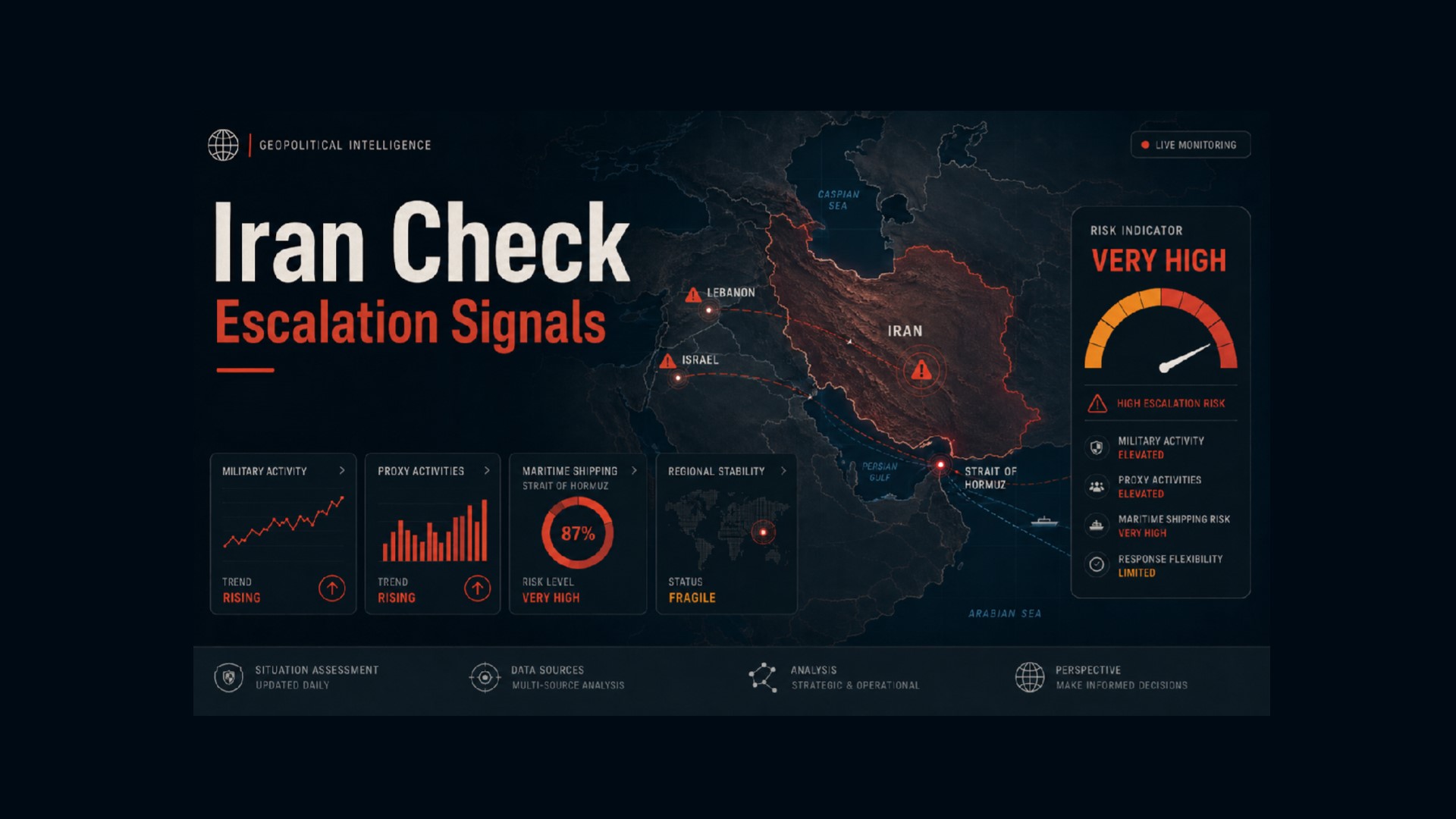
This escalation radar summarizes five relevant signals as of July 28, 2026. The focus is on verifiable statements by official actors, confirmed events and monitoring sources with potential impact on energy prices, supply chains, markets, maritime security, aviation and regional stability.
The key change: according to Reuters, Oman has presented Iran with a regional mechanism for administering the Strait of Hormuz. This shifts the situation from the question of “open or closed” to a power question: who controls navigation, security, environmental costs, search and rescue services and possible contribution or fee logic in the most important energy chokepoint?
Iran accuses Ukraine of attacking an Iranian vessel in the Caspian Sea. Araghchi later says the attack cannot go unanswered. This turns a maritime incident into a political retaliation signal linking the Ukraine war, Russia-Iran cooperation, US security interests and the Middle East conflict.
Trump receives Netanyahu and Zelenskyy while the Iran and Ukraine wars reach critical phases. Zelenskyy warns of Russian support for Iran through military imagery. Netanyahu brings Israeli security priorities and Iran dossiers into the talks. This shifts the crisis from regional escalation to networked great-power logic.
| Actor | Type | Severity | Status | Source / verification status | Business impact |
|---|---|---|---|---|---|
| Oman / Iran / Gulf states / Hormuz / United States | Regional mechanism for Hormuz instead of exclusive Iranian transit control | Critical · Level 5/5 | The operational and political Hormuz situation changes significantly on July 28, 2026. Reuters reports that Oman has presented Iran with a regional cooperation mechanism for administering the Strait of Hormuz. According to Reuters, the proposal has regional support and does not rely on exclusive Iranian control, but on shared responsibility for navigational safety, environmental issues and search and rescue services. The logic resembles the Strait of Malacca model, with voluntary contributions for security and environmental services. At the same time, the power question remains open: Iran criticizes US aggression as the source of insecurity in the waterway, while the United States wants unrestricted free passage and no Iranian toll or control logic. The power dynamic: Tehran is trying to anchor its de facto role in Hormuz politically. Oman is trying to translate that role into a regionally acceptable format. Washington wants to prevent crisis management from becoming a precedent for Iranian chokepoint sovereignty. | Confirmed by Reuters, 28.07.2026. Verification status: confirmed for Oman’s proposal of a regional Hormuz mechanism and the discussion of shared responsibility; it remains open whether Iran will give up exclusive control, transit fees or stronger regional co-administration and whether shipowners and insurers will accept this structure as reliable. | Critical business impact on oil and LNG transport, tanker clearances, shipowner decisions, insurability, war-risk premiums, charter costs, delivery times, port planning, energy procurement, raw material prices, refinery supply, air-freight costs, diversions, just-in-time supply chains, personnel movement and companies with Gulf, Asia or Europe transit risk. |
| Saudi Arabia / Iraq / Iran-aligned groups / oil targets / United States | Drones launched from Iraq against Saudi oil targets and expansion of regional attack axes | Critical · Level 5/5 | The operational energy and security situation deteriorates on July 27/28 through a new attack axis. Reuters reports that Saudi air defenses destroyed drones launched from Iraq and intended to strike oil targets in the Eastern Province as well as Riyadh. According to Reuters, the Saudi Defense Ministry blamed Iran-backed armed groups in Iraq. This means the threat to energy infrastructure is no longer visible only through Hormuz, Bab el-Mandeb or Houthi activity in the Red Sea, but also through Iraq as an operational space. The power dynamic: Iran-aligned networks can generate pressure on Saudi Arabia from multiple directions, while Riyadh is forced to protect oil, pipeline, export and capital infrastructure at the same time. For Washington, this adds risk because Iraqi Iran-aligned groups can also affect US locations, logistics and air corridors. | Confirmed by Reuters, 27./28.07.2026. Verification status: confirmed for Saudi Arabia’s report of intercepted drones launched from Iraq against oil targets and Riyadh, as well as the Saudi attribution to Iran-backed groups; the exact group, damage potential, number of drones and whether this creates a new Iraq-Saudi escalation line remain open. | Critical business impact on oil production, export terminals, pipelines, Saudi exposure, insurability, security costs, energy prices, port planning, war-risk premiums, air freight, business travel, expat safety, spare-parts chains, payment risks and companies with personnel, projects or supply chains in Saudi Arabia, Iraq, Kuwait, Bahrain, Qatar, Oman and the UAE. |
| United States / Iran / Qatar / Pakistan / Oman / regional mediators | Three-day attack pause, indirect talks and simultaneous drone incidents in the region | High to critical · Level 4/5 | The diplomatic situation shows progress on July 28, but no reliable stabilization. AP reports that mediators see progress in efforts to stop the escalating Iran-US conflict. According to AP, there is a three-day attack pause by both sides, while Qatar and Pakistan support indirect talks and Oman is working in parallel on the administration of Hormuz passage. At the same time, AP continues to report drone incidents in Saudi Arabia, Jordan and Iraq as well as tense shipping in Hormuz. The power dynamic: the United States and Iran are testing de-escalation without giving up their pressure tools. Mediators are trying to prevent a return to open bombing. Iran-aligned actors, however, keep regional attack options visible, meaning the negotiation pause can be broken at any time by operational events. | Confirmed by AP News, 28.07.2026. Verification status: confirmed for reported mediation progress, the three-day attack pause and indirect talks; it remains partly open whether the drone incidents are part of coordinated escalation, local pressure tools or independent militia actions. | High to critical business impact on crisis planning, insurability, energy procurement, maritime corridors, flight routes, air freight, personnel movement, expat safety, emergency logistics, supply-chain buffers, banking and payment risks and companies dependent on stable Gulf, Iraq, Jordan, Saudi or Asia-Europe corridors. |
| United States / Israel / Ukraine / Iran / Russia / Netanyahu / Zelenskyy / Trump | Washington meetings connect the Iran, Israel and Ukraine dossiers with the Russia-Iran intelligence question | High to critical · Level 4/5 | The political escalation situation gains new sharpness on July 28 through the parallel Washington meetings with Netanyahu and Zelenskyy. Reuters reports that Trump is hosting Netanyahu and Zelenskyy while the Iran and Ukraine wars reach critical phases. According to Reuters, Zelenskyy’s agenda includes air defense, Patriot systems and strategic cooperation with the United States. AP additionally reports that Zelenskyy warned of direct cooperation between Russia and Iran over US military imagery. At the same time, according to AP, Netanyahu is bringing Israeli security priorities, information on Iran’s nuclear program, Lebanon and regional stabilization into Washington. The power dynamic: Israel is trying to bind the US line toward Iran and Hezbollah more closely to Israeli security logic. Ukraine is trying to draw Washington’s attention to the operational connection between Russia and Iran. The United States therefore has to coordinate two war theatres at the same time: Iran-Israel-Gulf and Ukraine-Russia. This linkage increases the risk that intelligence, air defense, sanctions, drone logistics and targeting information escalate across conflicts. | Confirmed by Reuters, 28.07.2026 and AP News, 28.07.2026. Verification status: confirmed for the parallel Washington meetings, Zelenskyy’s agenda on air defense and strategic cooperation, Netanyahu’s Iran and Lebanon priorities and Zelenskyy’s warning about Russia-Iran cooperation over military imagery; it remains open whether this will produce concrete new US commitments, intelligence cooperation, air-defense packages or new red lines toward Iran and Russia. | High to critical business impact on Israel, Ukraine, Russia, Iran and Gulf exposure, aviation, business travel, insurance, regional security planning, energy prices, sanctions, export controls, defense and dual-use supply chains, cyber risks, satellite and intelligence risks and companies with projects, personnel or customers in Israel, the Levant, Ukraine, Russia, Central Asia and the Gulf region. |
| Iran / Ukraine / Russia / Caspian Sea / United States | Iranian retaliation formula after Ukrainian attack on Iranian vessel in the Caspian Sea | High to critical · Level 4/5 | Ukraine-Iran tension becomes a standalone escalation signal on July 25/26 and remains relevant on July 28 through Zelenskyy’s Washington meetings and the Russia-Iran question. Reuters reports that Iran accuses Ukraine of attacking an Iranian merchant vessel in the Caspian Sea. According to Reuters, Iran’s Foreign Ministry condemned the attack, reported one sailor killed and another injured, and summoned the Ukrainian chargé d’affaires. Even more serious is the later statement by Iranian Foreign Minister Abbas Araghchi: the Ukrainian attack cannot go unanswered. This is a clear retaliation formula. Ukraine presents the incident differently and, according to Reuters, points to vessels connected to Iran-linked military cargo or Russian military logistics. The power dynamic: Ukraine signals that Iranian-Russian logistics are vulnerable even in the Caspian region. Iran signals willingness to retaliate against Ukraine. Russia remains in the background as a possible intelligence and logistics amplifier for Iran. This connects the Ukraine war operationally with the Iran-Gulf conflict. | Confirmed by Reuters, 25./26.07.2026 and Reuters, 26./28.07.2026. Verification status: confirmed for Iran’s condemnation of the Ukrainian attack, the reported fatality, the summoning of the Ukrainian chargé d’affaires and Araghchi’s retaliation formula; it remains open whether Iran responds militarily, diplomatically, through cyber means or via Russia-aligned or Iran-aligned networks. | High to critical business impact on Caspian Sea exposure, energy and military logistics, Russia-Iran routes, sanctions, insurability, trade finance, security checks, dual-use supply chains, satellite and intelligence risks, cyber risks, Gulf locations, flight routes, air freight and companies with Russia, Ukraine, Iran, Caucasus, Central Asia or Gulf exposure. |
The central escalation node on July 28, 2026 lies in the dangerous simultaneity of negotiation progress, chokepoint restructuring, regional attack logic and Ukraine-Iran linkage. Compared with July 26, the situation has shifted further: Oman presents Iran with a regional mechanism for Hormuz, the United States and Iran are maintaining a three-day attack pause, Trump meets Netanyahu and Zelenskyy in Washington, and Saudi Arabia reports drones launched from Iraq against oil targets.
Operationally, the situation remains critical for companies. Hormuz is not normalized, but part of a regional power and control architecture. Saudi oil infrastructure is threatened not only through the Red Sea and Houthi pressure, but also through drone axes from Iraq. In addition, the Caspian region becomes a relevant escalation space because Iran accuses Ukraine of attacking an Iranian vessel and signals retaliation. At the same time, drone incidents in Jordan and Iraq, maritime uncertainty, insurability, war-risk premiums, air-freight substitution costs and the EASA warning situation for Iran, Iraq, Lebanon, the Persian Gulf and the Gulf of Oman remain relevant operational risk amplifiers.
Politically, the situation remains dangerous because diplomacy and military fallback options exist side by side. Trump keeps talks with Iran open, but warns of a return to strong military action. Netanyahu is trying to bind the US line toward Iran and Hezbollah more strongly to Israeli security priorities. Zelenskyy warns of Russia-Iran cooperation over military imagery. Araghchi says that the Ukrainian attack on an Iranian vessel cannot go unanswered. This connects the Iran conflict, Ukraine war, Russia logic and Gulf security more directly than before.
The five most important signals for a European business risk picture are: Oman’s proposal for a regional Hormuz mechanism, Saudi Arabia’s interception of drones launched from Iraq against oil targets, the three-day attack pause with indirect US-Iran talks, the Washington meetings with Netanyahu and Zelenskyy as a connection point between the Iran, Israel and Ukraine dossiers, and Iran’s retaliation formula after the Ukrainian attack on an Iranian vessel in the Caspian Sea while EASA warnings remain active for Iran, Iraq, Lebanon, the Persian Gulf, the Gulf of Oman and adjacent air corridors.
Note: This assessment was created with support from our Geo AI. AI can make mistakes. This document serves as a radar for potential escalation signals and does not replace a fully verified final intelligence assessment.
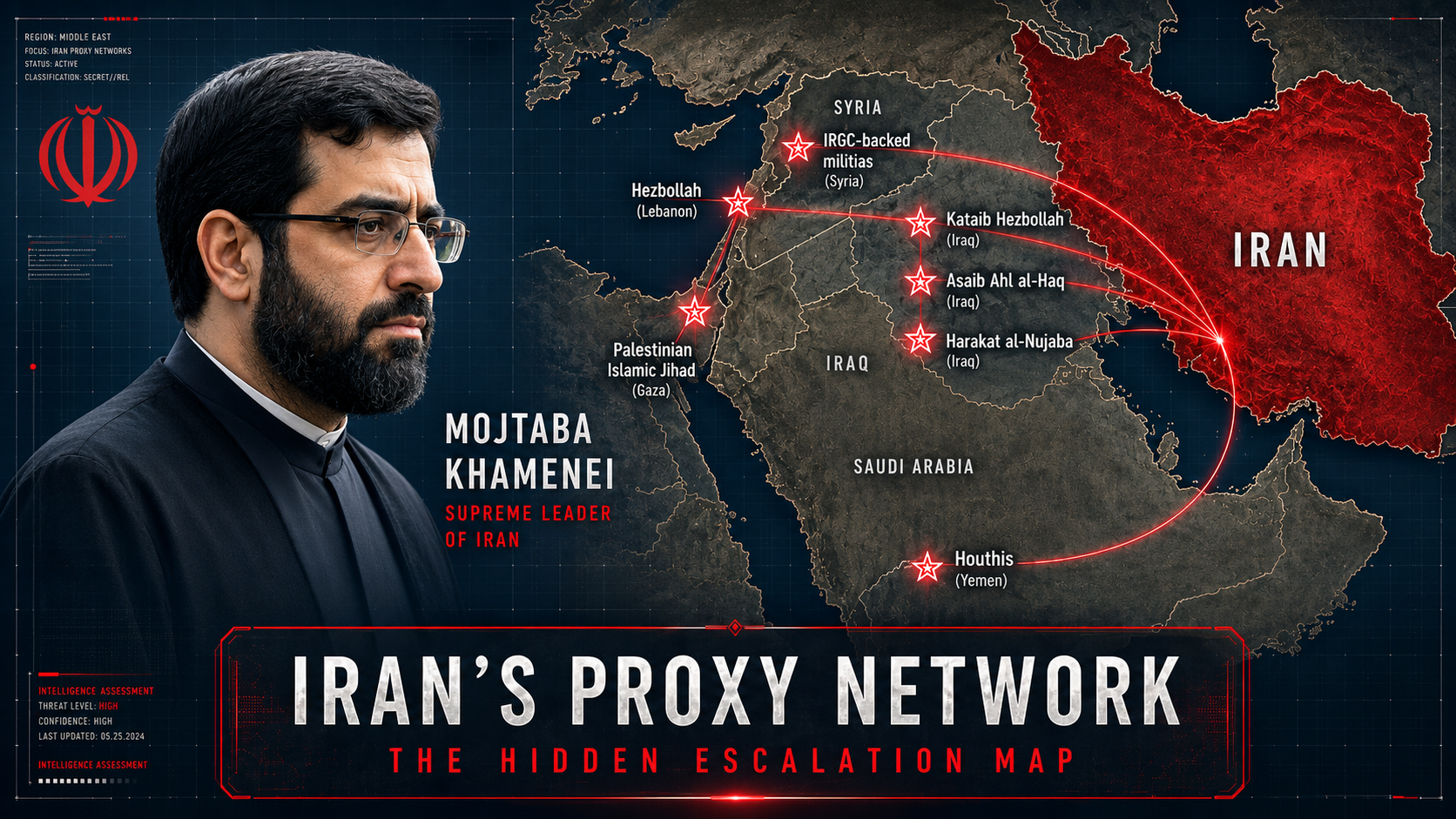
What decision-makers should watch now — before proxy escalation becomes a cost, compliance or supply-chain shock.
This 17-page executive briefing translates Iran’s proxy network into concrete business risks: energy price exposure, maritime chokepoints, war-risk premiums, sanctions, shadow fleets, supply-chain disruption and early-warning indicators for board-level decisions.
You are currently viewing a placeholder content from X. To access the actual content, click the button below. Please note that doing so will share data with third-party providers.
More Information