Executive Intelligence. Industrial Risk. Geopolitics.
Strategic Sparring
for Decision-Makers
Risk intelligence across technology, law, markets and power dynamics.


Verdeckte Geschäftsrisiken, strategische Widersprüche und kritische Abhängigkeiten frühzeitig erkennen.
Kostenlose Analyse starten →
Verdeckte Machtstrukturen, Führungsrisiken und organisatorische Blockaden frühzeitig erkennen.
Kostenlose Analyse starten →
Geopolitische Risiken, globale Abhängigkeiten und kritische Lieferkettenrisiken frühzeitig erkennen.
Kostenlose Analyse starten →
Identify hidden business risks, strategic contradictions and critical dependencies at an early stage.
Start Free Analysis →
Identify hidden power structures, leadership risks and organizational blockers at an early stage.
Start Free Analysis →
Identify geopolitical risks, global dependencies and critical supply-chain vulnerabilities at an early stage.
Start Free Analysis →
Verdeckte Geschäftsrisiken, strategische Widersprüche und kritische Abhängigkeiten frühzeitig erkennen.
Kostenlose Analyse starten →
Verdeckte Machtstrukturen, Führungsrisiken und organisatorische Blockaden frühzeitig erkennen.
Kostenlose Analyse starten →
Geopolitische Risiken, globale Abhängigkeiten und kritische Lieferkettenrisiken frühzeitig erkennen.
Kostenlose Analyse starten →
Identify hidden business risks, strategic contradictions and critical dependencies at an early stage.
Start Free Analysis →
Identify hidden power structures, leadership risks and organizational blockers at an early stage.
Start Free Analysis →
Identify geopolitical risks, global dependencies and critical supply-chain vulnerabilities at an early stage.
Start Free Analysis →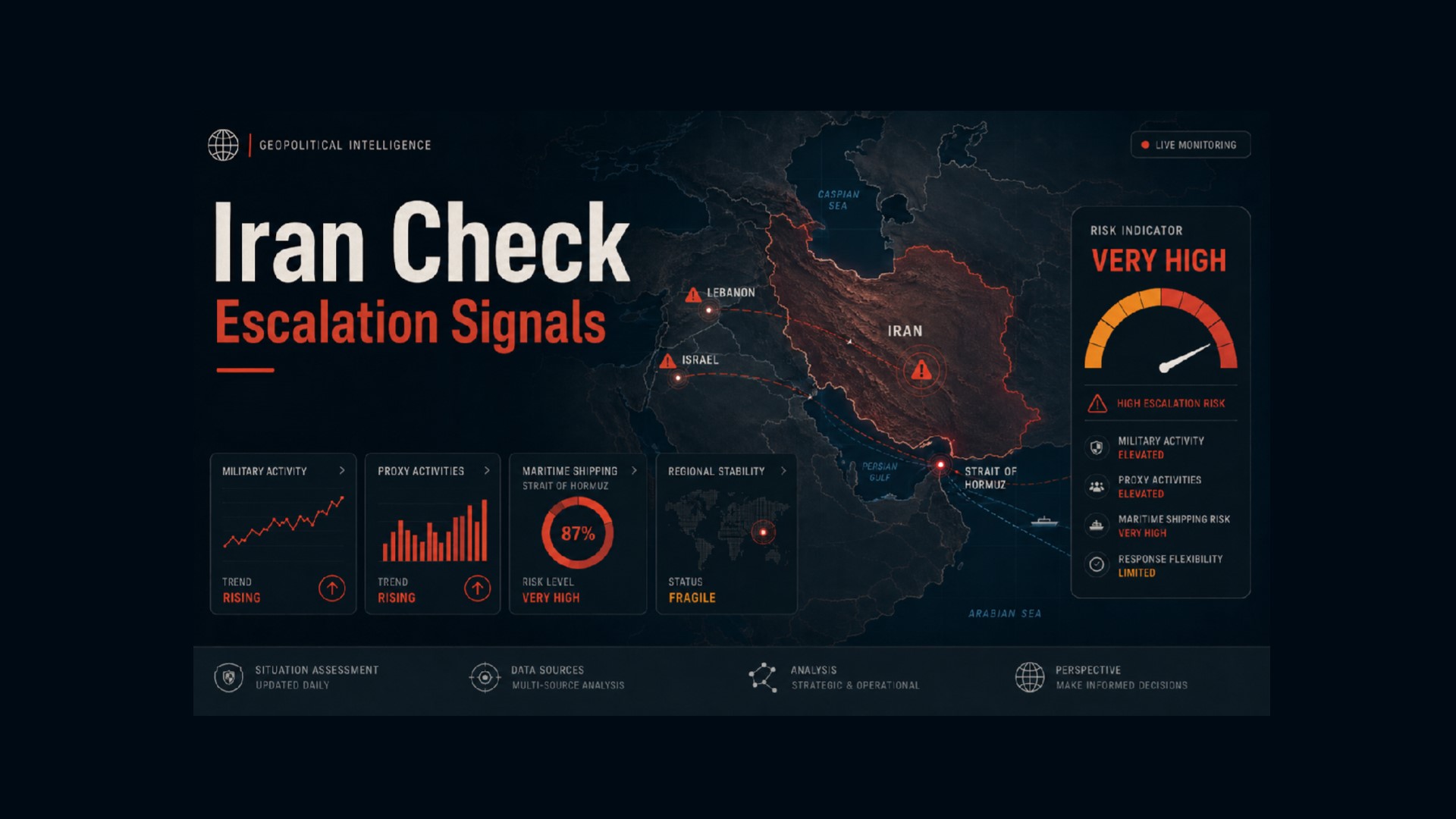
This escalation radar summarises five relevant signals as of August 1, 2026. It focuses on substantiated statements by official bodies, verified events and monitoring sources with potential implications for energy prices, supply chains, markets, maritime security, aviation and regional stability.
The most important change on August 1: Kuwait reports a new wave of Iranian drone attacks, while another tanker has been hit in the Strait of Hormuz. Trump has responded by threatening additional US strikes. This means the direct retaliation cycle is continuing, even though the United States did not conduct another wave of strikes against Iran during the preceding night.
Iran stated that it had prevented two vessels from leaving the Strait of Hormuz and forced four others to turn back. At the same time, visible shipping traffic remains unusually limited. Individual tankers can still pass through the waterway, but passage is increasingly subject to a politically and militarily controlled clearance regime.
Saudi Arabia is advancing a multinational maritime protection coalition for the Red Sea, Bab el-Mandeb and the Gulf of Aden. Several states, including Türkiye, Pakistan, Egypt, Sudan and Djibouti, support the initiative. The Houthi blockade is therefore evolving from a regional proxy conflict into a broader military and logistical alliance issue.
| Actor | Type | Severity | Status | Source / Verification Status | Business Impact |
|---|---|---|---|---|---|
| Iran / IRGC / Kuwait / United States / tanker in Hormuz | New Iranian drone attacks against Kuwait, another tanker hit and a US threat of additional strikes | Critical · Level 5/5 | The direct military escalation is continuing on August 1, 2026. Kuwait stated that it had responded to a new round of Iranian drone attacks. According to the Kuwaiti authorities, damage was reported, but no fatalities were initially confirmed. At the same time, another tanker was hit in the Strait of Hormuz. Iran’s Revolutionary Guards had already stated on July 31 that they had attacked two tankers. US President Donald Trump subsequently threatened additional strikes against Iran and accused Tehran of breaking the recent pause in attacks and again targeting international commercial shipping. Although no further known US wave of strikes took place during the night preceding the new threat, Washington is explicitly keeping the military option open. Power dynamics: Iran is attempting to increase the cost of the US Hormuz strategy by attacking US-aligned Gulf states and commercial vessels. Washington is responding with a credible, but not yet immediately implemented, threat of retaliation. Kuwait is therefore once again shifting from a support and transit state into a direct operational target. | Confirmed by AP News, August 1, 2026 . Verification status: confirmed regarding the new Iranian drone wave against Kuwait, the tanker hit in Hormuz and Trump’s threat of further strikes; the identity and full extent of damage to the tanker, the complete target set of the Iranian drones and the timing and scale of a possible new US response remain partially unresolved. | Critical business impact on exposure to Kuwait, Bahrain, Saudi Arabia and the wider Gulf, expatriate and personnel security, refineries, power and water infrastructure, tanker operations, port planning, business travel, war-risk insurance, air freight, evacuation planning, cyber risks, payment flows and companies with facilities, suppliers, customers or personnel in US-aligned Gulf states. |
| Iran / IRGC / Hormuz / international tankers / Oman / Gulf states | Iran stops or turns back several vessels and demonstrates selective control over the Strait of Hormuz | Critical · Level 5/5 | The operational situation in Hormuz escalated again on July 31. Iran stated that it had prevented two vessels from leaving the Strait of Hormuz and forced four others to turn back. The announcement triggered another rise in oil prices. At the same time, vessel-tracking data continues to show only very limited traffic through the waterway. On July 31, two very large crude carriers, each carrying around two million barrels, were able to leave Hormuz, including a vessel loaded with Iraqi Basrah crude and heading for China. These individual transits do not amount to a return to normal conditions. Instead, they indicate that Iran can selectively obstruct, tolerate or apparently link shipping movements to negotiated conditions. Oman is continuing to mediate a managed transit mechanism. However, Iran has not formally agreed to a stable and generally applicable passage arrangement. Power dynamics: Tehran is using Hormuz not only as a military chokepoint, but increasingly as a political clearance and negotiating instrument. Individual departures reduce immediate supply pressure, but also reinforce Iran’s claim to influence safe routes and permitted passage. | Confirmed by Reuters, July 31, 2026 and Reuters, July 31, 2026 . Verification status: confirmed regarding Iran’s interference with several vessels, the continued low level of traffic, the departure of two VLCCs and the immediate oil-market reaction; the identity and cargo of all vessels stopped by Iran and the specific political or operational conditions governing further passage remain unclear. | Critical business impact on oil, LNG, chemicals and fertiliser markets, Asia-Europe trade, tanker charters, delivery times, freight rates, insurability, force majeure, energy procurement, hedging, production planning, alternative sourcing and companies dependent on exports from Saudi Arabia, Qatar, Kuwait, Iraq or the United Arab Emirates. |
| Saudi Arabia / Türkiye / Pakistan / Egypt / Sudan / Djibouti / EU / Houthis | Multinational maritime protection coalition in response to the Houthi blockade and attacks in the Red Sea | High to critical · Level 4/5 | Saudi Arabia is internationalising the military protection of the Red Sea. The Saudi Ministry of Defence presented a multinational maritime protection initiative intended to strengthen the security of international shipping, energy exports, Bab el-Mandeb and the Gulf of Aden. The initiative follows the naval blockade against Saudi Arabia declared by the Iran-aligned Houthis and attacks against Saudi vessels and energy targets. Representatives of numerous states and the European Union participated in the preceding consultations. Fourteen states signalled support, including Türkiye, Pakistan, Egypt, Sudan and Djibouti. Notably, Oman and the United Arab Emirates were not among the initially named supporters. This exposes diverging Gulf strategies: Saudi Arabia is pursuing military coordination and maritime deterrence, while Oman is simultaneously seeking a negotiated transit arrangement for Hormuz. Power dynamics: Riyadh is attempting to prevent the Houthi blockade from being treated merely as a bilateral Saudi-Yemen conflict and instead frame it as a threat to international trade and energy interests. Türkiye, Pakistan and African coastal states are therefore becoming more deeply involved in the Iran-Houthi-Saudi conflict architecture. | Confirmed by Reuters, reporting updated on July 31, 2026 and AP News, July 31, 2026 . Verification status: confirmed regarding the Saudi initiative, international participation and support from fourteen states; the mandate, rules of engagement, operational command structure, specific naval contributions and the timing of any deployment remain unresolved. | High to critical business impact on Red Sea and Suez routing, Saudi exports, ports, tanker and container shipping, naval escorts, insurance conditions, security costs, delivery times between Asia and Europe, export controls, geopolitical compliance and companies with exposure to Türkiye, Pakistan, Egypt, East Africa, the Gulf or Saudi Arabia. |
| Houthis / Iran / Saudi Arabia / Bab el-Mandeb / international shipping companies | Houthi blockade remains in place, but plans for passage fees are officially denied | High to critical · Level 4/5 | The Houthi naval blockade against Saudi Arabia remains an acute risk for the Red Sea. On July 31, the maritime coordination body controlled by the Houthis rejected reports that fees were to be imposed on vessels passing through Bab el-Mandeb. The body stated that its service for coordinating safe passage was voluntary and free of charge. Shipping companies were advised not to make payments to individuals or organisations falsely claiming to represent Houthi structures. The denial reduces the risk of an immediately formalised toll system, but does not remove the declared blockade against Saudi vessels or the danger of selective attacks and informal clearance procedures. Tankers had previously switched off their AIS signals or altered routes in order to reduce the risk of detection and possible attacks. Power dynamics: The Houthis are attempting to demonstrate political and operational control over the waterway without publicly committing themselves to a formal fee regime at this stage. This preserves a deliberately ambiguous grey zone between blockade, threat, selective tolerance and allegedly free security coordination. | Confirmed by Reuters, July 31, 2026 . Verification status: confirmed regarding the official denial of a planned fee system and the reference to free and voluntary transit coordination; the previously declared Houthi blockade against Saudi Arabia also remains confirmed. It remains unclear whether unofficial payments, security arrangements or selective clearances are taking place and which vessels are specifically regarded as targets. | High to critical business impact on Bab el-Mandeb and Suez passages, Saudi oil and goods exports, AIS and security procedures, fraud and extortion risks, insurability, routing decisions, port calls, charter agreements, shipments to India and Asia and companies handling time-sensitive container, commodity, energy or project cargo. |
| Israel / Lebanon / Hezbollah / Beaufort / United States / regional mediators | Destruction of suspected Hezbollah tunnels and renewed pressure ahead of further disarmament and security talks | High · Level 3/5 | The Israel-Lebanon front remains capable of escalation despite the stronger focus on Iran and Hormuz. According to current reports, Israeli forces destroyed tunnel facilities beneath or near the historic Beaufort Castle in southern Lebanon. Israel attributed the facilities to Hezbollah. The operation triggered renewed diplomatic tensions with the Lebanese leadership and comes as further talks on security arrangements and the disarmament of Hezbollah are being prepared. The military action therefore has a dual effect: Operationally, Israel is attempting to eliminate remaining underground Hezbollah infrastructure. Politically, Jerusalem is demonstrating that it will pursue security objectives independently of ongoing negotiating formats if necessary. This increases domestic pressure on Beirut, as the government is caught between its claim to state sovereignty, international pressure for disarmament and Hezbollah’s continuing military structure. Power dynamics: Israel is linking negotiations with continued military coercion. Hezbollah potentially loses infrastructure, but can also use the attacks to justify retaining its weapons. | Confirmed by AP News, August 1, 2026 . Verification status: confirmed regarding Israel’s destruction of tunnels described as Hezbollah infrastructure and the resulting diplomatic tensions with Lebanon; the full extent, previous operational use of the facilities and Hezbollah’s immediate response remain partially unclear. | High business impact on exposure to Lebanon and Israel, border regions, business travel, evacuation planning, aviation, port and road logistics, construction and infrastructure projects, insurance, cyber risks and companies with personnel, partners or supply chains in Beirut, southern Lebanon, northern Israel or the wider Levant. |
The central escalation point on August 1, 2026 lies in the combination of renewed Iranian attacks, a US threat of retaliation and Iran’s expanding control over the Strait of Hormuz. Compared with July 30, the situation has not escalated through another major US wave of strikes, but through the continuation of Iran’s counteroffensive: Kuwait reports a new round of drone attacks, another tanker has been hit in Hormuz, and Iran states that it has stopped several vessels or forced them to turn back. Trump is explicitly keeping the option of additional strikes open.
Operationally, the situation remains critical for businesses. Individual VLCCs were able to leave Hormuz, but visible traffic remains unusually limited and does not reflect reliably open passage. Iran is demonstrating that it can stop vessels, turn them back or apparently allow them to pass selectively. At the same time, Bab el-Mandeb remains at risk because of the Houthi blockade against Saudi Arabia. The denial of a formal Houthi fee system therefore provides only limited relief: the underlying targeting, blockade and control logic remains intact. The EASA warnings that remain in force for Iran, Iraq, Jordan, Lebanon, the Persian Gulf and the Gulf of Oman were not issued as new warnings on August 1, but continue to represent a major risk amplifier for aviation, air freight and business travel.
Politically and strategically, the conflict is continuing to widen. Saudi Arabia is attempting to internationalise the threat in the Red Sea through a multinational maritime coalition. Türkiye, Pakistan, Egypt, Sudan and Djibouti are among the additional states being drawn into the protection of a conflict zone directly linked to Iran and the Houthis. At the same time, the differing positions of Saudi Arabia, Oman and the United Arab Emirates show that there is no fully unified strategy within the Gulf region. While Riyadh is pursuing maritime deterrence and coalition-building, Oman continues to seek a negotiated transit mechanism. On the Israel-Lebanon front, Israel is combining military pressure on Hezbollah infrastructure with ongoing disarmament and security talks.
The five most important signals for a European and German business risk assessment are: the new Iranian drone wave against Kuwait and the additional tanker hit in Hormuz alongside the US threat of further strikes, Iran’s demonstrated ability to prevent several vessels from leaving the Strait of Hormuz or force them to turn back, the Saudi-led multinational maritime protection coalition involving external actors such as Türkiye and Pakistan, the continuing Houthi blockade logic in Bab el-Mandeb despite the denial of a formal fee system, and Israel’s destruction of suspected Hezbollah tunnels in southern Lebanon ahead of further disarmament and security talks, while EASA warnings remain active for key regional air corridors.
Note: This assessment was prepared with the support of our Geo AI. AI can make mistakes. The analysis is intended as a radar for potential escalation signals and does not replace a fully verified intelligence assessment.
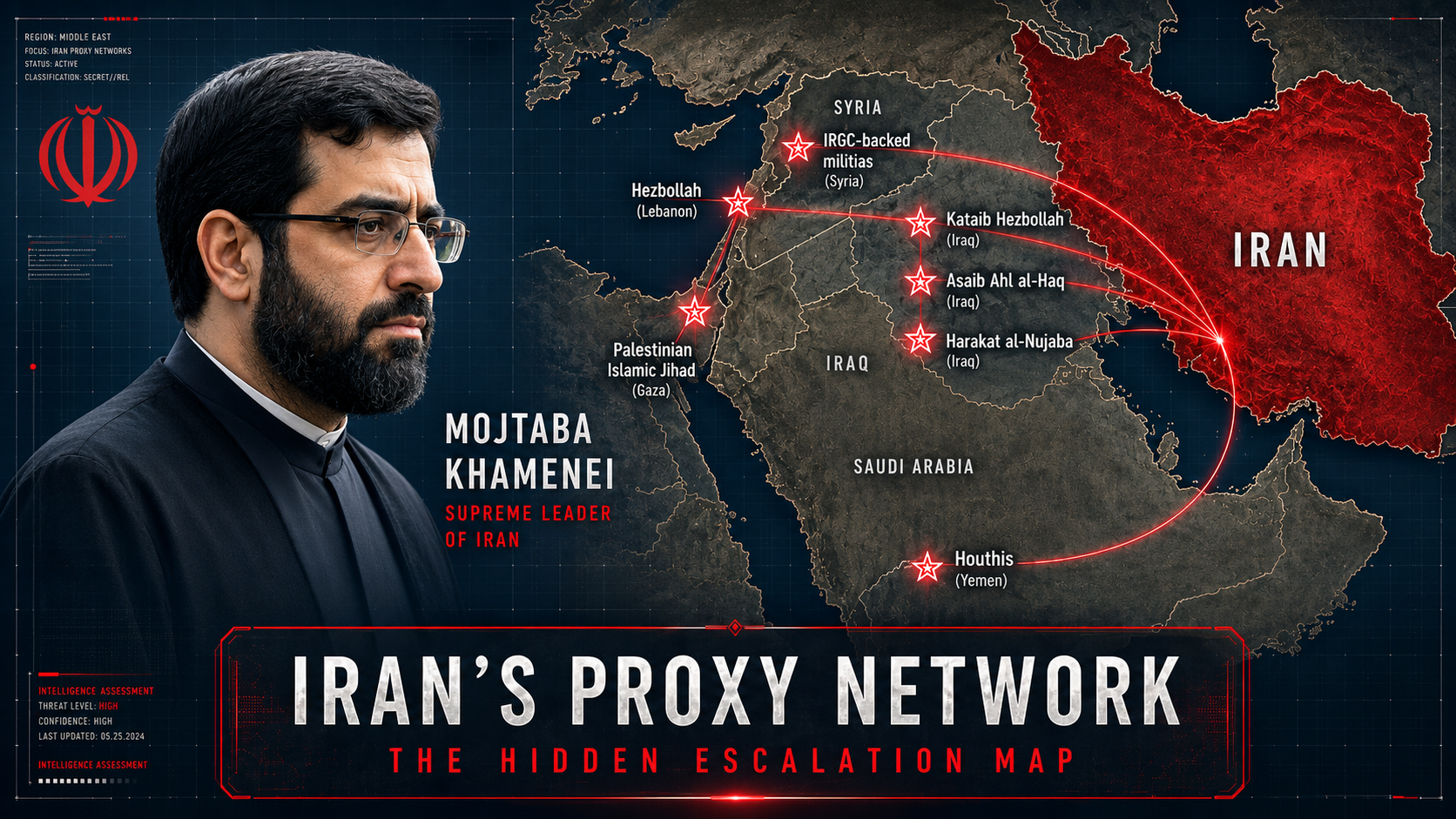
What decision-makers should watch now — before proxy escalation becomes a cost, compliance or supply-chain shock.
This 17-page executive briefing translates Iran’s proxy network into concrete business risks: energy price exposure, maritime chokepoints, war-risk premiums, sanctions, shadow fleets, supply-chain disruption and early-warning indicators for board-level decisions.
You are currently viewing a placeholder content from X. To access the actual content, click the button below. Please note that doing so will share data with third-party providers.
More Information