Executive Intelligence. Industrial Risk. Geopolitics.
Strategic Sparring
for Decision-Makers
Risk intelligence across technology, law, markets and power dynamics.


Verdeckte Geschäftsrisiken, strategische Widersprüche und kritische Abhängigkeiten frühzeitig erkennen.
Kostenlose Analyse starten →
Verdeckte Machtstrukturen, Führungsrisiken und organisatorische Blockaden frühzeitig erkennen.
Kostenlose Analyse starten →
Geopolitische Risiken, globale Abhängigkeiten und kritische Lieferkettenrisiken frühzeitig erkennen.
Kostenlose Analyse starten →
Identify hidden business risks, strategic contradictions and critical dependencies at an early stage.
Start Free Analysis →
Identify hidden power structures, leadership risks and organizational blockers at an early stage.
Start Free Analysis →
Identify geopolitical risks, global dependencies and critical supply-chain vulnerabilities at an early stage.
Start Free Analysis →
Verdeckte Geschäftsrisiken, strategische Widersprüche und kritische Abhängigkeiten frühzeitig erkennen.
Kostenlose Analyse starten →
Verdeckte Machtstrukturen, Führungsrisiken und organisatorische Blockaden frühzeitig erkennen.
Kostenlose Analyse starten →
Geopolitische Risiken, globale Abhängigkeiten und kritische Lieferkettenrisiken frühzeitig erkennen.
Kostenlose Analyse starten →
Identify hidden business risks, strategic contradictions and critical dependencies at an early stage.
Start Free Analysis →
Identify hidden power structures, leadership risks and organizational blockers at an early stage.
Start Free Analysis →
Identify geopolitical risks, global dependencies and critical supply-chain vulnerabilities at an early stage.
Start Free Analysis →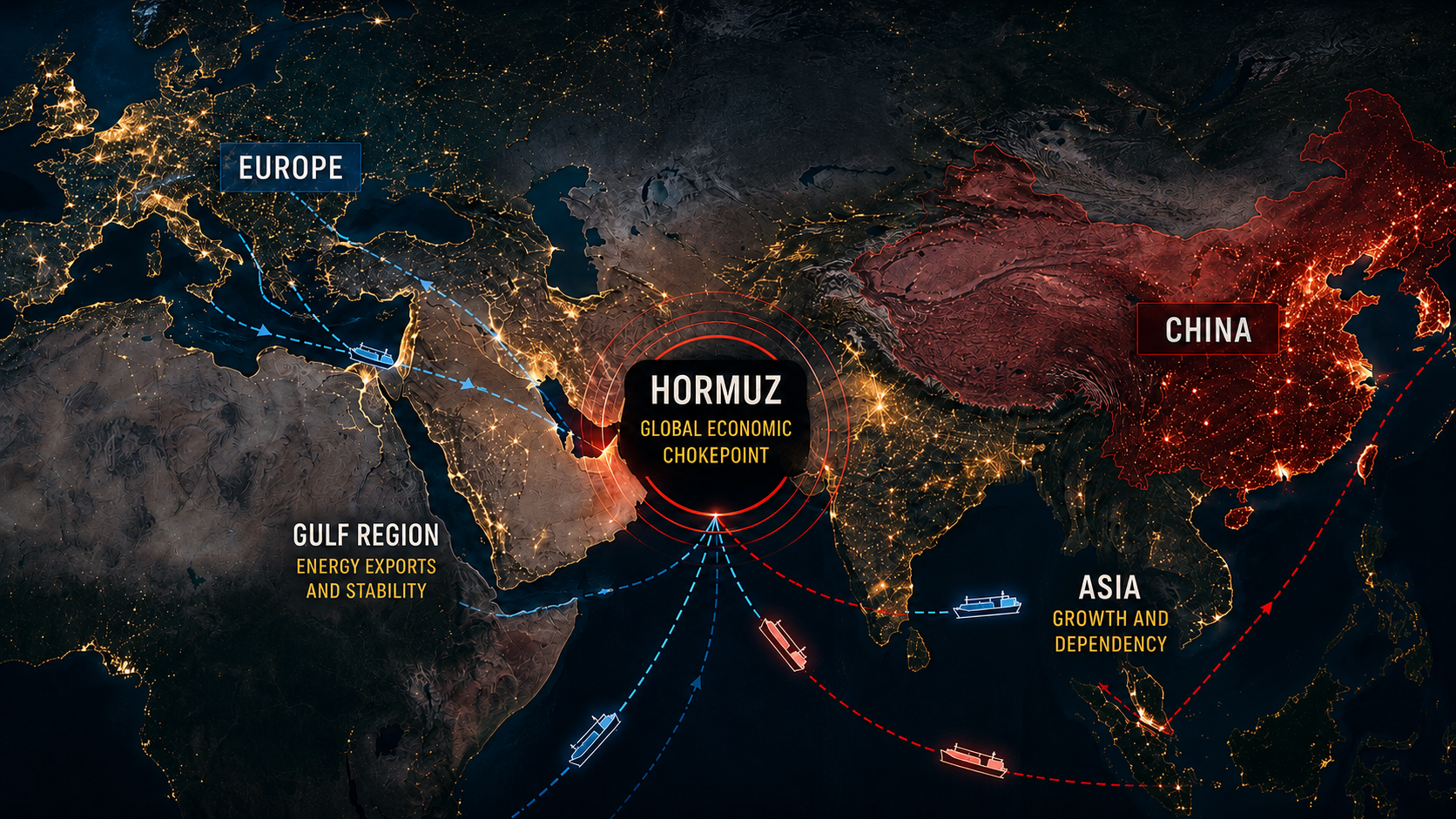
This Chokepoint Check assesses the current pressure on the Strait of Hormuz, Bab al-Mandab and the Gulf region’s critical water, power, port and energy infrastructure. The analysis focuses not only on whether a shipping route remains geographically open, but also on whether transport, supply, insurance coverage and site operations remain operationally viable.
Visible transit has almost completely collapsed, while a possible reopening model could grant Iran permanent access control.
According to Kpler data, only two visible commodity vessels passed through the Strait of Hormuz on Wednesday. Eight transits had been recorded on the previous day, while the pre-war daily average stood at approximately 130 to 140 vessels. At the same time, Iran and Oman stated that they had moved closer to an agreement on the coordinates of a possible shipping route. The proposed model would require inbound vessels to use a route controlled by Iran, while outbound vessels would use a corridor monitored by Oman. Fees, inspections and the removal of the US blockade against Iranian ports remain unresolved.
The southern gateway to the Red Sea remains geographically open, but has almost come to an operational standstill.
Only one visible commodity transit through Bab al-Mandab was recorded on Wednesday. Twenty vessels had passed through on the previous day. The Houthis stated that they had attacked two Saudi oil tankers with missiles: one tanker near Yanbu in the Red Sea and another in the Gulf of Aden. Saudi Arabia had not confirmed the claimed attacks by the reporting cut-off. Nevertheless, the near-total collapse in transit demonstrates that shipping companies, charterers and crews are already pricing the attack risk into operational decisions.
The escalation is increasingly targeting Saudi Arabia’s mobile energy infrastructure and therefore the redundancy of its export strategy.
The claimed attacks on Saudi oil tankers affect more than individual vessels. They target the link between Saudi export terminals, the East-West Pipeline, the port of Yanbu and international markets. Saudi Arabia had shifted a substantial share of its exports to the west coast in order to bypass Hormuz. If the Red Sea corridor is now also impaired by missile risk and a de facto Houthi blockade, the kingdom’s most important alternative route loses its operational reliability. No new confirmed attack on a fixed refinery, pipeline or desalination facility was identified for August 6.
According to Kpler data, only two visible commodity vessels passed through the Strait of Hormuz on Wednesday. Eight transits had been recorded on Tuesday. Before the war, the daily average stood at approximately 130 to 140 vessels. Visible traffic is therefore operating at only a fraction of its previous normal level.
The decline is not merely a political warning signal, but an immediate operational loss of capacity. The strait remains geographically passable, but cannot be described as reliably open. Attack risk, Iranian controls, US blockade measures and unclear passage conditions prevent normal commercial operations.
Energy buyers and industrial companies must prepare for irregular export windows, limited tanker availability, extended waiting times and additional security clearances. A later political agreement would not immediately resolve accumulated cargo backlogs, crew shortages and restricted insurance coverage.
Verification Status: confirmed regarding the visible Kpler transit data. Vessels operating with AIS disabled may not be captured, but this does not alter the exceptionally low and non-transparent level of traffic. Reuters, August 6, 2026
The Houthis stated that they had attacked two Saudi oil tankers with missiles. One attack allegedly took place near Yanbu in the Red Sea and the second in the Gulf of Aden. Saudi Arabia had not confirmed the attacks by the reporting cut-off. At the same time, visible transit through Bab al-Mandab fell from 20 vessels to only one vessel.
The precise strike outcome remains partly unclear. However, the operational impact is already measurable: Bab al-Mandab is effectively becoming unusable for normal commodity traffic. The Houthis are attempting to disrupt Saudi Arabia’s alternative strategy for bypassing Hormuz and to exert control over access to Saudi ports and export routes.
Shipping companies must weigh direct passage against military escort or the longer diversion around the Cape of Good Hope. This keeps tankers occupied for longer, increases bunker and personnel costs and extends delivery times for crude oil, refined products and industrial inputs.
Verification Status: partially confirmed. The Houthi claim and the sharp decline in visible traffic are confirmed. Saudi Arabia had not confirmed the attacks, while independent evidence of strikes and damage was not initially available. Reuters, August 6, 2026
Iran stated that an agreement with Oman on the coordinates of a new shipping route was close to completion. The proposed model includes an Iranian-controlled corridor for inbound vessels and an Omani-monitored corridor for outbound vessels. Outstanding issues include inspections, fees and Iran’s demand for the removal of the US blockade against its ports.
The agreement could provide operational relief, but would also represent a strategic upgrade for Iran. Tehran could convert its de facto military control into an institutionalised access regime. Reopening would therefore not be equivalent to a return to free and neutral passage.
Companies could regain limited transport windows, but might face Iranian registration, inspection and possibly fee requirements. The commercial viability of the route would remain dependent on political relations, US sanctions rules and insurer acceptance.
Verification Status: partially confirmed. The convergence between Iran and Oman and the proposed division of route oversight are confirmed. A final, published and operationally implemented agreement has not yet been established. Reuters, published August 5, 2026 and immediately operationally relevant on August 6
Two Israeli soldiers were killed in an explosion during an operation in southern Lebanon, while four others were seriously injured. Israel responded with air strikes. According to Lebanese authorities, one person was killed and 12 others were injured. Israel had previously ordered residents of Mansouri to evacuate.
These were the first Israeli fatalities since the ceasefire agreed in June. Israel’s initial claim of a Hezbollah violation was not later maintained unequivocally. Nevertheless, the combination of soldier fatalities, evacuation warnings and air strikes substantially increases the risk of a renewed escalation cycle.
The violence threatens cross-border traffic, reconstruction, infrastructure projects and the return of displaced residents. A renewed expansion could again disrupt airports, ports, land corridors and supply chains between Lebanon, Israel, Syria and Jordan.
Verification Status: confirmed regarding the Israeli fatalities and injuries, Israeli retaliatory strikes and Lebanese casualty figures. The precise cause of the explosion and direct Hezbollah responsibility remained unclear initially. Reuters, August 6, 2026
New July assessments show that crude oil and condensate exports from Gulf states amounted to approximately 10.7 million barrels per day. This remained around 40 percent below pre-war levels. Iraq increased exports compared with June, while Saudi Arabia and the United Arab Emirates recorded declines. More attacks on vessels were also reported in July than in June.
The figures demonstrate that limited export stabilisation must not be equated with restored security of supply. The system is operating at a significantly reduced level and remains dependent on individual tanker passages, alternative pipelines and exposed Red Sea terminals. Even an immediate normalisation of Hormuz would not quickly restore depleted inventories.
Industrial companies remain exposed to price spikes, constrained product availability and longer procurement lead times. Lower daily prices do not demonstrate relaxed supply conditions, as strategic inventories, tanker capacity and export reserves remain under substantial pressure.
Verification Status: confirmed regarding the published export and attack data. The figures describe July, but were newly published on August 5 and remain immediately relevant to the current capacity assessment on August 6. Reuters, August 5, 2026
The Houthis claim attacks on Saudi oil tankers, while Hormuz remains under Iranian control and US blockade pressure.
Shipping companies avoid both corridors, disable AIS, wait for clearance or reroute around Africa.
Hormuz falls to two visible transits, Bab al-Mandab to one, while Gulf exports remain 40 percent below pre-war levels.
Tanker capacity, inventories, delivery times, insurance premiums and industrial energy supply remain structurally strained.
Visible transit has fallen to two commodity vessels in Hormuz and one in Bab al-Mandab. At the same time, the Houthis claim missile attacks on two Saudi oil tankers. Both routes remain geographically open, but are barely usable in reliable economic and operational terms.
Simultaneous de facto transit collapse at both central energy chokepointsSaudi Arabia’s mobile export infrastructure is directly threatened by claimed attacks on oil tankers near Yanbu and in the Gulf of Aden. No new physical attack on a fixed refinery, pipeline, power facility or water installation was confirmed for August 6.
Energy export system directly affected · fixed Gulf facilities remain exposedHormuz, Bab al-Mandab and the Israel-Lebanon front are deteriorating at the same time. A possible Iran-Oman model links the reopening of the strait with Iranian access control and the US blockade of Iranian ports. Gulf exports simultaneously remain well below pre-war levels.
Maritime control, energy scarcity and regional multi-front escalation confirmedEscalation signals clearly outweigh de-escalation signals. Compared with August 4, operational transport conditions have deteriorated dramatically again. The decisive factor is the simultaneous collapse at both chokepoints: Hormuz records only two visible commodity transits, while Bab al-Mandab records only one. This means that disruption is no longer confined to a single route. The entire maritime redundancy system supporting Gulf exports is effectively constrained. An Iran-Oman agreement could provide relief, but would grant Iran substantial control over inbound traffic and would resolve neither the US blockade of Iranian ports nor the Houthi threat in the Red Sea. Renewed violence in Lebanon creates the parallel risk of another active front. Shipping, energy supply, insurance coverage, aviation and site continuity therefore remain critically exposed.
Note: This assessment was produced with support from our Geo-AI. AI can make mistakes. The analysis is intended as a source-based radar for potential escalation signals and does not replace fully verified intelligence, security, insurance or investment advice. In rapidly evolving situations, status, source availability and risk assessments may change at short notice.
Independent of the subject covered in this article, this separate Executive Briefing provides an in-depth analysis of another critical risk domain affecting European companies.
The 27-page Executive Briefing “Black Swan Risk Mapping for Europe’s Next Mobility and Infrastructure Shock” examines how geopolitical, infrastructural and administrative developments that are currently viewed in isolation could reinforce one another.
Based on the GFDD Framework™, the report shows how these dynamics could affect operational continuity, access to critical resources and the strategic resilience of companies.
The briefing includes a structured systemic-shock analysis and a directly applicable Business Exposure Checklist for CEOs, CFOs, COOs, investors and strategy teams.
You are currently viewing a placeholder content from X. To access the actual content, click the button below. Please note that doing so will share data with third-party providers.
More Information