Executive Intelligence. Industrial Risk. Geopolitics.
Strategic Sparring
for Decision-Makers
Risk intelligence across technology, law, markets and power dynamics.

Verdeckte Geschäftsrisiken, strategische Widersprüche und kritische Abhängigkeiten frühzeitig erkennen.
Kostenlose Analyse starten →
Verdeckte Machtstrukturen, Führungsrisiken und organisatorische Blockaden frühzeitig erkennen.
Kostenlose Analyse starten →
Geopolitische Risiken, globale Abhängigkeiten und kritische Lieferkettenrisiken frühzeitig erkennen.
Kostenlose Analyse starten →
Identify hidden business risks, strategic contradictions and critical dependencies at an early stage.
Start Free Analysis →
Identify hidden power structures, leadership risks and organizational blockers at an early stage.
Start Free Analysis →
Identify geopolitical risks, global dependencies and critical supply-chain vulnerabilities at an early stage.
Start Free Analysis →
Verdeckte Geschäftsrisiken, strategische Widersprüche und kritische Abhängigkeiten frühzeitig erkennen.
Kostenlose Analyse starten →
Verdeckte Machtstrukturen, Führungsrisiken und organisatorische Blockaden frühzeitig erkennen.
Kostenlose Analyse starten →
Geopolitische Risiken, globale Abhängigkeiten und kritische Lieferkettenrisiken frühzeitig erkennen.
Kostenlose Analyse starten →
Identify hidden business risks, strategic contradictions and critical dependencies at an early stage.
Start Free Analysis →
Identify hidden power structures, leadership risks and organizational blockers at an early stage.
Start Free Analysis →
Identify geopolitical risks, global dependencies and critical supply-chain vulnerabilities at an early stage.
Start Free Analysis →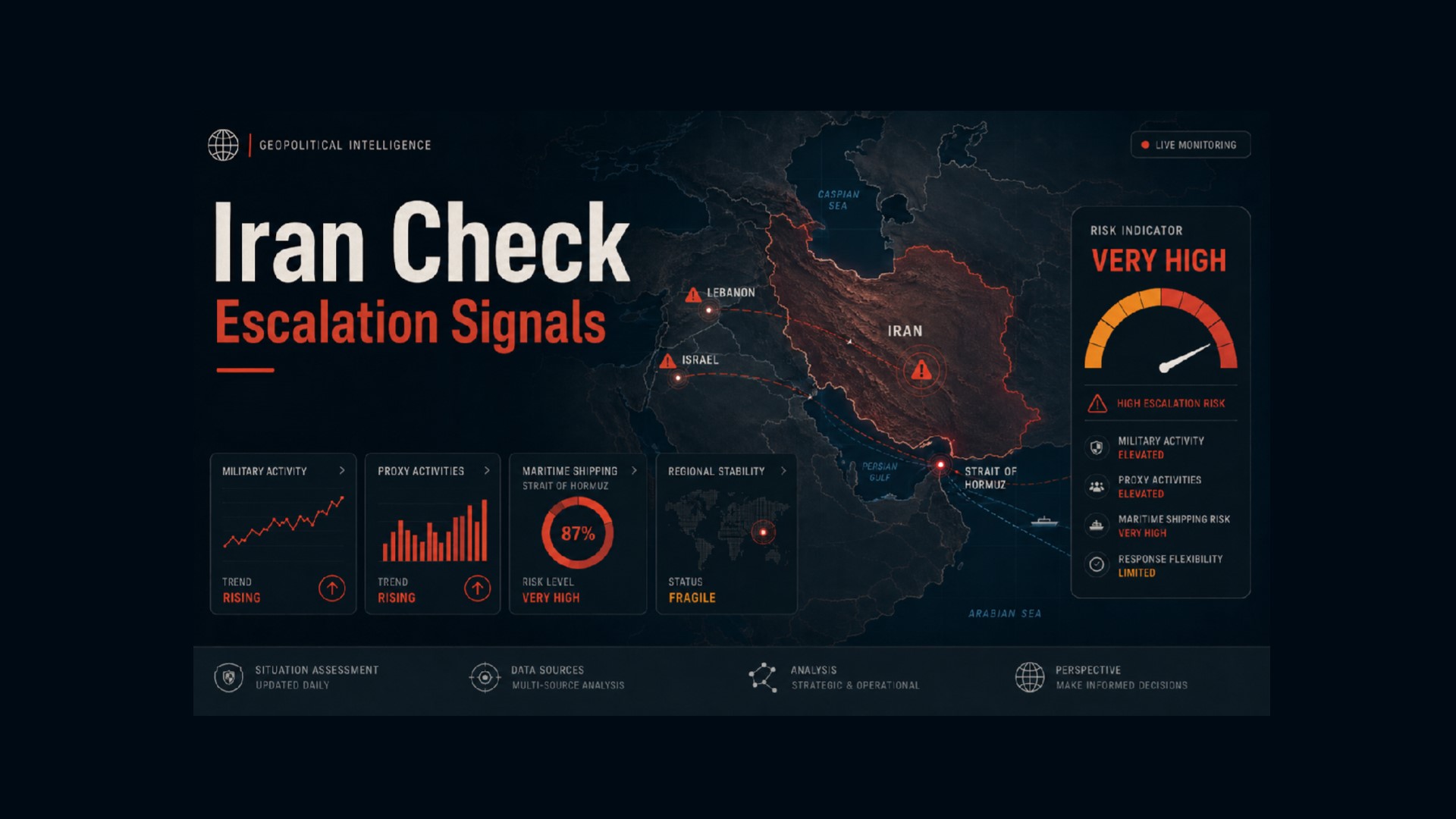
This escalation radar summarises five relevant signals as of August 7, 2026. It focuses on substantiated statements by official bodies, verified events and monitoring sources with potential implications for energy prices, supply chains, markets, maritime security, aviation and regional stability.
Iran is warning Saudi Arabia, Qatar and other Gulf states: renewed US strikes could trigger retaliation against oil fields, refineries, power grids, water facilities and transport infrastructure. This explicitly makes key Gulf economic assets part of Iran’s deterrence strategy.
Only 33 visible transits were recorded from Monday through Thursday. On Thursday, there were just four. Despite Iraqi crude discounts of almost USD 30 per barrel, buyers are struggling to find shipowners willing to accept the risk of entering Hormuz.
Saudi Arabia, Türkiye and Pakistan are set to sign a joint defence agreement on August 7. The new axis links a key Gulf power, NATO’s second-largest military and the only Muslim-majority nuclear-armed state. The backdrop is growing pressure from Iran and Iran-aligned actors, as well as doubts about the existing regional security order.
| Actor | Type | Severity | Status | Source / Verification Status | Business Impact |
|---|---|---|---|---|---|
| Iran / Saudi Arabia / Qatar / Türkiye / Pakistan / United States | Iran threatens Gulf states with attacks on energy, water and transport infrastructure | Critical · Level 5/5 | Iran has significantly escalated its deterrence posture towards Gulf states. According to Reuters, Tehran warned regional governments that renewed US strikes against Iran could trigger retaliation against oil fields, refineries, power grids, water facilities, transport networks and other strategic infrastructure. Foreign Minister Abbas Araghchi conveyed the message to Saudi Arabia, Qatar and Türkiye, among others, as well as to Pakistan’s military leadership. Saudi Arabia subsequently again urged Trump to delay military action and prioritise diplomacy, while also stating that it would respond militarily to any attack on Saudi territory. Power dynamics: Iran is attempting to turn the vulnerability of Gulf economies directly into deterrence against Washington. Energy, water and logistics systems are therefore now being explicitly framed as potential retaliation targets. | Confirmed by Reuters, August 6, 2026 . Verification status: confirmed regarding the Iranian threat, the categories of critical infrastructure named and the diplomatic contacts with Gulf states. Specific targets, the threshold for Iranian retaliation and the scale of any potential military implementation remain unresolved. | Critical business impact on oil and gas production, refineries, power supply, desalination and water systems, ports, airports, logistics hubs, expatriate security, insurance, business travel and site continuity across the Gulf region. |
| Iran / Oman / Iraq / China / India / international shipowners | Hormuz traffic falls further as shipowners avoid even heavily discounted Iraqi cargoes | Critical · Level 5/5 | The operational situation in Hormuz had not improved by August 7. Only 33 visible vessels passed through the strait from Monday through Thursday, compared with 50 over the same period the previous week. On Thursday, only four transits were recorded. Particularly significant: Chinese and Indian refiners are showing interest in heavily discounted Iraqi crude. SOMO is offering discounts of almost USD 30 per barrel. Even so, corresponding vessels have so far not been firmly booked, because shipowners continue to regard entry into Hormuz as too risky. US sanctions and insurance conditions are also complicating the proposed Iran-Oman arrangement. Power dynamics: Increasingly, it is not the oil price but physical passage, insurability and shipowner willingness that determine which Gulf exports can actually reach the global market. | Confirmed by Reuters, August 7, 2026 and Reuters, August 6, 2026 . Verification status: confirmed regarding 33 visible transits from Monday through Thursday, only four passages on Thursday, the substantial Iraqi discounts and shipowners’ continued reluctance. AIS shutdowns may distort the absolute vessel count, but do not change the overall picture of severely constrained traffic. | Critical business impact on crude oil and LNG, tanker charters, war-risk insurance, freight rates, trade finance, deliveries to India and China, refineries, chemicals, fertilisers, energy procurement and production planning. |
| Iran / Parliament / United States / Israel / international shipping | Draft law would exclude US, Israeli and other “hostile” vessels from Hormuz | High to critical · Level 4/5 | An Iranian parliamentary committee is reviewing a draft law that would ban US, Israeli and other vessels classified as hostile from passing through Hormuz. Under the draft, violations could be punished with fines of up to 20 percent of the cargo value. The proposal has not yet been passed. Politically, however, it is highly significant because it introduces a new selective access restriction into the ongoing debate over a controlled reopening. Power dynamics: Iran is attempting to translate its de facto influence over Hormuz into formal national rules. This deepens the dispute with Washington over the status of an international waterway and makes a universally accessible transit mechanism more difficult. | Confirmed by Reuters, August 6, 2026 . Verification status: confirmed regarding parliamentary review, the vessel categories concerned and possible fines of up to 20 percent of cargo value. The draft has not yet been finalised or enacted. | High to critical business impact on vessel registration, ownership structures, charter chains, insurance, sanctions, compliance, freight contracts, routing and companies whose vessels or financing have US or Israeli links. |
| Houthis / Iran-aligned Iraqi militias / Saudi Arabia / Najran | Houthi attack injures eleven civilians and Saudi Arabia warns of coordinated follow-on strikes | Critical · Level 5/5 | The operational threat to Saudi Arabia escalated further on August 6 and 7. A Houthi attack on the southern Saudi province of Najran injured eleven civilians, including nationals of Saudi Arabia, Egypt, Pakistan and Yemen. More importantly, Saudi Arabia warned of possible coordinated follow-on attacks. According to a senior Saudi official, intelligence indicates that the Houthis and Iran-aligned Iraqi militias could be preparing attacks against Saudi energy facilities, ports, airports and other civilian targets. Saudi Arabia stated that its operational cooperation with the United States remained very close and that the kingdom would respond to further aggression. Power dynamics: Proxy escalation is shifting from individual tankers increasingly towards the Saudi mainland and critical infrastructure. | Confirmed by Reuters, August 6/7, 2026 . Verification status: confirmed regarding the eleven injured civilians and the Saudi warning. The anticipated follow-on attacks have not yet occurred and are based on intelligence that has not been made public. | Critical business impact on Saudi Arabia, energy facilities, ports, airports, industrial parks, business travel, personnel and evacuation planning, insurance, air freight, port logistics and site continuity. |
| Saudi Arabia / Türkiye / Pakistan / NATO / Iran | Joint defence agreement creates a new regional security axis | High to critical · Level 4/5 | Saudi Arabia, Türkiye and Pakistan are set to sign a joint defence agreement on August 7. This brings three of the most militarily significant Sunni-majority states closer together: Saudi Arabia as the leading Gulf power, Türkiye with NATO’s second-largest military and Pakistan as the only Muslim-majority nuclear-armed state. The agreement had already been under preparation for some time, but Iranian attacks on Gulf states, Houthi attacks and the current regional uncertainty give it new strategic significance. Details of specific mutual defence obligations have not yet been published. Power dynamics: Gulf states are increasingly responding not only through US-backed deterrence, but also through their own regional security structures. This more closely links the Iran conflict with NATO-member Türkiye, Pakistan and an emerging Sunni defence architecture. | Confirmed by Reuters, August 7, 2026 . Verification status: confirmed regarding the planned signing and the participation of Saudi Arabia, Türkiye and Pakistan. Specific mutual defence clauses, deployments, joint command structures and possible nuclear or air-defence components remain unresolved. | High to critical business impact on regional security planning, defence and dual-use supply chains, exposure to Türkiye, Pakistan and Saudi Arabia, export controls, defence procurement, air defence, insurance and long-term investment decisions in the Gulf region. |
The central escalation point on August 7, 2026 is not a new direct US-Iran strike, but the increasing institutionalisation of the confrontation. Iran is now explicitly threatening Gulf states with attacks on critical energy, power, water and transport infrastructure if Washington strikes again. At the same time, Iran’s parliament is considering rules that could completely deny certain vessels access to Hormuz. Iran’s strategy is therefore shifting from selective military disruption towards more permanent political and legal control over regional infrastructure and shipping.
Operationally, Hormuz remains far from normal. Only 33 visible vessels passed through the strait from Monday through Thursday. Even discounts of almost USD 30 per barrel on Iraqi crude are currently insufficient to persuade enough shipowners to enter the waterway. This is critical for businesses: a political Hormuz deal has little economic value as long as sanctions, insurance restrictions, security risks and Iranian access controls prevent regular transit.
At the same time, Saudi Arabia’s security environment is deteriorating. The Houthi attack on Najran injured eleven civilians. Saudi Arabia is also warning of coordinated attacks by the Houthis and Iran-aligned Iraqi militias against energy facilities, ports and airports. Riyadh is responding through closer regional defence cooperation: Saudi Arabia, Türkiye and Pakistan are creating a new security axis that links the Iran conflict more closely with NATO structures and Pakistan.
The EASA aviation warning environment remains an additional operational risk factor. High conflict-zone risks remain in place for Iran, Iraq and Lebanon; other Gulf airspaces also remain relevant for flight planning and business travel because of possible missile, drone and misidentification risks.
The five most important signals for a European and German business risk assessment are: Iran’s explicit threat against oil, power, water and transport infrastructure across Gulf states, the continued decline in Hormuz traffic despite substantial Iraqi crude discounts, the Iranian draft law to exclude US, Israeli and other “hostile” vessels, the Houthi attack on Najran and the Saudi warning of coordinated follow-on attacks, and the new defence agreement between Saudi Arabia, Türkiye and Pakistan as a strategic response to the regional security crisis.
Note: This assessment was prepared with the support of our Geo AI. AI can make mistakes. The analysis is intended as a radar for potential escalation signals and does not replace a fully verified intelligence assessment.
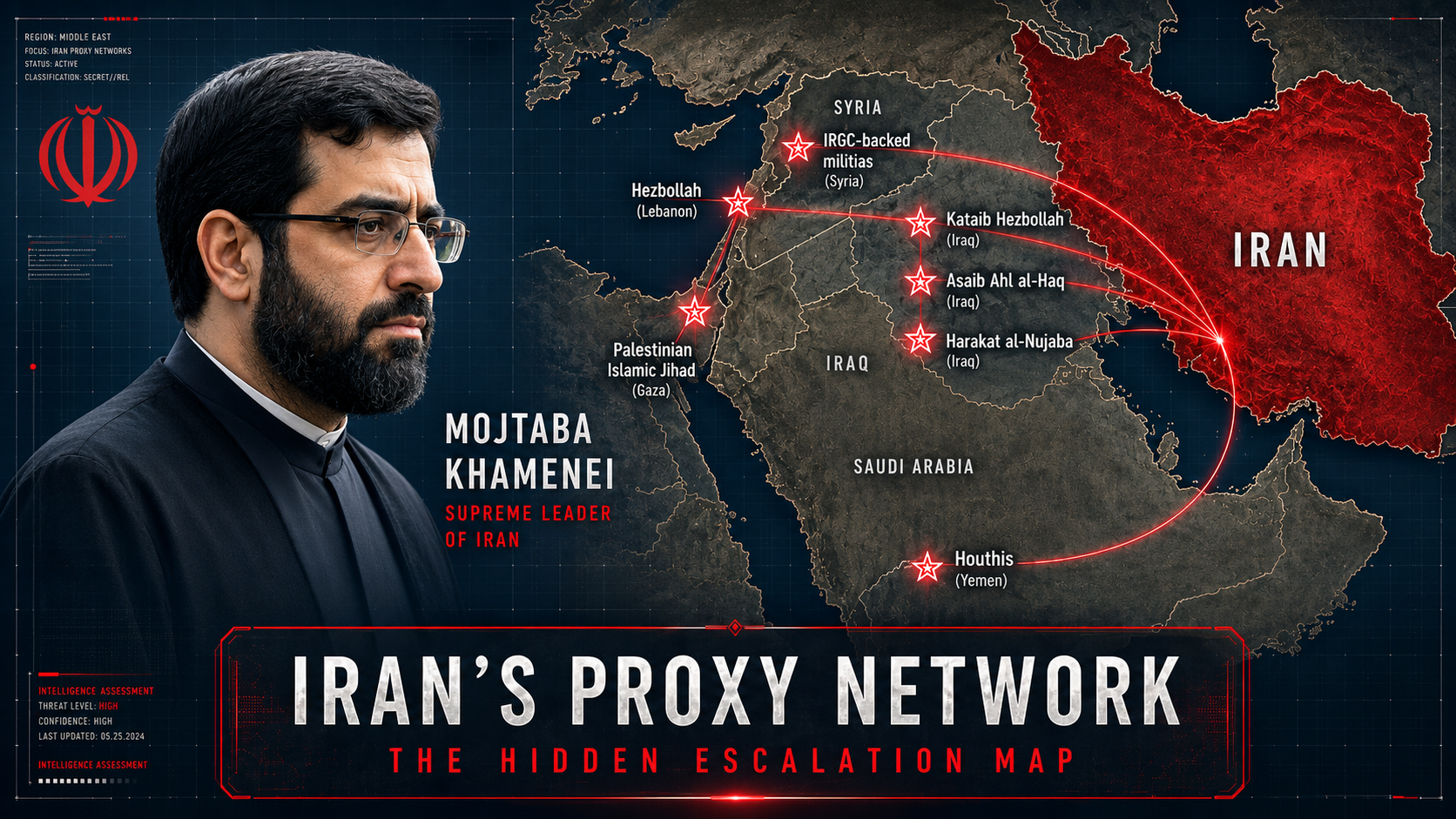
What decision-makers should watch now — before proxy escalation becomes a cost, compliance or supply-chain shock.
This 17-page executive briefing translates Iran’s proxy network into concrete business risks: energy price exposure, maritime chokepoints, war-risk premiums, sanctions, shadow fleets, supply-chain disruption and early-warning indicators for board-level decisions.
You are currently viewing a placeholder content from X. To access the actual content, click the button below. Please note that doing so will share data with third-party providers.
More Information