Executive Intelligence. Industrial Risk. Geopolitics.
Strategic Sparring
for Decision-Makers
Risk intelligence across technology, law, markets and power dynamics.

Verdeckte Geschäftsrisiken, strategische Widersprüche und kritische Abhängigkeiten frühzeitig erkennen.
Kostenlose Analyse starten →
Verdeckte Machtstrukturen, Führungsrisiken und organisatorische Blockaden frühzeitig erkennen.
Kostenlose Analyse starten →
Geopolitische Risiken, globale Abhängigkeiten und kritische Lieferkettenrisiken frühzeitig erkennen.
Kostenlose Analyse starten →
Identify hidden business risks, strategic contradictions and critical dependencies at an early stage.
Start Free Analysis →
Identify hidden power structures, leadership risks and organizational blockers at an early stage.
Start Free Analysis →
Identify geopolitical risks, global dependencies and critical supply-chain vulnerabilities at an early stage.
Start Free Analysis →
Verdeckte Geschäftsrisiken, strategische Widersprüche und kritische Abhängigkeiten frühzeitig erkennen.
Kostenlose Analyse starten →
Verdeckte Machtstrukturen, Führungsrisiken und organisatorische Blockaden frühzeitig erkennen.
Kostenlose Analyse starten →
Geopolitische Risiken, globale Abhängigkeiten und kritische Lieferkettenrisiken frühzeitig erkennen.
Kostenlose Analyse starten →
Identify hidden business risks, strategic contradictions and critical dependencies at an early stage.
Start Free Analysis →
Identify hidden power structures, leadership risks and organizational blockers at an early stage.
Start Free Analysis →
Identify geopolitical risks, global dependencies and critical supply-chain vulnerabilities at an early stage.
Start Free Analysis →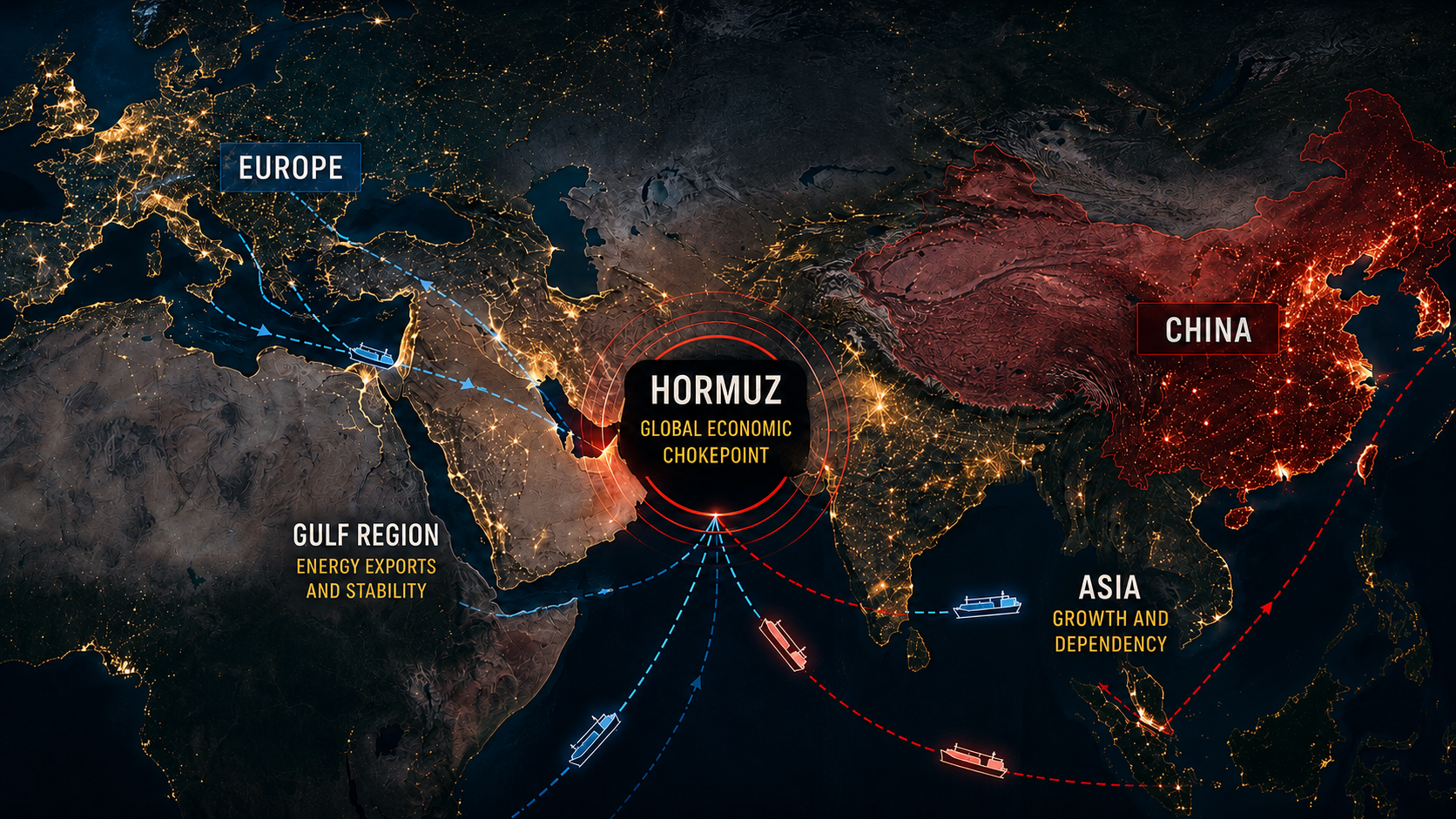
This Chokepoint Check assesses current pressure on the Strait of Hormuz, Bab al-Mandab and the Gulf region’s critical water, power, port and energy infrastructure. The analysis focuses not only on whether a shipping route remains geographically open, but also on whether transport, supply, insurance coverage and site operations remain operationally viable.
Traffic remains far from normal operations even as a political reopening mechanism moves closer.
Only 33 visible vessel movements were recorded from Monday through Thursday, compared with 50 in the previous week. On Thursday, just four vessels transited the strait, including one VLCC carrying around two million barrels of Iraqi Basrah crude. Only six crude tankers exited Hormuz during the week. Despite Iraqi discounts of up to around USD 30 per barrel, several Asian buyers were unable to secure vessels because shipowners continue to avoid the security risk.
Transit has recovered significantly from the extreme decline, but there is still no reliable all-clear.
Kpler recorded 26 transits through Bab al-Mandab on Thursday, while LSEG counted 28. Nineteen had been recorded on the previous day. The route has therefore recovered significantly from the near-total collapse seen on August 6. At the same time, the Houthis have expanded attacks against Saudi-backed forces and targets. The route is again being used more heavily, but remains exposed to military and insurance risk.
Repeated attacks are now directly affecting the operational energy and transport infrastructure of a major Gulf producer.
ADNOC stated on August 7 that three of its vessels had been attacked in this week alone. Since the start of the war, 15 ADNOC vessels have reportedly been struck by missiles or drones in Hormuz. The company says the attacks are having a significant impact on staff and operations. No new physical attack on a fixed refinery, pipeline or desalination facility was sufficiently confirmed within the current research window.
Only 33 visible vessels transited Hormuz from Monday through Thursday, with just four transits on Thursday. Only six crude tankers exited the strait during the week. Before the war, daily traffic typically stood at around 130 to 140 vessels.
The route is geographically open, but not operationally normalised. The fact that Chinese and Indian buyers cannot secure sufficient tanker capacity despite steep Iraqi discounts clearly demonstrates continuing shipowner risk aversion.
Low crude prices or deep producer discounts do not compensate for the transport bottleneck. Tanker shortages, war-risk costs and unpredictable loading windows remain key risks for energy buyers and industrial companies.
Verification Status: confirmed regarding Kpler data, transit volumes, Iraqi price discounts and shipowner reluctance. Reuters, August 7, 2026 · immediately operationally relevant on August 8
ADNOC stated on August 7 that three of its vessels had been attacked in this week alone. Since the beginning of the conflict, 15 ADNOC vessels have reportedly been struck by missiles or drones in Hormuz. One crew member was killed and 20 were injured.
The threat is no longer abstract. A major state-owned Gulf producer is confirming repeated physical attacks and significant operational disruption. The uncertainty now affects personnel, tankers and export continuity at the same time.
Repeated attacks increase security costs, charter rates and insurance requirements. Even where production remains sufficient, the reliable physical export of oil, gas and refined products can become the primary bottleneck.
Verification Status: confirmed by ADNOC regarding the attacks, casualty figures and significant impact on its operations. Reuters, August 7, 2026 · immediately operationally relevant on August 8
Saudi Arabia, Turkey and Pakistan signed a joint defence agreement in Mecca on August 7. An armed attack on any one of the three states is to be treated as an attack on all. Specific automatic military commitments were not made public.
The agreement represents a significant systemic shift. Saudi Arabia is aligning more closely with NATO’s second-largest military and the only Muslim nuclear-armed state. The signatories stress the defensive nature of the pact, but it nevertheless creates a new regional deterrence structure.
Stronger deterrence could improve site and infrastructure security over the longer term. In the short term, however, military integration across bases, air defence, defence procurement and maritime security is increasing throughout the Gulf region.
Verification Status: confirmed regarding the signing, mutual-defence clause and political purpose. The scope and specific operational commitments remain open. Reuters, August 7, 2026
According to the Saudi military, 11 civilians were injured in Houthi attacks in Najran. In parallel, the Houthis attacked Saudi-backed forces in Marib and Hadramout with ballistic missiles and drones. Numerous casualties were reported there.
The escalation is therefore moving beyond attacks against shipping. The conflict is returning to the Saudi-Yemeni border and to major land theatres. This increases pressure on Riyadh to make practical use of its new defence architecture.
Border regions, roads, airports and projects in southern Saudi Arabia are again facing higher security risk. A wider ground escalation could additionally disrupt personnel, cargo and energy movements between Yemen and Saudi Arabia.
Verification Status: confirmed regarding Saudi reports of 11 injured civilians and attacks on Marib and Hadramout. Individual Houthi casualty claims have not been treated as independently confirmed. Associated Press, August 7, 2026 · continuing escalation on August 8
A US government official stated late on August 7 that Washington expected an Iran-Oman agreement soon. Once unhindered commercial shipping is restored, the United States would lift its blockade of Iranian ports.
For the first time, a concrete US concession is being tied to verifiable maritime implementation. This is an important de-escalation signal, but not yet an operational breakthrough. Previous convergence failed over implementation and control.
A functioning agreement could gradually improve export capacity, tanker availability and insurability. What matters are actual transits, accepted payment terms and declining security premiums, not the political announcement.
Verification Status: confirmed regarding US willingness to lift the blockade under defined conditions. A final Iran-Oman agreement and its operational implementation have not yet been established. Reuters, August 7, 2026, 19:14 UTC · immediately current on August 8
ADNOC vessels face repeated attacks, while Houthi strikes again reach Saudi territory.
Shipowners avoid Hormuz despite steep oil discounts, while security and insurance requirements remain high.
Only six crude tankers exit Hormuz during the week, leaving vessels and crews as key bottlenecks.
Freight rates, procurement lead times and energy supply remain vulnerable despite diplomatic progress.
Hormuz remains severely constrained, with only 33 transits from Monday through Thursday. ADNOC reports three attacks in one week. Bab al-Mandab, by contrast, has recovered to 26 to 28 daily transits.
Hormuz remains critical · Bab al-Mandab has partially recovered operationallyADNOC confirms repeated attacks on its transport infrastructure and significant operational disruption. No new confirmed attack on a fixed Gulf refinery, pipeline or water facility has been identified.
Energy transport infrastructure physically affectedThe Saudi-Turkey-Pakistan alliance links Gulf defence with NATO military capabilities and Pakistani capabilities. At the same time, the Houthis are escalating again along the Saudi border while Hormuz remains commercially unreliable.
Regional defence blocs and the chokepoint crisis are increasingly interconnectedThe picture is less clear-cut than on August 6, but remains structurally critical. Bab al-Mandab has recovered significantly and a Hormuz agreement appears closer. Hormuz itself, however, remains severely constrained: shipowners continue to avoid the route even in the face of exceptional oil discounts. ADNOC has also confirmed three new attacks within one week. In parallel, the Saudi-Turkey-Pakistan pact is reshaping the region’s security architecture, while Houthi attacks are again reaching Saudi territory. Genuine de-escalation therefore begins only when Hormuz sustains higher traffic volumes and attacks on commercial vessels actually decline.
Note: This assessment was produced with support from our Geo-AI. AI can make mistakes. The analysis is intended as a source-based radar for potential escalation signals and does not replace fully verified intelligence, security, insurance or investment advice. In rapidly evolving situations, status, source availability and risk assessments may change at short notice.
Independent of the subject covered in this article, this separate Executive Briefing provides an in-depth analysis of another critical risk domain affecting European companies.
The 27-page Executive Briefing “Black Swan Risk Mapping for Europe’s Next Mobility and Infrastructure Shock” examines how geopolitical, infrastructural and administrative developments that are currently viewed in isolation could reinforce one another.
Based on the GFDD Framework™, the report shows how these dynamics could affect operational continuity, access to critical resources and the strategic resilience of companies.
The briefing includes a structured systemic-shock analysis and a directly applicable Business Exposure Checklist for CEOs, CFOs, COOs, investors and strategy teams.
You are currently viewing a placeholder content from X. To access the actual content, click the button below. Please note that doing so will share data with third-party providers.
More Information