Executive Intelligence. Industrial Risk. Geopolitics.
Strategic Sparring
for Decision-Makers
Risk intelligence across technology, law, markets and power dynamics.


Verdeckte Geschäftsrisiken, strategische Widersprüche und kritische Abhängigkeiten frühzeitig erkennen.
Kostenlose Analyse starten →
Verdeckte Machtstrukturen, Führungsrisiken und organisatorische Blockaden frühzeitig erkennen.
Kostenlose Analyse starten →
Geopolitische Risiken, globale Abhängigkeiten und kritische Lieferkettenrisiken frühzeitig erkennen.
Kostenlose Analyse starten →
Identify hidden business risks, strategic contradictions and critical dependencies at an early stage.
Start Free Analysis →
Identify hidden power structures, leadership risks and organizational blockers at an early stage.
Start Free Analysis →
Identify geopolitical risks, global dependencies and critical supply-chain vulnerabilities at an early stage.
Start Free Analysis →
Verdeckte Geschäftsrisiken, strategische Widersprüche und kritische Abhängigkeiten frühzeitig erkennen.
Kostenlose Analyse starten →
Verdeckte Machtstrukturen, Führungsrisiken und organisatorische Blockaden frühzeitig erkennen.
Kostenlose Analyse starten →
Geopolitische Risiken, globale Abhängigkeiten und kritische Lieferkettenrisiken frühzeitig erkennen.
Kostenlose Analyse starten →
Identify hidden business risks, strategic contradictions and critical dependencies at an early stage.
Start Free Analysis →
Identify hidden power structures, leadership risks and organizational blockers at an early stage.
Start Free Analysis →
Identify geopolitical risks, global dependencies and critical supply-chain vulnerabilities at an early stage.
Start Free Analysis →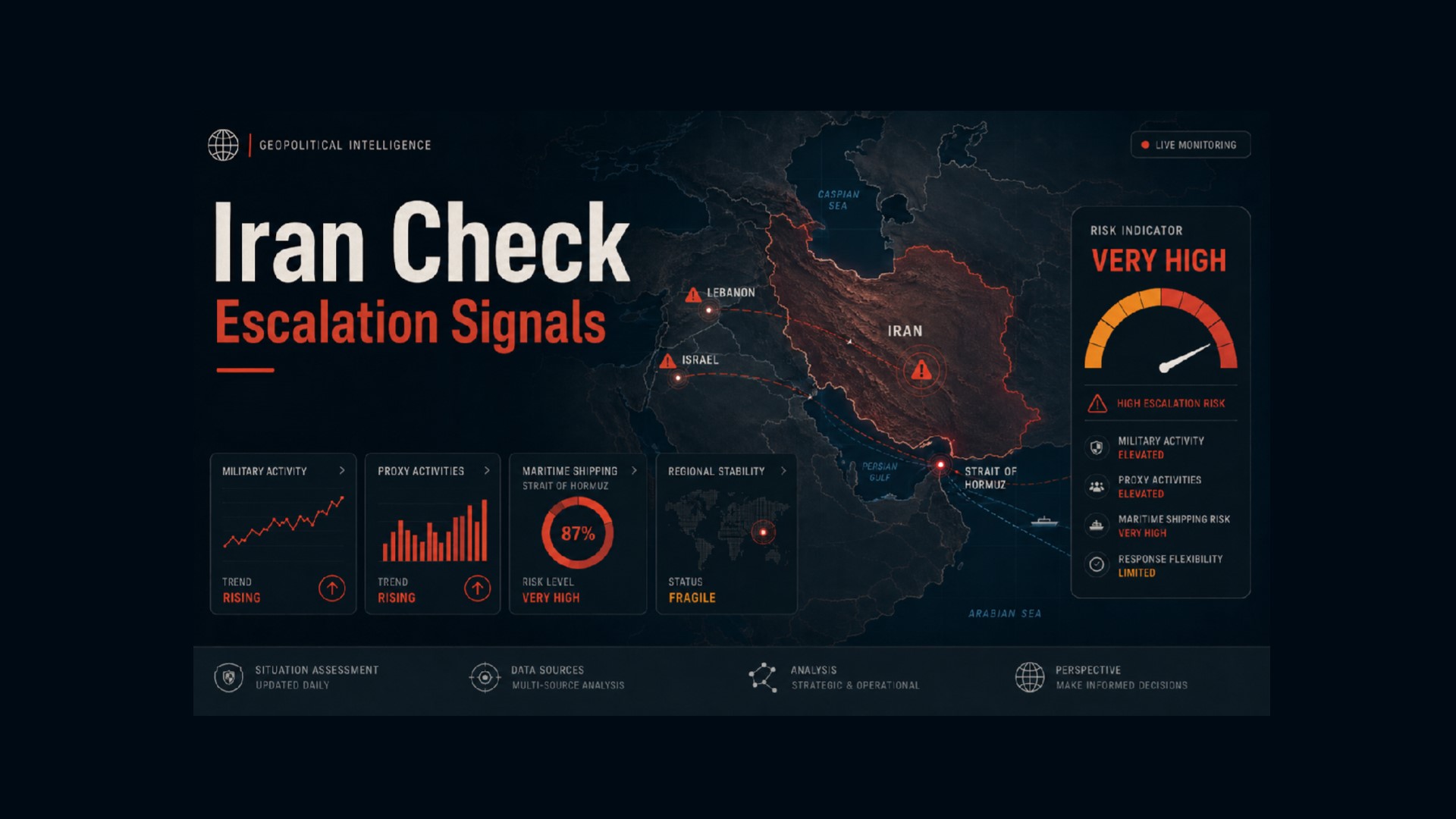
This escalation radar summarises five relevant signals as of August 13, 2026. It focuses on substantiated statements by official bodies, verified events and monitoring sources with potential implications for energy prices, supply chains, markets, maritime security, aviation and regional stability.
The chairman of the Iranian Parliament’s National Security Committee stated on August 13 that Iran would target US security interests worldwide if Iranian security were threatened again. Tehran also claims that it has foiled a planned ground offensive against Iran.
Israel is continuing its strikes in southern Lebanon and intends to keep troops in occupied areas. Lebanon was drawn directly into the US-Israeli Iran war through Hezbollah attacks launched in support of Tehran. The risk of renewed Hezbollah escalation therefore remains high.
Saudi tankers departing Yanbu are increasingly switching off their AIS signals. Around 70 percent of west coast cargoes recently lacked continuous AIS coverage. Traffic through Bab el-Mandeb is also declining. This means that Saudi Arabia’s main alternative route to Hormuz remains under pressure as well.
| Actor | Type | Severity | Status | Source / Verification Status | Business Impact |
|---|---|---|---|---|---|
| Iran / United States / Parliament / Iranian security forces | Iran threatens US security interests worldwide and reports foiled ground offensive | Critical · Level 5/5 | Ebrahim Azizi, chairman of the Iranian Parliament’s National Security and Foreign Policy Committee, stated on August 13 that Iranian forces had foiled a planned ground offensive from several directions. More important is the threat that followed: if Iranian security is threatened again, Iran will target US security interests, regardless of where they are located. Azizi also stated that Iran would pursue the United States until its complete defeat. Power dynamics: Tehran is therefore expanding its deterrence logic geographically beyond Iran and the Gulf. Potential US targets are no longer being limited to the immediate theatre of war. | Confirmed by IRNA, August 13, 2026 . Verification status: confirmed regarding Azizi’s statements and threats. The claimed foiled ground offensive is an official Iranian account and has not yet been independently confirmed. | Critical business impact on US sites and personnel in the region, security planning, business travel, evacuation scenarios, insurance, aviation, US-Iran exposure and international crisis planning. |
| Iran / United States / Araghchi / Strait of Hormuz | Iran hardens control claim and warns United States against another miscalculation in Hormuz | Critical · Level 5/5 | The power struggle over Hormuz intensified again on August 13. While Washington claims full US control over the strait, Tehran is emphasising its own control and administration. Foreign Minister Abbas Araghchi is simultaneously warning the United States against an even greater miscalculation over Hormuz. The two sides are therefore moving further away from a neutral international transit solution. Power dynamics: Hormuz is no longer merely the subject of negotiations over safe passage, but the core of an open sovereignty, deterrence and control dispute between Iran and the United States. | Confirmed by Al Jazeera, August 13, 2026 . Verification status: confirmed regarding the opposing control claims and Araghchi’s new warning. Political claims of control are not equivalent to complete operational control over every transit. | Critical business impact on crude oil, LNG, tankers, charter agreements, insurability, freight rates, energy procurement and supply chains. Hapag-Lloyd now estimates the additional costs arising from the Middle East conflict in the second quarter at around USD 600 million; affected areas include fuel, insurance, storage, rerouting and inland transport. Hapag-Lloyd, August 13, 2026 . |
| Israel / Lebanon / Hezbollah / Iran / southern Lebanon | Israel continues strikes and military presence in direct Lebanon sub-theatre | Critical · Level 5/5 | Israel is continuing its military operations in southern Lebanon on August 13. Israeli Defence Minister Israel Katz stated that Israeli forces would not fully withdraw from occupied areas in Lebanon. The Lebanese government accuses Israel of systematically destroying homes and civilian infrastructure. Critical for the Iran Check: Lebanon was drawn directly into the Iran war on March 2, after Iran-aligned Hezbollah attacked northern Israel in support of Tehran. Power dynamics: Lebanon is therefore not a separate secondary conflict, but part of the broader Iran-Israel escalation architecture. New Israeli strikes immediately increase the risk of renewed Hezbollah retaliation. | Confirmed by Al Jazeera, August 13, 2026 . Verification status: confirmed regarding Israeli operations, Katz’s statement on the continued presence and the Lebanese government’s condemnation. No new large-scale Hezbollah retaliation has been confirmed on August 13 so far. | Critical business impact on Lebanon and Israel, regional aviation, port and land logistics, business travel, personnel, evacuations, insurance and site continuity. The risk increases further if the Lebanon front becomes more closely linked again with direct Iran-Israel attacks. |
| Saudi Arabia / Houthis / Yanbu / Red Sea / Bab el-Mandeb | Houthi threat increasingly forces Saudi oil exports into “dark voyages” | Critical · Level 5/5 | The Houthi threat is now structurally changing Saudi export logistics. Tankers departing Yanbu are increasingly switching off their AIS signals to conceal their positions from potential attacks. Around 70 percent of Saudi west coast cargoes have at times lacked continuous AIS coverage since July 23. At the same time, the number of vessels transiting Bab el-Mandeb has fallen from around 50 to 32. Saudi Arabia is therefore redirecting more oil via Suez and Egypt’s SUMED pipeline. Power dynamics: Saudi Arabia’s main alternative to Hormuz remains operational, but increasingly under military risk, reduced transparency and higher insurance costs. | Confirmed by Dawn, August 13, 2026 . Verification status: confirmed regarding increasing AIS shutdowns, the roughly 70 percent tracking gap and the decline in Bab el-Mandeb traffic. Because of these “dark voyages”, export estimates from different tracking providers now vary significantly. | Critical business impact on Saudi oil exports, Bab el-Mandeb, Suez, SUMED, tanker tracking, war-risk insurance, freight rates, price discovery and global energy planning. |
| Pakistan / Iran / defence ministries / regional security architecture | Pakistan deepens cooperation with Iran alongside emerging Gulf security architecture | High · Level 3/5 | Pakistan’s Defence and Aviation Minister Khawaja Muhammad Asif met the Iranian ambassador in Islamabad and called on August 13 for a further deepening of bilateral cooperation. According to Pakistan’s Defence Ministry, current regional developments and additional areas of cooperation were discussed. The signal is strategically relevant because Pakistan is simultaneously part of the new defence pact with Saudi Arabia and Türkiye. Power dynamics: Islamabad is therefore attempting to balance its new Sunni security architecture with close ties to Tehran. Pakistan is increasingly becoming an important connecting actor between Iran and its regional counterweights. | Confirmed by IRNA, August 13, 2026 . Verification status: confirmed regarding the meeting and the intention reported by Pakistan’s Defence Ministry to deepen bilateral cooperation with Iran. No new formal military mutual-defence commitment towards Iran has been announced. | High business impact on Pakistan, Iran and Gulf exposure, regional security planning, energy and transport corridors, defence, dual-use supply chains, export controls and long-term investment decisions. |
The central escalation point on August 13, 2026 is the renewed hardening of direct US-Iran deterrence. Iran is now explicitly threatening to target US security interests worldwide if its own security is threatened again. At the same time, Washington and Tehran are intensifying their open power struggle over control and administration of the Strait of Hormuz.
Lebanon must also be assessed today as a direct sub-theatre of the Iran war. Israel is continuing its operations in southern Lebanon and intends to keep troops in occupied areas. Because Hezbollah originally pulled Lebanon into the war in support of Iran, any renewed Hezbollah response could immediately widen the Iran-Israel escalation chain again.
The chokepoint situation is also deteriorating structurally. Alongside Hormuz, Saudi Arabia’s Red Sea alternative route is now under increasing pressure. Tankers departing Yanbu are increasingly going “dark”, while fewer vessels are using Bab el-Mandeb and Saudi Arabia is redirecting more oil through Suez and SUMED.
The economic impact is becoming measurable at the same time. Hapag-Lloyd estimates the additional costs of the Middle East conflict in the second quarter alone at around USD 600 million. EASA CZIBs for Iran, Iraq, Jordan, Lebanon, the Persian Gulf and the Gulf of Oman also remain active and valid until August 31, 2026; no new tightening was issued on August 13.
The five most important signals for a European and German risk assessment are: Iran’s new threat against US security interests worldwide, the intensifying US-Iran power struggle over control and administration of Hormuz, continued Israeli attacks in Lebanon as a direct sub-theatre of the Iran war, the increasing use of “dark voyages” by Saudi oil tankers due to the Houthi threat, and Pakistan’s parallel deepening of security cooperation with Iran despite its new defence architecture with Saudi Arabia and Türkiye.
Note: This assessment was prepared with the support of our Geo AI. AI can make mistakes. The analysis is intended as a radar for potential escalation signals and does not replace a fully verified intelligence assessment.
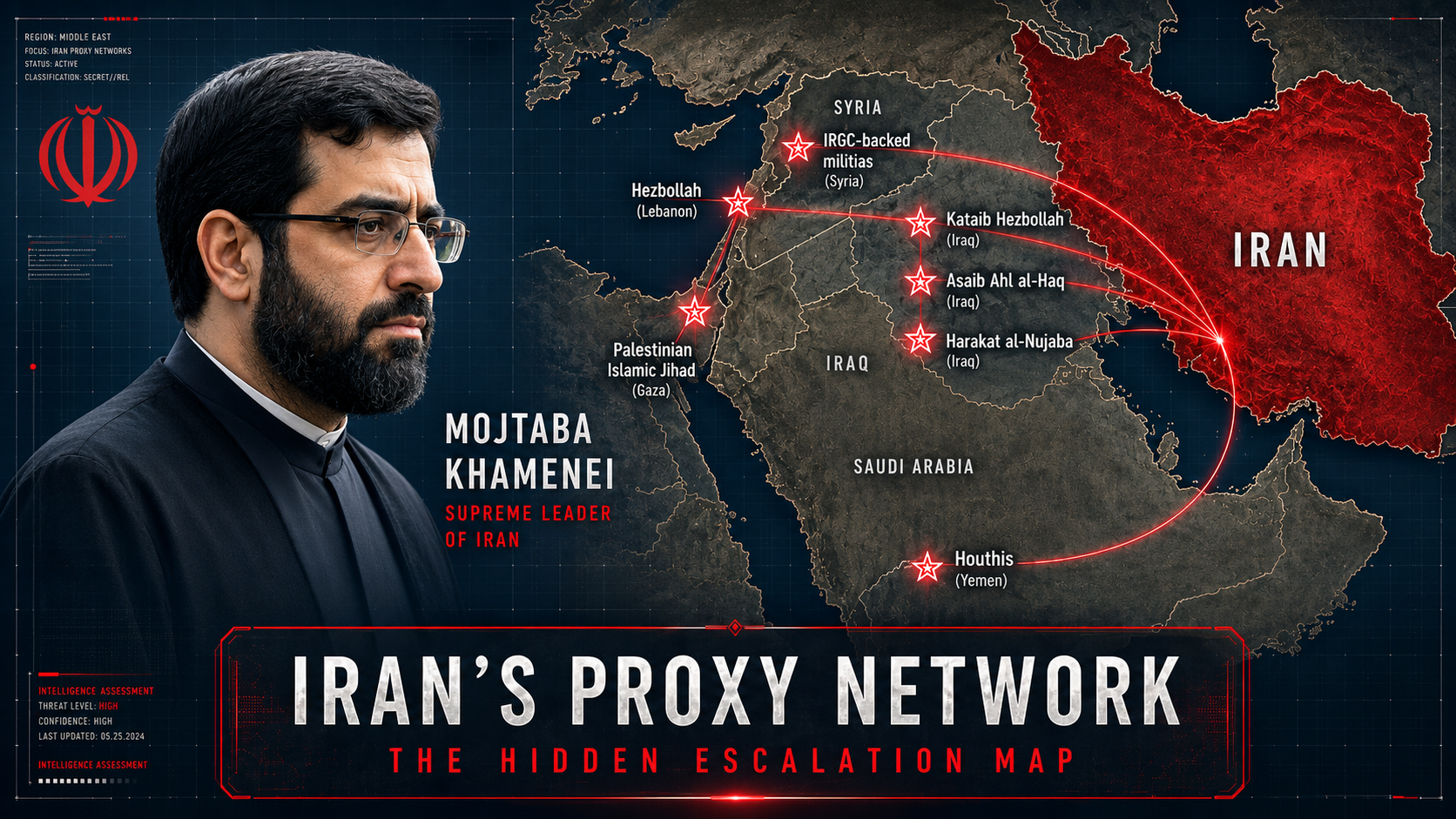
What decision-makers should watch now — before proxy escalation becomes a cost, compliance or supply-chain shock.
This 17-page executive briefing translates Iran’s proxy network into concrete business risks: energy price exposure, maritime chokepoints, war-risk premiums, sanctions, shadow fleets, supply-chain disruption and early-warning indicators for board-level decisions.
You are currently viewing a placeholder content from X. To access the actual content, click the button below. Please note that doing so will share data with third-party providers.
More Information