Executive Intelligence. Industrial Risk. Geopolitics.
Strategic Sparring
for Decision-Makers
Risk intelligence across technology, law, markets and power dynamics.


Verdeckte Geschäftsrisiken, strategische Widersprüche und kritische Abhängigkeiten frühzeitig erkennen.
Kostenlose Analyse starten →
Verdeckte Machtstrukturen, Führungsrisiken und organisatorische Blockaden frühzeitig erkennen.
Kostenlose Analyse starten →
Geopolitische Risiken, globale Abhängigkeiten und kritische Lieferkettenrisiken frühzeitig erkennen.
Kostenlose Analyse starten →
Identify hidden business risks, strategic contradictions and critical dependencies at an early stage.
Start Free Analysis →
Identify hidden power structures, leadership risks and organizational blockers at an early stage.
Start Free Analysis →
Identify geopolitical risks, global dependencies and critical supply-chain vulnerabilities at an early stage.
Start Free Analysis →
Verdeckte Geschäftsrisiken, strategische Widersprüche und kritische Abhängigkeiten frühzeitig erkennen.
Kostenlose Analyse starten →
Verdeckte Machtstrukturen, Führungsrisiken und organisatorische Blockaden frühzeitig erkennen.
Kostenlose Analyse starten →
Geopolitische Risiken, globale Abhängigkeiten und kritische Lieferkettenrisiken frühzeitig erkennen.
Kostenlose Analyse starten →
Identify hidden business risks, strategic contradictions and critical dependencies at an early stage.
Start Free Analysis →
Identify hidden power structures, leadership risks and organizational blockers at an early stage.
Start Free Analysis →
Identify geopolitical risks, global dependencies and critical supply-chain vulnerabilities at an early stage.
Start Free Analysis →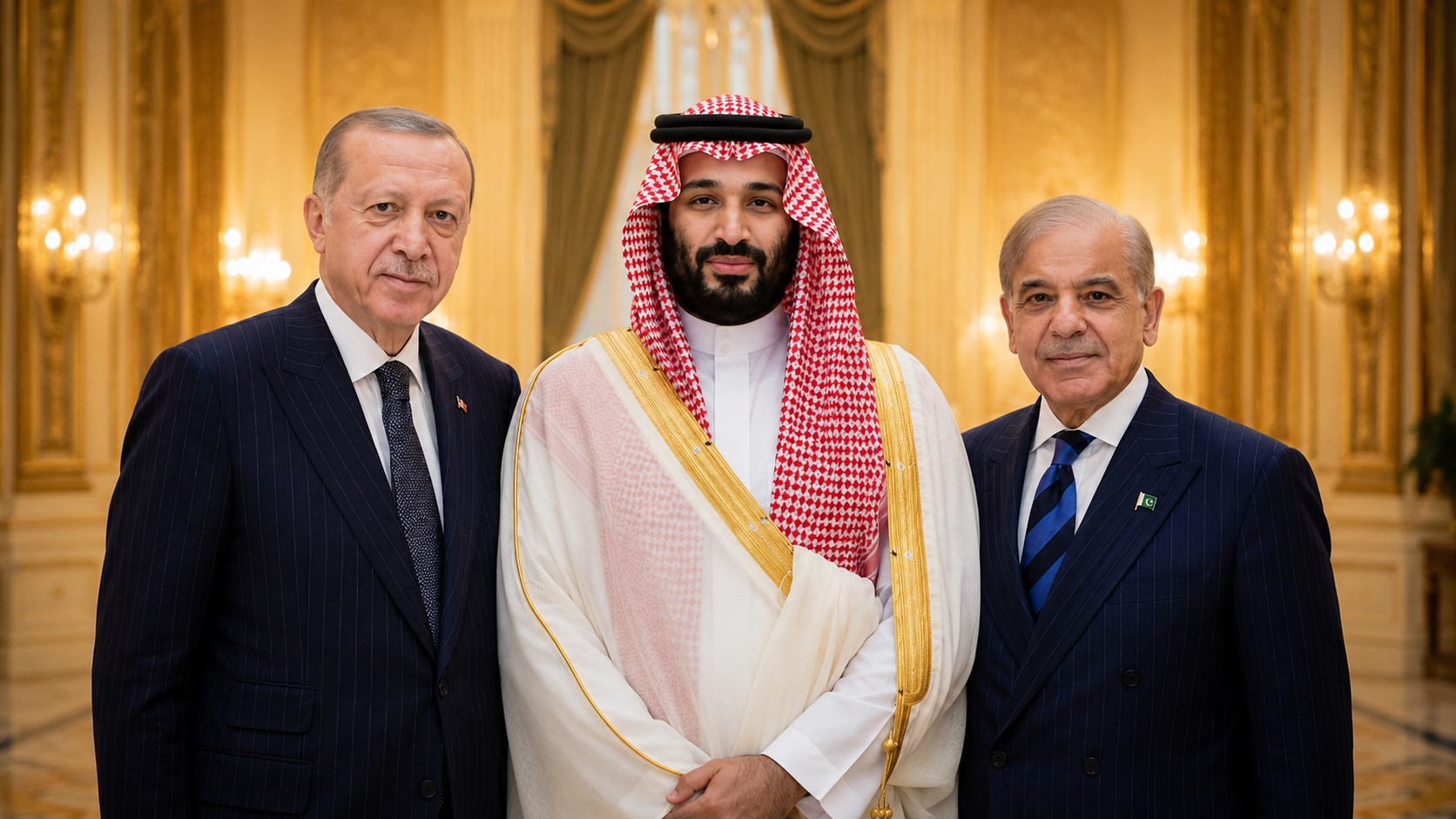
Strategic Risk Intelligence Brief by Global Insight Group.
This analysis is based on the GFDD Framework™ developed by Michaela Schaaf-Hoffelner and is designed for executives, investors and strategic decision-makers.
Updated: August 09, 2026
The Iran war is usually framed in military terms: strikes, missiles, negotiations, and the question of when the Strait of Hormuz will fully reopen. But beneath this visible layer, a much larger shift may be taking place.
At first glance, the individual developments appear disconnected. Iran remains strategically capable despite massive attacks. Saudi Arabia, Türkiye and Pakistan are building their own defence architecture. Egypt could join. Iran and Oman are negotiating new rules for Hormuz. At the same time, regional chokepoints, Asian energy markets and alternative security structures are gaining strategic importance.
The central hypothesis of this analysis is therefore: The West is carrying a significant share of the military burden, while the region is beginning to organise its future power, security and trade architecture increasingly on its own terms.
Iran has suffered severe military damage. Yet Tehran has neither been reliably disarmed nor removed from the regional balance of power. Instead of pursuing Iran’s complete neutralisation, key Gulf states are once again pushing for negotiations.
In early August, Iran explicitly warned Saudi Arabia and other Gulf states that further attacks could trigger Iranian retaliation against oil, electricity and water infrastructure. Riyadh subsequently urged Washington once again towards negotiations. Reuters
This caution becomes even more significant when viewed alongside the nuclear developments of recent years.
The IAEA’s current information gap did not begin with the present war. Since 23 February 2021, Iran has no longer implemented the Additional Protocol, depriving the IAEA of important additional verification capabilities. IAEA
Monitoring was restricted further in 2022. By 2023, the IAEA was still able to inspect certain facilities, but lacked access to data from some surveillance equipment. In September 2023, Iran also withdrew the accreditation of several of the agency’s most experienced inspectors. IAEA and IAEA
None of this proves that Iran possesses a nuclear weapon. It does mean, however, that neighbouring states have had to plan for years under growing uncertainty about Iran’s actual strategic capabilities.
This is where the first connection emerges. The decisive shift may be that regional powers no longer assume Iran can eventually be fully disarmed or permanently contained through Western military power.
That changes the strategic objective.
The question is no longer necessarily how to exclude Iran from the regional order. The question becomes how much counterweight is required to coexist with a permanently powerful Iran without allowing Tehran to dominate that order.
In this interpretation, Iran does not need to defeat every neighbouring state. It only needs to demonstrate that no sustainable regional security architecture can be built without taking Iranian interests into account.
That is a very different form of power.
On 7 August 2026, Saudi Arabia, Türkiye and Pakistan signed the Mecca Joint Defence Agreement. An attack on one of the three countries is, in principle, considered an attack on all. Turkish Foreign Minister Hakan Fidan explicitly compared the mechanism to NATO’s Article 5.
The agreement also foresees regular political consultations and a permanent secretariat in Saudi Arabia. Egypt could join at a later stage. Reuters
The roots of this structure, however, go back much further.
Saudi Arabia and Türkiye agreed to deepen cooperation on defence capabilities, the defence industry, research and development as early as July 2023. Saudi Press Agency
The first trilateral Saudi-Turkish-Pakistani defence meeting took place in Riyadh in August 2023. At their second meeting in January 2024, the three states explicitly discussed pooling intellectual, technical, financial and human resources in order to become more independent in defence. Anadolu Agency
The timing is striking. While transparency over Iran’s nuclear programme had been deteriorating progressively since 2021, the construction of a new regional defence architecture became publicly visible by 2023.
Its composition is equally important.
Pakistan is a nuclear-armed state. Türkiye has one of NATO’s largest armed forces and remains firmly inside the alliance. Saudi Arabia contributes financial, energy and regional power.
Yet Ankara explicitly states that the pact is not directed against Iran. Associated Press
This creates the second connection. Saudi Arabia may be pursuing a dual strategy.
On one side, it is building military counterweight. On the other, it is keeping Iran diplomatically close.
That is not necessarily contradictory. It is strategic hedging.
Riyadh does not have to trust Tehran, nor does it have to defeat it. It needs enough deterrent power to prevent Iran from dominating the regional order, while maintaining sufficient diplomatic access to prevent confrontation from becoming uncontrollable.
Türkiye makes this development even more significant.
Ankara already benefits from NATO’s collective defence guarantee. Yet it is simultaneously helping to create a second, regional Article 5-style structure outside NATO.
That suggests that even one of NATO’s most important military members no longer intends to organise all of its Middle Eastern security interests exclusively through a Western-led architecture.
If Egypt joins, another layer is added. The alliance would then include a major military power that also controls the Suez Canal, one of the world’s most important trade corridors.
The emerging structure could therefore be less about forming a conventional anti-Iran bloc and more about building sufficient regional weight to negotiate with Iran from a position of balance.
The decisive change at Hormuz is not simply that fewer ships are passing through.
The more important question is who will determine the conditions of passage in the future.
Iran and Oman are currently negotiating a new mechanism for the Strait of Hormuz. One proposal under discussion would give Iran control over inbound shipping traffic. Controls over outbound traffic and potential transit fees remain contested.
According to Reuters, Iran has demanded fees equivalent to five to seven percent of cargo value, while Oman has proposed a lower model. The international shipping industry considers the structure currently under discussion difficult to implement. Reuters
Yet the fact that such terms are being negotiated at all is strategically significant.
A US official stated on 7 August that Washington expected an agreement between Iran and Oman soon. Only after an agreement guaranteeing commercial traffic would the United States consider lifting its blockade of Iranian ports. Reuters
For decades, the operating assumption around Hormuz was that freedom of international navigation would ultimately be protected by Western, particularly American, naval power.
That logic may now be changing.
This is where the third connection becomes visible. Iran may be attempting to convert military leverage into institutional power.
A missile creates temporary impact. A permanent system of control, authorisation, fees or veto rights creates political and economic leverage that can persist for years.
If Iran emerges from the war with any recognised role in determining the rules of Hormuz, that could ultimately be more strategically significant than an individual battlefield success.
The world’s most important energy chokepoint would no longer operate solely under the assumption of Western-guaranteed free passage. Access would increasingly become a matter of regional negotiation.
Iran would then have succeeded in transforming geography into political authority.
And that would represent a genuine redistribution of economic power.
Hormuz can increasingly no longer be analysed in isolation.
When the Strait becomes unavailable or unreliable, Saudi Arabia and other producers attempt to shift energy exports through pipelines and terminals on the Red Sea.
But the risk does not disappear.
It simply moves to the next chokepoint.
Bab el-Mandeb has been under pressure from Houthi attacks for years. Saudi export infrastructure on the Red Sea is also becoming increasingly exposed. Saudi Arabia is therefore building a multinational maritime defence structure in parallel.
Türkiye, Pakistan and Egypt are among the states involved in discussions over stronger regional protection of the Red Sea. Maritime security is also becoming part of the broader regional defence cooperation. Reuters
The geographical logic is straightforward.
A vessel bypassing Hormuz through alternative Saudi export infrastructure enters the Red Sea system. Traffic heading from the Red Sea towards Europe then depends heavily on Suez.
A disruption therefore does not simply disappear because an alternative route exists. It moves downstream to the next strategic bottleneck.
This chain reaction is already visible in the economic consequences. The Strait of Hormuz matters not only because of the volume of oil passing through it, but because alternative export capacity cannot fully compensate for a prolonged disruption. Schaaf Media
This creates the fourth connection. A state or group of actors does not need to exercise absolute control over every chokepoint to gain strategic power.
The ability to influence the availability, cost, insurability or political accessibility of several critical corridors can create disproportionate leverage over energy markets, freight rates and global supply chains.
A canal does not have to be physically closed.
It can become economically dysfunctional because security risks increase insurance premiums, shipping companies withdraw capacity, or political approval becomes uncertain.
At the same time, Saudi Arabia, Türkiye, Pakistan and potentially Egypt are strengthening their security relationships.
This creates a remarkable geographical concentration.
Iran and Oman sit on Hormuz. Saudi Arabia connects the Gulf with the Red Sea. Egypt controls Suez. Türkiye controls the Bosporus and Dardanelles, another strategic gateway linking the Black Sea with the Mediterranean.
This does not prove the existence of a coordinated “chokepoint alliance”.
But it does demonstrate something strategically important: an extraordinary share of the routes connecting Europe, Asia and Middle Eastern energy markets runs through or alongside states that are simultaneously seeking greater strategic autonomy from the West.
The underlying power shift may therefore be larger than the Iran war itself.
This security transformation is occurring alongside a second long-term shift.
Asia has become increasingly important to the Gulf states economically.
Saudi Arabia now sells significantly more oil to China than to the United States. At the same time, alternative currencies, bilateral settlement mechanisms and reduced dependence on the US dollar are becoming increasingly important themes in global energy trade.
The Iran war reinforces this trend because sanctions, payment risks and geopolitical fragmentation encourage governments and companies to develop alternative financial and trade channels.
A sudden collapse of the petrodollar is therefore not required.
The more important development would be a gradual erosion of its exclusivity.
The long-term relationship between energy, geopolitical power and de-dollarisation has already been examined in previous analysis. Schaaf Media
China does not need to lead the Iran war militarily in order to benefit strategically from a changing regional order.
As Gulf energy exports become increasingly oriented towards Asia and regional states build security structures of their own, complete political dependence on Washington becomes less necessary.
This is where the fifth and most important connection closes the loop.
The United States can remain the strongest military power and still lose institutional power.
Washington is carrying enormous costs for military deployments, missile defence, naval operations and regional security. Yet the outcome of the war could be an order in which Iran acquires stronger chokepoint leverage, Saudi Arabia, Türkiye and Pakistan operate their own defence structure, Egypt potentially joins, and China becomes increasingly important economically.
That would make the Iran war strategically paradoxical.
The West would carry a substantial share of the military burden while other states build the structures that remain after the conflict.
This would not constitute a conventional American military defeat.
It would represent a shift in systemic power.
Washington could continue to present itself publicly as mediator, security guarantor and military leader. Beneath that visible layer, however, a new regional order could be emerging in which the United States no longer automatically determines the rules governing security, energy flows and strategic access.
The West could fight the war and still lose the post-war order.
Intelligence on Demand
Experience the analytical power of GFDD Diagnostics™ through a concrete business case.
Our proprietary AI was developed around the methodology, knowledge structures and analytical patterns of GFDD Diagnostics™.
Test whether this approach can reveal hidden dependencies, leadership risks and strategic blind spots within your organization.
Test GFDD Diagnostics™
This analysis is a hypothesis. That makes it testable. The following nine indicators will show whether the underlying power shift is actually taking place.
The more of these developments occur simultaneously, the stronger the case that the Iran war is not restoring Western dominance, but accelerating the transition towards a more regional and multipolar power structure.
A military defeat and a loss of geopolitical dominance are not the same thing. The United States can severely weaken Iranian forces and infrastructure while simultaneously losing institutional influence if regional states subsequently create their own security, trade and chokepoint structures.
Officially, no. Türkiye has explicitly stated that the agreement is not directed against any particular country. That position is strategically significant because Iran simultaneously represents one of the most important security risks facing several of the participating states. Reuters
Türkiye already benefits from NATO’s collective defence guarantee. Ankara’s decision to participate in an additional Article 5-style regional structure with Saudi Arabia and Pakistan therefore suggests that NATO membership alone does not fully cover Türkiye’s regional strategic requirements.
Pakistan contributes large armed forces, but its most distinctive strategic characteristic is its nuclear arsenal. This does not automatically mean that Saudi Arabia or Türkiye are covered by a Pakistani nuclear umbrella. Pakistan nevertheless adds a significant strategic deterrence component to the emerging security architecture.
Iran is demanding such fees, and several models are being negotiated. Their legal basis and practical enforceability remain highly contested. Strategically, however, the precise fee level matters less than Iran’s attempt to convert military leverage into permanent political and economic power. Reuters
Not in the short term. A gradual erosion of dollar exclusivity is more plausible. As Gulf energy trade and security relationships become increasingly oriented towards Asia, the scope for alternative payment and financing structures expands.
China does not need to replace the United States as the region’s military security provider to gain strategic influence. As a major energy buyer, trading partner and investor, Beijing benefits from an order in which economic relationships shift towards Asia and regional political decisions become less dependent on Washington.
Iran Conflict & Oil Prices: Hormuz, Supply Chains and Escalation Risks
The continuously updated Iran Check tracks escalation signals around the Strait of Hormuz, energy prices, maritime security and global supply chains.
Iran War and Oil Price Shock: Who Wins and Who Really Loses?
This analysis examines why military winners and economic winners are not necessarily the same, and which states may benefit from shifting global energy and power structures.
Gold and the Petrodollar 2026: Strategic Scenarios for Decision-Makers
A systemic analysis of the relationship between the Iran conflict, energy, water infrastructure, de-dollarisation, gold and the long-term resilience of the petrodollar.
Hormuz Blockade 2026: Strategies for the Chokepoint Shock
This analysis examines the Strait of Hormuz as a strategic chokepoint and explains why alternative routes can only partially reduce structural dependence.
Hormuz Blockade: Why Everything Is Becoming More Expensive
This analysis traces the domino effect of a Hormuz disruption across energy prices, inflation, critical supply systems and global supply chains.
Author of Global Insight Group Intelligence:
Michaela Schaaf-Hoffelner has more than 35 years of experience in strategic and technical project and product management, particularly in IT, control systems and intralogistics. Through her long-standing work with complex systems, she identifies structural risks and dynamic misalignments at an early stage – risks that are often overlooked in conventional analysis.
Her focus is on making causal relationships and systemic dependencies visible and translating them into concrete strategic advantages for investors and decision-makers. Her analyses combine deep technical systems understanding with geopolitical and economic developments.
GFDD Framework™ and GFDD Diagnostics™ are proprietary analytical concepts developed by Michaela Schaaf-Hoffelner. © 2026 Global Insight Group LLC. All rights reserved.
You are currently viewing a placeholder content from X. To access the actual content, click the button below. Please note that doing so will share data with third-party providers.
More Information