Executive Intelligence. Industrial Risk. Geopolitics.
Strategic Sparring
for Decision-Makers
Risk intelligence across technology, law, markets and power dynamics.


Verdeckte Geschäftsrisiken, strategische Widersprüche und kritische Abhängigkeiten frühzeitig erkennen.
Kostenlose Analyse starten →
Verdeckte Machtstrukturen, Führungsrisiken und organisatorische Blockaden frühzeitig erkennen.
Kostenlose Analyse starten →
Geopolitische Risiken, globale Abhängigkeiten und kritische Lieferkettenrisiken frühzeitig erkennen.
Kostenlose Analyse starten →
Identify hidden business risks, strategic contradictions and critical dependencies at an early stage.
Start Free Analysis →
Identify hidden power structures, leadership risks and organizational blockers at an early stage.
Start Free Analysis →
Identify geopolitical risks, global dependencies and critical supply-chain vulnerabilities at an early stage.
Start Free Analysis →
Verdeckte Geschäftsrisiken, strategische Widersprüche und kritische Abhängigkeiten frühzeitig erkennen.
Kostenlose Analyse starten →
Verdeckte Machtstrukturen, Führungsrisiken und organisatorische Blockaden frühzeitig erkennen.
Kostenlose Analyse starten →
Geopolitische Risiken, globale Abhängigkeiten und kritische Lieferkettenrisiken frühzeitig erkennen.
Kostenlose Analyse starten →
Identify hidden business risks, strategic contradictions and critical dependencies at an early stage.
Start Free Analysis →
Identify hidden power structures, leadership risks and organizational blockers at an early stage.
Start Free Analysis →
Identify geopolitical risks, global dependencies and critical supply-chain vulnerabilities at an early stage.
Start Free Analysis →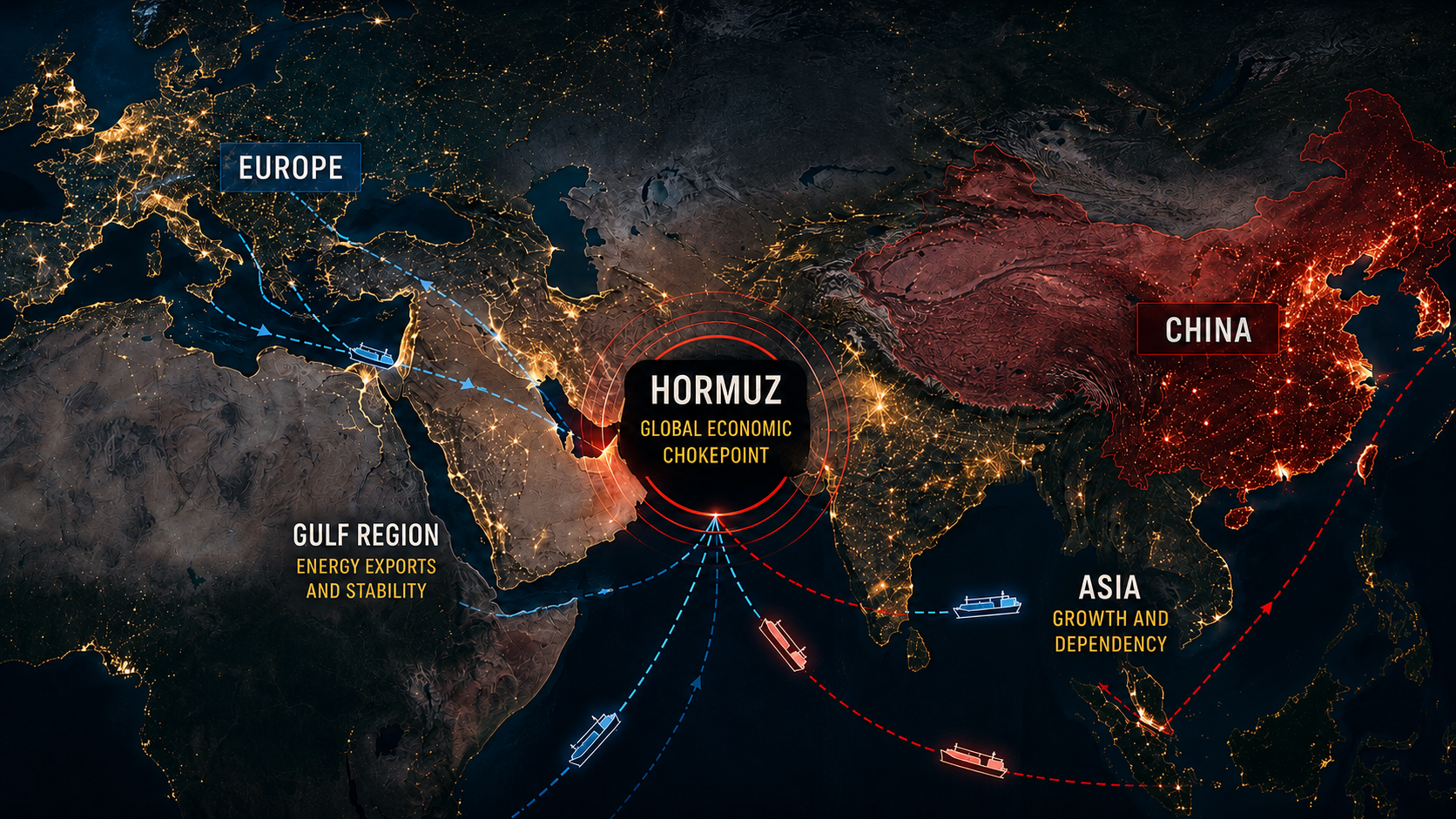
This Chokepoint Check assesses current pressure on the Strait of Hormuz, Bab al-Mandab and the Gulf region’s critical water, power, port and energy infrastructure. The key question is not only whether a route remains geographically open, but whether transport, insurance coverage, energy supply and site operations remain operationally viable.
No sufficiently confirmed new physical incident was identified for August 15–16, but the regional confrontation over the strait remains unresolved.
The Gulf Cooperation Council again explicitly condemned the recent attacks on ADNOC tankers on August 16, describing them as a direct threat to international shipping and trade. Operational risk around the strait therefore remains high, although no new attack was confirmed today.
No sufficiently confirmed new daily signal was identified for this area.
Following the recent Houthi escalation and deadly attacks on merchant vessels, operational risk remains high. Within the current August 15–16 research window, however, no new confirmed attack on a merchant vessel or new physical restriction of the passage was identified.
No sufficiently confirmed new daily signal was identified for fixed Gulf infrastructure on August 16.
Structural risks to refineries, ports, pipelines, airports and energy supply remain high. Within the current research window, however, no new physical attack on fixed Gulf infrastructure was confirmed. Today’s escalation is more heavily concentrated on Lebanon.
Israeli airstrikes in southern Lebanon killed at least eleven people on August 15. Israel stated on August 16 that two Hezbollah commanders had been targeted. Civilians were also among the casualties.
These were the deadliest strikes since the June ceasefire began. Israel says the strikes followed a Hezbollah attack in which three Israeli soldiers were seriously injured.
A renewed larger Lebanon front would significantly increase risks to land transport, ports, aviation and investment across the eastern Mediterranean, while weakening regional de-escalation efforts.
Verification Status: confirmed for the strikes and casualty figures. The identity and role of the Hezbollah commanders are based on Israeli statements. Associated Press, 16.08.2026 · SchaafMedia: Iran War – How the West Is Losing Its Dominance
On August 16, the US State Department described so-called pilot or model zones as the only viable path towards long-term security between Lebanon and Israel.
The Lebanese army is expected to take control of areas gradually. Washington explicitly links this process to Hezbollah’s disarmament while also expecting Israeli forces to withdraw.
If the mechanism works, security risk in southern Lebanon could decline. If it fails after the latest wave of violence, the risk of another larger front rises.
Verification Status: confirmed for the new US position. Operational implementation of the model zones has not yet been completed. Asharq via Arab News, 16.08.2026
CENTCOM Commander Brad Cooper concluded a ten-day trip through six countries on August 15 and visited the USS Abraham Lincoln in the Arabian Sea. According to CENTCOM, more than 50,000 US troops are operating across the region.
The Lincoln continues to support US operations against Iran, including the port blockade. The visit therefore confirms a longer-term US military architecture that has not been scaled back.
The high US presence supports deterrence and maritime control, but also prolongs the military risk premium for shipping, energy infrastructure and regional investment.
Verification Status: confirmed by US Central Command. The trip ended on August 15 and remains directly relevant to the operational picture on August 16. US CENTCOM, 15.08.2026 · SchaafMedia: Chokepoint Check – Hormuz, Trade Routes & Supply Chain Risks
A Hamas delegation led by Khalil al-Hayya is in Cairo on August 16 for talks with Egyptian officials. Discussions are focused on implementing the US-led Gaza peace plan.
The central dispute remains the sequencing of Hamas disarmament and Israeli withdrawal. Israel continues to reject withdrawal before Hamas has been fully disarmed.
Substantive progress would reduce an important regional escalation driver. Without implementation, Gaza remains an additional source of uncertainty for the wider Middle East.
Verification Status: confirmed for the talks in Cairo. No new ceasefire or implementation breakthrough has yet been confirmed. Al Jazeera, 16.08.2026
GCC Secretary-General Jasem Albudaiwi condemned the repeated attacks on ADNOC tankers on August 16, describing them as a direct threat to international shipping and trade.
The new development is political, not operational: the attacks themselves predate today’s research window. What is new is the collective institutional positioning of the Gulf states towards Iran.
The Hormuz dispute is increasingly evolving from a bilateral US-Iran confrontation into a regional Gulf security issue. This increases political pressure for a maritime solution.
Verification Status: confirmed for the GCC statement on August 16. The underlying ADNOC attacks are not treated as a new daily signal. WAM / GCC, 16.08.2026 · SchaafMedia: Iran War – How the West Is Losing Its Dominance
The Israel-Hezbollah front is escalating again while Hormuz remains operationally insecure.
Military presence, blockade measures and fragile ceasefires continue to prevent reliable normalisation.
Shipping, aviation and regional supply chains must continue to account for multiple escalation zones.
Insurance, energy and logistics costs remain elevated despite no new confirmed chokepoint disruption today.
No new confirmed chokepoint attack was identified for August 15–16. Previous attacks and military control mechanisms nevertheless remain in effect.
No new daily signal · operational normalisation still not confirmedNo new confirmed physical attack on fixed Gulf infrastructure was identified within the current research window. Existing regional risks nevertheless remain high.
No new daily signal · structural risk remainsThe Lebanon front is intensifying again, while more than 50,000 US troops operate across the region and parallel diplomatic processes continue in Lebanon, Gaza and the Gulf.
Multiple conflict and security zones remain interconnectedThe situation remains high to critical, but is developing differently from August 14. No new major physical incident was confirmed at the two main chokepoints within the current research window. At the same time, the Israel-Hezbollah front is escalating significantly. Washington is simultaneously trying to stabilise the regional order through military presence, Lebanon model zones and renewed Gaza talks. The conflict therefore remains systemically broad even though maritime escalation is not increasing today.
Note: This assessment was produced with support from our Geo-AI. AI can make mistakes. The analysis is intended as a source-based radar for potential escalation signals and does not replace fully verified intelligence, security, insurance or investment advice. In rapidly evolving situations, status, source availability and risk assessments may change at short notice.
Independent of the subject covered in this article, this separate Executive Briefing provides an in-depth analysis of another critical risk domain affecting European companies.
The 27-page Executive Briefing “Black Swan Risk Mapping for Europe’s Next Mobility and Infrastructure Shock” examines how geopolitical, infrastructural and administrative developments that are currently viewed in isolation could reinforce one another.
Based on the GFDD Framework™, the report shows how these dynamics could affect operational continuity, access to critical resources and the strategic resilience of companies.
The briefing includes a structured systemic-shock analysis and a directly applicable Business Exposure Checklist for CEOs, CFOs, COOs, investors and strategy teams.
You are currently viewing a placeholder content from X. To access the actual content, click the button below. Please note that doing so will share data with third-party providers.
More Information