Executive Intelligence. Industrial Risk. Geopolitics.
Strategic Sparring
for Decision-Makers
Risk intelligence across technology, law, markets and power dynamics.


Verdeckte Geschäftsrisiken, strategische Widersprüche und kritische Abhängigkeiten frühzeitig erkennen.
Kostenlose Analyse starten →
Verdeckte Machtstrukturen, Führungsrisiken und organisatorische Blockaden frühzeitig erkennen.
Kostenlose Analyse starten →
Geopolitische Risiken, globale Abhängigkeiten und kritische Lieferkettenrisiken frühzeitig erkennen.
Kostenlose Analyse starten →
Identify hidden business risks, strategic contradictions and critical dependencies at an early stage.
Start Free Analysis →
Identify hidden power structures, leadership risks and organizational blockers at an early stage.
Start Free Analysis →
Identify geopolitical risks, global dependencies and critical supply-chain vulnerabilities at an early stage.
Start Free Analysis →
Verdeckte Geschäftsrisiken, strategische Widersprüche und kritische Abhängigkeiten frühzeitig erkennen.
Kostenlose Analyse starten →
Verdeckte Machtstrukturen, Führungsrisiken und organisatorische Blockaden frühzeitig erkennen.
Kostenlose Analyse starten →
Geopolitische Risiken, globale Abhängigkeiten und kritische Lieferkettenrisiken frühzeitig erkennen.
Kostenlose Analyse starten →
Identify hidden business risks, strategic contradictions and critical dependencies at an early stage.
Start Free Analysis →
Identify hidden power structures, leadership risks and organizational blockers at an early stage.
Start Free Analysis →
Identify geopolitical risks, global dependencies and critical supply-chain vulnerabilities at an early stage.
Start Free Analysis →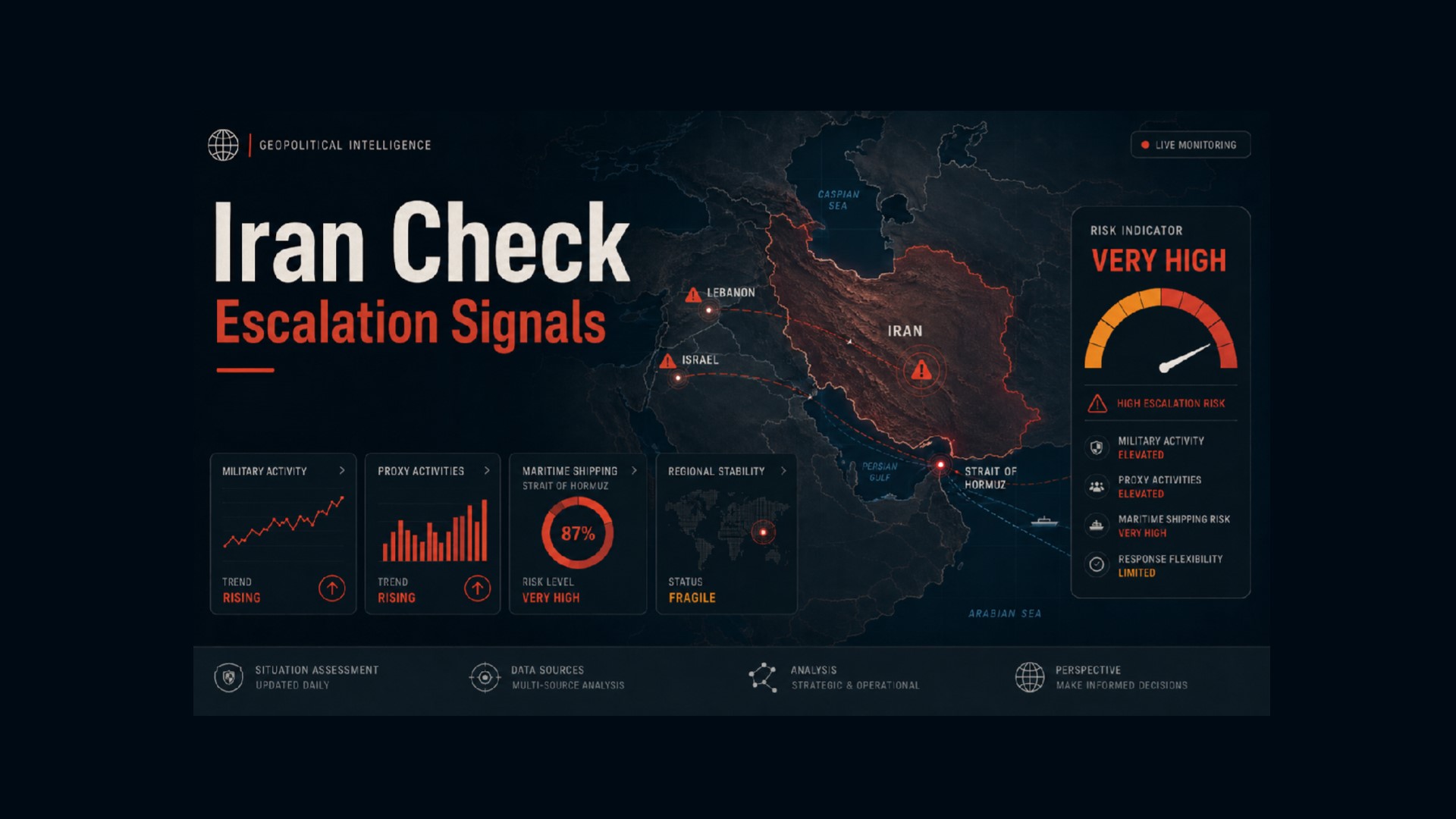
This escalation radar summarises five relevant signals as of August 17, 2026. It focuses on substantiated statements by official bodies, verified events and monitoring sources with potential implications for energy prices, supply chains, markets, maritime security, aviation and regional stability.
The 60-day deadline agreed in June expires on August 17 without a comprehensive settlement. Washington and Tehran remain far apart over Hormuz, sanctions, the blockade and the consequences of the war.
IRGC Brigadier General Yadollah Javani states that Iran’s previously defensive posture could become more offensive under a new “Maximum Deterrence” strategy. This raises the risk of active Iranian countermeasures after the diplomatic deadline expires.
Only five visible vessels transited Hormuz on Saturday; no transit was recorded on Sunday. Despite the Iran-Oman understanding, the strait therefore remains operationally far from normalisation.
| Actor | Type | Severity | Status | Source / Verification Status | Business Impact |
|---|---|---|---|---|---|
| Iran / United States / Trump / Araghchi / Pakistan / Oman | 60-day deadline expires without a peace agreement | Critical · Level 5/5 | The 60-day deadline agreed in June for a lasting US-Iran settlement expires on August 17 without a comprehensive agreement. There is still no breakthrough on Hormuz, the US blockade, sanctions, war compensation or the nuclear programme. At the same time, Iran says it has reached an understanding with Oman on the map of a future Hormuz transit route. A joint statement is still being prepared. Power dynamics: Technical transit diplomacy is making progress, while the broader US-Iran peace process is failing. Two distinct levels are therefore emerging: regional management of maritime traffic without a political resolution of the conflict. | Confirmed by AP News, August 17, 2026 . Verification status: confirmed regarding the expiry of the 60-day deadline and the continued absence of a peace breakthrough. The Iran-Oman understanding on the transit map is also confirmed, but does not amount to a full reopening of Hormuz. Background: Schaaf Media · Middle East Escalation Check from August 16, 2026 . | Critical business impact on oil prices, LNG, Iran sanctions, trade finance, charter agreements, insurance and strategic procurement. Technical progress on transit should not be interpreted as political normalisation. |
| Iran / IRGC / United States / Israel | IRGC signals shift from defensive to offensive deterrence | Critical · Level 5/5 | Brigadier General Yadollah Javani, a senior commander of the Islamic Revolutionary Guard Corps, states on August 17 that Iran’s military posture could shift from a defensive towards a more offensive strategy. He describes this as part of a new “Maximum Deterrence” policy. The signal coincides precisely with the expiry of the 60-day deadline under the US-Iran agreement. Power dynamics: Tehran is signalling that the failure of diplomatic progress may not simply result in political deadlock, but could be answered with a more active military deterrence posture. This increases the likelihood of pre-emptive or retaliatory Iranian action. | Confirmed by Al Jazeera, August 17, 2026 . Verification status: confirmed regarding Javani’s statement and the announced strategic shift. This does not mean that a new offensive has already begun. Further analysis: Schaaf Media · Iran War: How the West Is Fighting While Losing Its Dominance . | Critical business impact on US facilities, Gulf states, energy infrastructure, aviation, maritime security, business travel, evacuation planning and war-risk insurance. For companies, the primary risk is an increase in sudden military shifts with limited warning time. |
| Iran / Oman / international shipowners / Strait of Hormuz | Visible Hormuz traffic nearly disappears over the weekend | Critical · Level 5/5 | The operational shipping situation deteriorated further. Only five visible transits through the Strait of Hormuz were recorded on Saturday. No transit was recorded on Sunday. By comparison, 31 vessels had still been recorded during the previous weekend. The Iran-Oman understanding on a future transit route has therefore not yet produced operational normalisation. Power dynamics: The decisive metric is not whether a route is being negotiated, but whether shipowners, insurers and crews are actually willing to use it. At present, the answer is: only to an extremely limited extent. | Confirmed by Reuters, August 17, 2026 . Verification status: confirmed regarding five visible transits on Saturday and no recorded transit on Sunday. AIS shutdowns may mean that individual non-visible movements were not captured. Further reading: Schaaf Media · Middle East Escalation Check: Hormuz, Bab al-Mandab and Gulf Infrastructure . | Critical business impact on crude oil, LNG, tanker charters, freight rates, war-risk premiums, refineries, energy procurement and Europe-Asia supply chains. A route on paper does not yet solve the real capacity problem. |
| Iran / Qatar / Iranian Air Force / Gulf states | Iran describes three allegedly detained pilots in Qatar as prisoners | High to critical · Level 4/5 | On August 17, Iran escalates its dispute with Qatar over three Iranian military pilots. Tehran says their fate remains unresolved and considers them prisoners. Iran had previously claimed that the three pilots were detained by Qatari forces after their Su-24 crashed during the war. Qatar denies holding Iranian pilots. Power dynamics: A new bilateral conflict point is therefore emerging between Iran and a Gulf state that both hosts US military infrastructure and acts as a regional mediator. This directly connects the military consequences of the war with Gulf diplomacy. | Confirmed by The National, August 17, 2026 . Verification status: confirmed regarding Iran’s current demand and Qatar’s rejection of the detention claim. Whether the three pilots are actually being held by Qatar has not been independently confirmed. | High to critical business impact on Qatar-Iran relations, US bases, aviation, diplomatic mediation, business travel, personnel security and Gulf risk planning. A further escalation could additionally weaken Qatar’s role as a mediator in the Iran conflict. |
| Israel / Hezbollah / Iran / southern Lebanon | Israel confirms killing of a senior Hezbollah commander | High to critical · Level 4/5 | On August 17, Israel confirms new details about the major strikes carried out in southern Lebanon on August 15. According to Israel, Ali Mohammad Fakhreddine, also known as Abu Hassan Alaa, was killed in a strike in Deir al-Zahrani. Israel describes him as a senior commander in Hezbollah’s Badr region. The strikes followed a Hezbollah drone attack in which three Israeli soldiers were seriously injured. Power dynamics: What is new on August 17 is not the strike itself, but Israel’s confirmation that it deliberately targeted a higher level of Hezbollah’s command structure. This raises the risk of targeted Hezbollah retaliation and a renewed closer linkage between the Lebanon and Iran fronts. | Confirmed by Arab News, August 17, 2026 . Verification status: confirmed regarding Israel’s identification of the killed commander. The underlying airstrike took place on August 15; what is new on August 17 is the official assessment of his role within Hezbollah’s command structure. Background: Schaaf Media · Iran’s Proxies: The Hidden Escalation Map of the Middle East . | High to critical business impact on Lebanon and Israel, aviation, ports, land logistics, business travel, evacuation planning, insurance and site continuity. Targeted Hezbollah retaliation could rapidly destabilise the currently fragile ceasefire again. |
The most important systemic shift on August 17, 2026 is the expiry of the 60-day deadline without a US-Iran peace agreement. At the same time, the Revolutionary Guard is signalling a possible shift towards more offensive deterrence. The diplomatic deadline therefore ends not with a settlement, but with a harder Iranian military message.
Hormuz simultaneously reveals a striking contradiction. Iran and Oman have agreed on the map of a possible transit route. Operationally, however, visible traffic continues to decline: five transits on Saturday, and no recorded transit on Sunday. Diplomatic progress and real-world usability therefore remain far apart.
In addition, the conflict is spreading further into the regional security architecture. The dispute over three Iranian pilots creates a new point of tension with Qatar. In Lebanon, Israel also confirms the killing of a senior Hezbollah commander, increasing the risk of retaliation again.
For businesses, the operational risk picture therefore remains more important than political announcements. Hormuz remains severely restricted, while military deterrence and regional secondary fronts are intensifying. EASA CZIBs for Iran, Iraq, Jordan, Lebanon, the Persian Gulf and the Gulf of Oman remain active until August 31, 2026; no new tightening was issued on August 17.
The five most important signals for a European and German risk assessment are: the expiry of the 60-day deadline without a US-Iran peace agreement, Iran’s announced shift towards a more offensive “Maximum Deterrence” strategy, the temporary collapse of visible Hormuz traffic to zero, the new Iran-Qatar dispute over three Iranian military pilots, and Israel’s confirmation today that a senior Hezbollah commander was killed in the recent Lebanon strikes.
Note: This assessment was prepared with the support of our Geo AI. AI can make mistakes. The analysis is intended as a radar for potential escalation signals and does not replace a fully verified intelligence assessment.
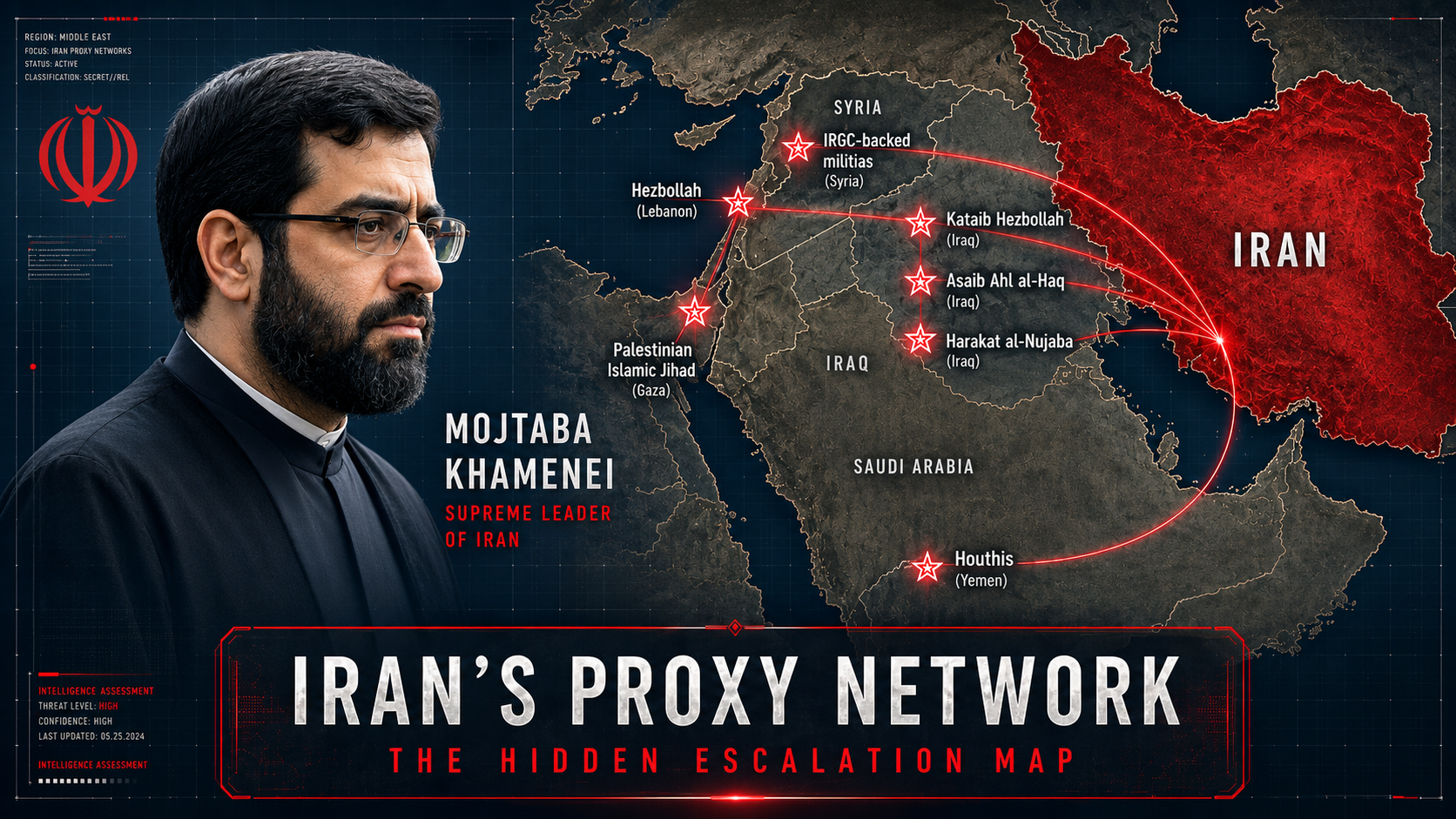
What decision-makers should watch now — before proxy escalation becomes a cost, compliance or supply-chain shock.
This 17-page executive briefing translates Iran’s proxy network into concrete business risks: energy price exposure, maritime chokepoints, war-risk premiums, sanctions, shadow fleets, supply-chain disruption and early-warning indicators for board-level decisions.
You are currently viewing a placeholder content from X. To access the actual content, click the button below. Please note that doing so will share data with third-party providers.
More Information