Executive Intelligence. Industrial Risk. Geopolitics.
Strategic Sparring
for Decision-Makers
Risk intelligence across technology, law, markets and power dynamics.


Verdeckte Geschäftsrisiken, strategische Widersprüche und kritische Abhängigkeiten frühzeitig erkennen.
Kostenlose Analyse starten →
Verdeckte Machtstrukturen, Führungsrisiken und organisatorische Blockaden frühzeitig erkennen.
Kostenlose Analyse starten →
Geopolitische Risiken, globale Abhängigkeiten und kritische Lieferkettenrisiken frühzeitig erkennen.
Kostenlose Analyse starten →
Identify hidden business risks, strategic contradictions and critical dependencies at an early stage.
Start Free Analysis →
Identify hidden power structures, leadership risks and organizational blockers at an early stage.
Start Free Analysis →
Identify geopolitical risks, global dependencies and critical supply-chain vulnerabilities at an early stage.
Start Free Analysis →
Verdeckte Geschäftsrisiken, strategische Widersprüche und kritische Abhängigkeiten frühzeitig erkennen.
Kostenlose Analyse starten →
Verdeckte Machtstrukturen, Führungsrisiken und organisatorische Blockaden frühzeitig erkennen.
Kostenlose Analyse starten →
Geopolitische Risiken, globale Abhängigkeiten und kritische Lieferkettenrisiken frühzeitig erkennen.
Kostenlose Analyse starten →
Identify hidden business risks, strategic contradictions and critical dependencies at an early stage.
Start Free Analysis →
Identify hidden power structures, leadership risks and organizational blockers at an early stage.
Start Free Analysis →
Identify geopolitical risks, global dependencies and critical supply-chain vulnerabilities at an early stage.
Start Free Analysis →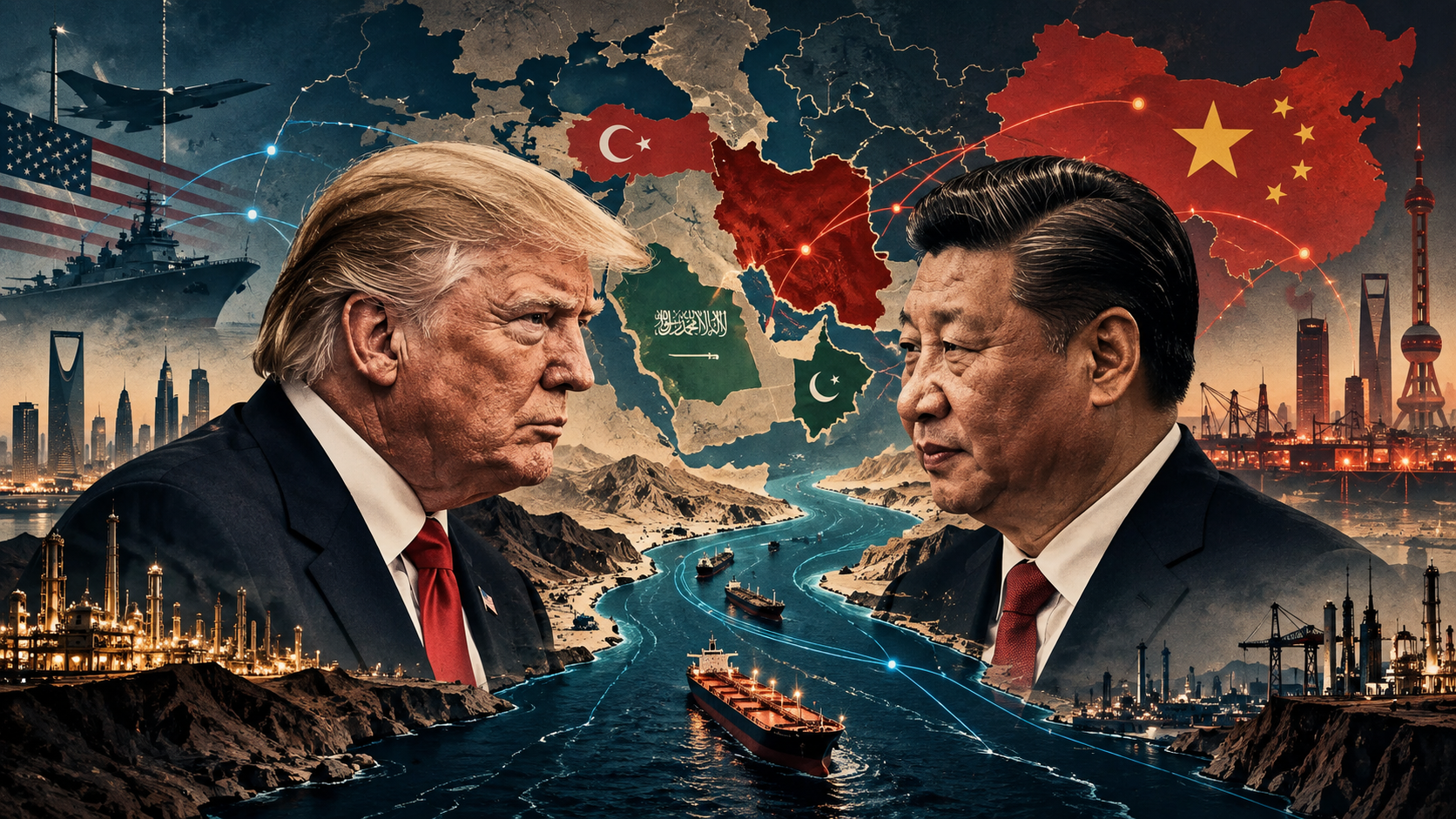
Iran is portrayed in much of the Western security debate as a key destabilising force in the Middle East. Yet Tehran is simultaneously being discussed as a potential participant in an emerging regional security architecture around the Mecca Pact. Meanwhile, as Washington pressures China to scale back its support for Iran, Beijing is reassuring Tehran that their strategic partnership remains intact. What appears to be a contradiction may signal a deeper shift in the Middle East power order.
Strategic Risk Intelligence Brief by Global Insight Group.
This analysis is based on the GFDD Framework™ developed by Michaela Schaaf-Hoffelner and is designed for executives, investors and strategic decision-makers.
Updated: September 26, 2026
The emerging defence cooperation between Saudi Arabia, Türkiye and Pakistan is increasingly being discussed as a potential nucleus of a more autonomous regional security architecture.
Caution remains necessary. The Condor Research Group notes that the framework still lacks an integrated military command, clearly defined automatic mutual-defence mechanisms and a publicly articulated nuclear component.
Politically, however, the development is significant.
Iran is particularly noteworthy. Formal Iranian accession to the Mecca Pact has not been confirmed. Nevertheless, Tehran’s potential role in a broader collective regional security framework is being discussed.
This creates a strategic paradox: Why would Iran become part of a regional security architecture when Tehran is simultaneously portrayed as a primary security threat and a supporter of non-state actors such as the Houthis?
The answer may lie in a changing security logic.
For decades, Gulf security has relied heavily on US security guarantees, with Iran largely treated as a power to be contained.
A more regionalised order would follow a different logic: security would no longer depend exclusively on deterring Iran, but potentially also on integrating Tehran into a regional balance of power.
Remarkably, Beijing is publicly supporting precisely this broader direction.
During a meeting with Iranian Foreign Minister Abbas Araghchi on September 16, Chinese Foreign Minister Wang Yi argued that the existing Middle East security architecture was inadequate and required reform. China supported regional countries in building a “new security architecture for the Middle East.” At the same time, Beijing continued to describe Iran as a comprehensive strategic partner and explicitly characterised its Iran policy as continuous and stable. Source: Ministry of Foreign Affairs of China.
Just days later, Xi Jinping was sitting across the table from Donald Trump.
Washington is clearly seeking to leverage China’s influence over Iran. According to the US ambassador in Beijing, Trump told Xi during their September 24 meeting that Chinese support for Iran – whether direct or indirect – was unacceptable to Washington. Source: Reuters.
Yet Beijing has so far shown no indication that it intends to abandon Tehran. Ahead of the summit, Reuters reported that expectations of Xi applying decisive pressure on Iran at Washington’s request remained limited. Source: Reuters.
This points to an intriguing strategic balancing act.
China can position itself as a potential intermediary vis-à-vis Washington without sacrificing its relationship with Iran. For Tehran, Beijing remains an important economic and diplomatic partner. At the same time, China is supporting the emergence of a more regional security architecture among the Gulf states. Wang Yi has similarly told Qatar that Beijing supports regional countries taking greater control over their own future. Source: Ministry of Foreign Affairs of China.
This may be precisely where China’s strategic advantage lies.
Beijing does not need to replace the United States as the Middle East’s primary security guarantor. A more autonomous regional security order could already reduce the exclusive dependence of regional powers on Washington.
At the same time, China’s relationship with Iran becomes increasingly valuable in its dealings with the United States: the more Washington needs Beijing’s influence over Tehran, the greater China’s diplomatic leverage becomes.
Iran would therefore be more than a partner. It could also become strategic bargaining capital.
The Mecca Pact, discussions about Iran’s possible integration and China’s call for a new Middle East security architecture should therefore not be viewed in isolation. They may represent different manifestations of the same underlying development: the Middle East is diversifying its security relationships.
For investors and geopolitical risk analysts, this shift matters far beyond military alliances. A changing Middle East power order could reshape influence over energy security, the Strait of Hormuz, global trade routes, defence cooperation, investment flows and geopolitical risk premiums.
The critical question may therefore no longer be whether China supports Iran or accommodates Trump.
It is this:
How much strategic leverage does Beijing gain when both sides need China?
Energy flows, the Strait of Hormuz and control over transport routes are critical components of the Middle East power balance. This analysis examines why oil functions not merely as a commodity, but as a geopolitical system asset.
China’s strategic leverage extends far beyond diplomacy. Rare earths, supply chains and energy dependencies demonstrate how Beijing can translate control over critical economic dependencies into geopolitical influence.
Ukraine and Iran appear to be separate geopolitical theatres. Viewed systemically, however, simultaneous conflicts can bind US resources, military capacity and political attention – potentially altering the wider global balance of power.
Author of Global Insight Group Intelligence:
Michaela Schaaf-Hoffelner has more than 35 years of experience in strategic and technical project and product management, particularly in IT, control systems and intralogistics. Through her long-standing work with complex systems, she identifies structural risks and dynamic misalignments at an early stage – risks that are often overlooked in conventional analysis.
Her focus is on making causal relationships and systemic dependencies visible and translating them into concrete strategic advantages for investors and decision-makers. Her analyses combine deep technical systems understanding with geopolitical and economic developments.
GFDD Framework™ and GFDD Diagnostics™ are proprietary analytical concepts developed by Michaela Schaaf-Hoffelner. © 2026 Global Insight Group LLC. All rights reserved.
You are currently viewing a placeholder content from X. To access the actual content, click the button below. Please note that doing so will share data with third-party providers.
More Information