Executive Intelligence. Industrial Risk. Geopolitics.
Strategic Sparring
for Decision-Makers
Risk intelligence across technology, law, markets and power dynamics.


Verdeckte Geschäftsrisiken, strategische Widersprüche und kritische Abhängigkeiten frühzeitig erkennen.
Kostenlose Analyse starten →
Verdeckte Machtstrukturen, Führungsrisiken und organisatorische Blockaden frühzeitig erkennen.
Kostenlose Analyse starten →
Geopolitische Risiken, globale Abhängigkeiten und kritische Lieferkettenrisiken frühzeitig erkennen.
Kostenlose Analyse starten →
Identify hidden business risks, strategic contradictions and critical dependencies at an early stage.
Start Free Analysis →
Identify hidden power structures, leadership risks and organizational blockers at an early stage.
Start Free Analysis →
Identify geopolitical risks, global dependencies and critical supply-chain vulnerabilities at an early stage.
Start Free Analysis →
Verdeckte Geschäftsrisiken, strategische Widersprüche und kritische Abhängigkeiten frühzeitig erkennen.
Kostenlose Analyse starten →
Verdeckte Machtstrukturen, Führungsrisiken und organisatorische Blockaden frühzeitig erkennen.
Kostenlose Analyse starten →
Geopolitische Risiken, globale Abhängigkeiten und kritische Lieferkettenrisiken frühzeitig erkennen.
Kostenlose Analyse starten →
Identify hidden business risks, strategic contradictions and critical dependencies at an early stage.
Start Free Analysis →
Identify hidden power structures, leadership risks and organizational blockers at an early stage.
Start Free Analysis →
Identify geopolitical risks, global dependencies and critical supply-chain vulnerabilities at an early stage.
Start Free Analysis →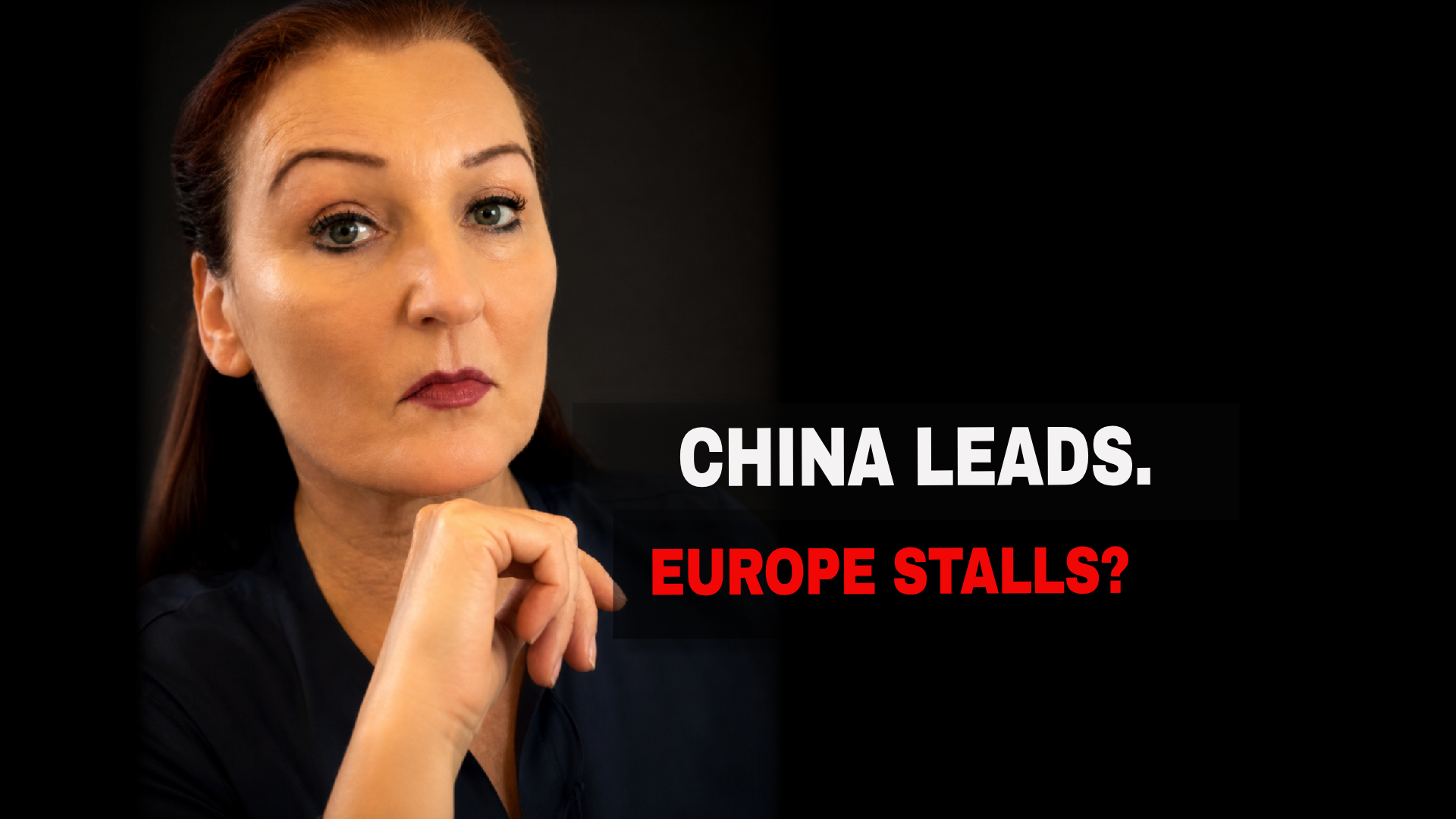
Strategic Risk Intelligence Brief by Global Insight Group.
This analysis is based on the GFDD Framework™ developed by Michaela Schaaf-Hoffelner and is designed for executives, investors and strategic decision-makers.
Updated: May 26, 2026
An uncomfortable conclusion now dominates the European industrial debate: China has not only caught up in key future industries. In several segments, it has reached a structural leadership position. Electric mobility, battery technology, solar technology, industrial automation and digital production ecosystems all show a pattern that can no longer be explained by lower costs or state support alone.
Europe usually discusses the “China shock” through familiar factors: subsidies, industrial policy, energy prices, regulation, access to capital and bureaucracy. These factors matter. But they do not fully explain why European companies so often fail internally when it comes to transformation, scaling, innovation capability and post-merger integration.
The deeper thesis is this: Europe’s problem is not only a technology or location problem. It is also a governance problem. More precisely, many European companies underestimate the power of actors who hold no formal corporate office, yet control operational reality.
In corporate governance, attention almost automatically focuses on formal responsibility: executive boards and managing directors are subject to clear duties of care and loyalty toward the company. Their responsibility is formally visible, legally addressable and mapped within governance systems. In M&A transactions, this level is reviewed in detail: corporate bodies, contracts, compliance systems, liability risks, reporting lines and control mechanisms.
Below this level, however, a structural blind spot emerges: division heads, senior managers, programme owners, HR-adjacent key people, long-standing internal gatekeepers and informal power holders can exercise considerable de facto power over operational decisions, information flows and social sanctions without being visible as corporate risk carriers in the same way as formal officeholders.
These individuals often do not formally decide strategy. But they do decide, in practice, which information is escalated, which risks are downplayed, which people are considered credible and which critical voices are isolated. As a result, they often shape the real transformation capability of a company more strongly than the official organisational chart would suggest.
For investors and buyers, this creates a valuation problem: classic due diligence primarily reviews documented structures. Yet the real integration capability of a company depends heavily on whether the organisation remains truth-capable, conflict-capable and innovation-capable after closing.
The value destruction at stake here rarely occurs through open sabotage. It emerges through omission in the grey zone: cumulative micro-omissions, informal steering actions, information filtering and social sanctions. This is precisely why such transformation risks and innovation blockages remain difficult to detect in classic review processes.
Typical patterns include:
The economic damage does not arise only from individual poor decisions. It arises from the systematic weakening of organisational perception. When relevant information does not reach the top, when risks are socially softened and when analytically strong people are treated as disruptive factors, the company loses its internal correction capability.
This is the real governance core: not every omission is unlawful. But repeated omission, information filtering and the social sanctioning of critical perception can factually damage the company’s interest. For M&A investors, this dynamic is especially dangerous because it materialises only after closing – through integration delays, talent loss, blocked synergies and operational friction.
M&A is not the main subject of this analysis, but it is a particularly clear stress test. In an acquisition, the difference between formal structure and de facto power suddenly becomes capital-relevant: during post-merger integration, it becomes visible who actually holds implementation power in the target.
Classic M&A due diligence analyses financials, contracts, market position, technology, customer structure, IP, supply chains and legal risks. This review is necessary, but incomplete if it does not identify who factually controls operational truth within the target.
Key due diligence questions would include:
These questions belong in a modern governance and integration review. Without them, due diligence remains structurally blind to de facto blocking power.
The reformed Chinese company law provides a relevant contrast. The new PRC Company Law does not extend duties of loyalty and diligence to every middle manager across the board, but it addresses the problem of de facto control much more explicitly than many European governance reviews.
The central anchor is Article 180 of the reformed PRC Company Law. Under this provision, duties of loyalty and diligence apply not only to directors, supervisors and senior management. They may also cover controlling shareholders and actual controllers who do not serve as directors, but who factually conduct company affairs. JunHe – Material Impact of the Amendment to China’s Company Law, Reed Smith – PRC Company Law overhaul: Key changes and takeaways, Freshfields – New Company Law in China: 10 key changes
Article 192 goes one step further: If a controlling shareholder or actual controller instructs a director or senior manager to take actions that harm the interests of the company or its shareholders, that person may be held liable together with them. International law firms explicitly describe this provision as an approximation to “de facto directors” or “shadow directors.” Pillsbury – China Passes Significant Amendments to Company Law, Norton Rose Fulbright – China releases its newly revised Company Law
The decisive point is not that China has a perfect governance system. The narrower and more relevant point is this: the law explicitly recognises that actual corporate power is not necessarily identical with formal office. Under certain conditions, those who steer the company in practice can no longer fully hide behind the absence of a formal title.
For European M&A reviews, this creates a strategic lesson: those who review only formal functions may overlook the people and networks that, after closing, hold the real implementation power.
The economic relevance of this perspective is visible in practice. The starting point was a customer portfolio that was increasingly under pressure and losing customers. In response, a retention-oriented claims setup was to be built – not as an additional shadow structure, but as a transparent operational structure.
The decisive lever was not only process design. The decisive factor was the creation of operational clarity: responsibilities, information flows and decision points became transparent. This prevented informal shadow structures from having to emerge – structures in which problems are hidden, responsibilities are shifted and conflicts are handled indirectly.
In implementation, this meant clear processes, visible responsibilities, open conflict resolution, accepted ideas and a consistent focus on win-win solutions between customer interests, operational feasibility and commercial objectives.
The result: A previously endangered portfolio developed into a clearly growing business area within three years. Revenue doubled, with an additional volume of around EUR 2.5 million per year.
The case shows: value creation does not come only from reporting or process manuals. It arises when operational truth becomes visible, responsibilities are clear and conflicts do not have to escape into informal shadow structures.
If European companies want to realistically assess their transformation capability, a classic management and culture review is not enough. For investors, this applies even more strongly: anyone acquiring a target does not only acquire assets, markets and technologies, but also informal power structures. Governance risks emerge where de facto blocking power remains invisible. What is required is an analysis of the company’s social architecture.
Such an assessment would need to cover at least four levels:
This perspective shifts the focus: formal risks are not the only risks that matter. What also matters is a company’s ability to process internal truth.
Europe will not catch up with China’s industrial lead through more funding programmes, less bureaucracy or new strategy papers alone. The decisive question is whether European companies recognise their own internal blocking power.
The most dangerous power in a company is often not listed in the commercial register. It sits in informal networks, middle management layers and operational gatekeeper structures. This is where information is filtered, risks are softened, critical voices are devalued and innovation is slowed down.
For corporate leaders, this means: those who look only at processes, strategies and organisational charts underestimate the internal blocking points of their own transformation.
For M&A investors, it means something additional: those who review only numbers, contracts and formal governance see the deal. Those who review de facto power structures see the integration risk.
The next stage of due diligence therefore does not lie in even more detailed Excel models. It lies in a precise analytical model for social architecture, informal power and organisational truth capability.
This article shows the blind spot. The in-depth reports address two different dimensions of the problem.
The report “Why Asian Players Are Taking Control of Europe’s Intralogistics Sector” analyses the external strategic pressure: China’s platform logic, modular robotics, brownfield and retrofit capability, open standards, raw material power and the loss of European change flexibility. It is aimed at decision-makers who want to understand why European intralogistics and automation providers are coming under structural pressure.
The report “The Biggest Misjudgement in the European Industrial Sector” analyses the internal governance and valuation blind spot: informal decision-making power, network power, role power and information power, personalised problem narratives, blocked early warning systems, the loss of key talent and specific due diligence questions for investors.
In short: the first report shows the external China and platform pressure. The second report provides the assessment model for hidden transformation risks in the target.
This is where it is decided whether a deal creates value – or quietly bleeds out after closing.
These topics deepen the connection between leadership, structure and economic performance – and show concrete points of intervention for improving organisational effectiveness. Selected related articles. Some linked articles are currently available in German.
Author of Global Insight Group Intelligence:
Michaela Schaaf-Hoffelner has more than 35 years of experience in strategic and technical project and product management, particularly in IT, control systems and intralogistics. Through her long-standing work with complex systems, she identifies structural risks and dynamic misalignments at an early stage – risks that are often overlooked in conventional analysis.
Her focus is on making causal relationships and systemic dependencies visible and translating them into concrete strategic advantages for investors and decision-makers. Her analyses combine deep technical systems understanding with geopolitical and economic developments.
GFDD Framework™ and GFDD Diagnostics™ are proprietary analytical concepts developed by Michaela Schaaf-Hoffelner. © 2026 Global Insight Group LLC. All rights reserved.
You are currently viewing a placeholder content from X. To access the actual content, click the button below. Please note that doing so will share data with third-party providers.
More Information