Executive Intelligence. Industrial Risk. Geopolitics.
Strategic Sparring
for Decision-Makers
Risk intelligence across technology, law, markets and power dynamics.


Verdeckte Geschäftsrisiken, strategische Widersprüche und kritische Abhängigkeiten frühzeitig erkennen.
Kostenlose Analyse starten →
Verdeckte Machtstrukturen, Führungsrisiken und organisatorische Blockaden frühzeitig erkennen.
Kostenlose Analyse starten →
Geopolitische Risiken, globale Abhängigkeiten und kritische Lieferkettenrisiken frühzeitig erkennen.
Kostenlose Analyse starten →
Identify hidden business risks, strategic contradictions and critical dependencies at an early stage.
Start Free Analysis →
Identify hidden power structures, leadership risks and organizational blockers at an early stage.
Start Free Analysis →
Identify geopolitical risks, global dependencies and critical supply-chain vulnerabilities at an early stage.
Start Free Analysis →
Verdeckte Geschäftsrisiken, strategische Widersprüche und kritische Abhängigkeiten frühzeitig erkennen.
Kostenlose Analyse starten →
Verdeckte Machtstrukturen, Führungsrisiken und organisatorische Blockaden frühzeitig erkennen.
Kostenlose Analyse starten →
Geopolitische Risiken, globale Abhängigkeiten und kritische Lieferkettenrisiken frühzeitig erkennen.
Kostenlose Analyse starten →
Identify hidden business risks, strategic contradictions and critical dependencies at an early stage.
Start Free Analysis →
Identify hidden power structures, leadership risks and organizational blockers at an early stage.
Start Free Analysis →
Identify geopolitical risks, global dependencies and critical supply-chain vulnerabilities at an early stage.
Start Free Analysis →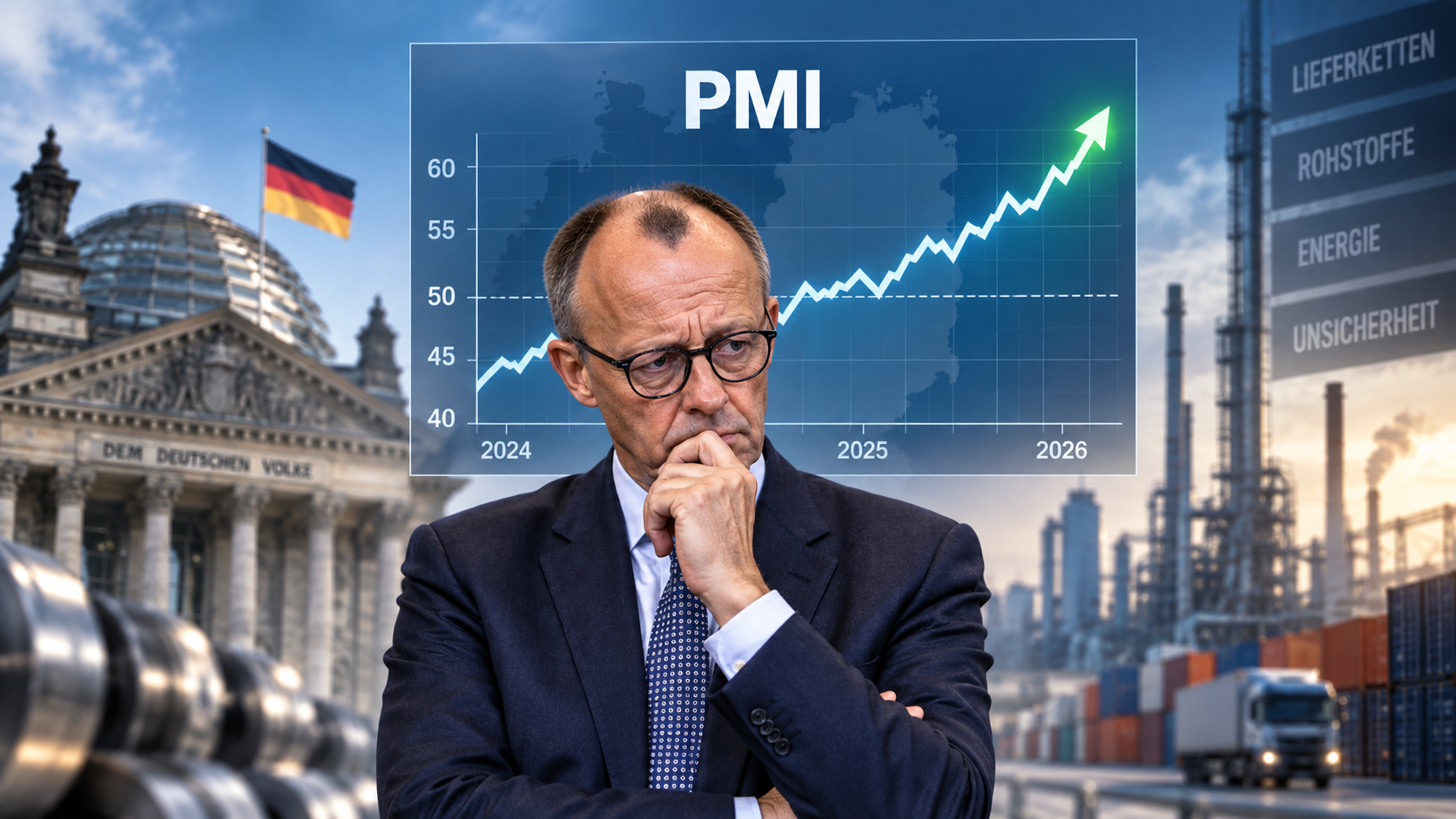
Strategic Risk Intelligence Brief by Global Insight Group.
This analysis is based on the GFDD Framework™ developed by Michaela Schaaf-Hoffelner and is designed for executives, investors and strategic decision-makers.
Updated: September 11, 2026
Germany’s manufacturing sector is sending what, at first glance, looks like a surprisingly positive signal.
The S&P Global/BME Germany Manufacturing PMI rose from 52.2 to 54.3 in August 2026, reaching its highest level in 51 months. New orders increased at their fastest pace since February 2022, output expanded strongly, and business expectations improved.
After years of industrial weakness, the obvious interpretation would be:
Germany’s manufacturing sector is finally recovering.
But a closer look at the data tells a much more complex story.
The most important question is not simply whether new orders are rising.
It is why they are rising.
Companies surveyed by S&P Global and BME identified several key drivers:
Even more revealing is what is happening in procurement.
German manufacturers increased their purchasing activity in August at the fastest rate since May 2022. At the same time, supply constraints intensified and companies increased their purchases of raw materials.
BME explicitly refers to precautionary measures.
This opens up a second interpretation of Germany’s PMI increase:
Companies may not simply be buying more because they expect to produce more. They may also be buying earlier and building inventories because they expect future supply disruptions.
Several indicators challenge the idea that Germany is already experiencing a broad-based industrial recovery.
Real production in Germany’s producing sector fell by 1.1% month-on-month in July.
Manufacturing output excluding energy and construction declined by 2.2%, while industrial production was 3.3% lower than in July 2025.
Factory orders also look considerably weaker once the headline number is examined more closely.
Total orders increased by 2.5% in July.
But excluding large-scale orders, new orders actually declined by 1.4%.
Over the three-month period, orders excluding major contracts were down 2.2%.
Much of the headline increase came from exceptionally large orders in other transport equipment — including aircraft, ships, trains and military vehicles. Orders in this category jumped by 126.4%.
At the same time, orders in Germany’s automotive industry fell by 12.5%.
That is hardly the profile of a uniform industrial recovery.
Another factor is becoming increasingly important: rising input costs.
German import prices in July were 6.8% higher than a year earlier.
Imported intermediate goods rose by 10.2%, while energy imports increased by 26.4%.
Prices for materials including copper, aluminium, plastics and electronic components also increased sharply. Germany’s Federal Statistical Office identified the Iran war and developments in the Middle East as important drivers of the price increase.
For procurement managers, this changes the risk calculation.
When shipping routes become less secure, critical components may become harder to source and input prices are expected to rise, there is a rational response:
Secure materials today before they become more expensive — or unavailable — tomorrow.
That is precisely how precautionary buying and safety-stock building begin.
Germany’s PMI reading of 54.3 should therefore not be dismissed.
Parts of the industrial economy are clearly expanding — particularly sectors benefiting from defence spending, infrastructure investment, data-centre construction and selected capital-goods demand.
But the broader data does not support a simple narrative of a widespread German industrial recovery.
Instead, another mechanism may increasingly be influencing the PMI:
Geopolitical uncertainty → higher supply chain risk → higher expected input costs → forward purchasing → inventory build-up → stronger purchasing activity → higher PMI.
If this mechanism is contributing materially to the current increase, part of Germany’s PMI strength may not be driven by optimism alone.
It may also reflect companies hedging against what they believe could come next.
That would fundamentally change how the current PMI should be interpreted.
The German manufacturing PMI would no longer be merely an early indicator of economic recovery.
It could also be starting to reveal fear inside industrial supply chains.
Author of Global Insight Group Intelligence:
Michaela Schaaf-Hoffelner has more than 35 years of experience in strategic and technical project and product management, particularly in IT, control systems and intralogistics. Through her long-standing work with complex systems, she identifies structural risks and dynamic misalignments at an early stage – risks that are often overlooked in conventional analysis.
Her focus is on making causal relationships and systemic dependencies visible and translating them into concrete strategic advantages for investors and decision-makers. Her analyses combine deep technical systems understanding with geopolitical and economic developments.
GFDD Framework™ and GFDD Diagnostics™ are proprietary analytical concepts developed by Michaela Schaaf-Hoffelner. © 2026 Global Insight Group LLC. All rights reserved.
You are currently viewing a placeholder content from X. To access the actual content, click the button below. Please note that doing so will share data with third-party providers.
More Information