Executive Intelligence. Industrial Risk. Geopolitics.
Strategic Sparring
for Decision-Makers
Risk intelligence across technology, law, markets and power dynamics.

Verdeckte Geschäftsrisiken, strategische Widersprüche und kritische Abhängigkeiten frühzeitig erkennen.
Kostenlose Analyse starten →
Verdeckte Machtstrukturen, Führungsrisiken und organisatorische Blockaden frühzeitig erkennen.
Kostenlose Analyse starten →
Geopolitische Risiken, globale Abhängigkeiten und kritische Lieferkettenrisiken frühzeitig erkennen.
Kostenlose Analyse starten →
Identify hidden business risks, strategic contradictions and critical dependencies at an early stage.
Start Free Analysis →
Identify hidden power structures, leadership risks and organizational blockers at an early stage.
Start Free Analysis →
Identify geopolitical risks, global dependencies and critical supply-chain vulnerabilities at an early stage.
Start Free Analysis →
Verdeckte Geschäftsrisiken, strategische Widersprüche und kritische Abhängigkeiten frühzeitig erkennen.
Kostenlose Analyse starten →
Verdeckte Machtstrukturen, Führungsrisiken und organisatorische Blockaden frühzeitig erkennen.
Kostenlose Analyse starten →
Geopolitische Risiken, globale Abhängigkeiten und kritische Lieferkettenrisiken frühzeitig erkennen.
Kostenlose Analyse starten →
Identify hidden business risks, strategic contradictions and critical dependencies at an early stage.
Start Free Analysis →
Identify hidden power structures, leadership risks and organizational blockers at an early stage.
Start Free Analysis →
Identify geopolitical risks, global dependencies and critical supply-chain vulnerabilities at an early stage.
Start Free Analysis →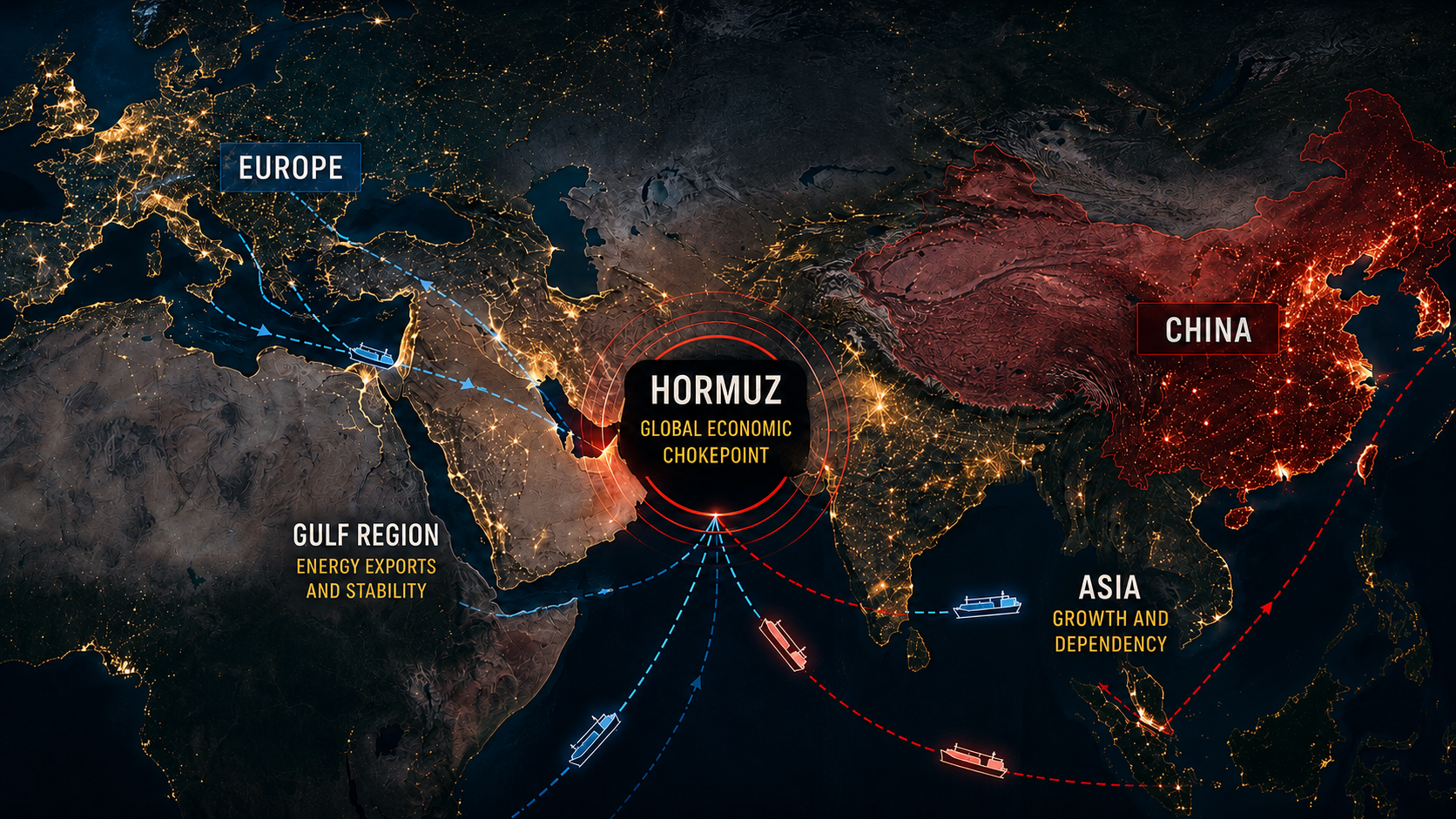
This Chokepoint Check assesses current pressure on the Strait of Hormuz, Bab al-Mandab and the Gulf region’s critical water, power, port and energy infrastructure. The key question is not only whether a route remains geographically open, but whether transport, insurance coverage, energy supply and site operations remain operationally viable.
The route remains open, but is still far from reliable commercial normality.
Only seven commodity vessels transited Hormuz on Thursday, compared with a 10-day average of around 15. At the same time, the first known QatarEnergy-linked LNG cargo since July reached Pakistan.
The risk is shifting from isolated attacks towards territorial control directly at the chokepoint.
Houthi forces reached Dhubab directly on Bab al-Mandab, opposite the strategic island of Perim. They had previously captured Mocha. Twenty-six vessels transited the strait on Thursday.
No sufficiently confirmed new attack on Gulf energy facilities was identified for September 10 or 11.
The IEA nevertheless warns that normal Gulf oil flows are unlikely to return fully before 2027. Global supply and inventories therefore remain under sustained pressure.
Kpler recorded only seven commodity-vessel transits on Thursday, compared with a 10-day average of 15. Three QatarEnergy-linked LNG vessels were tracked.
Al Marrouna delivered LNG to Pakistan – the first known Qatar-linked delivery since July. Dark transits remain excluded.
Individual LNG flows are stabilising, but the extremely low overall traffic level keeps capacity, insurance and lead-time risks elevated.
Verification Status: confirmed through current Kpler vessel data. The LNG delivery is a positive isolated signal, not a return to normal operations. Reuters / Kpler, 11.09.2026 · SchaafMedia: Chokepoint Risk Analysis – Hormuz & Supply Chain Risks
Houthi forces reached Dhubab directly on the strait, opposite the strategic island of Perim. Mocha had previously fallen to the Houthis.
The risk is therefore shifting from attacks on vessels towards potential territorial control over key approaches to the chokepoint.
Shipowners must prepare for rising war-risk, rerouting and crew-safety exposure across the Red Sea and Suez as well as Saudi export routes.
Verification Status: partially confirmed. The advance to Dhubab was confirmed by two Yemeni government sources; full control of Bab al-Mandab has not been established. Reuters, 11.09.2026 · SchaafMedia: Middle East Escalation Check from September 9, 2026
The IEA cut its forecast for global oil supply in 2026. Normal Gulf flows are now expected to return only during 2027.
Global production is expected to decline by around 5.7 million barrels per day in 2026. Inventories are also being drawn down further.
Companies must prepare for a prolonged period of elevated energy, transport and procurement costs as well as greater inflation and margin pressure.
Verification Status: confirmed through the latest IEA Oil Market Report. The forecast reflects a structural supply gap, not merely short-term price volatility. Reuters / IEA, 11.09.2026 · SchaafMedia: Oil as a Weapon – Energy and Geopolitics in 2026
Israel said on September 10 that it had completely destroyed a Hezbollah tunnel complex more than two kilometres long near Ali al-Taher.
Israel says it now has full operational control over the ridge. The planned withdrawal from southern Lebanon therefore remains blocked.
The second front remains active. Risks to aviation, infrastructure and investment across the eastern Mediterranean remain elevated.
Verification Status: confirmed for the Israeli operation and explosion. The scale and military significance of the complex are based partly on Israeli statements. Reuters, 10.09.2026 · directly relevant on 11.09. · SchaafMedia: Iran War – How the West Is Losing Its Dominance
Pakistan said on September 10 that no military response under the Makkah Joint Defence Agreement was currently under discussion.
Islamabad explicitly maintains its alliance commitments, but is currently prioritising diplomacy. No alliance expansion is planned for now.
The immediate risk of a three-state military intervention has eased. The pact nevertheless remains a new escalation mechanism if attacks continue.
Verification Status: confirmed by Pakistan’s Ministry of Foreign Affairs. No operational activation has been decided; the collective-defence commitment remains in place. Pakistan Ministry of Foreign Affairs, 10.09.2026 · SchaafMedia: Iran Check – 5 Escalation Signals from September 10, 2026
Hormuz remains heavily constrained while Houthis gain territorial positions directly on Bab al-Mandab.
Shipowners, energy traders and insurers must reassess both regional chokepoints simultaneously.
Hormuz remains at seven transits while full recovery of Gulf oil flows is pushed further out.
Energy prices, freight, inflation, financing and procurement remain under simultaneous pressure.
Hormuz remains in single digits, while Houthi forces are now positioned directly on Bab al-Mandab.
Both chokepoints open · operational reliability remains significantly constrainedNo new confirmed facility attack was identified for September 10 or 11. The IEA nevertheless expects Gulf oil flows to remain impaired for longer.
No new facility destruction · energy supply remains structurally disruptedTwo chokepoints, Gulf energy supply, the Lebanon front and the regional defence architecture are acting simultaneously.
Maritime, energy, military and alliance risks remain fully interconnectedOverall risk remains critical. Compared with September 9, the most important new operational risk is shifting from the Gulf towards Bab al-Mandab. Hormuz nevertheless remains heavily constrained. Individual LNG deliveries and Pakistan’s restraint are not sufficient to constitute credible de-escalation.
Note: This assessment was produced with support from our Geo-AI. AI can make mistakes. The analysis is intended as a source-based radar for potential escalation signals and does not replace fully verified intelligence, security, insurance or investment advice. In rapidly evolving situations, status, source availability and risk assessments may change at short notice.
Independent of the subject covered in this article, this separate Executive Briefing provides an in-depth analysis of another critical risk domain affecting European companies.
The 27-page Executive Briefing “Black Swan Risk Mapping for Europe’s Next Mobility and Infrastructure Shock” examines how geopolitical, infrastructural and administrative developments that are currently viewed in isolation could reinforce one another.
Based on the GFDD Framework™, the report shows how these dynamics could affect operational continuity, access to critical resources and the strategic resilience of companies.
The briefing includes a structured systemic-shock analysis and a directly applicable Business Exposure Checklist for CEOs, CFOs, COOs, investors and strategy teams.
You are currently viewing a placeholder content from X. To access the actual content, click the button below. Please note that doing so will share data with third-party providers.
More Information