Executive Intelligence. Industrial Risk. Geopolitics.
Strategic Sparring
for Decision-Makers
Risk intelligence across technology, law, markets and power dynamics.


Verdeckte Geschäftsrisiken, strategische Widersprüche und kritische Abhängigkeiten frühzeitig erkennen.
Kostenlose Analyse starten →
Verdeckte Machtstrukturen, Führungsrisiken und organisatorische Blockaden frühzeitig erkennen.
Kostenlose Analyse starten →
Geopolitische Risiken, globale Abhängigkeiten und kritische Lieferkettenrisiken frühzeitig erkennen.
Kostenlose Analyse starten →
Identify hidden business risks, strategic contradictions and critical dependencies at an early stage.
Start Free Analysis →
Identify hidden power structures, leadership risks and organizational blockers at an early stage.
Start Free Analysis →
Identify geopolitical risks, global dependencies and critical supply-chain vulnerabilities at an early stage.
Start Free Analysis →
Verdeckte Geschäftsrisiken, strategische Widersprüche und kritische Abhängigkeiten frühzeitig erkennen.
Kostenlose Analyse starten →
Verdeckte Machtstrukturen, Führungsrisiken und organisatorische Blockaden frühzeitig erkennen.
Kostenlose Analyse starten →
Geopolitische Risiken, globale Abhängigkeiten und kritische Lieferkettenrisiken frühzeitig erkennen.
Kostenlose Analyse starten →
Identify hidden business risks, strategic contradictions and critical dependencies at an early stage.
Start Free Analysis →
Identify hidden power structures, leadership risks and organizational blockers at an early stage.
Start Free Analysis →
Identify geopolitical risks, global dependencies and critical supply-chain vulnerabilities at an early stage.
Start Free Analysis →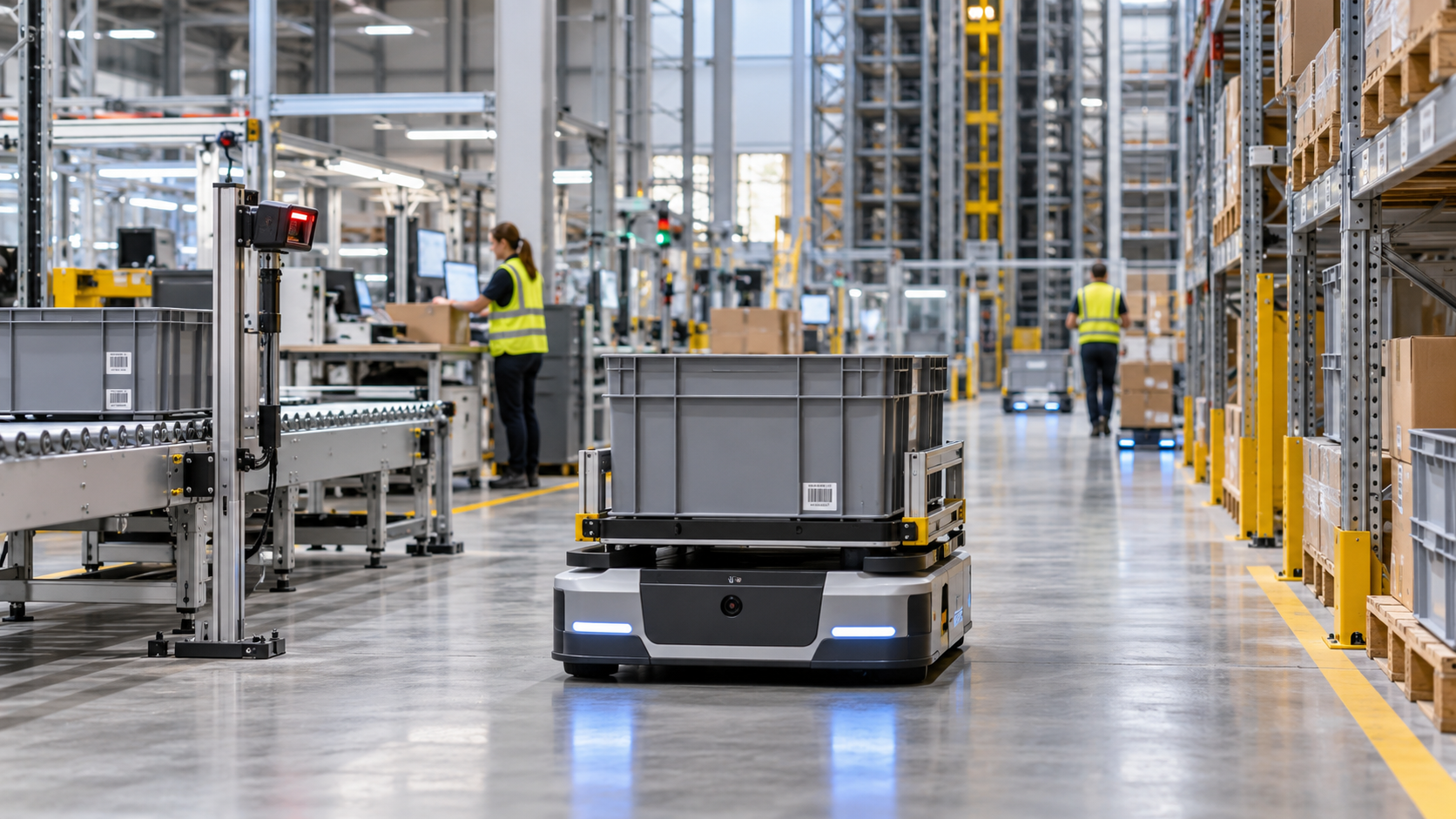
Strategic Risk Intelligence Brief by Global Insight Group.
This analysis is based on the GFDD Framework™ developed by Michaela Schaaf-Hoffelner and is designed for executives, investors and strategic decision-makers.
Updated: October 23, 2026
Europe’s industrial economy is not simply in crisis. Beneath weak headline growth, clear winners and losers are emerging, with performance increasingly diverging across industrial sectors. This structural split is particularly visible in mechanical engineering and intralogistics.
While specialist machinery, energy infrastructure, electrical distribution equipment and optical technologies are expanding strongly, traditional machine tools are losing ground. At the same time, the intralogistics market is undergoing another fundamental shift: companies are still investing in automation, but increasingly in existing facilities rather than large-scale greenfield projects.
This could significantly change the competitive dynamics of Europe’s warehouse automation industry.
EU manufacturing output was virtually flat between January 2025 and August 2026, increasing by just 0.1%.
Yet the sector-level picture looks completely different.
Production of specialised machinery increased by 27.6%. Engines and turbines gained 24.0%, optical and photonic equipment rose by 20.7%, and electrical distribution and switching equipment increased by 11.8%.
Traditional metalworking machine tools moved in the opposite direction, with production falling by 7.5% over the same period. Pumps and compressors recorded growth of only 1.3%.
Europe therefore has two very different industrial cycles operating simultaneously. Specialist technology is expanding rapidly, while several traditional capital goods sectors are stagnating or contracting.
The key question is no longer whether European industry is growing.
The more important question is where companies are still willing to invest.
This is where intralogistics becomes particularly interesting.
EU production of lifting and material handling equipment, which includes important parts of traditional intralogistics technology, remained under considerable pressure throughout 2025.
Production was 7.0% below the previous year in January 2025 and 8.0% lower in February. By August 2025, the decline had narrowed to 4.9%.
The market turned positive in 2026. Production increased by 3.9% year on year in January, by 4.8% in June and by 1.5% in August.
That is not an explosive recovery.
It is a selective recovery, and Germany stands out.
While EU production of lifting and handling equipment was 1.5% higher year on year in August 2026, German production was still 6.9% lower.
The divergence does not automatically mean that Germany is falling behind technologically. But it fits another trend that could be even more important for the future of intralogistics.
Europe’s logistics market is currently growing less through additional capacity and more through the optimisation of existing locations.
CBRE expects net expansion of European logistics space to accelerate again only from 2027. Companies are currently more likely to move into more efficient buildings or improve existing operations rather than aggressively expanding their overall logistics footprint. (cbre.de)
Germany shows the same pattern. In the first quarter of 2026, take-up of newly built logistics space fell by 21% year on year. New developments accounted for just 40% of total take-up. (cbre.de)
For intralogistics suppliers, this distinction matters.
A greenfield project often means an entirely new warehouse or distribution centre, including new conveyor systems, storage technology, controls and large-scale automation.
Brownfield investment means something different: making an existing warehouse more productive.
Companies can therefore continue spending heavily on automation without ordering a completely new automated warehouse.
This is where one of the most important distinctions in the current intralogistics market emerges.
Warehouse automation can involve autonomous mobile robots, automated guided vehicles, software, picking technologies or modular conveyor systems. These technologies can often be introduced incrementally into existing facilities.
Large fixed automated storage and retrieval systems are a very different proposition. Systems based on stacker cranes, shuttles, lifts or cube-storage technologies require substantially higher capital expenditure and are typically more closely linked to major greenfield or large-scale transformation projects.
Their market penetration remains surprisingly limited.
According to recent Prologis research, only around 3% to 5% of the warehouses studied use large fixed automation systems. Mobile robots and automated guided vehicles already reach penetration levels of around 10% to 15%. (prologis.com)
That changes the meaning of the widely discussed “warehouse automation boom”.
Growth in warehouse automation does not automatically mean equivalent growth in large-scale fixed automation projects.
Demand for logistics real estate also contradicts the simplistic idea that logistics itself is in decline.
Transport and logistics companies accounted for 41% of demand in Germany’s industrial and logistics property market in the first quarter of 2026, making them the largest user group. Manufacturing companies accounted for only 18%, down 14 percentage points from the previous year. (cbre.de)
That points to a structural shift rather than a disappearing market.
Logistics companies still need greater productivity, faster processes and more automation. What remains weaker are large industrial capacity expansions and capital-intensive greenfield developments.
The relative winner could therefore increasingly be brownfield automation: increasing throughput in existing warehouses, reducing labour dependence, integrating software and robotics, and adding modular automation without rebuilding the entire facility.
This creates a strategic challenge for the intralogistics industry.
When market studies report rising investment in warehouse automation, headline market growth is no longer enough. Executives and investors need to understand which type of automation is actually growing.
Are companies investing in large greenfield automation projects? Or is capital increasingly moving towards retrofit solutions, mobile robotics, warehouse software and modular brownfield automation?
The answer can determine which business models genuinely benefit from the automation trend.
Europe’s broader industrial economy already demonstrates that growth and contraction can exist at the same time. Intralogistics may now reveal the next stage of this transformation.
The dividing line between winners and losers may no longer be automation versus non-automation. It may be which type of automation companies are still willing to finance and actually need.
Eurostat, Production in industry – monthly data, Dataset sts_inpr_m, NACE Rev. 2, data through August 2026. (ec.europa.eu)
CBRE, European Real Estate Market Outlook 2026 and German industrial and logistics real estate market data for 2026. (cbre.de)
Prologis Research, Applied Automation in the Warehouse Boosts Value Across Stakeholders, 2026. (prologis.com)
Author of Global Insight Group Intelligence:
Michaela Schaaf-Hoffelner has more than 35 years of experience in strategic and technical project and product management, particularly in IT, control systems and intralogistics. Through her long-standing work with complex systems, she identifies structural risks and dynamic misalignments at an early stage – risks that are often overlooked in conventional analysis.
Her focus is on making causal relationships and systemic dependencies visible and translating them into concrete strategic advantages for investors and decision-makers. Her analyses combine deep technical systems understanding with geopolitical and economic developments.
GFDD Framework™ and GFDD Diagnostics™ are proprietary analytical concepts developed by Michaela Schaaf-Hoffelner. © 2026 Global Insight Group LLC. All rights reserved.
You are currently viewing a placeholder content from X. To access the actual content, click the button below. Please note that doing so will share data with third-party providers.
More Information