Executive Intelligence. Industrial Risk. Geopolitics.
Strategic Sparring
for Decision-Makers
Risk intelligence across technology, law, markets and power dynamics.

Verdeckte Geschäftsrisiken, strategische Widersprüche und kritische Abhängigkeiten frühzeitig erkennen.
Kostenlose Analyse starten →
Verdeckte Machtstrukturen, Führungsrisiken und organisatorische Blockaden frühzeitig erkennen.
Kostenlose Analyse starten →
Geopolitische Risiken, globale Abhängigkeiten und kritische Lieferkettenrisiken frühzeitig erkennen.
Kostenlose Analyse starten →
Identify hidden business risks, strategic contradictions and critical dependencies at an early stage.
Start Free Analysis →
Identify hidden power structures, leadership risks and organizational blockers at an early stage.
Start Free Analysis →
Identify geopolitical risks, global dependencies and critical supply-chain vulnerabilities at an early stage.
Start Free Analysis →
Verdeckte Geschäftsrisiken, strategische Widersprüche und kritische Abhängigkeiten frühzeitig erkennen.
Kostenlose Analyse starten →
Verdeckte Machtstrukturen, Führungsrisiken und organisatorische Blockaden frühzeitig erkennen.
Kostenlose Analyse starten →
Geopolitische Risiken, globale Abhängigkeiten und kritische Lieferkettenrisiken frühzeitig erkennen.
Kostenlose Analyse starten →
Identify hidden business risks, strategic contradictions and critical dependencies at an early stage.
Start Free Analysis →
Identify hidden power structures, leadership risks and organizational blockers at an early stage.
Start Free Analysis →
Identify geopolitical risks, global dependencies and critical supply-chain vulnerabilities at an early stage.
Start Free Analysis →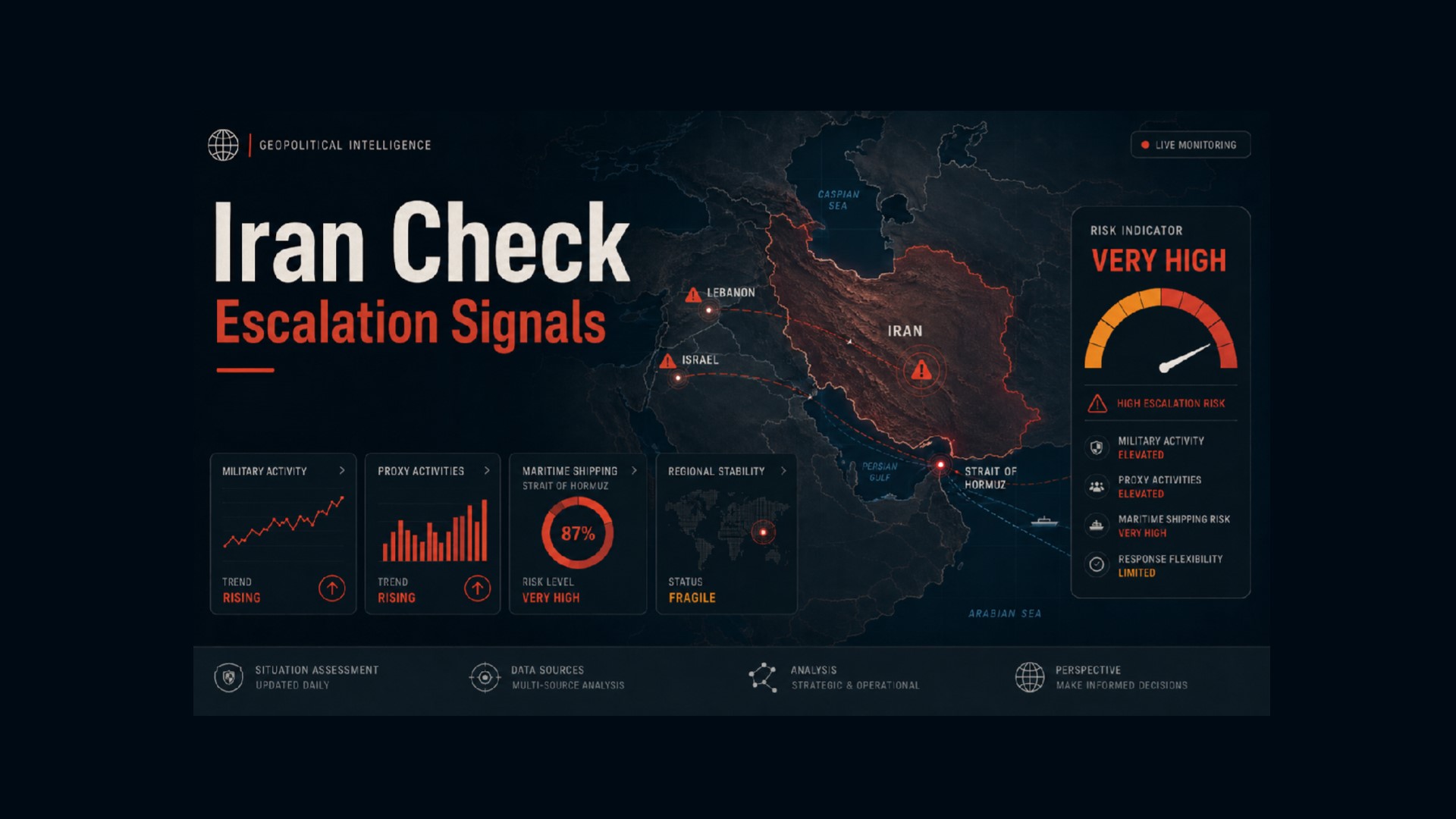
This escalation radar summarises five relevant signals as of August 3, 2026. It focuses on substantiated statements by official bodies, verified events and monitoring sources with potential implications for energy prices, supply chains, markets, maritime security, aviation and regional stability.
The most important political change on August 3: Trump cancelled a planned US strike against Iran and announced talks for Monday. The main issues are the full reopening of the Strait of Hormuz and Iran’s nuclear programme. This reduces the immediate risk of attack, but does not yet establish a reliable ceasefire, as neither a deadline nor a confirmed completion mechanism has been announced.
Visible shipping traffic through Hormuz declined again over the weekend. A GasLog tanker carrying LNG from Qatar is positioned outside the strait off Oman following an incident. At the same time, Iraq is offering crude oil for loading inside Hormuz at substantial discounts. This shows that political optimism continues to collide with real transport, security and market-access problems.
While Washington is shifting towards negotiations, Israel says it could act independently if Iran resumes nuclear or missile activities. De-escalation is therefore not proceeding uniformly: the United States is temporarily shifting its focus towards diplomacy, while Israel is explicitly maintaining military deterrence.
| Actor | Type | Severity | Status | Source / Verification Status | Business Impact |
|---|---|---|---|---|---|
| United States / Iran / Trump / Araghchi / Oman / Saudi Arabia / Pakistan | Planned US strike cancelled, talks announced for Monday and regional mediation intensified | High to critical · Level 4/5 | The political situation changed significantly on August 2 and 3, 2026. US President Donald Trump stated that a planned new strike against Iran would not proceed for the time being, because Iran and several states in the region had requested time to reach a rapid agreement. Trump announced talks for Monday, but did not set a firm deadline for their conclusion. The negotiations are expected to focus primarily on two areas of conflict: the full reopening of the Strait of Hormuz and limiting or ending what the United States describes as the Iranian nuclear threat. Iranian Foreign Minister Abbas Araghchi simultaneously held talks with Saudi and Pakistani representatives. Oman remains involved in negotiations over a mechanism for shipping through Hormuz. Politically, this is the strongest short-term de-escalation signal in several days. However, it is not a confirmed peace settlement or a reliable ceasefire. Trump is keeping the military option open in principle, while Iran continues to insist that it is not seeking nuclear weapons. Power dynamics: Washington is using the previously established threat of attack as negotiating pressure. Iran is using its control over Hormuz as its central lever. Saudi Arabia, Pakistan and Oman are gaining importance as mediators and regional stabilisers. The talks therefore represent less a resolution of underlying differences than a temporary shift from military escalation to coercive diplomacy. | Confirmed by Reuters, August 2/3, 2026 and Reuters, August 3, 2026 . Verification status: confirmed regarding the cancellation of the planned US strike, the announcement of talks for Monday, the focus on Hormuz and the nuclear programme, and Iran’s diplomatic contacts with Saudi Arabia, Pakistan and Oman. The location, participants, specific draft agreement, Iranian concessions and the conditions under which Washington would reactivate the threat of attack remain unresolved. | High to critical business impact on oil and gas prices, exposure to Iran, the Gulf and the wider Middle East, sanctions planning, payment flows, contractual clauses, investment decisions, business travel, insurance, cyber risks, crisis communications and companies whose planning depends directly on a ceasefire or the reopening of Hormuz. |
| Iran / Oman / Qatar / GasLog / LNG shipping / Strait of Hormuz | LNG tanker off Oman following Hormuz incident and continued restrictions on shipping traffic | Critical · Level 5/5 | The operational situation in and around the Strait of Hormuz remains critical on August 3. Greek shipowner GasLog stated that the LNG tanker GasLog Shanghai was stable following an incident. The vessel had loaded LNG at Qatar’s Ras Laffan export terminal on July 27 and 28. Vessel-tracking data showed the tanker inside the Strait of Hormuz on July 31 and back outside the strait off Oman’s Musandam Peninsula on August 2. At the same time, visible traffic through Hormuz declined again over the weekend. Even for individual LNG vessels attempting or completing passage, the operational environment therefore remains shaped by security risks, unclear route clearances and possible incidents. Political talks over a full reopening of the strait have not yet removed the actual risks facing vessels, crews and cargoes. Power dynamics: Through the uncertainty surrounding passage, Iran continues to exert pressure on Qatar, international shipping companies and Asian LNG buyers. Oman is simultaneously becoming both a mediator and a geographical security zone where damaged or endangered vessels position themselves outside the strait. | Confirmed by Reuters, August 3, 2026 . Verification status: confirmed regarding the tanker’s loading in Ras Laffan, its position inside Hormuz on July 31, its reappearance outside the strait on August 2 and the shipowner’s statement that the vessel was stable. The nature and cause of the incident, possible damage to the vessel or cargo and the tanker’s onward voyage and discharge plan remain unresolved. | Critical business impact on LNG deliveries from Qatar, shipping companies, charter agreements, war-risk premiums, vessel safety, delivery schedules, Asian gas buyers, energy prices, alternative sourcing, force majeure, port planning and companies dependent on gas, power, chemicals, fertilisers or heavy industry. |
| Iraq / SOMO / China / crude oil buyers / Hormuz / tanker markets | Iraq offers steep discounts for crude loaded inside Hormuz and shifts transport risk to buyers | High to critical · Level 4/5 | Export disruption through Hormuz is creating new pricing and contractual mechanisms on August 3. According to Reuters, Iraq’s state oil marketer SOMO is offering crude oil for loading inside the Strait of Hormuz at substantial discounts. The offer shows that available crude volumes are not automatically safe to export. Buyers loading inside the endangered corridor must assume additional transport, security, insurance and disruption risks. Visible shipping traffic through Hormuz declined over the weekend following renewed reports of attacks. A VLCC loaded with Iraqi Basrah crude, which had already loaded on July 25, was able to leave the strait on Friday and is heading to China. The operational signal is twofold: individual cargoes continue to reach the global market, but only at elevated risk and with price concessions. The Hormuz crisis is therefore increasingly being priced directly into crude discounts, charter terms and the allocation of risk between sellers and buyers. Power dynamics: Iraq is attempting to maintain export revenues despite blocked or insecure routes. Buyers with a high risk tolerance, particularly in Asia, can obtain price advantages, but in return assume a larger share of the geopolitical and operational risk. | Confirmed by Reuters, August 3, 2026 . Verification status: confirmed regarding the substantial price discounts, the planned loading inside Hormuz, the renewed decline in visible shipping traffic and the departure of a VLCC carrying Basrah crude. The number of completed transactions, buyer structure, insurance conditions and whether the discounts will attract further risk-tolerant buyers remain unresolved. | High to critical business impact on crude oil procurement, pricing formulas, Incoterms, risk transfer, tanker charters, insurance, trade finance, refinery margins, Asian supply chains, compliance reviews and companies physically purchasing or processing Iraqi or other Gulf crude oil. |
| OPEC+ / Saudi Arabia / Russia / Iran / global energy markets | Production increase of 188,000 barrels per day has limited near-term impact because export routes remain disrupted | High · Level 3/5 | OPEC+ agreed to increase production quotas by 188,000 barrels per day from September. This continues the reversal of previous production cuts. In the short term, however, the decision has only limited stabilising effect. The Iran conflict, the partially blocked Strait of Hormuz and risks in Bab el-Mandeb prevent additional production from automatically and safely reaching the global market. At the same time, several OPEC+ states are already producing below their targets. A higher quota therefore does not necessarily translate into a corresponding increase in actual exports. The sharp decline in oil prices on August 3 was driven primarily by the cancellation of the planned US strike and hopes for an agreement, rather than by immediately available additional supply. Power dynamics: OPEC+ is signalling a willingness to increase supply, but remains dependent on the military and political control of key sea routes. Actual market power is therefore shifting from nominal production quotas to physical export capacity and secure passage. | Confirmed by Reuters, August 3, 2026 and Reuters, August 3, 2026 . Verification status: confirmed regarding the quota increase of 188,000 barrels per day, disrupted export capacity, the influence of Hormuz and Bab el-Mandeb, and the sharp decline in oil prices following the cancellation of the planned US strike. It remains unclear how much of the additional quota can actually be produced and exported. | High business impact on oil prices, energy hedging, procurement strategies, refineries, petrochemicals, transport costs, inflation expectations, production planning and companies that may interpret falling prices too quickly as evidence of normalised supply. |
| Israel / Iran / United States / nuclear programme / missile programme / Iranian security authorities | Israel keeps independent military strikes on the table while Iran executes two alleged Israeli spies | High to critical · Level 4/5 | Political and intelligence escalation remains active on August 3, despite Washington’s shift towards talks. Israeli Energy Minister Eli Cohen stated that Israel was prepared to act independently if Iran resumed its nuclear activities or missile programme. Israel is therefore accepting the US-led diplomatic pause only conditionally. A successful agreement between Washington and Tehran would not automatically bind Israel to military restraint. At the same time, Iran reported on August 3 that it had executed two Iranian citizens accused of spying for Israel. According to the Iranian account, they had transmitted sensitive coordinates of military and security-related locations. Operationally, this does not constitute a new external attack. Politically, however, the measure shows that Iran increasingly treats the conflict with Israel as an internal intelligence and security war as well. Power dynamics: Israel is maintaining the threat of unilateral action to constrain Iranian behaviour during US negotiations. Iran is simultaneously intensifying deterrence and repression at home to make Israeli intelligence gathering, sabotage and targeting more difficult. Diplomacy and intelligence warfare are therefore continuing in parallel. | Confirmed by Reuters, August 2/3, 2026 and Reuters, August 3, 2026 . Verification status: confirmed regarding Israel’s publicly stated willingness to act independently and Iran’s execution of two people convicted of spying for Israel. The specific Iranian espionage allegations and the extent of the information allegedly transmitted have not been independently verified. | High to critical business impact on exposure to Israel and Iran, cyber and espionage risks, protection of sensitive site data, employee screening, telecommunications, cloud and satellite data, travel and liability risks, dual-use compliance and companies with security-sensitive infrastructure or technology. |
The central escalation point on August 3, 2026 lies in the contrast between political relief and a continuing operationally disrupted reality. Trump cancelled a planned strike against Iran and announced talks for Monday. This lowers the immediate risk of another major US strike wave. At the same time, there is still no confirmed agreement, no binding deadline and no demonstrably fully reopened Strait of Hormuz. The situation has therefore not stabilised, but has shifted from military threat to coercive diplomacy.
Operationally, Hormuz remains the decisive risk factor. Visible shipping traffic declined again over the weekend. A tanker carrying Qatari LNG is positioned off Oman following an incident. Iraqi crude is being offered for loading inside the strait at substantial discounts. These developments show that the market is facing not only a supply-volume problem, but also a problem of secure physical export capacity. Even if OPEC+ approves higher production quotas, their near-term impact remains dependent on secure passage, available tonnage, insurability and the willingness of buyers to assume the operational risk.
Politically, de-escalation remains fragmented. The United States is temporarily prioritising negotiations. Saudi Arabia, Pakistan and Oman are emerging as mediators. Israel nevertheless continues to reserve the option of an independent strike if Iran reactivates its nuclear or missile programme. Iran is simultaneously intensifying its internal intelligence conflict and has executed two alleged Israeli spies. Diplomacy, military deterrence, intelligence confrontation and economic pressure are therefore continuing at the same time.
The EASA warnings that remain active for Iran, Iraq, Jordan, Lebanon, the Persian Gulf and the Gulf of Oman were not tightened again on August 3. However, they remain a substantial risk amplifier for flight planning, air freight, crew changes, business travel, evacuations and time-critical spare-parts supply chains.
The five most important signals for a European and German business risk assessment are: the cancellation of a planned US strike and the talks with Iran announced for Monday, the continued severe restrictions on Hormuz traffic and the incident involving an LNG tanker off Oman, the substantial Iraqi crude discounts for high-risk loading inside the strait, the limited near-term impact of the OPEC+ production increase because export routes remain disrupted, and Israel’s continuing unilateral military option alongside Iran’s intensified internal counter-intelligence measures, while EASA warnings remain active for key regional air corridors.
Note: This assessment was prepared with the support of our Geo AI. AI can make mistakes. The analysis is intended as a radar for potential escalation signals and does not replace a fully verified intelligence assessment.
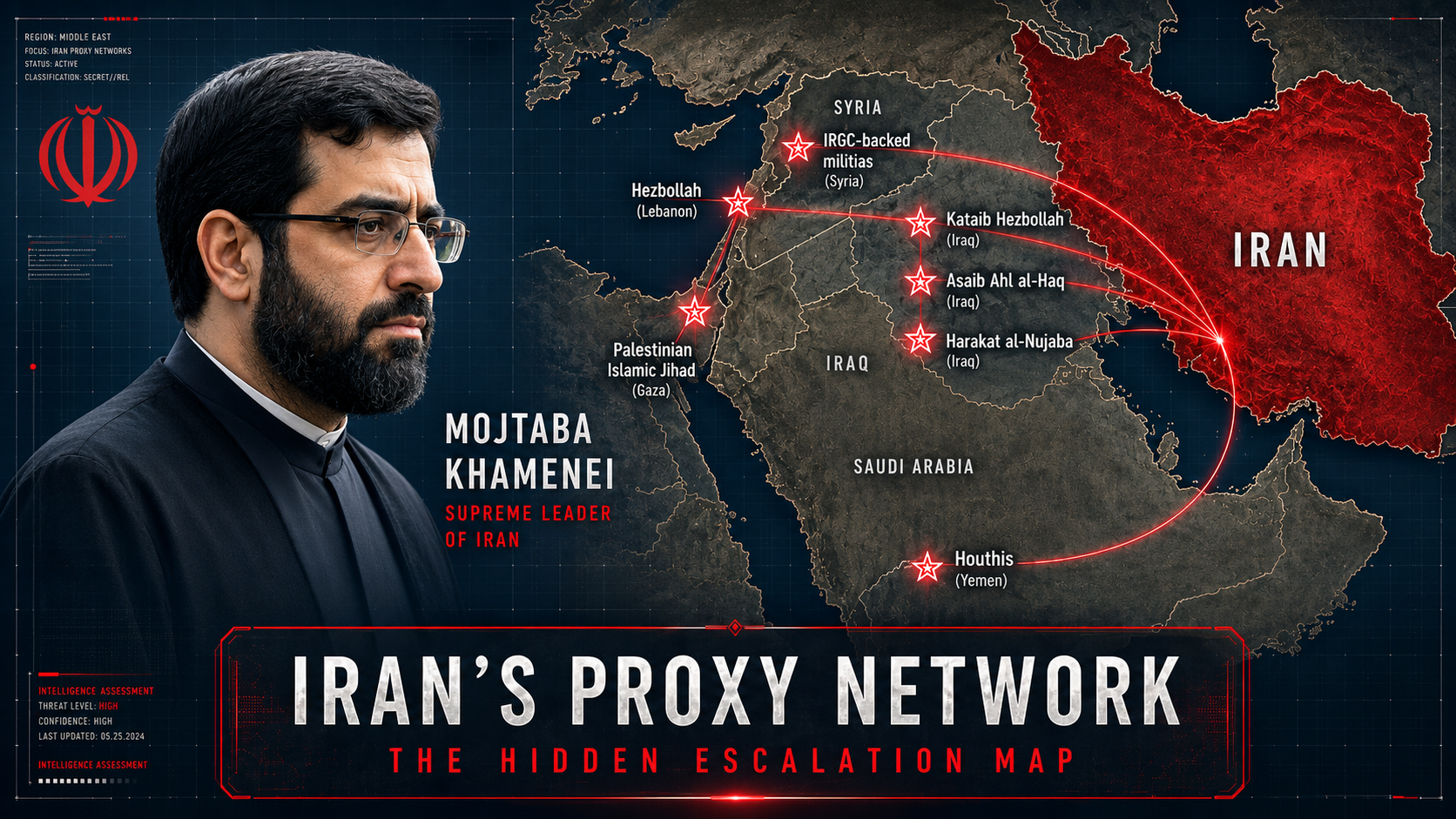
What decision-makers should watch now — before proxy escalation becomes a cost, compliance or supply-chain shock.
This 17-page executive briefing translates Iran’s proxy network into concrete business risks: energy price exposure, maritime chokepoints, war-risk premiums, sanctions, shadow fleets, supply-chain disruption and early-warning indicators for board-level decisions.
You are currently viewing a placeholder content from X. To access the actual content, click the button below. Please note that doing so will share data with third-party providers.
More Information