Executive Intelligence. Industrial Risk. Geopolitics.
Strategic Sparring
for Decision-Makers
Risk intelligence across technology, law, markets and power dynamics.


Verdeckte Geschäftsrisiken, strategische Widersprüche und kritische Abhängigkeiten frühzeitig erkennen.
Kostenlose Analyse starten →
Verdeckte Machtstrukturen, Führungsrisiken und organisatorische Blockaden frühzeitig erkennen.
Kostenlose Analyse starten →
Geopolitische Risiken, globale Abhängigkeiten und kritische Lieferkettenrisiken frühzeitig erkennen.
Kostenlose Analyse starten →
Identify hidden business risks, strategic contradictions and critical dependencies at an early stage.
Start Free Analysis →
Identify hidden power structures, leadership risks and organizational blockers at an early stage.
Start Free Analysis →
Identify geopolitical risks, global dependencies and critical supply-chain vulnerabilities at an early stage.
Start Free Analysis →
Verdeckte Geschäftsrisiken, strategische Widersprüche und kritische Abhängigkeiten frühzeitig erkennen.
Kostenlose Analyse starten →
Verdeckte Machtstrukturen, Führungsrisiken und organisatorische Blockaden frühzeitig erkennen.
Kostenlose Analyse starten →
Geopolitische Risiken, globale Abhängigkeiten und kritische Lieferkettenrisiken frühzeitig erkennen.
Kostenlose Analyse starten →
Identify hidden business risks, strategic contradictions and critical dependencies at an early stage.
Start Free Analysis →
Identify hidden power structures, leadership risks and organizational blockers at an early stage.
Start Free Analysis →
Identify geopolitical risks, global dependencies and critical supply-chain vulnerabilities at an early stage.
Start Free Analysis →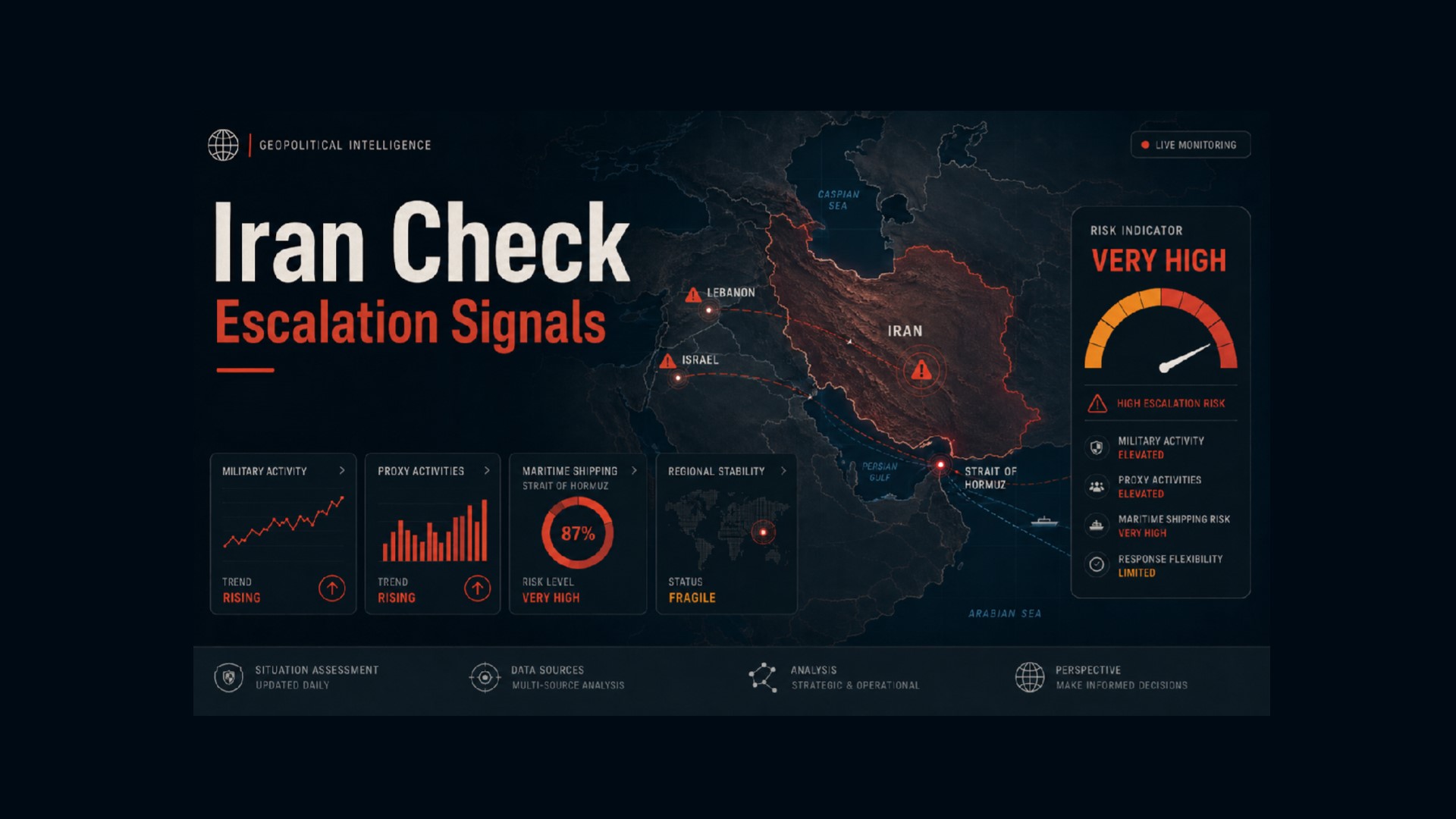
This escalation radar summarizes five relevant signals as of July 6, 2026. The focus is on verifiable statements by official actors, confirmed events and monitoring sources with potential impact on energy prices, supply chains, markets, maritime security, aviation and regional stability.
The key change: the dispute is no longer only about whether the Strait of Hormuz remains open. The decisive question is who controls the routes, which corridors are used, whether Iran can impose fees or approval logic, and how safe insurers, shipowners and energy traders consider the passage to be.
The US-Iran talks are currently showing no visible breakthrough. While political talks are being pushed back until after Khamenei’s funeral ceremonies, an operational test is already underway in the Gulf: maritime trade links are partly being resumed, but still under control, insurance and security constraints.
Israeli strikes, Hezbollah’s rejection of a Washington-backed ceasefire approach and demands for a full Israeli withdrawal show that even if the United States and Iran continue negotiating, the Lebanon front can re-intensify regional risk at any time.
| Actor | Type | Severity | Status | Source / verification status | Business impact |
|---|---|---|---|---|---|
| Iran / IRGC / Hormuz / United States / Oman | Route control, IRGC warnings, mine risk and maritime power projection | Critical · Level 5/5 | The operational core change is centered on Hormuz: Iran is trying to visibly assert control over the Strait of Hormuz, while Western actors and Oman are seeking to secure alternative or safer transit routes. According to The Guardian, the situation is increasingly about whether Iran can effectively determine which ships use which route. At the same time, UKMTO/JMIC reports stable but still tense traffic flows over the past 72 hours: vessels are passing through both the southern Omani corridor and the northern, Iran-controlled route. IRGC hailing, UAS activity, targeted surveillance, GNSS interference and mine warnings remain active. The power dynamic: Iran is signaling that Hormuz is not merely a sea lane, but a geopolitical pressure instrument. The West is signaling that free passage must not become dependent on Iranian approval. | Confirmed by The Guardian, 05./06.07.2026 and UKMTO/JMIC Advisory Update 067, 05.07.2026. Verification status: confirmed for the route and control conflict, stable but monitored transits, GNSS interference, IRGC monitoring and mine risk; it remains unclear how far Iran will practically escalate the enforcement of its own route or fee logic. | Critical business impact on oil and LNG transport, tanker routing, war-risk premiums, insurability, charter costs, delivery times, port planning, energy procurement, hedging and companies with Gulf, chemicals, raw materials or energy exposure. |
| United States / Iran / Qatar / Pakistan / Gulf markets | Negotiation pause, lack of breakthrough and partial operational normalization in Gulf trade | High to critical · Level 4/5 | As of July 6, 2026, the US-Iran track shows less genuine negotiation progress than operational damage control. Reuters reports that most Gulf markets reacted cautiously on July 5 because no clear breakthrough was visible in the indirect US-Iran talks. The next political round is expected only after Khamenei’s funeral ceremonies. In parallel, Reuters reports that Iran and Qatar have resumed maritime trade: the connection between Iran’s Dayyer port and Qatar’s Al Ruwais Port was restarted after an interruption of around five months. In addition, Iranian goods are again being handled via Jebel Ali in the United Arab Emirates. The power dynamic: Washington and Tehran are currently avoiding a return to open escalation, but the real power question is shifting to the operational level: who controls maritime normalization, payment flows, ports, transit and technical implementation? Qatar and Pakistan remain important mediators, but they do not replace a political breakthrough. | Confirmed by Reuters, 05.07.2026 and Reuters, 05.07.2026. Verification status: confirmed for the cautious Gulf market reaction, the lack of breakthrough in indirect talks, the expected continuation after Khamenei’s funeral ceremonies and the resumption of Iran-Qatar maritime trade; it remains partly unclear how robust this operational normalization is as long as Hormuz control, sanctions, insurability and political guarantees remain unresolved. | High relevance for market volatility, Gulf exposure, port planning, regional trade routes, payment processing, sanctions assumptions, Iran and Qatar business, energy procurement, hedging, financial planning, investment decisions and short-term geopolitical scenario planning. |
| Israel / Iran / Katz / Khamenei succession | Direct deterrence threat against Iranian leadership and escalation of leadership logic | High to critical · Level 4/5 | Israel is sharpening its personal deterrence posture toward Iran’s leadership. According to Sky News, Israeli media reported that Defense Minister Israel Katz said any Iranian leader who again advances plans to destroy Israel would also be “thwarted”. This statement comes during Khamenei’s funeral ceremonies, during which Sky News also reported renewed threats against Trump and Netanyahu. The power dynamic: Israel is signaling not only military responsiveness, but direct leadership deterrence. For Iran, this increases the pressure to present the succession as capable and untouchable. This raises the risk of symbolic counter-signals, proxy actions or controlled retaliation rhetoric. | Confirmed by Sky News Liveblog, 06.07.2026. Verification status: confirmed for the reported Katz statement, the funeral context and the threat environment; individual details on Iranian succession security are based on media and intelligence-adjacent reporting and require further verification. | High relevance for regional risk premiums, security planning, insurance, flight routes, executive travel risks, crisis communication, Middle East exposure and companies with sites or partners in Israel, the Gulf states, Lebanon or Iran-linked markets. |
| Lebanon / Hezbollah / Israel / United States | Ceasefire conflict, Israeli strikes and Hezbollah rejection of the disarmament logic | High to critical · Level 4/5 | Lebanon remains a separate escalation theatre. L’Orient Today reports that Hezbollah rejects the ceasefire approach announced in Washington. Naim Qassem is demanding a comprehensive ceasefire and full Israeli withdrawal; as long as the occupation continues, the “resistance” will also continue. At the same time, L’Orient Today reports several Israeli strikes in southern Lebanon and the western Bekaa region, including strikes on Sohmor, Qalaya, Braasheet, Kafra and areas in Nabatieh. The power dynamic: Israel maintains military pressure and security zones. Hezbollah rejects a logic in which disarmament or the weakening of the “resistance” becomes the price of de-escalation. As a result, the Lebanon front can undermine US-Iran diplomacy at any time. | Confirmed by L’Orient Today, 06.07.2026. Verification status: confirmed for Qassem’s rejection, the demand for a comprehensive ceasefire and Israeli withdrawal, as well as reported Israeli strikes; information on target structures and military effect differs by source and requires continued cross-checking. | High relevance for Lebanon and northern Israel exposure, aviation, evacuation planning, security services, insurance, humanitarian logistics, regional supply chains, border risks and political risk premiums. |
| EASA / Iran / Iraq / Lebanon / Gulf region | Active aviation warning despite political de-escalation signals | High to critical · Level 4/5 | The operational aviation environment remains significantly more tense than the political communication suggests. EASA continues to assess the region as a conflict-zone risk. For Iran, Iraq and Lebanon, it recommends avoiding the affected airspace. For Bahrain, Kuwait, Israel, Jordan, Qatar, Oman, the United Arab Emirates and Saudi Arabia, it recommends increased caution and up-to-date risk assessments. Particularly relevant is EASA’s assessment that short-term violations of the US-Iran ceasefire remain possible, especially in and around Hormuz and in adjacent airspace. Lebanon also remains a high-risk area for civil aviation due to the fragile Israel-Hezbollah situation. The operational takeaway: diplomacy, falling oil prices or talks in Doha do not automatically mean safe flight routes. | Confirmed by EASA Conflict Zone Information Bulletin 2026-03-R14. Verification status: official EU aviation source; active recommendation to avoid Iran, Iraq and Lebanon and to exercise increased caution across the wider Gulf region. | High relevance for air freight, airlines, rerouting, spare-parts supply chains, insurance, business travel, crisis logistics, airport risk, just-in-time supply chains and companies with Middle East or Gulf exposure. |
The central escalation node on July 6, 2026 is not a single new major escalation, but the shift from open war logic to control logic. Hormuz remains open, but it is not normalized. The question is no longer only: “Can ships pass?” The more important question is: “Who controls the passage, who sets the rules, who monitors vessels, who carries the risk and who ultimately pays the cost?”
Politically, US-Iran talks are paused during Khamenei’s funeral ceremonies. Washington signals willingness to negotiate, but markets remain cautious because no reliable breakthrough is visible. At the same time, the operational level is testing whether parts of Gulf trade can be normalized again: Iran-Qatar maritime trade has resumed, while Hormuz, sanctions, insurability and maritime control remain unresolved. In parallel, Israel is sharpening deterrence against Iran’s leadership, while Hezbollah in Lebanon rejects a ceasefire approach that would make disarmament or the weakening of the “resistance” a precondition.
For companies, the most important change is this: the risk is not disappearing; it is shifting into operational bottlenecks. Especially relevant are maritime route selection, insurability, war-risk premiums, air freight, flight routes, crisis logistics, energy prices, political risk premiums and the question of whether de-escalation signals can actually translate into stable infrastructure and transport conditions.
The five most important signals for a European business risk picture are: Iran’s stronger claim to control over Hormuz, the lack of visible US-Iran negotiation momentum during the Khamenei funeral phase, the partial resumption of Iran-Qatar maritime trade as an operational normalization test, Hezbollah’s rejection of a Washington-backed ceasefire approach amid continued Israeli strikes, and the still-active EASA warning status for Iran, Iraq, Lebanon and the wider Gulf region.
Note: This assessment was created with support from our Geo AI. AI can make mistakes. This document serves as a radar for potential escalation signals and does not replace a fully verified final intelligence assessment.
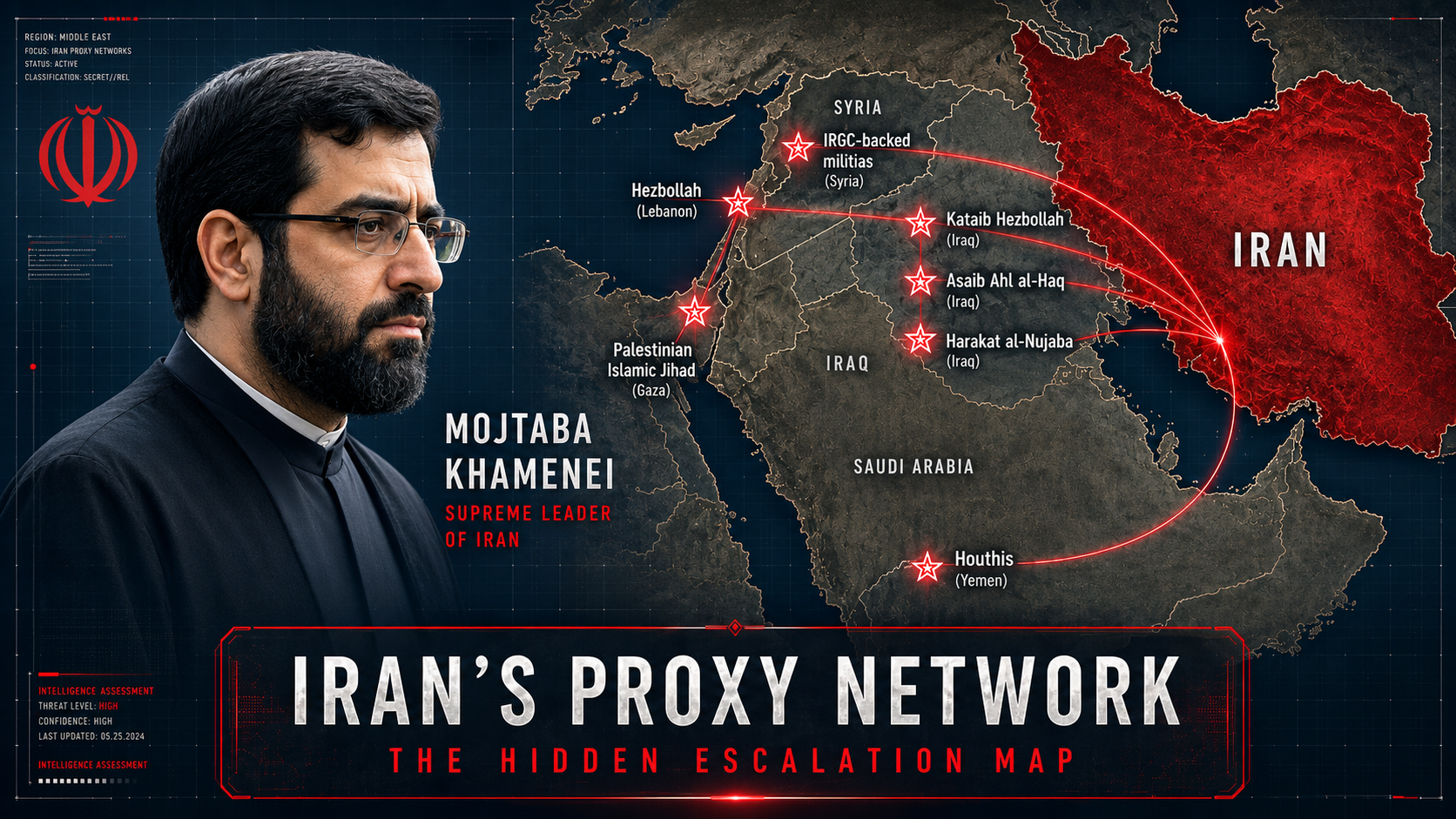
What decision-makers should watch now — before proxy escalation becomes a cost, compliance or supply-chain shock.
This 17-page executive briefing translates Iran’s proxy network into concrete business risks: energy price exposure, maritime chokepoints, war-risk premiums, sanctions, shadow fleets, supply-chain disruption and early-warning indicators for board-level decisions.
You are currently viewing a placeholder content from X. To access the actual content, click the button below. Please note that doing so will share data with third-party providers.
More Information