Executive Intelligence. Industrial Risk. Geopolitics.
Strategic Sparring
for Decision-Makers
Risk intelligence across technology, law, markets and power dynamics.


Verdeckte Geschäftsrisiken, strategische Widersprüche und kritische Abhängigkeiten frühzeitig erkennen.
Kostenlose Analyse starten →
Verdeckte Machtstrukturen, Führungsrisiken und organisatorische Blockaden frühzeitig erkennen.
Kostenlose Analyse starten →
Geopolitische Risiken, globale Abhängigkeiten und kritische Lieferkettenrisiken frühzeitig erkennen.
Kostenlose Analyse starten →
Identify hidden business risks, strategic contradictions and critical dependencies at an early stage.
Start Free Analysis →
Identify hidden power structures, leadership risks and organizational blockers at an early stage.
Start Free Analysis →
Identify geopolitical risks, global dependencies and critical supply-chain vulnerabilities at an early stage.
Start Free Analysis →
Verdeckte Geschäftsrisiken, strategische Widersprüche und kritische Abhängigkeiten frühzeitig erkennen.
Kostenlose Analyse starten →
Verdeckte Machtstrukturen, Führungsrisiken und organisatorische Blockaden frühzeitig erkennen.
Kostenlose Analyse starten →
Geopolitische Risiken, globale Abhängigkeiten und kritische Lieferkettenrisiken frühzeitig erkennen.
Kostenlose Analyse starten →
Identify hidden business risks, strategic contradictions and critical dependencies at an early stage.
Start Free Analysis →
Identify hidden power structures, leadership risks and organizational blockers at an early stage.
Start Free Analysis →
Identify geopolitical risks, global dependencies and critical supply-chain vulnerabilities at an early stage.
Start Free Analysis →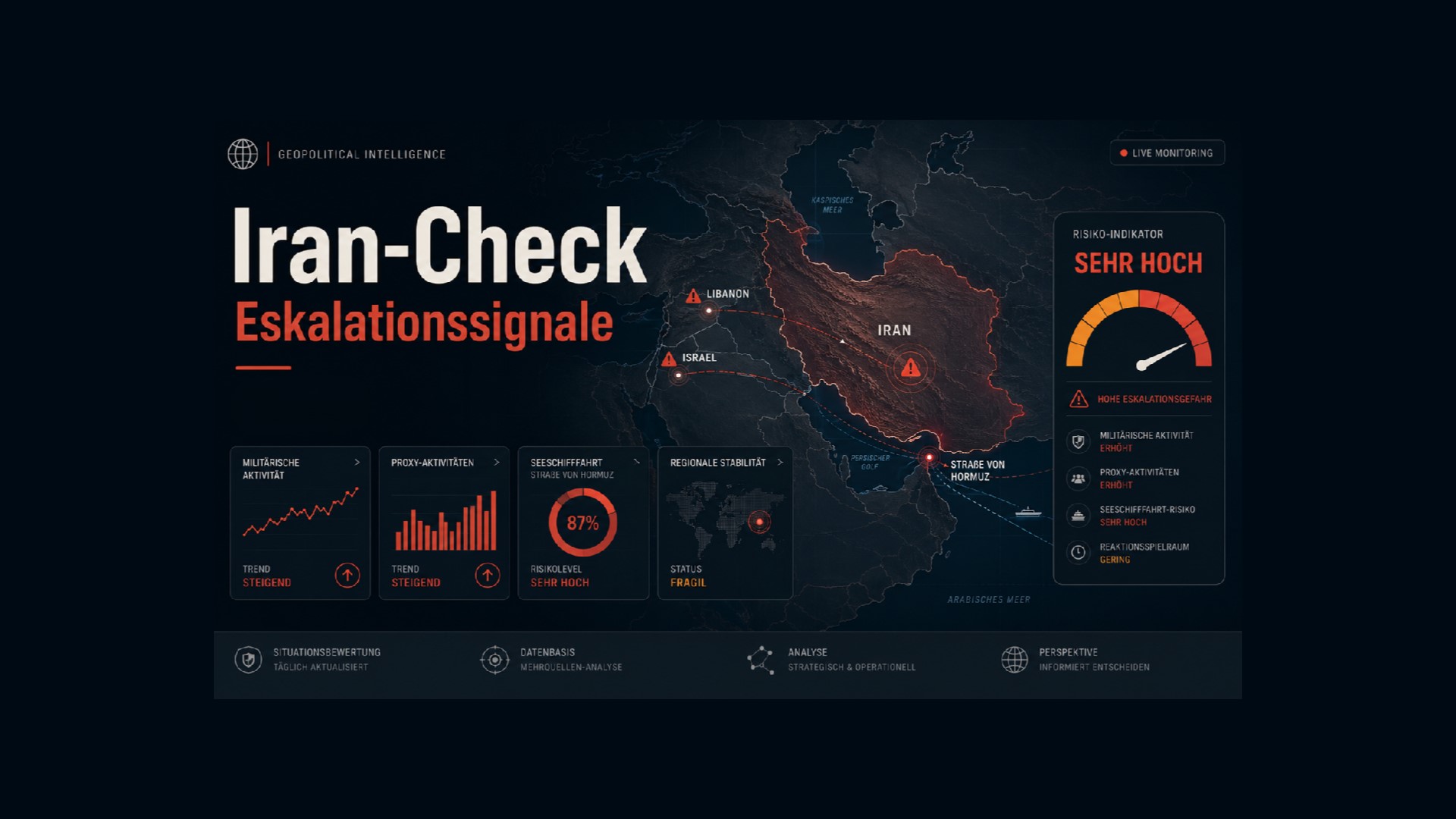
This escalation radar summarizes five relevant signals as of July 30, 2026. The focus is on verifiable statements by official actors, confirmed events and monitoring sources with potential impact on energy prices, supply chains, markets, maritime security, aviation and regional stability.
The key change: the short negotiation pause is no longer the dominant condition. The United States reports a new two-hour strike wave against dozens of IRGC targets, after Iran fired missiles at US forces in the region. AP also reports reciprocal missile attacks, Iranian hits in Kuwait, intercepted missiles over Jordan and US strikes on Qeshm.
Reuters reports that drone attacks triggered fires on two gas vessels in Egypt’s port of Damietta. This means the escalation logic no longer runs only through Hormuz, Bab el-Mandeb and the Red Sea, but now also touches an Egyptian port near the Suez corridor. For energy and LNG flows, this creates another operational uncertainty zone.
Reuters reports that Iran could receive up to 400 Chinese shoulder-launched air defense systems within weeks. China denies the report, and Pakistan rejects involvement in the transit route. Still, the signal is strategically relevant: the Iran conflict is shifting further toward external rearmament, supply routes and great-power logic.
| Actor | Type | Severity | Status | Source / verification status | Business impact |
|---|---|---|---|---|---|
| United States / Iran / IRGC / Jordan / Kuwait / Qeshm / regional US bases | New US strike wave, Iranian missile attacks and regional hits in Jordan, Kuwait and Qeshm | Critical · Level 5/5 | The military US-Iran situation escalates openly again on July 30, 2026. Reuters reports that the US military completed a two-hour strike wave against Iran. According to CENTCOM, dozens of IRGC targets were hit, including command centers, missile and drone facilities, coastal surveillance, defensive positions and maritime capabilities. The US strikes were presented as a response to Iranian missiles fired at US forces in the region. AP also reports that the United States and Iran exchanged missile attacks on Thursday. According to Reuters, Iran confirmed missile attacks on US bases in Jordan and on vessels in the Strait of Hormuz. AP additionally reports that an Iranian attack hit a Chinese company building in Kuwait and killed one worker, while Jordanian air defenses intercepted five Iranian missiles. Iranian state media also reported fatalities after US strikes on Qeshm near Hormuz. The power dynamic: Washington is trying to further weaken Iran’s regional attack capacity and maritime disruption capability. Tehran responds with attacks against US-aligned locations, transit points and regional target areas. The attack pause has therefore effectively collapsed, and the conflict has returned to a direct retaliation logic. | Confirmed by Reuters, 30.07.2026 and AP News, 30.07.2026. Verification status: confirmed for the US strike wave against IRGC targets, Iranian missile attacks on US forces, Jordan’s interception of Iranian missiles, the Iranian hit on a Chinese company building in Kuwait and reported US strikes on Qeshm; the exact damage level, full target selection and whether further Iranian or US retaliation waves follow immediately remain open. | Critical business impact on Gulf exposure, Jordan, Kuwait, Iraq and Saudi exposure, US-base and expat security, energy prices, insurability, war-risk premiums, maritime security, port planning, air freight, business travel, evacuation, spare-parts chains, payment risks, cyber risks and companies with personnel, facilities, suppliers or customers in US-aligned Gulf states, Iraq, Jordan, Kuwait and along the Hormuz route. |
| Egypt / Damietta / Suez / Saudi Arabia / United States / Iran-aligned groups | Drone attack on gas vessels near Damietta and new Suez / LNG risk front | Critical · Level 5/5 | The operational energy and shipping situation expands into the Egyptian Mediterranean space on July 30. Reuters reports that a drone attack triggered fires on two gas vessels in the port of Damietta. According to the Egyptian government, an initial investigation showed that an unidentified drone caused the fire. Reuters reports that a US-owned gas storage tanker was affected; the fire then spread to another vessel. This creates a new risk area near Suez, exactly where Saudi oil and LNG flows could use alternative routes if Hormuz, Bab el-Mandeb and the Red Sea remain under pressure. Reuters also reports that Saudi Arabia publicly joined US forces for the first time in strikes against Iran-aligned groups in eastern Iraq, after drones launched from Iraq threatened Saudi oil targets. The power dynamic: Iran-aligned actors or unidentified attackers can destabilize not only Gulf and Red Sea routes, but also the supposed alternative corridor around Suez and Egyptian energy infrastructure. The chokepoint crisis is therefore becoming a chain of connected energy and sea-route risks. | Confirmed by Reuters, 30.07.2026. Verification status: confirmed for the drone attack on two gas vessels in Damietta, the fire development, the proximity to the Suez corridor and the first publicly reported Saudi participation in strikes against Iran-aligned groups in Iraq; it remains open who is responsible for the Damietta attack and whether Egypt will be drawn permanently into the escalation zone. | Critical business impact on LNG, gas storage, Suez routing, Egypt and Mediterranean exposure, tanker clearances, port operations, insurability, war-risk premiums, diversions, air-freight substitution costs, energy procurement, delivery times, crisis logistics, security services and companies with Asia-Europe, Mediterranean, Gulf, energy, chemicals or heavy industry exposure. |
| QatarEnergy / Qatar / Iran / Hormuz / LNG markets / Asia | First QatarEnergy LNG exit through Hormuz since July 11 and simultaneous US LNG replacement purchases | High to critical · Level 4/5 | The operational Hormuz and LNG situation shows a limited relief signal on July 30, but no normalization. Reuters reports that an LNG tanker controlled by QatarEnergy exited the Strait of Hormuz overnight. According to vessel-tracking data, it was the first visible QatarEnergy LNG exit from Hormuz since July 11. The Al Areesh had previously loaded in Ras Laffan and was reportedly heading to Port Qasim in Pakistan. According to Reuters, Iranian media said the vessel used the Iran-designated route with Iranian approval. At the same time, Reuters separately reports that QatarEnergy has purchased 33 US LNG spot cargoes this year to offset delivery disruptions caused by the Hormuz disruption. The power dynamic: Iran can allow individual LNG vessels to pass and thereby demonstrate its control role, while QatarEnergy uses US LNG purchases to serve Asian customers despite disrupted Gulf exports. For companies, this is not a sign of free passage, but a sign of politically controlled transit and costly replacement procurement. | Confirmed by Reuters, 30.07.2026 and Reuters, 30.07.2026. Verification status: confirmed for the first QatarEnergy LNG exit since July 11, the link to Iranian approval, the continued disruption in Hormuz and QatarEnergy’s US LNG replacement purchases; it remains open whether this becomes regular LNG passage or remains limited to individual approved transits. | High to critical business impact on LNG procurement, energy prices, Asian deliveries, Pakistan, India, Japan, Taiwan, Bangladesh and South Korea exposure, contract risks, force-majeure risks, replacement procurement, hedging, freight rates, port planning, air-freight costs, production planning and companies dependent on gas, chemicals, fertilizers, power or heavy industry. |
| China / Iran / Pakistan / United States / air defense / supply chains | Possible delivery of up to 400 Chinese MANPADS to Iran and new external rearmament axis | High to critical · Level 4/5 | The external actor situation changes significantly on July 29/30. Reuters exclusively reports that Iran could receive an initial delivery of up to 400 Chinese shoulder-launched air defense systems within weeks. The systems reportedly include QW-12 and FN-16 missiles and would strengthen Iran’s short-range air defense after months of US and Israeli attacks. Reuters also reports that China rejected the report as unfounded, while Pakistan explicitly denied speculation about involvement in the transfer route. According to Reuters, Trump said such a delivery would be surprising, because Xi Jinping had assured him that China would not take Iran’s side in the war. The power dynamic: Iran is trying to harden its vulnerable military and strategic sites through mobile air defense. China becomes visible as a potential arms and great-power factor despite its denial. Pakistan enters the situational picture as a possible transit or corridor space. This shifts the Iran conflict further from regional escalation toward external rearmament, sanctions risk and great-power competition. | Confirmed by Reuters, 29./30.07.2026. Verification status: partially confirmed; Reuters reports, citing multiple sources, a signed contract and possible delivery within weeks, while China denies the report and Pakistan denies involvement in the transfer. The actual delivery volume, timeline, route and whether the systems reach Iran operationally in the short term remain open. | High to critical business impact on export controls, sanctions, dual-use supply chains, China, Pakistan, Iran and Gulf exposure, aviation and drone risks, military escalation costs, insurability, compliance checks, logistics routes through Central and South Asia, payment risks, reputational risks and companies with components, electronics, aviation, defense or Asia supply-chain exposure. |
| United States / Israel / Iran / Netanyahu / Trump / Pickaxe Mountain | US-Israeli Iran options between deal, blockade, economic pressure and massive attack | High to critical · Level 4/5 | The political escalation situation remains highly dangerous on July 29/30 through the US-Israeli line. Reuters reports that Trump and Netanyahu discussed all possible paths to contain Iran’s nuclear program, including diplomacy, economic pressure and military force. According to Reuters, a senior Israeli official said three options were discussed in detail: a negotiated deal, continued blockade and economic pressure, and a massive attack. The Israeli official also rejected the idea that Netanyahu had pushed Trump toward military escalation, while acknowledging that Trump is the senior partner and Netanyahu the junior partner in the conflict with Iran. Reuters also reports that Israel warned Iran it would respond forcefully if attacked. The power dynamic: Washington keeps diplomatic and military options open at the same time. Israel is trying to embed Iran’s nuclear program and Hezbollah risks into US decision logic. Diplomacy therefore remains under the pressure of a military attack option that can be reactivated at any time. | Confirmed by Reuters, 29./30.07.2026. Verification status: confirmed for the US-Israeli discussion of several Iran options including deal, blockade, economic pressure and massive attack, as well as Israel’s warning of a forceful response if attacked; it remains open whether this produces a concrete new red line, an attack decision or a diplomatic framework. | High to critical business impact on Israel, Iran, Lebanon and Gulf exposure, energy prices, sanctions, insurance, business travel, aviation, cyber risks, export controls, defense and dual-use supply chains, banking and payment risks and companies with projects, personnel or customers in Israel, the Levant, Iran, the Gulf region or security-adjacent industries. |
The central escalation node on July 30, 2026 lies in the collapse of the short US-Iran attack pause and the simultaneous expansion of the conflict space. Compared with July 28, the situation has deteriorated significantly: the United States launches another major strike wave against Iran, Iran fires at US forces in Jordan and at vessels in Hormuz, Kuwait reports an Iranian hit on a Chinese company building, and Jordan intercepts Iranian missiles.
Operationally, the situation is again significantly more dangerous for companies. Hormuz remains unnormalized, even though a QatarEnergy LNG tanker visibly exits the waterway for the first time since July 11. This passage confirms the new control logic: individual vessels can pass, but apparently only under Iranian approval and route logic. At the same time, the drone attack on gas vessels in Damietta creates a new risk area near Suez. This means that not only Hormuz, Bab el-Mandeb and the Red Sea are under pressure, but also alternative energy and LNG corridors in the eastern Mediterranean. The continued EASA warning situation for Iran, Iraq, Lebanon, the Persian Gulf and the Gulf of Oman remains an additional risk amplifier for aviation, air freight and business travel.
Politically, the situation is even more dangerous because diplomacy, retaliation and external rearmament are running at the same time. Trump and Netanyahu are discussing deal, blockade, economic pressure and massive attack as parallel Iran options. Iran responds with missile attacks and retaliation rhetoric. China becomes visible through possible MANPADS deliveries as an external arms factor, even though Beijing denies the report. Saudi Arabia becomes more visibly involved in the conflict through joint strikes with the United States against Iran-aligned groups in Iraq. This pushes the Iran conflict further from regional escalation into a networked energy, great-power, aviation and supply-chain crisis.
The five most important signals for a European business risk picture are: the new heavy US strike wave against IRGC targets in Iran after Iranian missile attacks on US forces, the drone attack on gas vessels in Egypt’s port of Damietta as a new Suez / LNG risk front, the first visible QatarEnergy LNG exit through Hormuz since July 11 under continued Iranian approval logic, the possible Chinese delivery of up to 400 MANPADS to Iran as an external rearmament axis, and the US-Israeli discussion of all Iran options including deal, blockade, economic pressure and massive attack while EASA warnings remain active for Iran, Iraq, Lebanon, the Persian Gulf, the Gulf of Oman and adjacent air corridors.
Note: This assessment was created with support from our Geo AI. AI can make mistakes. This document serves as a radar for potential escalation signals and does not replace a fully verified final intelligence assessment.
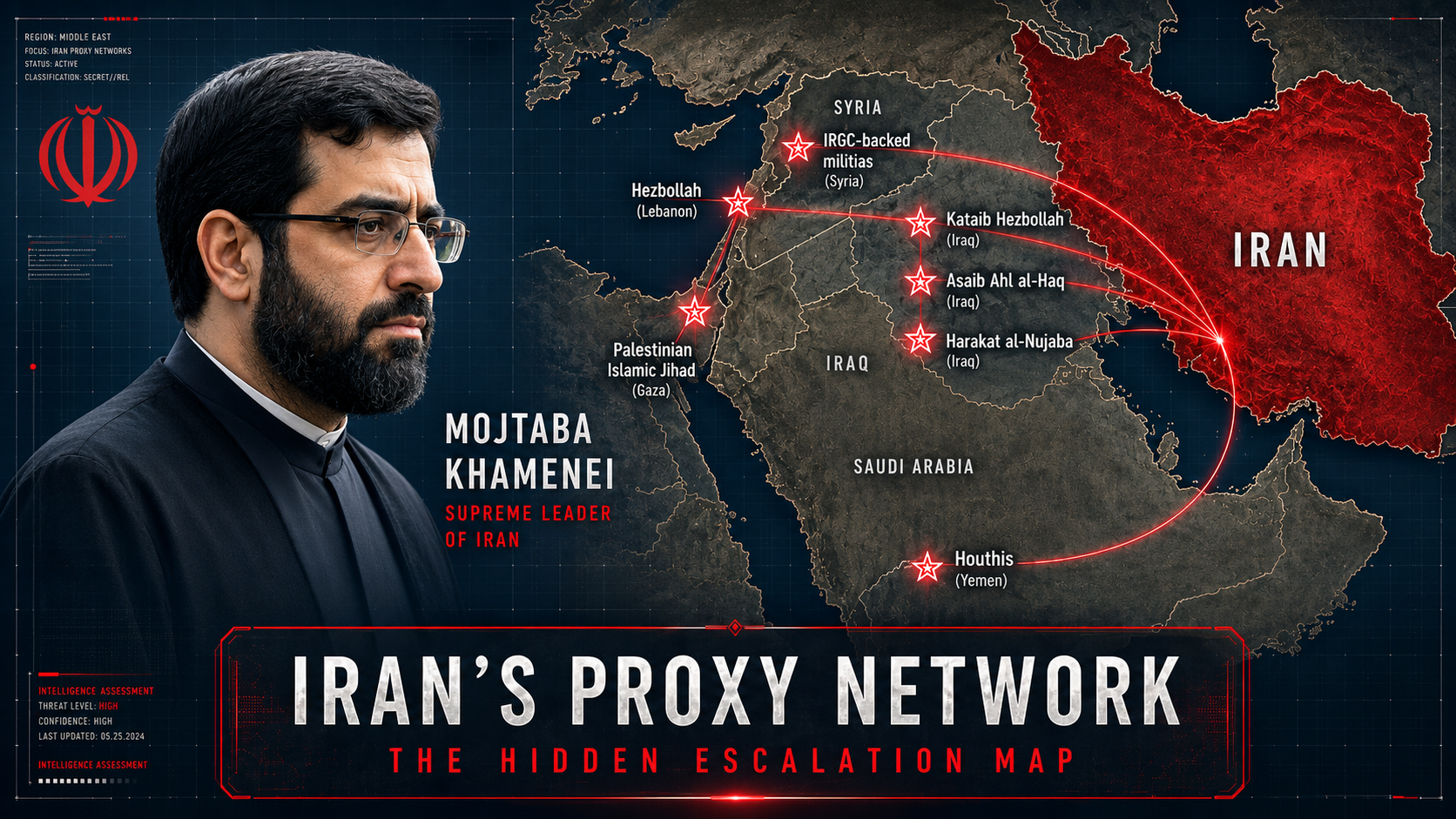
What decision-makers should watch now — before proxy escalation becomes a cost, compliance or supply-chain shock.
This 17-page executive briefing translates Iran’s proxy network into concrete business risks: energy price exposure, maritime chokepoints, war-risk premiums, sanctions, shadow fleets, supply-chain disruption and early-warning indicators for board-level decisions.
You are currently viewing a placeholder content from X. To access the actual content, click the button below. Please note that doing so will share data with third-party providers.
More Information