Executive Intelligence. Industrial Risk. Geopolitics.
Strategic Sparring
for Decision-Makers
Risk intelligence across technology, law, markets and power dynamics.

Verdeckte Geschäftsrisiken, strategische Widersprüche und kritische Abhängigkeiten frühzeitig erkennen.
Kostenlose Analyse starten →
Verdeckte Machtstrukturen, Führungsrisiken und organisatorische Blockaden frühzeitig erkennen.
Kostenlose Analyse starten →
Geopolitische Risiken, globale Abhängigkeiten und kritische Lieferkettenrisiken frühzeitig erkennen.
Kostenlose Analyse starten →
Identify hidden business risks, strategic contradictions and critical dependencies at an early stage.
Start Free Analysis →
Identify hidden power structures, leadership risks and organizational blockers at an early stage.
Start Free Analysis →
Identify geopolitical risks, global dependencies and critical supply-chain vulnerabilities at an early stage.
Start Free Analysis →
Verdeckte Geschäftsrisiken, strategische Widersprüche und kritische Abhängigkeiten frühzeitig erkennen.
Kostenlose Analyse starten →
Verdeckte Machtstrukturen, Führungsrisiken und organisatorische Blockaden frühzeitig erkennen.
Kostenlose Analyse starten →
Geopolitische Risiken, globale Abhängigkeiten und kritische Lieferkettenrisiken frühzeitig erkennen.
Kostenlose Analyse starten →
Identify hidden business risks, strategic contradictions and critical dependencies at an early stage.
Start Free Analysis →
Identify hidden power structures, leadership risks and organizational blockers at an early stage.
Start Free Analysis →
Identify geopolitical risks, global dependencies and critical supply-chain vulnerabilities at an early stage.
Start Free Analysis →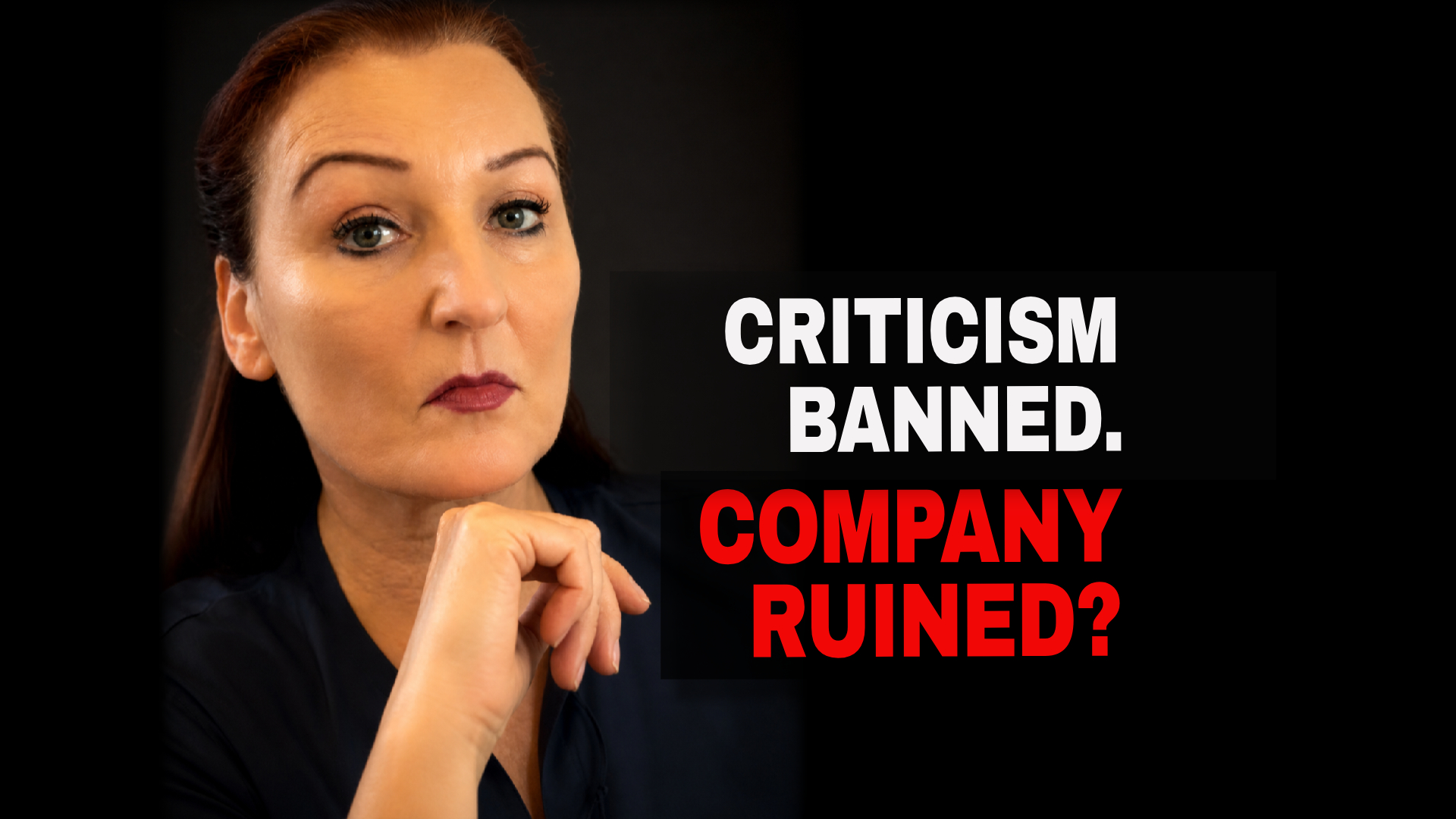
Strategic Risk Intelligence Brief by Global Insight Group.
This analysis is based on the GFDD Framework™ developed by Michaela Schaaf-Hoffelner and is designed for executives, investors and strategic decision-makers.
Updated: July 15, 2026
Top performers who are no longer performing — and eventually resign. Employees without motivation. Innovation that dries up. And hanging over everything: an unsettling, grave-like silence.
Does this sound familiar?
Then you are not alone.
These are often the first visible symptoms of a high-risk leadership culture that disciplines critical employees until silence feels safer than productive participation — and the best people leave the company.
Not every objection is valuable. But professional leaders assess criticism based on facts. Toxic leaders assess it based on who raises it and whether it threatens their authority.
Some managers are considered exceptionally assertive because their departments operate without friction. No open conflicts. No critical questions. No uncomfortable escalations.
To CEOs, this may initially look like efficient leadership.
But behind this calm may lie a toxic power system: Critical employees are worn down through institutional victim–perpetrator reversal, workplace gaslighting and social isolation until they fall silent, disengage internally or leave the company.
When strong specialists suddenly stop speaking up or resign abruptly, narcissistically driven leadership may even celebrate this as a victory.
In reality, this is where economic decline begins.
Because when critical employees fall silent, the company does not have fewer problems.
Senior management simply receives less information about those problems.
For professional leaders, manageability does not mean submission. It means setting shared goals, clarifying responsibilities and using different perspectives productively.
In toxic power structures, manageability means something else:
The employee must stop objecting.
Critical employees pose a particular threat to such systems. They ask questions. They identify risks earlier. They challenge unrealistic plans. They point out mistakes that a weak manager would rather keep invisible.
That is why the problem itself is no longer addressed.
Instead, the person who makes it visible is attacked.
Organizational researchers Elizabeth Morrison and Frances Milliken describe this mechanism as Organizational Silence. Employees withhold relevant information when they expect speaking up to be dangerous or ineffective. As a result, management loses precisely the information it needs for error correction and change. See Morrison and Milliken: Organizational Silence – A Barrier to Change and Development.
The first attack is rarely overt.
An employee points out unrealistic deadlines, quality issues, technical risks or flawed decisions. But instead of examining the arguments, leadership abandons the factual level.
Suddenly, comments such as these appear:
“You are simply not a team player.”
“Your communication is too aggressive.”
“You need to be more constructive.”
“You do not fit our culture.”
Professional responsibility is thereby turned into a personal loyalty test.
The relevant question is no longer whether the criticism is justified. What matters is whether the employee submits to the preferred narrative.
This is the beginning of institutional victim–perpetrator reversal:
Leadership creates or ignores a problem. The employee identifies it. The employee is then declared to be the problem.
This is where the strategic erosion begins.
The employee is summoned to repeated HR meetings. Projects are withdrawn. Responsibilities are changed. Information arrives late — or not at all. Vague development objectives are introduced to correct alleged “behavioural deficits.”
From the outside, everything appears professionally documented.
In reality, a closed system develops that repeatedly signals to the affected employee:
The situation is not the problem. Your perception is the problem.
The employee begins to weigh every word. They monitor their reactions, avoid objections and spend an increasing amount of energy trying not to provide another point of attack.
To CEOs, this may look like declining motivation, reduced resilience or unexplained job fatigue.
In reality, it may be the logical response to sustained psychological insecurity.
Amy Edmondson’s research shows that psychological safety is critical to whether people ask questions, disclose mistakes, raise risks and learn together. When this safety is absent, employees protect themselves through silence. See Amy Edmondson: Psychological Safety and Learning Behavior in Work Teams and Frazier et al.: Psychological Safety – A Meta-Analytic Review and Extension.
After months of isolation, devaluation and uncertainty, the employee’s behaviour changes.
They appear more exhausted. They may respond more emotionally, directly or forcefully. They may make mistakes that would not have happened before. They may withdraw completely.
This reaction is then presented as proof:
“You see? This is exactly the behaviour we were referring to.”
“This person is not resilient.”
“Further collaboration is impossible.”
The reaction to the pressure is used retrospectively to justify the pressure.
Institutional victim–perpetrator reversal is now complete.
The system creates the very symptoms it then uses to validate its original narrative.
Research on workplace exclusion links workplace ostracism, among other things, to poorer well-being, withdrawal, lower work performance and intentions to resign. See Li, Xu and Kwan: Consequences of Workplace Ostracism. A more recent meta-analysis also shows a significant connection between employee silence and burnout, particularly emotional exhaustion. See Lainidi et al.: Associations Between Burnout, Employee Silence and Voice.
Toxic leadership rarely appears under its real name.
It becomes visible through metrics, behavioural changes and strange contradictions: The department appears calm, but no one contributes new ideas. The numbers still look acceptable, but experienced employees are leaving. Meetings appear harmonious, but risks only emerge once they have already become expensive.
Visible symptoms, short-term effects and long-term business risks.
| Visible Symptom | Short-Term Effect | Long-Term Effect | Business Risk |
|---|---|---|---|
| Top performers are leaving in increasing numbers | Projects must be reassigned and teams become overloaded. | Loss of expertise, customer relationships and informal networks. | According to Gallup, replacing technical professionals costs approximately 80 % of annual salary, while replacing managers costs around 200 %. |
| Meetings are marked by conspicuous agreement | Decisions are made more quickly. | Errors, risks and counterarguments no longer reach senior leadership. | Delayed escalations can significantly increase project costs, deadlines and liability exposure. |
| Innovation dries up | Less friction and less effort spent on new proposals. | Products, processes and business models stagnate. | Loss of growth, differentiation and time-to-market; the financial impact varies significantly by industry. |
| Employees appear exhausted or mentally disengaged | Productivity and initiative decline. | Disengagement, sickness absence and employee turnover increase. | Gallup estimates global productivity losses caused by low employee engagement in 2025 at approximately USD 10 trillion. |
| Problems are reported far too late | Leadership experiences apparent stability. | Risks escalate unexpectedly and become significantly more expensive. | Depending on the project and industry: rework, contractual penalties, customer loss or compliance damage. |
| Critics are suddenly labelled “difficult” | The manager gains short-term control. | Competence is replaced by conformity. | Poor decisions and bad appointments become entrenched for years. |
| Employees wait only for instructions | High levels of formal controllability. | Responsibility, problem-solving and organisational learning disappear. | Rising management costs combined with declining operational performance. |
The cost information for the re-occupation come from Gallup: Employee Retention Depends on Getting Recognition Right. Gallup’s called, around 40 % of the annual salary for Frontline roles, 80 % for technical professionals and 200 % for managers and executives. Non-measurable losses due to outflows of Knowledge, team congestion, declining morality, or delayed projects is difficult.
The Gallup State of the Global Workplace 2026 estimates global productivity losses caused by low employee engagement at approximately USD 10 trillion in 2025. This global figure cannot be transferred directly to an individual company. It does, however, illustrate the scale of a problem that rarely appears on a balance sheet under the heading of leadership failure.
In many cases, a single poor appointment to a leadership position can quickly cost a company between €100,000 and €500,000 per year.
A focused Executive Intelligence analysis can reveal where these hidden costs arise within your organization-highlighting initial patterns, risks, and concrete areas for action. Free of charge and with no registration required.
Intelligence on Demand
Experience the analytical power of GFDD Diagnostics™ through a concrete business case.
Our proprietary AI was developed around the methodology, knowledge structures and analytical patterns of GFDD Diagnostics™.
Test whether this approach can reveal hidden dependencies, leadership risks and strategic blind spots within your organization.
Test GFDD Diagnostics™
The visible loss is the resignation.
The greater loss begins long before that.
Critical employees are often the people who detect deviations early. They see technical weaknesses, unrealistic assumptions, customer problems or political risks before these appear in formal reports.
Anyone who disciplines these voices disables the company’s human early-warning system.
Toxic leaders filter information upwards. Successes are personalised, problems are downplayed and critical employees are discredited.
Senior management then believes it is receiving facts.
In reality, it receives a politically filtered version of reality.
Innovation does not emerge from obedience. It emerges from challenge, experimentation, unfinished ideas and the courage to question established assumptions.
Research links employee voice and psychological safety to innovative behaviour. Where people expect negative consequences, they choose safe, conformist solutions. See Miao et al.: Employee Voice, Innovative Behavior and Psychological Safety.
The most capable specialists usually have alternatives.
They can leave a toxic structure.
Those who remain are not automatically the best employees. Often, they are the people who have learned to conform, avoid responsibility and read leadership expectations correctly.
The system gradually selects itself downwards.
A single narcissistically driven manager could achieve little if the organisation effectively limited their behaviour.
The situation becomes dangerous when the system itself acts as an amplifier:
Colleagues remain silent to protect their own positions.
HR reduces the conflict to the employee’s behaviour.
Senior management trusts the manager’s confident appearance.
And in the short term, the figures still look acceptable.
This creates the perfect deception: Upwards, the manager appears controlled, loyal and assertive. Downwards, fear, information control and emotional manipulation dominate.
The more critical employees fall silent, the calmer the department appears.
But this calm is not an achievement.
It is an early-warning signal.
When employee turnover, job fatigue and innovation stagnation occur at the same time, introducing new benefits, resilience training or motivational programmes is not enough.
Decision-makers should examine:
A toxic leader can deliver strong short-term figures while destroying competence, innovation and risk transparency over the long term.
That does not make the manager successful.
It makes the manager expensive.
Anyone who confuses obedience with loyalty destroys the real value of the company.
You may end up with a team that no longer objects. But that team will also remain silent when a project derails, a customer leaves, a technical risk escalates or a strategic decision is wrong.
Successful leadership addresses mistakes.
Toxic leadership attacks the people who expose them.
And when a department supposedly runs smoothly, but no one takes responsibility, innovation has disappeared and the best employees are leaving, CEOs should not ask:
“Why are our people so unmotivated?”
They should ask:
“What have they learned to remain silent about?”
No. Not every criticism is well-founded or constructive. Professional leaders nevertheless examine the facts, the data and the potential risks. Toxic leaders first assess whether the critic threatens their authority.
It occurs when an organisation stops investigating the original misconduct and instead problematises the person who pointed it out. Later stress reactions by the affected employee are then used as proof that the original treatment was supposedly necessary.
Innovation requires questions, experiments, unfinished ideas and the ability to raise mistakes openly. Where employees fear negative consequences, they choose conformity, safe standard solutions or complete silence.
No. Turnover can have many causes. It becomes critical when particularly experienced, independent or high-performing employees repeatedly leave the same manager and describe similar patterns.
Because these managers often appear confident, loyal and results-oriented to senior leadership. The negative consequences emerge further down the organisation through silence, knowledge loss, withdrawal and filtered information. As long as metrics continue to reflect past performance, the structural damage remains easy to overlook.
Author of Global Insight Group Intelligence:
Michaela Schaaf-Hoffelner has more than 35 years of experience in strategic and technical project and product management, particularly in IT, control systems and intralogistics. Through her long-standing work with complex systems, she identifies structural risks and dynamic misalignments at an early stage – risks that are often overlooked in conventional analysis.
Her focus is on making causal relationships and systemic dependencies visible and translating them into concrete strategic advantages for investors and decision-makers. Her analyses combine deep technical systems understanding with geopolitical and economic developments.
GFDD Framework™ and GFDD Diagnostics™ are proprietary analytical concepts developed by Michaela Schaaf-Hoffelner. © 2026 Global Insight Group LLC. All rights reserved.
You are currently viewing a placeholder content from X. To access the actual content, click the button below. Please note that doing so will share data with third-party providers.
More Information