Executive Intelligence. Industrial Risk. Geopolitics.
Strategic Sparring
for Decision-Makers
Risk intelligence across technology, law, markets and power dynamics.

Verdeckte Geschäftsrisiken, strategische Widersprüche und kritische Abhängigkeiten frühzeitig erkennen.
Kostenlose Analyse starten →
Verdeckte Machtstrukturen, Führungsrisiken und organisatorische Blockaden frühzeitig erkennen.
Kostenlose Analyse starten →
Geopolitische Risiken, globale Abhängigkeiten und kritische Lieferkettenrisiken frühzeitig erkennen.
Kostenlose Analyse starten →
Identify hidden business risks, strategic contradictions and critical dependencies at an early stage.
Start Free Analysis →
Identify hidden power structures, leadership risks and organizational blockers at an early stage.
Start Free Analysis →
Identify geopolitical risks, global dependencies and critical supply-chain vulnerabilities at an early stage.
Start Free Analysis →
Verdeckte Geschäftsrisiken, strategische Widersprüche und kritische Abhängigkeiten frühzeitig erkennen.
Kostenlose Analyse starten →
Verdeckte Machtstrukturen, Führungsrisiken und organisatorische Blockaden frühzeitig erkennen.
Kostenlose Analyse starten →
Geopolitische Risiken, globale Abhängigkeiten und kritische Lieferkettenrisiken frühzeitig erkennen.
Kostenlose Analyse starten →
Identify hidden business risks, strategic contradictions and critical dependencies at an early stage.
Start Free Analysis →
Identify hidden power structures, leadership risks and organizational blockers at an early stage.
Start Free Analysis →
Identify geopolitical risks, global dependencies and critical supply-chain vulnerabilities at an early stage.
Start Free Analysis →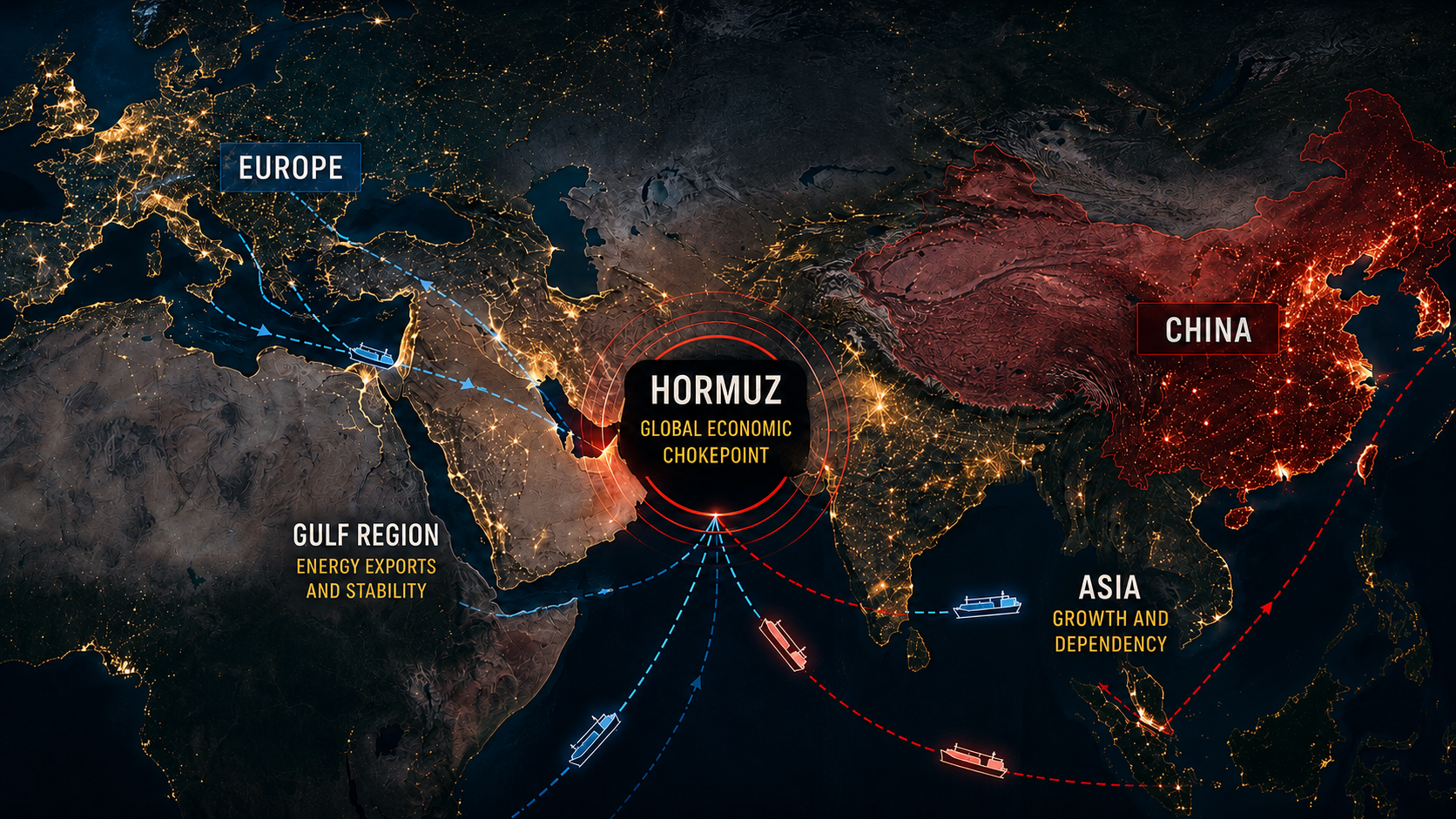
This Chokepoint Check assesses the current pressure on the Strait of Hormuz, Bab al-Mandab and critical water, power, port and energy infrastructure across the Gulf region. The key question is not merely whether a route remains geographically open, but whether transport, insurance, energy supply and site operations remain operationally viable.
The intensity of attacks has again reached a level where geographic openness no longer translates into reliable commercial usability.
UKMTO reports record at least twelve attacks within one week. Six vessels alone were retrospectively reported for October 11.
The Yemen front remains highly active; direct US support for Saudi Arabia could broaden the conflict around the Red Sea corridor.
The Houthis are threatening the United States with attacks on regional interests if Washington becomes directly involved in Saudi Arabia’s operations.
Repeated missile attacks have taken a major international aviation hub out of normal operation for several days.
King Khalid International Airport remains closed to regular operations under the current NOTAM until October 17 at 21:00 GMT.
UKMTO retrospectively published reports on six vessels hit on October 11: five tankers and one container ship.
This brings the number of tankers attacked in or around Hormuz within one week to at least twelve. A tanker off Sohar was subsequently confirmed as having been hit by a drone.
Insurability, crew safety and transit planning remain under extreme pressure. Repeated strikes continue to prevent reliable normalisation.
Verification status: confirmed through retrospective UKMTO warnings. The new confirmations were incorporated into the operational picture on October 12/13. The National / UKMTO, October 13, 2026 · SchaafMedia: Chokepoint Check – Hormuz, Trade Routes & Supply Chain Risks
Saudi Arabia extended the closure of King Khalid Airport until October 17 at 21:00 GMT. Another missile targeting Riyadh was intercepted on Monday evening.
The central hub remains out of normal operation for several days because of continuing attacks. This has now become a sustained operational infrastructure disruption.
Business travel, air freight, staff rotations and connecting traffic must be rerouted on a large scale. Time and security costs are rising.
Verification status: confirmed by Saudi Arabia’s aviation authority, the NOTAM and Reuters. The renewed missile threat remains active. Reuters, October 12/13, 2026 · SchaafMedia: Iran Check – 5 Escalation Signals from October 12, 2026
Air France-KLM is suspending Riyadh services through the end of the month, Etihad until October 19, while Lufthansa services remain cancelled until October 16.
The security situation is therefore moving beyond isolated flight cancellations and forcing longer-term network adjustments by international and regional airlines.
Travel times, cargo capacity and connecting services are deteriorating. Companies need to plan around alternative Gulf hubs and routings.
Verification status: confirmed through the respective airline measures. The suspensions remain in force on October 13 and some have been extended again. Business Recorder / Reuters, October 13, 2026 · SchaafMedia: Middle East Escalation Check from October 11, 2026
A Houthi official threatened the United States with a swift and painful response if Washington becomes directly involved in the Yemen war.
US bases and regional interests are therefore being explicitly incorporated into the retaliation logic. No new US combat decision has yet been taken.
US involvement could expand aviation, energy and security risks beyond Yemen and Saudi Arabia into additional Gulf states.
Verification status: confirmed for the Houthi threat. This is a political-military ultimatum, not an already executed US counterstrike. CBS News / AFP, October 12/13, 2026 · SchaafMedia: Iran Check – 5 Escalation Signals from October 12, 2026
President Erdoğan said the joint defence agreement with Saudi Arabia and Pakistan would be submitted to the Turkish parliament in the coming days.
Türkiye’s participation is therefore moving closer to formal domestic ratification. No new offensive deployment orders have been announced.
The regional defence architecture is becoming more institutionally robust. In the short term, however, this does not create additional chokepoint guarantees.
Verification status: confirmed by President Erdoğan. The next step is parliamentary ratification; no new operational mission has been approved. Reuters / Kathimerini, October 13, 2026 · SchaafMedia: Middle East Escalation Check from October 11, 2026
Repeated attacks hit commercial vessels around Hormuz, while Riyadh Airport remains closed after repeated missile strikes.
Ships avoid risk zones, airlines cancel services and regional defence systems are being reinforced.
Maritime transits remain unreliable and international flight capacity to Saudi Arabia is materially reduced.
Insurance, travel, freight and energy-logistics costs remain structurally elevated.
At least twelve tanker attacks within one week show repeated physical threats to the corridor.
Transit remains possible in places · repeated attacks prevent safe and reliably insurable useRiyadh Airport remains operationally closed until at least October 17 following repeated attacks.
A major international aviation hub cannot be used normally for several daysVessel attacks, airport closure, US escalation risk and alliance consolidation are occurring simultaneously.
Maritime, aviation, military and alliance risks are systemically interconnectedOverall risk remains critical. Two 5/5 layers dominate the picture: repeated physical attacks around Hormuz and the multi-day closure of Riyadh Airport. The 4/5 aviation stress amplifies the operational impact, while possible US involvement and alliance consolidation open additional escalation paths.
Disclaimer: This assessment was prepared with support from our Geo AI. AI can make mistakes. This analysis is intended as a source-based radar for potential escalation signals and does not constitute fully verified intelligence, security, insurance or investment advice. In fast-moving situations, status, source availability and risk assessments may change at short notice.
Independent of the subject covered in this article, this separate Executive Briefing provides an in-depth analysis of another critical risk domain affecting European companies.
The 27-page Executive Briefing “Black Swan Risk Mapping for Europe’s Next Mobility and Infrastructure Shock” examines how geopolitical, infrastructural and administrative developments that are currently viewed in isolation could reinforce one another.
Based on the GFDD Framework™, the report shows how these dynamics could affect operational continuity, access to critical resources and the strategic resilience of companies.
The briefing includes a structured systemic-shock analysis and a directly applicable Business Exposure Checklist for CEOs, CFOs, COOs, investors and strategy teams.
You are currently viewing a placeholder content from X. To access the actual content, click the button below. Please note that doing so will share data with third-party providers.
More Information