Executive Intelligence. Industrial Risk. Geopolitics.
Strategic Sparring
for Decision-Makers
Risk intelligence across technology, law, markets and power dynamics.


Verdeckte Geschäftsrisiken, strategische Widersprüche und kritische Abhängigkeiten frühzeitig erkennen.
Kostenlose Analyse starten →
Verdeckte Machtstrukturen, Führungsrisiken und organisatorische Blockaden frühzeitig erkennen.
Kostenlose Analyse starten →
Geopolitische Risiken, globale Abhängigkeiten und kritische Lieferkettenrisiken frühzeitig erkennen.
Kostenlose Analyse starten →
Identify hidden business risks, strategic contradictions and critical dependencies at an early stage.
Start Free Analysis →
Identify hidden power structures, leadership risks and organizational blockers at an early stage.
Start Free Analysis →
Identify geopolitical risks, global dependencies and critical supply-chain vulnerabilities at an early stage.
Start Free Analysis →
Verdeckte Geschäftsrisiken, strategische Widersprüche und kritische Abhängigkeiten frühzeitig erkennen.
Kostenlose Analyse starten →
Verdeckte Machtstrukturen, Führungsrisiken und organisatorische Blockaden frühzeitig erkennen.
Kostenlose Analyse starten →
Geopolitische Risiken, globale Abhängigkeiten und kritische Lieferkettenrisiken frühzeitig erkennen.
Kostenlose Analyse starten →
Identify hidden business risks, strategic contradictions and critical dependencies at an early stage.
Start Free Analysis →
Identify hidden power structures, leadership risks and organizational blockers at an early stage.
Start Free Analysis →
Identify geopolitical risks, global dependencies and critical supply-chain vulnerabilities at an early stage.
Start Free Analysis →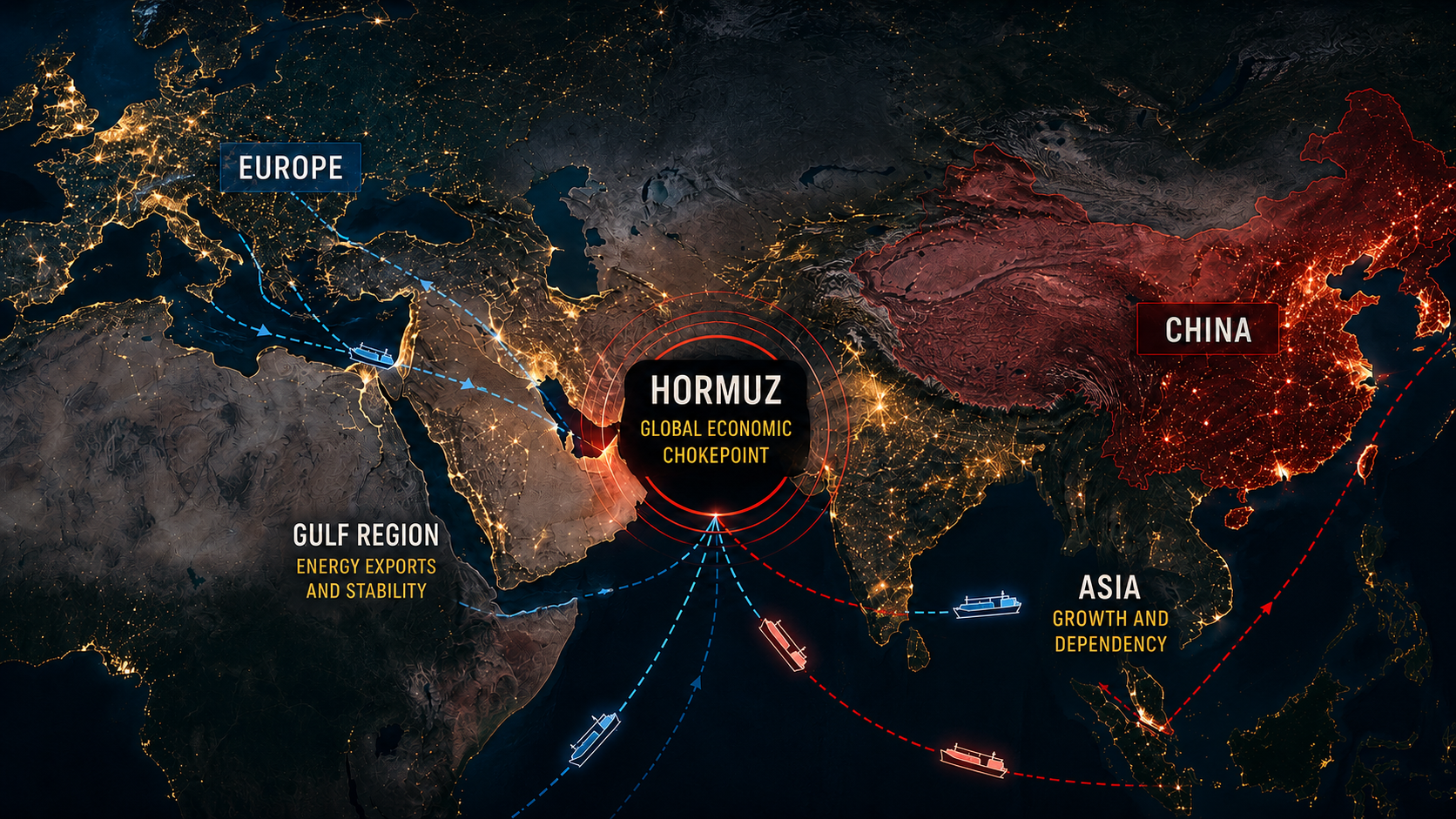
This Chokepoint Check assesses the current pressure on the Strait of Hormuz, Bab al-Mandab and critical water, power, port and energy infrastructure across the Gulf region. The key question is not merely whether a route remains geographically open, but whether transport, insurance, energy supply and site operations remain operationally viable.
The risk has now clearly spread beyond tankers to regular container and general cargo shipping.
The GFS Pride sank after sustaining damage and catching fire. The GFS Giselle was also hit, but reached a safe anchorage.
The Saudi-Houthi conflict remains highly active, but no new confirmed operational incident directly affecting Bab al-Mandab emerged today.
No sufficiently confirmed new daily signal is available for this area. The Red Sea corridor nevertheless remains high risk.
Saudi cities and the economically vital Eastern Region remain directly exposed to aerial attack risks.
Missile debris injured one resident in Riyadh. On October 15, a drone was also intercepted over the Eastern Region.
Singapore’s Maritime and Port Authority confirmed the sinking of the GFS Pride. The GFS Giselle was also struck by an unidentified projectile on October 14.
The attack wave therefore no longer primarily affects tankers. Container and general cargo shipping now face a direct risk of vessel loss as well.
Container availability, crew safety, cargo insurance and transit planning are coming under additional pressure. This increases demand for alternative routes.
Verification status: confirmed by Singapore’s Maritime and Port Authority. All 21 crew members of the GFS Pride and all 22 crew members of the GFS Giselle remained uninjured. Maritime and Port Authority of Singapore, October 14/15, 2026 · SchaafMedia: Iran Check – 5 Escalation Signals from October 14, 2026
Saudi Civil Defence reported that debris from an intercepted ballistic missile injured one resident and caused minor damage to a building and a vehicle.
The missile was intercepted, but still caused tangible civilian damage. Riyadh therefore remains directly exposed operationally.
Travel, site and business-continuity risks remain high. Even successful air defence cannot fully prevent secondary damage.
Verification status: confirmed for the interception, injury and limited property damage. No major infrastructure disruption was reported. Gulf News, updated October 15, 2026 · SchaafMedia: Iran Check – 5 Escalation Signals from October 14, 2026
Ship-to-ship transfers are expanding from Fujairah and Sohar into India’s Gulf of Kutch. Vortexa recorded around 680,000 barrels per day there in September.
Record volumes and operational delays at established transfer hubs are forcing producers into longer alternative chains. Some transfers now take more than one week.
More vessels are tied up, transport times increase and producers assume additional security risks. Asian sourcing becomes structurally more expensive.
Verification status: confirmed by Vortexa, Rystad, Kpler and BIMCO data. The precise scale of the eastward shift varies by dataset. The National, October 15, 2026 · SchaafMedia: Chokepoint Check – Hormuz, Trade Routes & Supply Chain Risks
The Houthis announced on October 14 further attacks against Saudi airports and oil facilities and extended their warning to international shipping companies.
The threat follows the attack on Aramco’s Dhahran complex. Aramco has so far reported no disruption to its production system.
Energy facilities, airports and logistics companies remain explicitly within the target spectrum. This increases preparedness and security costs.
Verification status: confirmed for the Houthi threat and limited damage at the Dhahran complex. Further announced attacks have not yet been confirmed. The Business Standard / Reuters, October 15, 2026 · SchaafMedia: Middle East Escalation Check from October 13, 2026
The Saudi-led coalition reported on October 15 that it had intercepted a drone over the Eastern Region.
The origin and specific target were initially not disclosed. The Eastern Region nevertheless hosts critical Saudi energy and industrial infrastructure.
The incident confirms continued pressure on air defences. Without a confirmed impact, the immediate operational effect remains limited.
Verification status: confirmed for the interception and location. The perpetrator, flight path and target were not initially publicly confirmed. The National – Saudi Arabia intercepts drone in Eastern Region, October 15, 2026 · SchaafMedia: Middle East Escalation Check from October 13, 2026
A container vessel sinks in Hormuz, additional commercial vessels are hit and Saudi infrastructure remains under aerial attack pressure.
Producers shift ship-to-ship transfers eastward from congested Gulf hubs and assume additional transport risks.
Longer transfer chains increase vessel turnaround times, tie up additional tankers and make delivery windows less predictable.
Freight, insurance, sourcing and energy-logistics costs remain structurally elevated.
One container vessel has sunk, another has been damaged, while repeated attacks now affect several vessel types.
Geographic passage remains possible · safe and normally insurable commercial use has not been restoredRiyadh remains under missile threat, while the Eastern Region reports another drone interception.
Critical Saudi aviation, industrial and energy infrastructure remains directly exposedVessel losses, aerial attacks, STS shifts and longer transport chains are occurring simultaneously.
Maritime security, energy supply and Asian logistics are now directly interconnectedOverall risk stands at high to critical. The 5/5 Hormuz signal dominates today’s risk picture because regular container shipping has now suffered a confirmed total vessel loss. The 4/5 logistics shift toward India shows that the disruption is already extending far beyond the chokepoint. At the same time, Saudi infrastructure and air defences remain under pressure.
Disclaimer: This assessment was prepared with support from our Geo AI. AI can make mistakes. This analysis is intended as a source-based radar for potential escalation signals and does not constitute fully verified intelligence, security, insurance or investment advice. In fast-moving situations, status, source availability and risk assessments may change at short notice.
Independent of the subject covered in this article, this separate Executive Briefing provides an in-depth analysis of another critical risk domain affecting European companies.
The 27-page Executive Briefing “Black Swan Risk Mapping for Europe’s Next Mobility and Infrastructure Shock” examines how geopolitical, infrastructural and administrative developments that are currently viewed in isolation could reinforce one another.
Based on the GFDD Framework™, the report shows how these dynamics could affect operational continuity, access to critical resources and the strategic resilience of companies.
The briefing includes a structured systemic-shock analysis and a directly applicable Business Exposure Checklist for CEOs, CFOs, COOs, investors and strategy teams.
You are currently viewing a placeholder content from X. To access the actual content, click the button below. Please note that doing so will share data with third-party providers.
More Information