Executive Intelligence. Industrial Risk. Geopolitics.
Strategic Sparring
for Decision-Makers
Risk intelligence across technology, law, markets and power dynamics.

Verdeckte Geschäftsrisiken, strategische Widersprüche und kritische Abhängigkeiten frühzeitig erkennen.
Kostenlose Analyse starten →
Verdeckte Machtstrukturen, Führungsrisiken und organisatorische Blockaden frühzeitig erkennen.
Kostenlose Analyse starten →
Geopolitische Risiken, globale Abhängigkeiten und kritische Lieferkettenrisiken frühzeitig erkennen.
Kostenlose Analyse starten →
Identify hidden business risks, strategic contradictions and critical dependencies at an early stage.
Start Free Analysis →
Identify hidden power structures, leadership risks and organizational blockers at an early stage.
Start Free Analysis →
Identify geopolitical risks, global dependencies and critical supply-chain vulnerabilities at an early stage.
Start Free Analysis →
Verdeckte Geschäftsrisiken, strategische Widersprüche und kritische Abhängigkeiten frühzeitig erkennen.
Kostenlose Analyse starten →
Verdeckte Machtstrukturen, Führungsrisiken und organisatorische Blockaden frühzeitig erkennen.
Kostenlose Analyse starten →
Geopolitische Risiken, globale Abhängigkeiten und kritische Lieferkettenrisiken frühzeitig erkennen.
Kostenlose Analyse starten →
Identify hidden business risks, strategic contradictions and critical dependencies at an early stage.
Start Free Analysis →
Identify hidden power structures, leadership risks and organizational blockers at an early stage.
Start Free Analysis →
Identify geopolitical risks, global dependencies and critical supply-chain vulnerabilities at an early stage.
Start Free Analysis →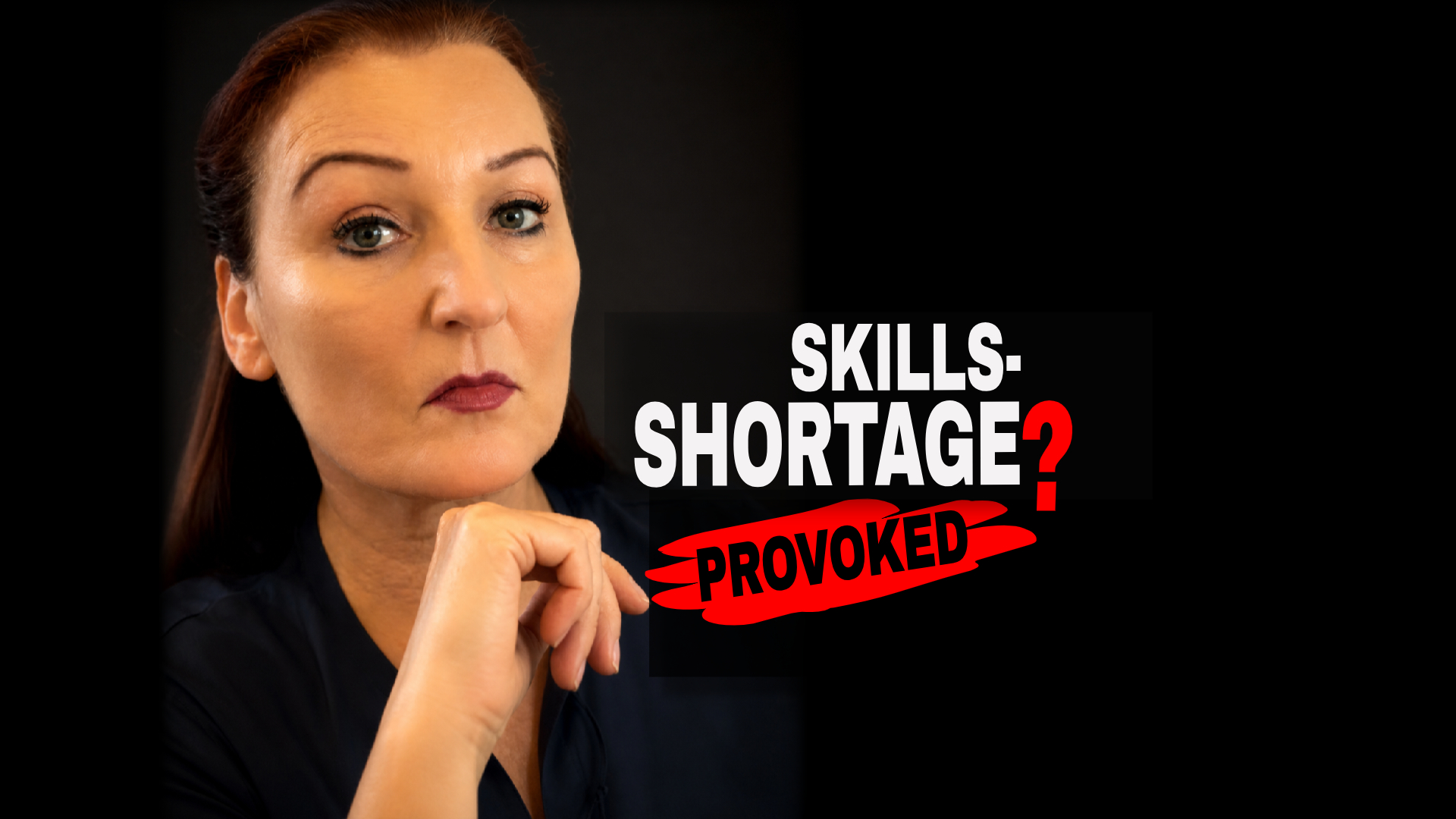
Strategic Risk Intelligence Brief by Global Insight Group.
This analysis is based on the GFDD Framework™ developed by Michaela Schaaf-Hoffelner and is designed for executives, investors and strategic decision-makers.
Updated: September 17, 2026
Germany keeps talking about a skills shortage. At the same time, industrial companies are cutting tens of thousands of jobs, scaling back training and looking for candidates who ideally match every requirement from day one.
Perhaps Germany is not simply running out of skilled workers. Perhaps companies have forgotten how to develop them.
In 2025 alone, Germany’s manufacturing sector lost 177,000 employees subject to social security contributions. The automotive industry accounted for 52,000 of those jobs, mechanical engineering for 28,000 and fabricated metal products for another 24,000. Federal Employment Agency
At the same time, the latest IG Metall works council survey reveals a striking contradiction: 63% of companies report good or very good capacity utilisation. Yet one in six companies with positive business prospects is still reducing its permanent workforce. Meanwhile, temporary agency employment is increasing again for the first time since 2023. IG Metall – State of German Industry 2026
Job cuts become particularly dangerous when companies are not merely reducing capacity — but losing knowledge.
According to the German Association of the Automotive Industry, 54% of surveyed automotive SMEs are reducing employment in Germany. Of those companies cutting jobs domestically, 44% are simultaneously expanding employment abroad.
And the cuts are not limited to administration or low-skilled work. Thirty-six percent are reducing development and innovation-related roles, while roughly half intend to increase research and development investment abroad. VDA – Germany’s Automotive Mittelstand Under Pressure
That is more than workforce restructuring.
It is potential brain drain.
Germany also has the oldest workforce in the European Union. Almost 24% of employees aged 15 to 64 are already between 55 and 64 years old. Over the coming years, a substantial share of Germany’s accumulated industrial expertise will therefore leave companies simply through retirement. Federal Statistical Office – Older Workers in Germany
The crucial question is therefore not only:
Who will replace them?
It is:
Who did they transfer their knowledge to before they left?
A company does not lose expertise when the last specialist walks through the door.
It loses expertise the moment there is nobody left to pass that knowledge on to.
This is where the recruiting paradox begins.
Companies increasingly report difficulties recruiting qualified employees. According to the IAB Establishment Panel, around 25% of businesses expected problems recruiting skilled workers in 2010. By 2024, that figure had risen to almost two thirds. IAB Establishment Panel
At the same time, the mechanism companies relied on for decades to build their own talent pipelines is weakening: vocational training.
In 2025, both the number of newly signed apprenticeship contracts and the number of company-based training positions declined. Only 55% of companies authorised to provide vocational training were actually doing so. IAB – German Apprenticeship Market 2026
In the past, companies hired people with the right foundations and developed them.
Today, candidates are increasingly expected to arrive with:
the right industry background,
the right software experience,
the right project history,
the right cultural fit
and preferably previous experience solving exactly the problem the company currently has.
Ideally, applicants should also possess a certain degree of clairvoyance — enough to work out from a job advertisement which five requirements actually matter and which twenty were added just in case.
Miss the profile by too much, and the application is rejected.
The diagnosis afterwards?
Skills shortage.
Germany is facing a genuine demographic skills problem. But that does not mean every unfilled vacancy proves that suitable people no longer exist.
Part of the shortage may be actively amplified by excessive demands for perfect fit, declining willingness to develop employees and short-term cost optimisation.
This becomes even more striking considering the substantial public support available to companies investing in Germany.
Large companies can receive investment grants of up to 25% of eligible costs in certain regions, with even higher support possible for some energy-efficiency and environmental projects. Germany has also expanded investment incentives and R&D tax support. Germany Trade & Invest – Incentive Programs in Germany
Public funding, however, does not create innovation on its own.
Innovation comes from people who understand systems, connect experience and turn accumulated knowledge into something new.
A company that cuts senior expertise today, reduces its training pipeline and simultaneously insists on hiring only perfectly matched external candidates may optimise next quarter’s personnel costs —
while quietly dismantling its knowledge pipeline for the next decade.
That is the real strategic risk.
A 60-year-old specialist leaves after thirty years in the company. No 35- or 45-year-old has spent enough time working alongside them to absorb the tacit knowledge behind technical decisions, customer relationships, system failures, supplier behaviour or project history.
A year later, the company publishes a vacancy:
“Ten years of experience in our highly specialised environment required.”
But where exactly is that candidate supposed to have acquired the experience?
The company itself stopped producing it.
This is why perfect-fit recruiting can become a competitive risk in an ageing economy.
It optimises for:
minimal onboarding today
while potentially sacrificing:
knowledge creation tomorrow.
Companies often treat employees as interchangeable resources.
In reality, competitiveness may depend on knowledge accumulated over years in people, relationships and experience.
That dependency rarely appears on the balance sheet.
But every evening, it walks out of the factory gate and goes home.
Germany PMI August 2026: Recovery — or Fear in the Supply Chain?
Why stronger purchasing activity does not necessarily signal a broad industrial recovery — and what current PMI data reveal about structural risk.
Investor Warning: How Internal Power Politics Become an M&A and Governance Risk
How internal power structures, toxic leadership and the destruction of expertise can become hidden risks to governance, integration and enterprise value.
Toxic Leadership: How Management Can Destroy Enterprise Value
Why poor leadership, loss of expertise and dysfunctional organisational structures can directly undermine long-term competitiveness and company value.
Topics: skills shortage, recruiting, brain drain, knowledge loss, workforce strategy, ageing workforce, talent development, German industry, competitiveness, human capital
Keywords: skills shortage Germany, recruiting paradox, brain drain Germany, skilled workers, knowledge transfer, workforce development, perfect-fit recruiting, talent shortage, German manufacturing, industrial competitiveness
Author of Global Insight Group Intelligence:
Michaela Schaaf-Hoffelner has more than 35 years of experience in strategic and technical project and product management, particularly in IT, control systems and intralogistics. Through her long-standing work with complex systems, she identifies structural risks and dynamic misalignments at an early stage – risks that are often overlooked in conventional analysis.
Her focus is on making causal relationships and systemic dependencies visible and translating them into concrete strategic advantages for investors and decision-makers. Her analyses combine deep technical systems understanding with geopolitical and economic developments.
GFDD Framework™ and GFDD Diagnostics™ are proprietary analytical concepts developed by Michaela Schaaf-Hoffelner. © 2026 Global Insight Group LLC. All rights reserved.
You are currently viewing a placeholder content from X. To access the actual content, click the button below. Please note that doing so will share data with third-party providers.
More Information