Executive Intelligence. Industrial Risk. Geopolitics.
Strategic Sparring
for Decision-Makers
Risk intelligence across technology, law, markets and power dynamics.

Verdeckte Geschäftsrisiken, strategische Widersprüche und kritische Abhängigkeiten frühzeitig erkennen.
Kostenlose Analyse starten →
Verdeckte Machtstrukturen, Führungsrisiken und organisatorische Blockaden frühzeitig erkennen.
Kostenlose Analyse starten →
Geopolitische Risiken, globale Abhängigkeiten und kritische Lieferkettenrisiken frühzeitig erkennen.
Kostenlose Analyse starten →
Identify hidden business risks, strategic contradictions and critical dependencies at an early stage.
Start Free Analysis →
Identify hidden power structures, leadership risks and organizational blockers at an early stage.
Start Free Analysis →
Identify geopolitical risks, global dependencies and critical supply-chain vulnerabilities at an early stage.
Start Free Analysis →
Verdeckte Geschäftsrisiken, strategische Widersprüche und kritische Abhängigkeiten frühzeitig erkennen.
Kostenlose Analyse starten →
Verdeckte Machtstrukturen, Führungsrisiken und organisatorische Blockaden frühzeitig erkennen.
Kostenlose Analyse starten →
Geopolitische Risiken, globale Abhängigkeiten und kritische Lieferkettenrisiken frühzeitig erkennen.
Kostenlose Analyse starten →
Identify hidden business risks, strategic contradictions and critical dependencies at an early stage.
Start Free Analysis →
Identify hidden power structures, leadership risks and organizational blockers at an early stage.
Start Free Analysis →
Identify geopolitical risks, global dependencies and critical supply-chain vulnerabilities at an early stage.
Start Free Analysis →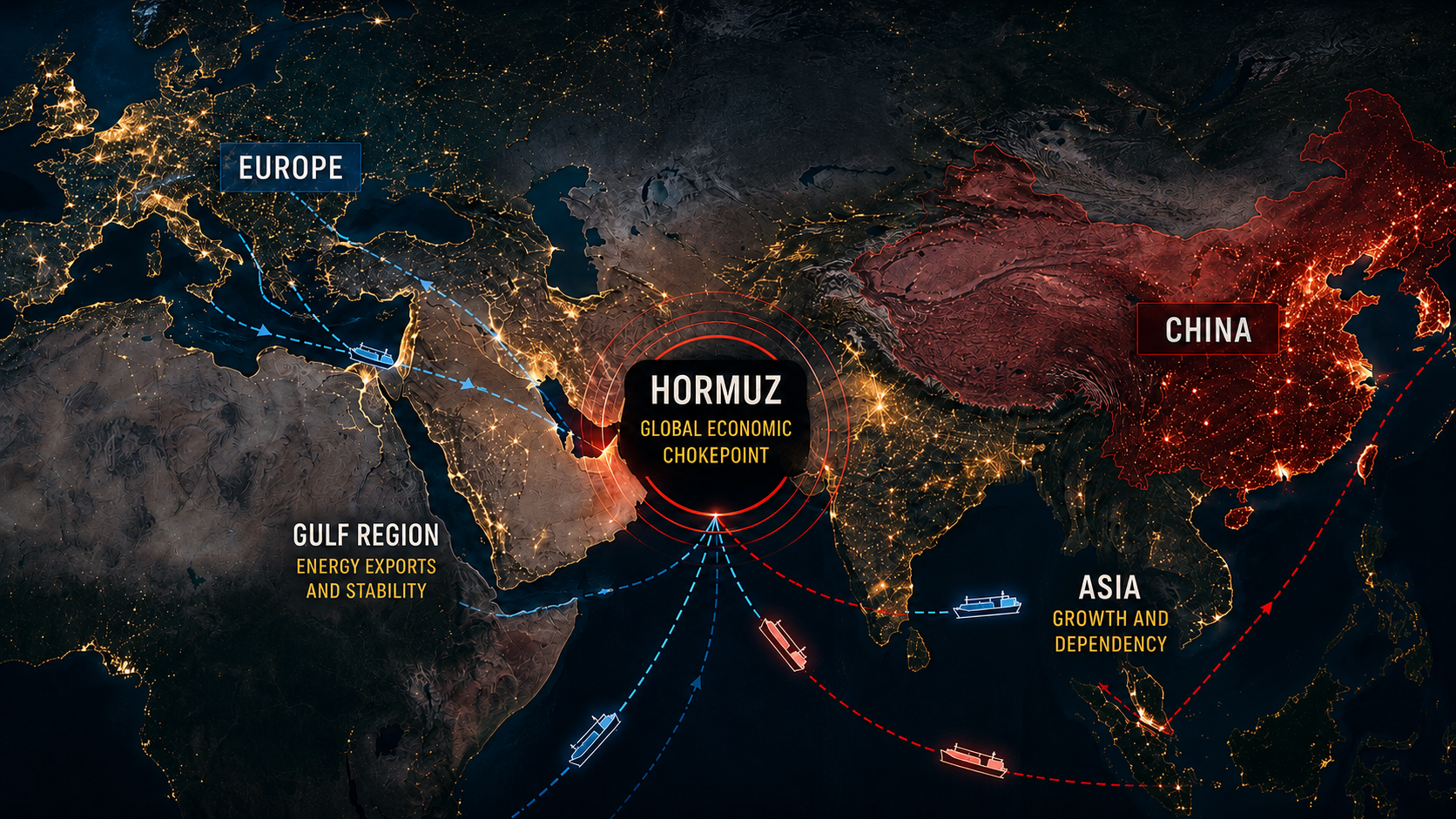
This Chokepoint Check assesses the current pressure on the Strait of Hormuz, Bab al-Mandab and critical water, power, port and energy infrastructure across the Gulf region. The key question is not merely whether a route remains geographically open, but whether transport, insurance, energy supply and site operations remain operationally viable.
The route remains geographically open, but visible commercial traffic has again fallen to an extreme low.
Kpler recorded only three commodity transits through Hormuz on Wednesday, down from twelve on Tuesday. Vessels operating without AIS are not included in the data.
Transit remains possible, while fighting along Yemen’s western coast and Houthi control continue to increase risks across the corridor.
Kpler recorded 21 commodity transits through Bab al-Mandab on Wednesday, down from 24 on Tuesday. Saudi airstrikes and Houthi operations in Yemen are continuing simultaneously.
Saudi Arabia is responding to disruption along the East-West export axis by creating additional loading capacity outside the Gulf.
Additional Saudi crude cargoes are being offered through ship-to-ship transfers off Oman’s Port of Sohar. Full restoration of the East-West Pipeline has not yet been confirmed.
Kpler recorded only three commodity vessels on Wednesday, down from twelve the previous day. Dark transits remain outside the dataset.
Visible transit therefore remains far below normal levels. Geographic openness still does not translate into operational normality.
Shipping companies and energy producers must continue planning for constrained capacity, longer rotations and elevated risk and insurance costs.
Verification status: confirmed by current Kpler data dated 17 September; AIS-dark transits are not included. Reuters / Business Recorder, 17 September 2026 · SchaafMedia: Chokepoint Check – Hormuz, Trade Routes & Supply Chain Risks
Saudi Arabia continued airstrikes in Yemen. The Houthis simultaneously reported further missile and drone attacks against Saudi Arabia.
The Yemen front is increasingly developing into a distinct theatre of war within the broader Middle East escalation.
Red Sea shipping, Saudi energy facilities and locations close to Yemen remain exposed to elevated military risk.
Verification status: confirmed for the continued hostilities. Individual Houthi claims regarding targets and military losses remain unverified. Reuters / The Daily Star, 17 September 2026 · SchaafMedia: Iran Check – 5 Escalation Signals, 16 September 2026
Saudi Arabia is offering additional crude cargoes to Asian refiners through ship-to-ship transfers off Oman’s Port of Sohar.
The new export route partially offsets disruption to the East-West Pipeline and reduces the dependence of individual cargoes on Yanbu.
The additional route provides short-term support for available oil supply. At the same time, it highlights the extent of disruption to the normal export architecture.
Verification status: confirmed. Reuters reported on 17 September that additional Saudi cargoes were being offered off Sohar; oil prices eased slightly in response. Reuters / Arab News, 17 September 2026 · SchaafMedia: Oil as a Power Instrument – Why Energy Dominates Geopolitics and Markets in 2026
Pakistan’s defence minister stated that the conditions for applying the trilateral pact with Saudi Arabia and Türkiye had now been met.
No formal joint military action has been confirmed. Islamabad is nevertheless signalling concrete political and practical support for Riyadh.
Activation would institutionally expand the Saudi-Houthi conflict to Pakistan and Türkiye and strengthen regional escalation chains.
Verification status: partially confirmed. The Pakistani statement is confirmed; formal military activation or a joint operation has not yet been established. Dawn, 17 September 2026 · SchaafMedia: Middle East Escalation Check – 15 September 2026
Pakistan’s army chief Asim Munir urged Iran’s foreign minister to use Tehran’s influence over the Houthis to halt attacks on Saudi energy facilities.
Islamabad is therefore combining its security commitment to Riyadh with direct diplomatic pressure on Tehran to contain the conflict.
Successful mediation could reduce attack risks for Saudi energy infrastructure. Failure would increase pressure to activate the new defence pact.
Verification status: partially confirmed. The conversation was reported by Pakistani government sources; Iran has not made a confirmed commitment to influence the Houthis accordingly. Anadolu Agency, 17 September 2026 · SchaafMedia: Hormuz Blockade 2026 – Protecting Margins and Supply Chains in the Chokepoint Shock
Hormuz falls to three transits, Bab al-Mandab to 21, while Saudi energy and export routes remain militarily exposed.
Saudi Arabia reroutes additional crude cargoes through ship-to-ship transfers off Sohar in Oman.
Normal export routes lose reliability, while alternative maritime logistics provide additional short-term capacity.
Oil prices remain above $100, while freight, insurance, routing and delivery-time risks remain elevated.
Hormuz falls to only three visible commodity transits, while Bab al-Mandab remains directly exposed to military risk.
Both chokepoints remain geographically open · operational predictability remains severely constrainedFollowing attacks on its export infrastructure, Saudi Arabia is being forced to reroute additional oil volumes through Oman and Sohar.
Critical export infrastructure impaired · alternative logistics reduce but do not eliminate the riskTwo chokepoints, Saudi energy infrastructure and the potential activation of regional defence commitments are now interacting simultaneously.
Maritime, energy, military and alliance-related risks are now interconnectedOverall risk remains critical. Compared with 15 September, visible Hormuz transit has deteriorated further, while Saudi Arabia is now making more explicit use of alternative export logistics via Oman. At the same time, the Saudi-Houthi conflict has reached a new alliance-related dimension: Pakistan is explicitly raising the potential application of the Makkah Defence Pact.
Disclaimer: This assessment was prepared with support from our Geo AI. AI can make mistakes. This analysis is intended as a source-based radar for potential escalation signals and does not constitute fully verified intelligence, security, insurance or investment advice. In fast-moving situations, status, source availability and risk assessments may change at short notice.
Independent of the subject covered in this article, this separate Executive Briefing provides an in-depth analysis of another critical risk domain affecting European companies.
The 27-page Executive Briefing “Black Swan Risk Mapping for Europe’s Next Mobility and Infrastructure Shock” examines how geopolitical, infrastructural and administrative developments that are currently viewed in isolation could reinforce one another.
Based on the GFDD Framework™, the report shows how these dynamics could affect operational continuity, access to critical resources and the strategic resilience of companies.
The briefing includes a structured systemic-shock analysis and a directly applicable Business Exposure Checklist for CEOs, CFOs, COOs, investors and strategy teams.
You are currently viewing a placeholder content from X. To access the actual content, click the button below. Please note that doing so will share data with third-party providers.
More Information