Executive Intelligence. Industrial Risk. Geopolitics.
Strategic Sparring
for Decision-Makers
Risk intelligence across technology, law, markets and power dynamics.

Verdeckte Geschäftsrisiken, strategische Widersprüche und kritische Abhängigkeiten frühzeitig erkennen.
Kostenlose Analyse starten →
Verdeckte Machtstrukturen, Führungsrisiken und organisatorische Blockaden frühzeitig erkennen.
Kostenlose Analyse starten →
Geopolitische Risiken, globale Abhängigkeiten und kritische Lieferkettenrisiken frühzeitig erkennen.
Kostenlose Analyse starten →
Identify hidden business risks, strategic contradictions and critical dependencies at an early stage.
Start Free Analysis →
Identify hidden power structures, leadership risks and organizational blockers at an early stage.
Start Free Analysis →
Identify geopolitical risks, global dependencies and critical supply-chain vulnerabilities at an early stage.
Start Free Analysis →
Verdeckte Geschäftsrisiken, strategische Widersprüche und kritische Abhängigkeiten frühzeitig erkennen.
Kostenlose Analyse starten →
Verdeckte Machtstrukturen, Führungsrisiken und organisatorische Blockaden frühzeitig erkennen.
Kostenlose Analyse starten →
Geopolitische Risiken, globale Abhängigkeiten und kritische Lieferkettenrisiken frühzeitig erkennen.
Kostenlose Analyse starten →
Identify hidden business risks, strategic contradictions and critical dependencies at an early stage.
Start Free Analysis →
Identify hidden power structures, leadership risks and organizational blockers at an early stage.
Start Free Analysis →
Identify geopolitical risks, global dependencies and critical supply-chain vulnerabilities at an early stage.
Start Free Analysis →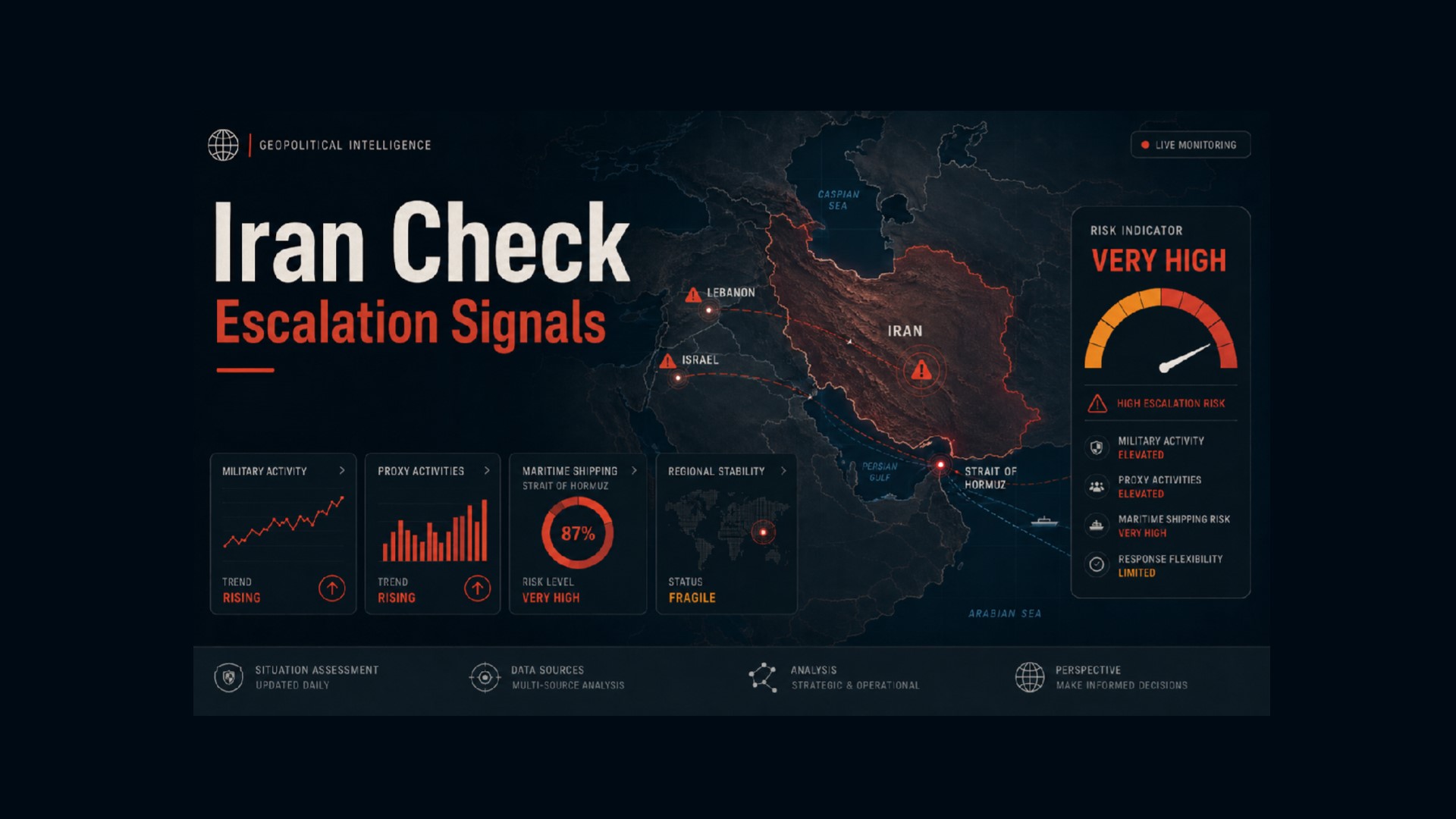
This escalation radar summarizes five relevant signals as of November 5, 2026. The focus is on verifiable statements by official sources, confirmed events and monitoring sources with potential implications for energy prices, supply chains, markets, maritime security, aviation and regional stability.
Iran reports several parallel maritime emergencies, including one tanker after an apparent mine strike. The incidents show how high the operational risk has become on shipping routes controlled by Iran.
A vessel is struck around 50 nautical miles off Qatar. The maritime threat therefore once again extends well beyond the immediate Strait of Hormuz.
Seoul plans to extend its anti-piracy mission towards Oman and deploy additional maritime surveillance capabilities. South Korea is seeking to protect its oil supply without entering the US-Iran war.
| Actor | Type | Severity | Status | Source / Verification | Business Impact |
|---|---|---|---|---|---|
| Iran / Hormuz / Tanker Shipping | Multiple tankers and a tug catch fire in Hormuz | Critical · Level 5/5 | Iran’s Revolutionary Guards report several maritime incidents in the Strait of Hormuz on November 5. One oil tanker reportedly hit a mine south of the strait after using an unauthorized route. In a second incident, a supertanker catches fire while leaving an eastern shipping route. A tugboat attempting to assist with firefighting subsequently also catches fire. Power dynamics: Iran’s control of authorized shipping lanes is increasingly becoming an operational risk in itself for commercial vessels. | Reported by Reuters, November 5, 2026 . Verification status: partially confirmed. Multiple maritime emergencies are confirmed. The exact causes and Iran’s account of navigation violations are not fully independently verified. Background: Schaaf Media · Hormuz Blockade 2026: Protecting Margins and Supply Chains in the Chokepoint Shock . | Critical business impact on oil tankers, LNG, charter rates, insurance, crews, energy exports and transit times. Particularly relevant: The risk now stems not only from attacks, but also from mines, alternative shipping routes and restricted navigation. |
| Qatar / Persian Gulf / Tanker Shipping | Tanker hit by two projectiles off Qatar | Critical · Level 5/5 | A tanker is hit on November 5 around 50 nautical miles off Qatar by two projectiles. The incident is reported by the British military through maritime security monitoring channels. No initial information is available regarding injuries, damage or possible environmental consequences. No group claims responsibility. Power dynamics: The maritime threat is not confined to the narrowest section of Hormuz, but extends deep into the Persian Gulf. | Reported by AP, November 5, 2026 . Verification status: confirmed for the projectile strike. The perpetrator, weapon type and extent of damage remain unclear. Further reading: Schaaf Media · Middle East Escalation Check from November 4, 2026 . | Critical business impact on Qatar, LNG, tankers, insurance, Gulf ports and energy exports. Key point: Even vessels outside the immediate Hormuz passage remain acutely exposed. |
| South Korea / Oman / Hormuz | South Korea expands maritime mission closer to Hormuz | High to Critical · Level 4/5 | South Korea plans to significantly expand the operational area of its Cheonghae Unit. The unit, previously deployed mainly in the Gulf of Aden, is expected to operate as far as waters off Oman’s port of Duqm. Seoul also plans to deploy a P-8A maritime patrol aircraft and around 75 additional personnel. South Korea stresses that it does not intend to enter the US-Iran war. Power dynamics: A major Asian energy importer is beginning to provide stronger military protection for its energy and shipping routes. | Confirmed by Reuters, November 5, 2026 . Verification status: confirmed. The expansion still requires parliamentary approval. Participation in the war against Iran is explicitly not planned. Background: Schaaf Media · Middle East Escalation Check from November 4, 2026 . | High to critical business impact on Asian energy imports, tankers, Oman, maritime security and supply chains. South Korea sourced around 70 percent of its oil imports from the Middle East in 2025. |
| USA / Iran / US Congress | US midterms increase political pressure on Trump’s Iran war | High to Critical · Level 4/5 | Democrats make significant gains in the US midterm elections. Iranian government officials publicly interpret the result as a rejection of the Iran war by US voters. Trump acknowledges that the war and high prices politically hurt Republicans. Tehran nevertheless expects no fundamental change in Washington’s policy. Power dynamics: Trump’s military room for maneuver remains fundamentally intact, but the domestic political cost of further escalation is rising. | Current source: AP, November 5, 2026 . Verification status: confirmed for the election result and Iranian reactions. Whether the new Congress can materially constrain military decisions remains politically uncertain. Background: Schaaf Media · Iran Check: 5 Escalation Signals from November 3, 2026 . | High to critical business impact on oil prices, markets, Iran policy, US sanctions and investment decisions. Markets currently assess an immediate new large-scale offensive as less likely. |
| Israel / Netanyahu / Opposition | Arab parties offer support for anti-Netanyahu government | High to Critical · Level 4/5 | Israel’s political situation shifts again on November 5. The Arab Joint List offers to support a Jewish-led government against Netanyahu in parliament. This could, for the first time, create a realistic path to bypass Netanyahu’s 53-seat bloc. The Arab parties would not necessarily have to formally join the government. Significant political and ideological obstacles remain. Power dynamics: Who governs Israel next could directly influence how aggressively Jerusalem approaches the next phase of the Iran conflict. | Confirmed by AP, November 5, 2026 . Verification status: confirmed for the offer of support. A new government has not yet been formed. Further reading: Schaaf Media · Iran Check: 5 Escalation Signals from November 3, 2026 . | High to critical business impact on Israel, Iran risk, defense, aviation, investment and regional planning. The key issue is less an immediate military operation than a potential shift in Israel’s future decision-making and escalation policy. |
The most important operational development on November 5, 2026 is the renewed deterioration of the maritime security situation. Two tankers and a tug catch fire in Hormuz in several separate incidents. One tanker reportedly struck a mine. At the same time, another vessel is hit by two projectiles around 50 nautical miles off Qatar.
The maritime risk zone is therefore expanding. The threat affects not only the narrowest section of Hormuz, but once again larger parts of the Persian Gulf. For tanker operators, LNG transport, insurers and energy importers, the risk therefore remains at a critical level.
At the same time, another external actor is responding. South Korea plans to extend its anti-piracy mission towards Oman and deploy additional maritime surveillance capabilities. Seoul is avoiding direct participation in the US-Iran war, but is visibly beginning to provide stronger military protection for its energy supply.
Politically, the US midterm elections and Israel’s government formation are changing the escalation logic. Trump’s Iran war is becoming more costly domestically. At the same time, the willingness of Arab parties to support an anti-Netanyahu government opens a more concrete path towards a change of power in Israel. EASA continues to maintain active warnings for Iran, Saudi Arabia, the Persian Gulf/Gulf of Oman, Iraq, Lebanon and Yemen; no new revision was identified on November 5.
The five most important signals for a German and European risk assessment are: the simultaneous fires involving multiple tankers and a tug in Hormuz, including one reported mine strike, the additional projectile attack on a tanker around 50 nautical miles off Qatar, South Korea’s planned expansion of its maritime mission towards Oman and Hormuz to protect strategic trade routes, the significantly increased domestic political pressure on Trump’s Iran strategy following the US midterm elections, and the new Israeli government-formation path created by Arab parties offering support for an anti-Netanyahu government.
Note: This assessment was prepared with the support of our Geo-AI. AI can make mistakes. The analysis is intended as a radar for potential escalation signals and does not replace a fully verified intelligence assessment.
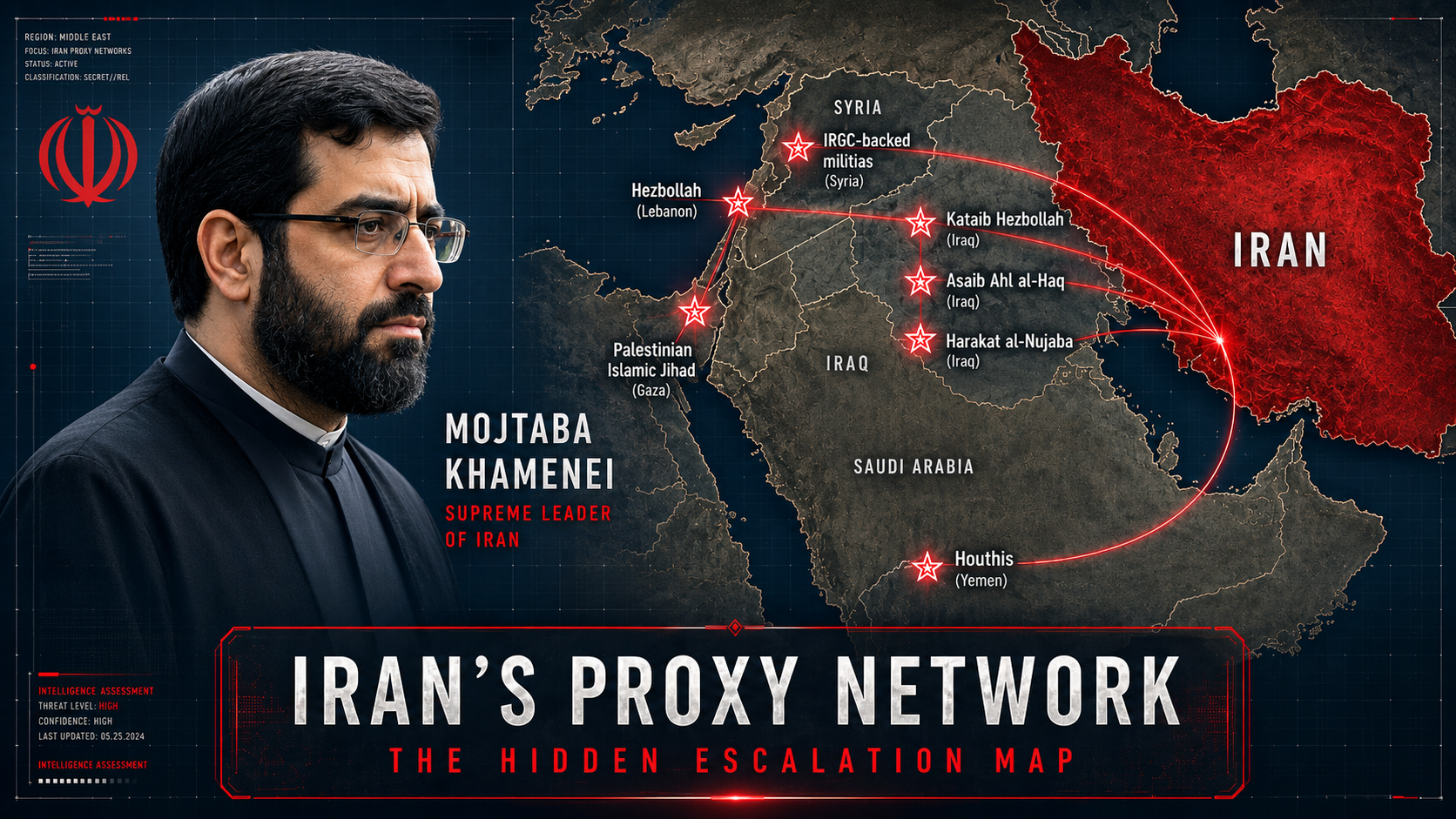
What decision-makers should watch now — before proxy escalation becomes a cost, compliance or supply-chain shock.
This 17-page executive briefing translates Iran’s proxy network into concrete business risks: energy price exposure, maritime chokepoints, war-risk premiums, sanctions, shadow fleets, supply-chain disruption and early-warning indicators for board-level decisions.
You are currently viewing a placeholder content from X. To access the actual content, click the button below. Please note that doing so will share data with third-party providers.
More Information