Executive Intelligence. Industrial Risk. Geopolitics.
Strategic Sparring
for Decision-Makers
Risk intelligence across technology, law, markets and power dynamics.

Verdeckte Geschäftsrisiken, strategische Widersprüche und kritische Abhängigkeiten frühzeitig erkennen.
Kostenlose Analyse starten →
Verdeckte Machtstrukturen, Führungsrisiken und organisatorische Blockaden frühzeitig erkennen.
Kostenlose Analyse starten →
Geopolitische Risiken, globale Abhängigkeiten und kritische Lieferkettenrisiken frühzeitig erkennen.
Kostenlose Analyse starten →
Identify hidden business risks, strategic contradictions and critical dependencies at an early stage.
Start Free Analysis →
Identify hidden power structures, leadership risks and organizational blockers at an early stage.
Start Free Analysis →
Identify geopolitical risks, global dependencies and critical supply-chain vulnerabilities at an early stage.
Start Free Analysis →
Verdeckte Geschäftsrisiken, strategische Widersprüche und kritische Abhängigkeiten frühzeitig erkennen.
Kostenlose Analyse starten →
Verdeckte Machtstrukturen, Führungsrisiken und organisatorische Blockaden frühzeitig erkennen.
Kostenlose Analyse starten →
Geopolitische Risiken, globale Abhängigkeiten und kritische Lieferkettenrisiken frühzeitig erkennen.
Kostenlose Analyse starten →
Identify hidden business risks, strategic contradictions and critical dependencies at an early stage.
Start Free Analysis →
Identify hidden power structures, leadership risks and organizational blockers at an early stage.
Start Free Analysis →
Identify geopolitical risks, global dependencies and critical supply-chain vulnerabilities at an early stage.
Start Free Analysis →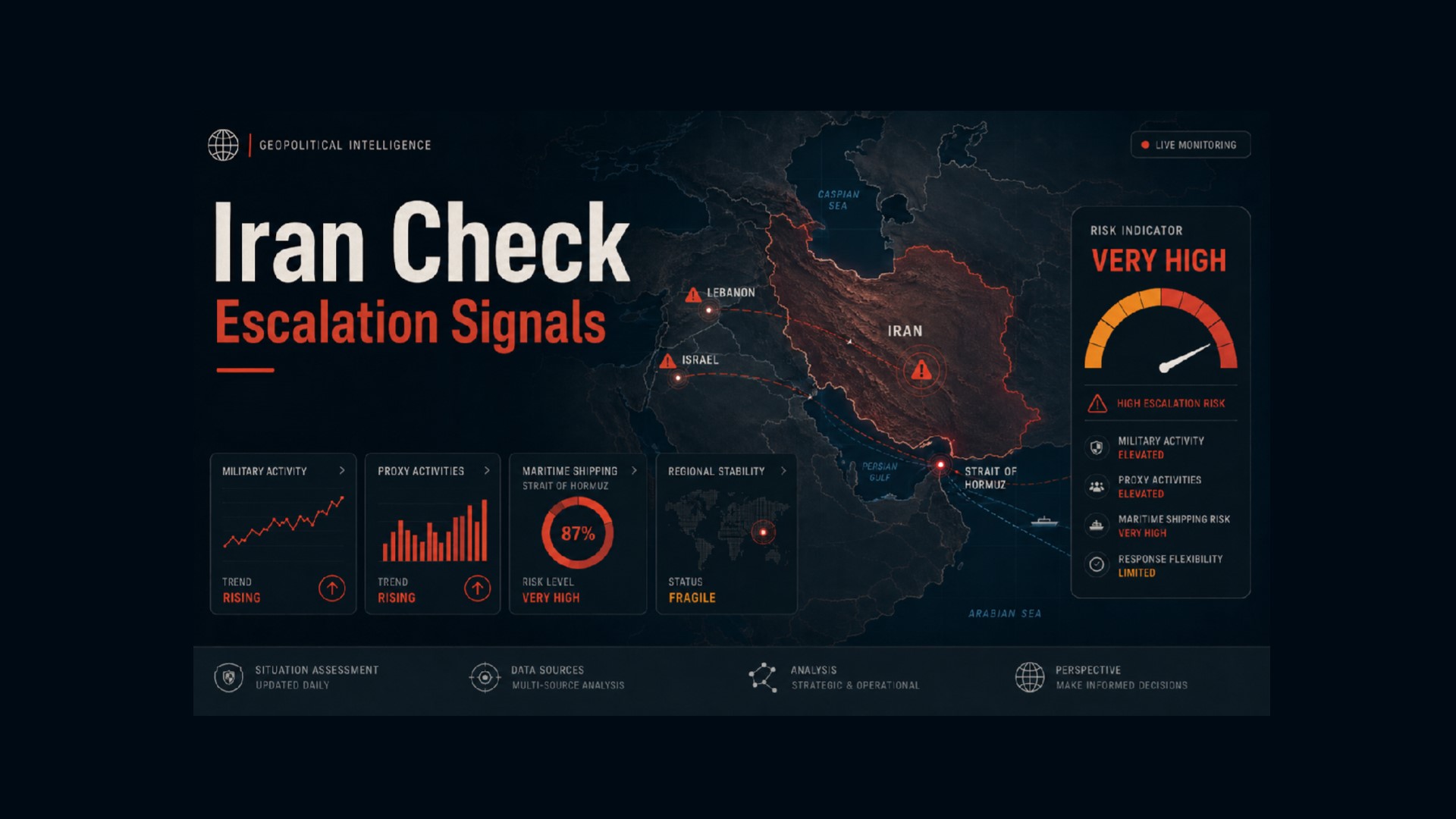
This escalation radar summarizes five relevant signals as of November 9, 2026. The focus is on verifiable statements by official sources, confirmed events and monitoring sources with potential implications for energy prices, supply chains, markets, maritime security, aviation and regional stability.
Task Force Iron Gate is intended to restrict weapons, dual-use goods and illicit revenue flows not only by sea, but also across Iran’s land borders and the Caspian Sea. Washington is turning the naval blockade into a broader economic and military containment system.
CENTCOM confirms disabling a commercial vessel in the Gulf of Oman after it allegedly attempted to breach the Iran blockade. The blockade is therefore being enforced not only economically, but directly through military action.
Bloomberg shipping data show no Iranian crude oil loaded onto tankers in September or October. Tehran is therefore losing its most important source of foreign currency while war, inflation and government spending increase funding needs.
| Actor | Type | Severity | Status | Source / Verification | Business Impact |
|---|---|---|---|---|---|
| USA / Iran / CENTCOM | USA expands Iran blockade to land routes and the Caspian Sea | Critical · Level 5/5 | CENTCOM launches Task Force Iron Gate. The new unit is intended to restrict Iran’s movement of weapons, dual-use technology and sanctioned goods across land borders and the Caspian Sea. It is also intended to disrupt illicit revenue flows. CENTCOM estimates that the existing naval blockade has already cost Iran more than USD 25 billion in crude oil exports. Power dynamics: Washington is expanding the blockade from a maritime instrument into a broader economic and military containment strategy. | Confirmed by Reuters, updated November 8, 2026 . Verification status: confirmed. Task Force Iron Gate has been announced by CENTCOM. Its precise operational reach along Iran’s land borders remains to be seen. Background: Schaaf Media · Iran Check: 5 Escalation Signals from November 7, 2026 . | Critical business impact on Iran-related trade, logistics, dual-use goods, land transport, sanctions and supply chains. Particularly relevant: Alternative routes that previously allowed partial circumvention of the naval blockade are now coming under greater pressure. |
| USA / Iran / Gulf of Oman | US military actively enforces naval blockade against commercial vessel | Critical · Level 5/5 | CENTCOM confirms opening fire on a commercial vessel in the Gulf of Oman. The vessel, sailing under the flag of St. Kitts, had previously called at an Iranian port. According to US officials, it repeatedly ignored warnings and attempted to leave the region despite the US naval blockade. The vessel was subsequently disabled. Power dynamics: The US blockade is no longer merely monitored, but is being directly enforced against commercial shipping through military action. | Confirmed by AP, November 8, 2026 . Verification status: confirmed. CENTCOM confirms the operation against the vessel. Details regarding damage and the crew remain limited. Further reading: Schaaf Media · Middle East Escalation Check from November 8, 2026 . | Critical business impact on commercial vessels, shipping companies, insurance, the Gulf of Oman, Iranian ports and sanctions exposure. For companies, the risk now includes not only attacks, but also becoming directly caught up in military enforcement of the blockade. |
| Iran / Oil / US Blockade / State Budget | Oil exports nearly collapsed as Iran’s public finances come under greater pressure | High to Critical · Level 4/5 | Iran’s crude oil exports have nearly ground to a halt under the US naval blockade. Shipping data analyzed by Bloomberg show no crude oil loaded onto tankers in September or October. FGE estimates that only 200,000 to 300,000 barrels per day are still reaching the market through Iraq. Before the war, China was Iran’s most important buyer. This removes a central source of foreign currency and government financing. Power dynamics: Economic pressure on Tehran is increasing, although no political concessions are yet visible. | Bloomberg report: Bloomberg via gCaptain, November 6, 2026 . Verification status: confirmed for the sharp collapse in seaborne exports. This is not a new development from November 9, but its impact remains immediate. Small volumes continue to reach the market through alternative routes. Background: Schaaf Media · Hormuz Blockade 2026: Protecting Margins and Supply Chains in the Chokepoint Shock . | High to critical business impact on Iranian public finances, the rial, inflation, energy trade, sanctions and regional stability. Particularly relevant: War spending is rising while the government’s most important revenue source is nearly disappearing. This increases the risk of budget deficits, currency pressure and social tensions. |
| USA / Iran / Qatar | Trump meets Qatari mediator, but no breakthrough is in sight | High to Critical · Level 4/5 | Trump meets Qatar’s Prime Minister Sheikh Mohammed bin Abdulrahman Al-Thani in Washington on November 9. Vice President JD Vance is also expected to speak with the key Iran mediator. Trump says new strikes would be very unlikely if negotiations make substantial progress. At the same time, Washington identifies further potential targets in the event of failure. Secretary of State Rubio says a breakthrough is not imminent. Power dynamics: Diplomacy reduces the short-term strike risk, but does not replace the military pressure. | Confirmed by Reuters, November 9, 2026 . Verification status: confirmed. Iran has submitted a new proposal through Qatar. Washington nevertheless considers key Iranian conditions unacceptable. Further reading: Schaaf Media · Iran Check: 5 Escalation Signals from November 7, 2026 . | High to critical business impact on Hormuz, oil, LNG, sanctions, Iranian exports and investment planning. The short-term risk of a new major offensive declines as long as negotiations show progress. Failure, however, would quickly increase the threat of renewed strikes. |
| Israel / Eisenkot / Netanyahu / USA | Eisenkot receives mandate to form government as Trump signals foreign-policy continuity | High to Critical · Level 4/5 | Israeli President Herzog tasks Gadi Eisenkot with forming a government. Eisenkot initially has 28 days to build a coalition. He received recommendations from parties representing a total of 67 seats. Netanyahu has 46 recommendations. Trump says on November 9 that Eisenkot and Netanyahu are very similar in policy and overall outlook. Washington is therefore signaling that a potential change of leadership in Israel would not automatically produce a fundamental change in policy towards Iran. Power dynamics: Israel’s leadership could change, while its hard strategic line towards Tehran may continue. | Current regional source: Jerusalem Post, November 9, 2026 . Verification status: confirmed. Eisenkot holds the official mandate to form a government. A viable coalition has not yet been formed. Background: Schaaf Media · Iran Check: 5 Escalation Signals from November 7, 2026 . | High to critical business impact on Israel, Iran strategy, defense, US-Israel relations, aviation and regional investment. Key point: A change in leadership does not automatically imply strategic de-escalation towards Iran. |
The most important structural development on November 9, 2026 is the expansion of the US pressure system. Task Force Iron Gate extends the existing naval blockade to land borders, the Caspian Sea, dual-use technologies and illicit revenue flows. At the same time, the US operation against a commercial vessel in the Gulf of Oman shows that the blockade is also being actively enforced through military means.
Economically, this strategy is becoming increasingly dangerous for Tehran. Bloomberg data show no Iranian crude oil loaded onto tankers in September or October. Iran is therefore losing almost its most important source of foreign currency and government revenue, while war, inflation and public spending increase funding needs. This puts the state budget under substantial additional pressure.
Diplomatically, however, a limited window for de-escalation remains open. Trump meets Qatar’s Prime Minister and says further strikes would be very unlikely if negotiations make substantial progress. Washington nevertheless warns that a breakthrough is not imminent.
At the same time, Israel’s political realignment is becoming more concrete. Eisenkot now officially holds the mandate to form a government. Trump’s assessment that Eisenkot and Netanyahu are politically similar nevertheless suggests that a change of government would not automatically lead to a softer Iran policy. EASA continues to maintain active warnings for Iran, Saudi Arabia, the Persian Gulf/Gulf of Oman, Iraq, Lebanon and Yemen; no new revision was identified on November 9.
The five most important signals for a German and European risk assessment are: the expansion of the US blockade strategy through Task Force Iron Gate to land routes and the Caspian Sea, the active military enforcement of the naval blockade against a commercial vessel in the Gulf of Oman, the near-total collapse of Iranian oil exports and the resulting severe fiscal pressure on Tehran, the intensified Qatari mediation with lower short-term strike risk but continued major differences between the USA and Iran, and Eisenkot’s official mandate to form Israel’s next government alongside Washington’s signal that the strategic Iran policy may change only marginally under new leadership.
Note: This assessment was prepared with the support of our Geo-AI. AI can make mistakes. The analysis is intended as a radar for potential escalation signals and does not replace a fully verified intelligence assessment.
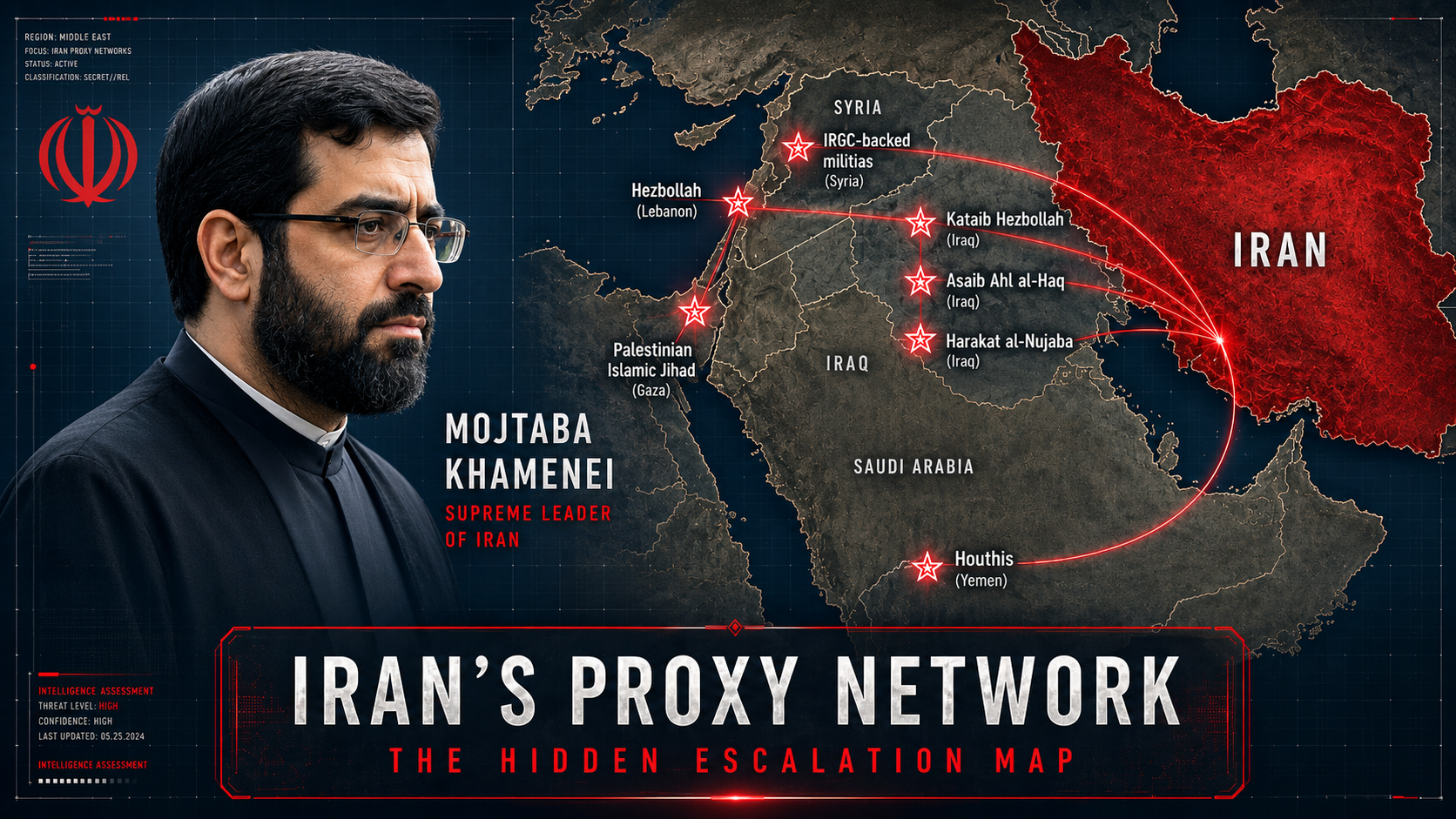
What decision-makers should watch now — before proxy escalation becomes a cost, compliance or supply-chain shock.
This 17-page executive briefing translates Iran’s proxy network into concrete business risks: energy price exposure, maritime chokepoints, war-risk premiums, sanctions, shadow fleets, supply-chain disruption and early-warning indicators for board-level decisions.
You are currently viewing a placeholder content from X. To access the actual content, click the button below. Please note that doing so will share data with third-party providers.
More Information