Executive Intelligence. Industrial Risk. Geopolitics.
Strategic Sparring
for Decision-Makers
Risk intelligence across technology, law, markets and power dynamics.

Verdeckte Geschäftsrisiken, strategische Widersprüche und kritische Abhängigkeiten frühzeitig erkennen.
Kostenlose Analyse starten →
Verdeckte Machtstrukturen, Führungsrisiken und organisatorische Blockaden frühzeitig erkennen.
Kostenlose Analyse starten →
Geopolitische Risiken, globale Abhängigkeiten und kritische Lieferkettenrisiken frühzeitig erkennen.
Kostenlose Analyse starten →
Identify hidden business risks, strategic contradictions and critical dependencies at an early stage.
Start Free Analysis →
Identify hidden power structures, leadership risks and organizational blockers at an early stage.
Start Free Analysis →
Identify geopolitical risks, global dependencies and critical supply-chain vulnerabilities at an early stage.
Start Free Analysis →
Verdeckte Geschäftsrisiken, strategische Widersprüche und kritische Abhängigkeiten frühzeitig erkennen.
Kostenlose Analyse starten →
Verdeckte Machtstrukturen, Führungsrisiken und organisatorische Blockaden frühzeitig erkennen.
Kostenlose Analyse starten →
Geopolitische Risiken, globale Abhängigkeiten und kritische Lieferkettenrisiken frühzeitig erkennen.
Kostenlose Analyse starten →
Identify hidden business risks, strategic contradictions and critical dependencies at an early stage.
Start Free Analysis →
Identify hidden power structures, leadership risks and organizational blockers at an early stage.
Start Free Analysis →
Identify geopolitical risks, global dependencies and critical supply-chain vulnerabilities at an early stage.
Start Free Analysis →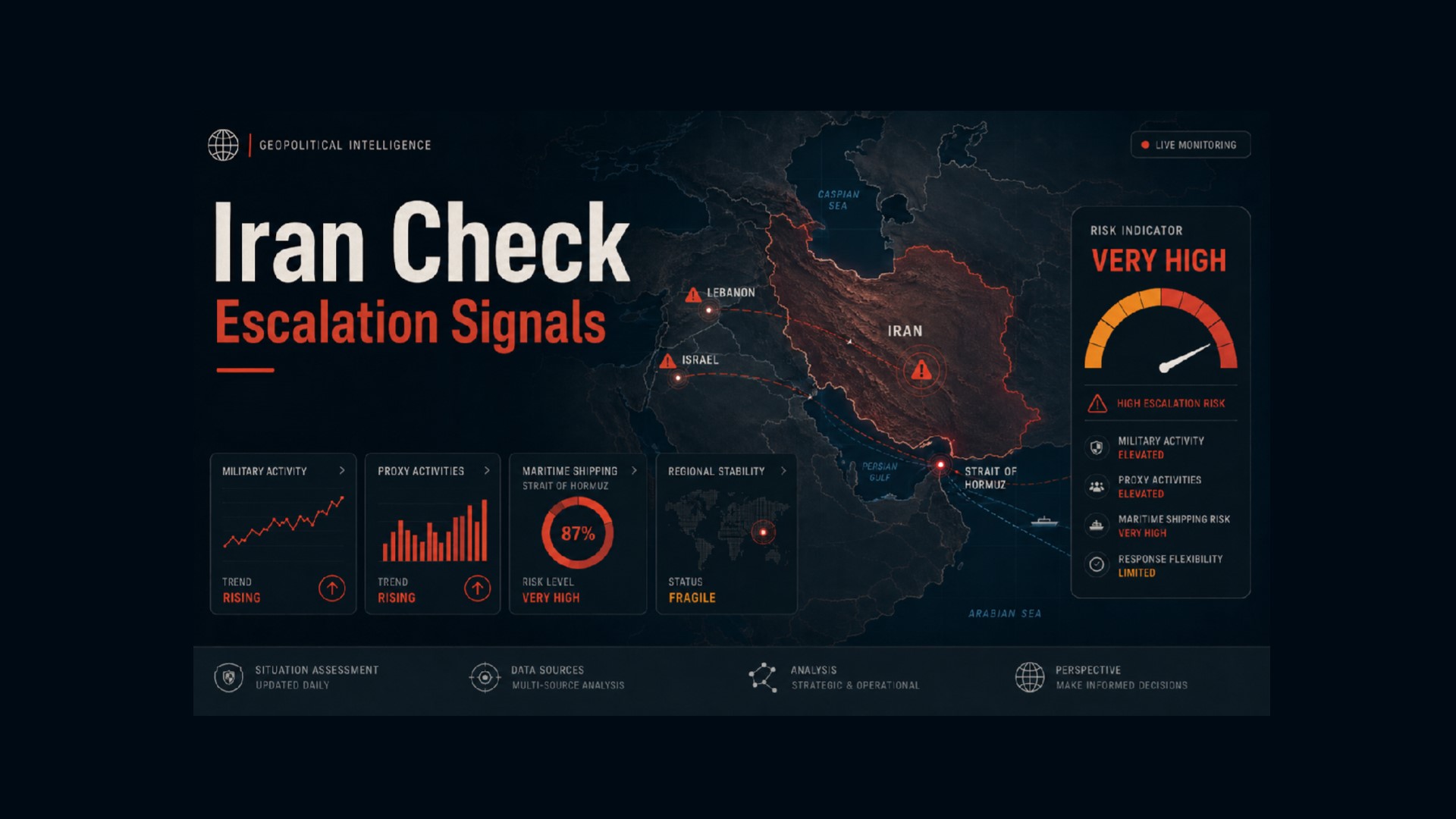
This escalation radar summarizes five relevant signals as of November 11, 2026. The focus is on verifiable statements by official sources, confirmed events and monitoring sources with potential implications for energy prices, supply chains, markets, maritime security, aviation and regional stability.
Tehran says no enriched nuclear material will leave the country. At the same time, Iran warns that renewed US attacks could trigger retaliation against more distant American bases.
The Revolutionary Guards report another tanker fire after an alleged sea-mine strike. Maritime risk therefore remains acute despite ongoing diplomatic efforts.
Tehran warns of major winter gas shortages following war damage to processing facilities. At the same time, the near-collapse of oil exports is depriving the government of critical foreign-currency revenue.
| Actor | Type | Severity | Status | Source / Verification | Business Impact |
|---|---|---|---|---|---|
| Iran / USA / Nuclear Program | Iran rejects uranium transfer and threatens more distant US bases | Critical · Level 5/5 | Iran’s security chief Mohsen Rezaei says on November 11 that no enriched uranium will leave Iran. Tehran intends to use the material itself, including for nuclear-powered ships and submarines. Iran is therefore rejecting a key potential compromise option under which Russia could take custody of enriched material. Rezaei also warns that renewed US attacks could trigger retaliation against more distant American bases. Power dynamics: Tehran is simultaneously increasing nuclear and military negotiating pressure. | Confirmed by Reuters, November 11, 2026 . Verification status: confirmed. It remains unclear how much highly enriched uranium is actually still available after the attacks. Background: Schaaf Media · Iran Check: 5 Escalation Signals from November 9, 2026 . | Critical business impact on Iran, US bases, Israel, Gulf states, aviation, energy and insurance. Particularly relevant: A central nuclear compromise option is being explicitly ruled out. |
| Iran / Hormuz / Tanker Shipping | New tanker fire after reported mine strike in Hormuz | Critical · Level 5/5 | Iran’s Revolutionary Guards report on November 11 another tanker fire in the Strait of Hormuz. The vessel reportedly struck a sea mine. A British maritime security authority confirms an incident in the region, without fully confirming the Iranian account. The incident follows numerous attacks and mine reports in recent weeks. Power dynamics: Even if political de-escalation advances, physical passage through Hormuz remains dangerous. | Current source: AP, November 11, 2026 . Verification status: partially confirmed. The maritime incident is confirmed. A mine strike has not yet been independently verified. Further reading: Schaaf Media · Middle East Escalation Check from November 10, 2026 . | Critical business impact on tankers, LNG, insurance, charter rates, energy prices and supply chains. Key point: A political agreement would not automatically eliminate maritime risks immediately. |
| Iran / Energy / State Budget | Gas shortages hit Iran as oil revenues collapse | High to Critical · Level 4/5 | Iran’s government warns on November 11 of substantial gas shortages this winter. War damage has hit several processing facilities and reduced available capacity. The expected supply gap rises to around 430 million cubic meters. Eleven of Iran’s 31 provinces could be particularly affected. At the same time, the near-collapse of oil exports is directly affecting public finances. Bloomberg had already reported no Iranian crude oil loaded onto tankers in September or October. Power dynamics: Tehran is losing revenue while the costs of energy supply, war and infrastructure continue to rise. | Confirmed by Reuters, November 11, 2026 . Verification status: confirmed for the current gas-supply situation. The collapse in oil exports remains an ongoing economic pressure factor. Background: Schaaf Media · Iran Check: 5 Escalation Signals from November 9, 2026 . | High to critical business impact on Iranian public finances, industry, energy supply, the rial, inflation and social stability. Particularly relevant: The government is losing oil revenue while its own energy supply becomes more expensive and less secure. |
| Iran / USA / Qatar / Hormuz | Tehran says no direct talks are underway as Hormuz remains a bargaining tool | High to Critical · Level 4/5 | Iran says no direct negotiations with Washington are currently underway. Tehran continues to demand a clear response to seven conditions before talks can resume. The reopening of the Strait of Hormuz also remains tied to these conditions. Qatar continues mediating, while Washington is not currently planning another major strike campaign. Power dynamics: Hormuz remains a central bargaining tool in negotiations between Tehran and Washington. | Current source: Dawn / Agencies, November 11, 2026 . Verification status: confirmed. Diplomatic contacts through intermediaries continue, but there are no direct negotiations. Further reading: Schaaf Media · Hormuz Blockade 2026: Protecting Margins and Supply Chains in the Chokepoint Shock . | High to critical business impact on Hormuz, oil, LNG, shipping, sanctions and investment planning. A political deal remains possible, but a rapid breakthrough is not yet visible. |
| Israel / Eisenkot / Netanyahu | First fractures emerge in Eisenkot camp over government formation | Elevated · Level 3/5 | Israel’s government formation becomes more complicated on November 11. Tensions are growing within Eisenkot’s camp over whether a government should be formed with ultra-Orthodox parties or with support from Arab parties. Yair Golan is considering a minority government, while other partners reject exactly that model. Eisenkot also remains under time pressure to assemble a viable majority. Power dynamics: Netanyahu’s replacement remains possible, but the path is considerably less straightforward than initially expected. | Current Israeli source: Jerusalem Post, November 11, 2026 . Verification status: confirmed for the political tensions. A new government has not yet been formed. Background: Schaaf Media · Iran Check: 5 Escalation Signals from November 9, 2026 . | Elevated business impact on Israel, Iran strategy, defense, US-Israel relations and regional planning. A change of government remains possible, but its timing and coalition basis are becoming more uncertain again. |
The most important strategic development on November 11, 2026 is Iran’s new nuclear and military red line. Tehran says no enriched uranium will leave the country. At the same time, Iran threatens to target more distant American bases if new US attacks occur. Two central points of dispute are therefore hardening simultaneously.
Operationally, the Strait of Hormuz remains highly dangerous. Another tanker catches fire after what Iran describes as a mine strike. Even with a political breakthrough, mines, insurance risks and damaged vessels could therefore prevent a rapid return to normal operations.
At the same time, Iran’s economic situation is deteriorating. The government warns of severe gas shortages in the coming winter. At the same time, crude oil exports have nearly collapsed under the US blockade. Tehran is therefore facing a dangerous combination: falling foreign-currency revenue alongside rising energy, infrastructure and war costs. Pressure on the state budget, the currency and the population is continuing to increase.
Diplomatically, the situation remains contradictory. Qatar continues mediating, but Tehran says there are currently no direct talks with Washington. Hormuz explicitly remains part of Iran’s negotiating conditions. In Israel, Eisenkot’s government formation is also becoming more difficult, as competing coalition models divide his camp. EASA continues to maintain active warnings for Iran, Saudi Arabia, the Persian Gulf/Gulf of Oman, Iraq and Lebanon; no new revision was identified on November 11.
The five most important signals for a German and European risk assessment are: Iran’s new red line against transferring enriched uranium abroad and its simultaneous threat against more distant US bases, the new maritime incident involving a tanker and a reported mine strike in the Strait of Hormuz, the combination of looming Iranian gas shortages, near-collapsed oil exports and growing pressure on the state budget, the continued absence of direct US-Iran negotiations despite ongoing Qatari mediation, with Hormuz remaining an Iranian bargaining tool, and the growing tensions within Eisenkot’s camp that are making a change of government in Israel more uncertain again.
Note: This assessment was prepared with the support of our Geo-AI. AI can make mistakes. The analysis is intended as a radar for potential escalation signals and does not replace a fully verified intelligence assessment.
You are currently viewing a placeholder content from X. To access the actual content, click the button below. Please note that doing so will share data with third-party providers.
More Information