Executive Intelligence. Industrial Risk. Geopolitics.
Strategic Sparring
for Decision-Makers
Risk intelligence across technology, law, markets and power dynamics.

Verdeckte Geschäftsrisiken, strategische Widersprüche und kritische Abhängigkeiten frühzeitig erkennen.
Kostenlose Analyse starten →
Verdeckte Machtstrukturen, Führungsrisiken und organisatorische Blockaden frühzeitig erkennen.
Kostenlose Analyse starten →
Geopolitische Risiken, globale Abhängigkeiten und kritische Lieferkettenrisiken frühzeitig erkennen.
Kostenlose Analyse starten →
Identify hidden business risks, strategic contradictions and critical dependencies at an early stage.
Start Free Analysis →
Identify hidden power structures, leadership risks and organizational blockers at an early stage.
Start Free Analysis →
Identify geopolitical risks, global dependencies and critical supply-chain vulnerabilities at an early stage.
Start Free Analysis →
Verdeckte Geschäftsrisiken, strategische Widersprüche und kritische Abhängigkeiten frühzeitig erkennen.
Kostenlose Analyse starten →
Verdeckte Machtstrukturen, Führungsrisiken und organisatorische Blockaden frühzeitig erkennen.
Kostenlose Analyse starten →
Geopolitische Risiken, globale Abhängigkeiten und kritische Lieferkettenrisiken frühzeitig erkennen.
Kostenlose Analyse starten →
Identify hidden business risks, strategic contradictions and critical dependencies at an early stage.
Start Free Analysis →
Identify hidden power structures, leadership risks and organizational blockers at an early stage.
Start Free Analysis →
Identify geopolitical risks, global dependencies and critical supply-chain vulnerabilities at an early stage.
Start Free Analysis →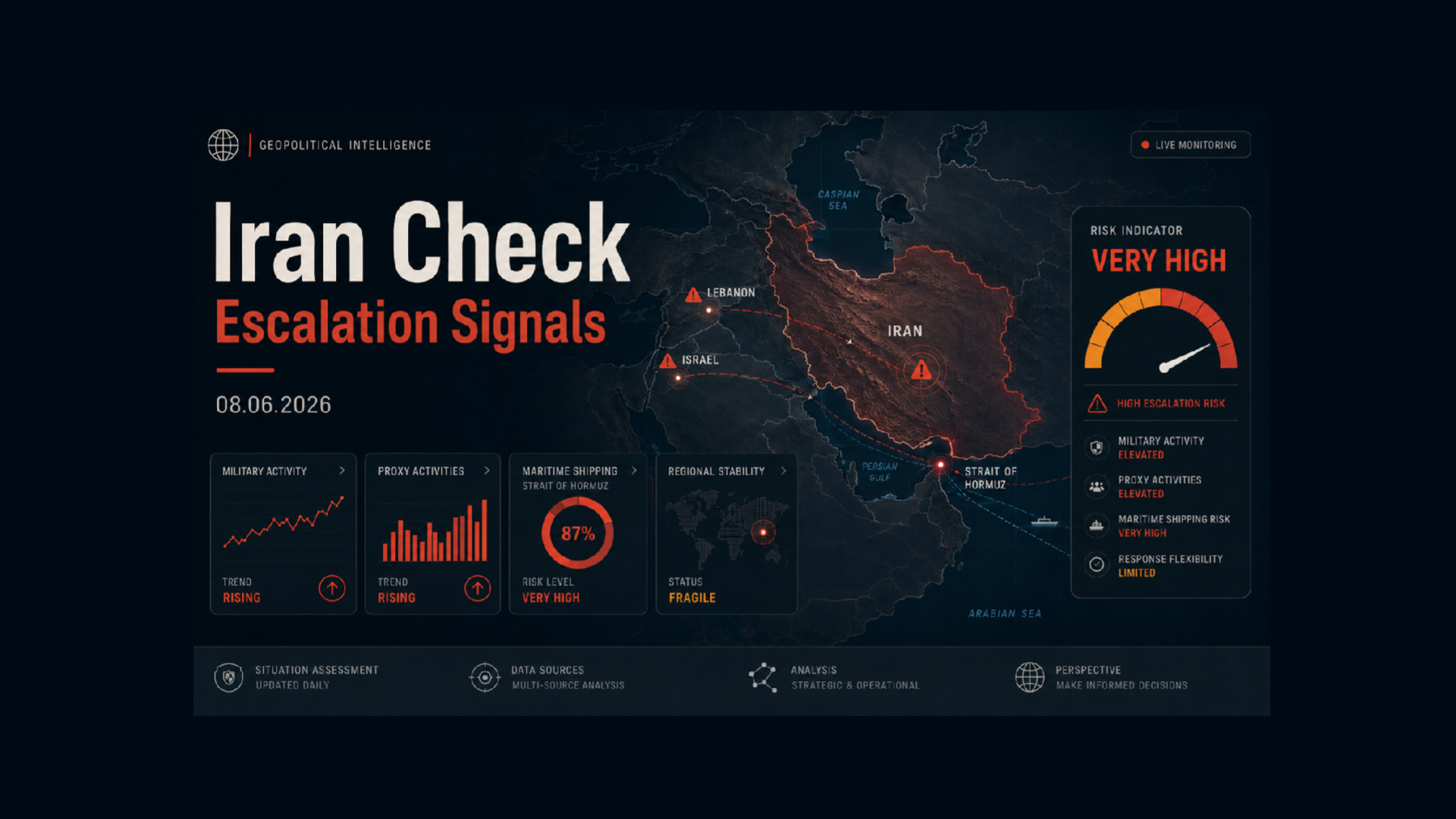
This escalation radar summarizes five relevant signals as of July 22, 2026. The focus is on verifiable statements by official actors, confirmed events and monitoring sources with potential impact on energy prices, supply chains, markets, maritime security, aviation and regional stability.
The key change: on July 22, Hormuz is no longer the only operational bottleneck. Reuters reports that in the Red Sea, two tankers loaded with Saudi crude oil turned around after Houthi threats near Bab el-Mandeb. This shifts the risk from a Hormuz crisis to a dual pressure scenario for Gulf, Red Sea and Asia-Europe energy routes.
Araghchi confirms that Iran warned neighboring governments against supporting US operations. The core message: since Iranian missiles cannot reach America, US bases in the region would be hit. This keeps Gulf states, Iraq, Jordan and other US-aligned locations inside the direct escalation architecture.
Rubio says the United States remains willing to negotiate, while accusing Tehran of not being serious. At the same time, Trump again threatens strikes against Iranian nuclear facilities in Natanz. This creates a dangerous double message: the diplomatic door is open, but military escalation remains possible at any time.
| Actor | Type | Severity | Status | Source / verification status | Business impact |
|---|---|---|---|---|---|
| United States / Iran / Araghchi / Trump / Rubio / regional US bases | Retaliation logic against US bases, US negotiation offer and renewed Natanz threat | Critical · Level 5/5 | The political US-Iran situation remains highly dangerous on July 22, 2026 because diplomacy and escalation threats are running at the same time. Reuters reports that US Secretary of State Marco Rubio continues to signal willingness to negotiate, while accusing Iran of lacking seriousness. At the same time, according to Reuters, Trump confirmed that 18 US soldiers had been killed in the war so far, including four in Iranian attacks on US military bases in Jordan and Iraq. Trump also again threatened to strike Iranian nuclear facilities in Natanz “pretty soon”. In parallel, The Guardian reports that Iranian Foreign Minister Abbas Araghchi said Iran had warned neighboring governments: if attacks were supported, regional targets would be hit because Iranian missiles cannot reach America. The power dynamic: Washington keeps the negotiation door rhetorically open, but keeps the nuclear escalation threat active. Tehran makes clear that US-aligned states and bases are not safe rear areas. The Gulf region therefore remains not only a transit and energy space, but part of a direct deterrence and retaliation architecture. | Confirmed by Reuters, 22.07.2026 and The Guardian, 22.07.2026. Verification status: confirmed for Rubio’s negotiation offer, Trump’s Natanz threat, the reported US fatalities and Araghchi’s retaliation logic toward regional US bases; it remains open whether this will lead to another near-term strike on nuclear facilities or new Iranian attacks on US bases. | Critical business impact on Gulf exposure, Iraq and Jordan exposure, energy prices, insurance, security costs, military risk premiums, expat safety, site continuity, banking and payment risks, crisis logistics and companies with offices, suppliers or customers in US-aligned Gulf states. |
| Hormuz / Bab el-Mandeb / Houthi / Saudi oil / shipowners | Dual pressure on Hormuz and the Red Sea from declining transits and Houthi threats | Critical · Level 5/5 | The operational situation for energy and shipping routes is deteriorating significantly on July 22. Reuters reports that vessel crossings through Hormuz continued to fall while security concerns over ongoing US-Iran attacks persisted. At the same time, two tankers carrying Saudi crude oil for Asia turned around in the Red Sea after the Iran-aligned Houthis threatened a blockade of Saudi oil transport through Bab el-Mandeb. This creates a new quality of supply-chain pressure: companies no longer need to assess only Hormuz, but Hormuz, Bab el-Mandeb, the Red Sea, rerouting and insurability at the same time. The power dynamic: Iran and aligned actors can geographically expand cost pressure on US-aligned states and energy exports. The United States and its partners therefore have to stabilize not only one chokepoint, but several connected energy and trade arteries. | Confirmed by Reuters, 22.07.2026. Verification status: confirmed for further declining Hormuz transits, the reversal of two Saudi oil tankers in the Red Sea and Houthi threats against Bab el-Mandeb transits; it remains open whether the threat will turn into a sustained blockade or attack campaign. | Critical business impact on oil and LNG transport, tanker routing, container traffic, war-risk premiums, insurability, charter costs, spot rates, delivery times, port planning, energy procurement, hedging, raw material prices, Asia-Europe routes, Red Sea exposure and companies with Gulf, energy, chemicals, fertilizer, air freight or heavy industry exposure. |
| Kuwait / Iran / civilian infrastructure / water and energy supply | Fourth day of reported attacks on power and desalination plants | High to critical · Level 4/5 | The escalation remains directly relevant to civilian supply systems in the Gulf region on July 22. Iran International reports, citing Kuwait’s Electricity, Water and Renewable Energy Ministry, that Iranian attacks hit power generation and water desalination plants in Kuwait for the fourth consecutive day. According to the report, several facilities were hit, fires were triggered and units were taken offline as a precaution to protect power and water systems. This is especially relevant because desalination plants in the Gulf region do not only secure civilian water supply, but also indirectly support industry, cooling, ports, hospitals, energy production, food supply and site continuity. This means the situation is not only military or maritime: water, energy, cooling, operational continuity, ports, industry and supply security are becoming part of the escalation logic. The power dynamic: Iran, or Iran-aligned pressure logic, is hitting US-aligned Gulf states where their modern infrastructure is particularly vulnerable. For the United States and Gulf states, this creates a protection problem far beyond military bases. | Confirmed by Iran International, 21./22.07.2026. Verification status: partially confirmed; Iran International reports, citing Kuwait’s Electricity, Water and Renewable Energy Ministry, that several power generation and water desalination plants in Kuwait were hit for the fourth consecutive day. The report confirms fires, emergency measures and units taken offline as a precaution to protect power and water systems; the exact damage level, target selection and independent technical verification require further daily review. | High to critical business impact on water and energy supply, port operations, cooling, production, site continuity, evacuation, spare-parts chains, crisis logistics, insurance, security services and companies with personnel, facilities, data centers, project sites or supply chains in the Gulf region. |
| Lebanon / Israel / Hezbollah / United States | Lebanon’s prime minister demands Israeli withdrawal, pilot zones remain politically fragile | High to critical · Level 4/5 | The Lebanon situation shows a clear political signal on July 22, but still no robust stabilization. AP reports that Lebanon’s prime minister visited a destroyed southern Lebanese town and demanded an Israeli military withdrawal. The US-brokered Lebanese-Israeli agreement appears formally to be entering an implementation phase. At the same time, the core political conflict remains unresolved: Lebanon’s leadership criticizes Hezbollah for dragging the country into another war, but also condemns Israel’s massive bombardments and ground offensive. According to AP, Trump pledged support for Lebanon during a meeting with President Aoun, without providing details on pilot-zone implementation. The power dynamic: Lebanon is trying to make state sovereignty and Israeli withdrawal visible, without yet being able to control Hezbollah’s armed power. Israel remains focused on security and border control, while the United States moderates political implementation. Lebanon therefore remains a de-escalation project with a very high relapse risk. | Confirmed by AP News, 22.07.2026. Verification status: confirmed for the Lebanese prime minister’s visit to the south, the demand for Israeli withdrawal, criticism of Hezbollah and the continuing criticism of Israel; it remains open how durable pilot-zone implementation will actually become. | High relevance for Lebanon and northern Israel exposure, security planning, evacuation, insurance, humanitarian logistics, regional supply chains, border risks, political risk premiums and companies with personnel, partners or projects in the Levant. |
| EASA / Iran / Iraq / Lebanon / Persian Gulf / Gulf of Oman | Active aviation warnings amid missile, drone, air-defense, GNSS and misidentification risk | Critical · Level 5/5 | The aviation situation remains critical on July 22 and is further burdened by continued US-Iran escalation. EASA lists active Conflict Zone Advisories and Information Notes for Iran, Iraq, Lebanon, the Persian Gulf and the Gulf of Oman. Particularly relevant remains the active EASA CZIB for the Persian Gulf and the Gulf of Oman, which is active according to the EASA list until July 29, 2026. In addition, Iran, Iraq and Lebanon remain listed as separate high-risk airspaces or covered by active CZIBs and Information Notes. The current escalation confirms this risk picture: US strikes, Iranian counterattacks, air-defense activity, military movements around Hormuz, attacks on maritime and infrastructure targets, Houthi threats in the Red Sea and possible GNSS/navigation disruptions increase risks for flight routes, air freight and business travel. The operational takeaway: aviation and air freight risk must not be inferred from oil price or shipping signals alone. | Confirmed by EASA CZIB-2026-07 Persian Gulf and Gulf of Oman, accessed 22.07.2026 and EASA Conflict Zones Advisories, accessed 22.07.2026. Verification status: confirmed for active EASA warning logic and continued risk assessment for Iran, Iraq, Lebanon, the Persian Gulf and the Gulf of Oman; specific airline route decisions remain dependent on operators, states, insurers and daily risk assessments. | Critical business impact on air freight, airlines, rerouting, spare-parts supply chains, business travel, crisis logistics, airport risk, just-in-time supply chains, insurance, personnel movement and companies with Middle East, Gulf, Red Sea or Asia-Europe air-corridor exposure. |
The central escalation node on July 22, 2026 lies in the expansion of the crisis from Hormuz into a dual-chokepoint risk. Compared with July 20, the situation has shifted again: Hormuz transits continue to fall, Houthi threats are forcing Saudi oil tankers in the Red Sea to turn around, and the United States signals willingness to negotiate while at the same time again threatening strikes on Natanz.
Operationally, the situation is now even more complex for companies because no single chokepoint is sufficient to monitor anymore. Hormuz remains critical, Bab el-Mandeb and the Red Sea are emerging as an additional energy corridor under pressure, and Kuwait continues to report attacks on power and desalination plants. The decisive issue is no longer only what oil costs, but whether several maritime corridors, water and energy supply, insurance, passage and personnel movements remain reliably planable at the same time.
Politically, the situation remains especially dangerous because negotiation offers and escalation threats are running side by side. Rubio says the United States remains willing to negotiate. Trump simultaneously threatens renewed strikes on Natanz. Araghchi confirms that Iran sees regional US bases as retaliation targets. In Lebanon, the prime minister demands Israeli withdrawal, while Hezbollah’s role, pilot zones and state control remain unresolved.
The five most important signals for a European business risk picture are: the expansion from Hormuz into an additional Bab el-Mandeb / Red Sea risk, further declining Hormuz transits, Rubio’s negotiation offer alongside Trump’s threat against Natanz, Araghchi’s confirmed retaliation logic against regional US bases, and Kuwait’s reported attacks on power and desalination plants while EASA warnings remain active for Iran, Iraq, Lebanon, the Persian Gulf, the Gulf of Oman and adjacent air corridors.
Note: This assessment was created with support from our Geo AI. AI can make mistakes. This document serves as a radar for potential escalation signals and does not replace a fully verified final intelligence assessment.
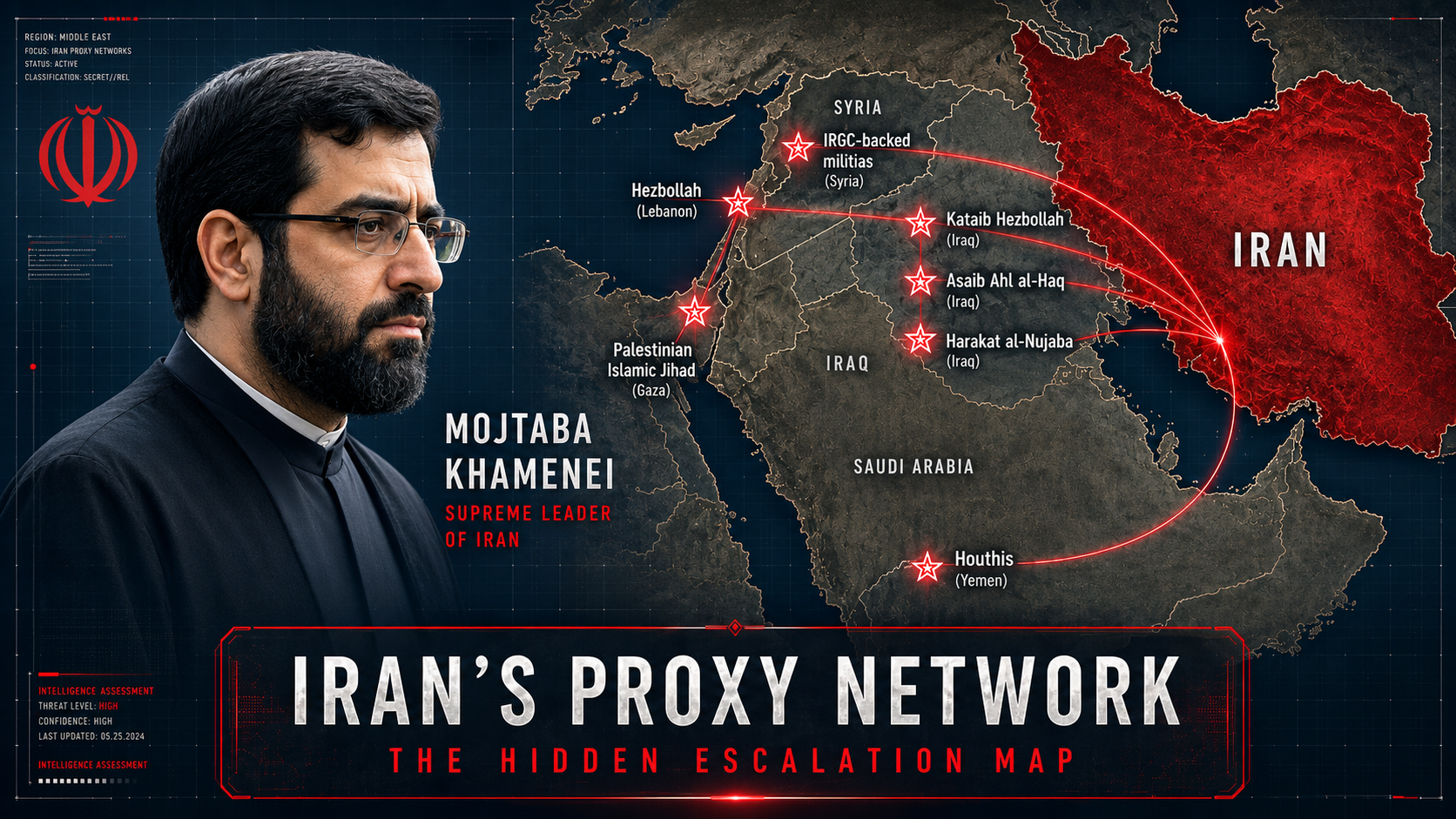
What decision-makers should watch now — before proxy escalation becomes a cost, compliance or supply-chain shock.
This 17-page executive briefing translates Iran’s proxy network into concrete business risks: energy price exposure, maritime chokepoints, war-risk premiums, sanctions, shadow fleets, supply-chain disruption and early-warning indicators for board-level decisions.
You are currently viewing a placeholder content from X. To access the actual content, click the button below. Please note that doing so will share data with third-party providers.
More Information