Executive Intelligence. Industrial Risk. Geopolitics.
Strategic Sparring
for Decision-Makers
Risk intelligence across technology, law, markets and power dynamics.


Verdeckte Geschäftsrisiken, strategische Widersprüche und kritische Abhängigkeiten frühzeitig erkennen.
Kostenlose Analyse starten →
Verdeckte Machtstrukturen, Führungsrisiken und organisatorische Blockaden frühzeitig erkennen.
Kostenlose Analyse starten →
Geopolitische Risiken, globale Abhängigkeiten und kritische Lieferkettenrisiken frühzeitig erkennen.
Kostenlose Analyse starten →
Identify hidden business risks, strategic contradictions and critical dependencies at an early stage.
Start Free Analysis →
Identify hidden power structures, leadership risks and organizational blockers at an early stage.
Start Free Analysis →
Identify geopolitical risks, global dependencies and critical supply-chain vulnerabilities at an early stage.
Start Free Analysis →
Verdeckte Geschäftsrisiken, strategische Widersprüche und kritische Abhängigkeiten frühzeitig erkennen.
Kostenlose Analyse starten →
Verdeckte Machtstrukturen, Führungsrisiken und organisatorische Blockaden frühzeitig erkennen.
Kostenlose Analyse starten →
Geopolitische Risiken, globale Abhängigkeiten und kritische Lieferkettenrisiken frühzeitig erkennen.
Kostenlose Analyse starten →
Identify hidden business risks, strategic contradictions and critical dependencies at an early stage.
Start Free Analysis →
Identify hidden power structures, leadership risks and organizational blockers at an early stage.
Start Free Analysis →
Identify geopolitical risks, global dependencies and critical supply-chain vulnerabilities at an early stage.
Start Free Analysis →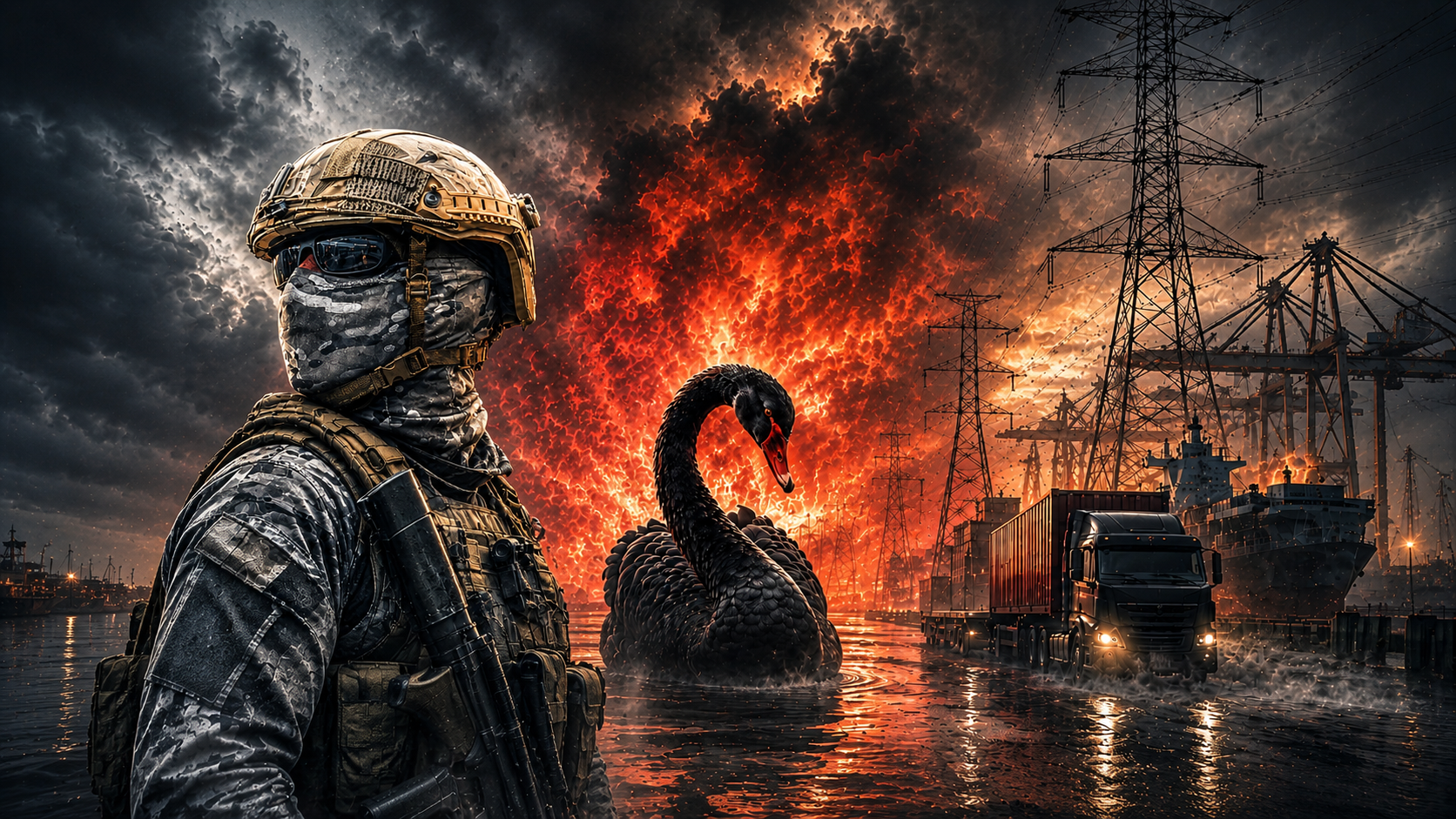
The developments outlined here represent only the visible surface of a deeper operational risk dynamic.
The 27-page Executive Briefing “Black Swan Risk Mapping for Europe’s Next Mobility and Infrastructure Shock” examines which developments, currently viewed in isolation, could reinforce one another—and what this could mean for the operational resilience of European companies.
Based on the GFDD Framework™, the report translates geopolitical, infrastructural and administrative shifts into concrete decision risks for CEOs, CFOs, COOs, investors and strategy teams.
The report includes a structured systemic-shock analysis and a directly applicable Business Exposure Checklist for assessing critical dependencies, operational access security and organisational resilience.
European companies generally assess risk in terms of prices, demand, delivery times and financing costs. However, several recent developments indicate that another question is becoming increasingly important: What happens when essential resources are no longer physically available in time—despite existing contracts and sufficient liquidity?
Fuel supplies, air freight, energy infrastructure and the mobility of key personnel are often treated as separate risk areas. For businesses, however, they all depend on the same fundamental operational requirement: operations can continue only as long as people, energy and goods can reach the locations where they are needed.
Disruptions in the Middle East have demonstrated the extent to which Europe’s aviation fuel supply depends on international transport routes. According to the International Energy Agency, European jet-fuel arrivals from the Middle East fell from approximately 330,000 barrels per day in March 2026 to around 60,000 barrels per day in April 2026. Europe has so far avoided a widespread shortage, but its supply buffers have remained exceptionally thin.
Jet fuel does not affect only holiday and business travel. Air freight transports high-value electronics, pharmaceuticals, machinery components and urgently required spare parts. When fuel becomes scarce or expensive, airlines may reduce capacity, adjust routes or pass additional costs on to customers.
For internationally operating companies, this creates a risk that is frequently underestimated in traditional procurement models: An order may be contractually secured and already paid for—and still fail to arrive at the production site on time.
The Andes hantavirus outbreak aboard a cruise ship led several countries to introduce extensive measures for contact persons in 2026. These included mandatory reporting, monitoring and, in some cases, quarantine periods of up to 42 days.
The specific outbreak has since been brought to an end. Nevertheless, it provides businesses with an important operational lesson: Key personnel can become unavailable for extended periods even when they show no symptoms of illness themselves.
This may affect international service technicians, pilots, project managers, commissioning teams and specialists who cannot be replaced at short notice. Companies should therefore consider not only conventional sick leave but also mobility and workplace-presence restrictions imposed by public authorities in their business continuity plans.
Europe is increasing its investment in military mobility. Roads, railways, ports, airports, energy supplies and fuel infrastructure are being prepared to support the rapid movement of personnel and equipment.
Many of these systems are also used by the civilian economy. This does not automatically mean that businesses will be displaced. During a severe security or supply crisis, however, the question may arise as to which transports and resources are processed and prioritised first.
For companies with time-critical supply chains, it is therefore becoming increasingly important to assess alternative routes, additional inventory buffers and their dependence on individual transport hubs.
Electricity and energy supplies are not merely questions of price. Low reserve buffers, volatile import flows and targeted attacks on infrastructure can intensify local disruptions.
The arson attack on high-voltage pylons near Garching demonstrated how heavily economic activity and public services depend on a limited number of physical grid nodes. At the same time, hybrid attacks against electricity networks, pipelines, data connections and maritime infrastructure are becoming increasingly significant from a security-policy perspective.
You can read more about this particular vulnerability in the article Blackout Bombs and EMP Weapons: How Power Grids Are Being Turned into Weapons.
Your company can remain solvent—and still become operationally incapacitated within a matter of days.
Not because of insufficient demand. Not because of poor management. And potentially not even because of the failure of an individual supplier.
The greater vulnerability arises where several conditions previously considered separately come under pressure at the same time: mobility, energy supplies, transport capacity, critical infrastructure and the availability of key personnel.
A black swan event does not therefore necessarily have to originate from a completely unknown trigger. It can also begin when visible warning signals are assessed in isolation and their combined operational impact is underestimated.
The decisive question is then no longer simply whether a company can pay. It is whether, at the critical moment, it still has access to the resources, people and transport routes required to keep its operations running.
During the next systemic shock, companies may not fail because of insufficient demand—but because they lose access to energy, mobility, personnel or transport capacity.
The briefing “Europe’s Next Systemic Shock – Black Swan Risk Mapping” is an exclusive Strategic Risk Intelligence Brief by Global Insight Group.
It is based on the GFDD Framework™ developed by Michaela Schaaf-Hoffelner.
The briefing is designed for executives, investors and strategic decision-makers who need to assess how geopolitical, regulatory and infrastructure-related risks may affect a company’s ability to remain operational.
It is particularly relevant for CEOs, COOs, CFOs, supply-chain leaders, risk and crisis managers, and investors with holdings in companies that depend heavily on energy, transport or complex supply chains.
The report does not require extensive prior knowledge of geopolitics. It has deliberately been structured to translate complex developments into concrete business risks, dependencies and decision-making questions.
A widespread jet-fuel shortage has so far been avoided. However, this does not mean that the risk has disappeared. The critical factors are the exceptionally thin supply buffers, the high level of import dependency and the limited flexibility available when important transport routes are disrupted at short notice.
Jet fuel must not only be available in principle; it must also be available at the right airport at the right time. Even when fuel can still be purchased on the international market, a shortage of tankers, disrupted shipping routes, limited refinery capacity or regional distribution problems may place individual airports and airlines under significant pressure.
For businesses, the actual risk therefore extends far beyond higher airfares. More critical consequences include potential flight cancellations, reduced freight capacity, altered routes, longer transport times and rising costs for time-sensitive deliveries. Companies that depend on air freight, international service technicians or rapidly available spare parts are particularly exposed.
Companies whose business models depend on continuously functioning mobility, energy and logistics infrastructure are particularly exposed. These include businesses with just-in-time production systems, a high dependence on air freight, frequent international technician deployments, critical spare-part requirements or energy-intensive processes.
Risk is also elevated when a small number of key individuals cannot be replaced at short notice. When service technicians, project managers, pilots, specialists or commissioning teams are prevented from travelling by restrictions, quarantine requirements or cancelled connections, a company may become operationally incapacitated despite having full order books.
Companies with highly concentrated supply chains are also vulnerable. A business that depends on a single airport, port, energy provider or logistics corridor often possesses less resilience than initially assumed. The decisive factor is not only the company’s own vulnerability but also the situation affecting suppliers, freight forwarders, infrastructure operators and critical service providers.
Higher inventory levels are an important part of contingency planning, but they do not solve every problem. They can cushion short-term supply interruptions, but they do not automatically provide protection against energy shortages, insufficient transport capacity, restricted mobility or the unavailability of key personnel.
Companies should therefore not only ask how many days or weeks their inventories will last. It is equally important to determine whether alternative supply routes exist, which components are genuinely critical and how quickly alternative suppliers can be activated. A warehouse full of standard components offers little protection when one specialised part is missing and the entire production process depends on it.
Effective safeguards should therefore also include alternative transport routes, contractually secured backup suppliers, contingency plans for international deployments, defined minimum inventory levels and an assessment of the company’s dependence on critical infrastructure.
Yes. The risk is especially significant when individual employees or small specialist teams are indispensable to operations. Government measures may prevent employees from travelling, working on-site or entering certain regions for several weeks – even when the employees themselves are not ill.
For a company, this may mean that machinery cannot be commissioned, facilities cannot be maintained or international projects cannot be completed. The risk is particularly critical for activities that cannot be transferred to digital channels or performed by local personnel at short notice.
Business continuity plans should therefore account for more than conventional employee sick leave. They should also cover extended absences imposed by public authorities, travel restrictions and the loss of international deployment capability.
The first step is an honest assessment of the company’s critical dependencies. Businesses should identify which people, resources, transport routes and suppliers are indispensable to maintaining operations.
They should then assess how long operations can continue without external supplies, which alternatives are genuinely available and which contracts provide sufficient protection. Particular attention should be paid to force majeure clauses, alternative supply routes, backup personnel, emergency power and energy concepts, and clearly defined escalation and communication processes.
The decisive factor is to avoid assessing individual risks in isolation. A company may be able to manage a brief power outage, a delayed delivery or the absence of one employee. The situation becomes critical when several of these factors occur simultaneously and reinforce one another.
Author of Global Insight Group Intelligence:
Michaela Schaaf-Hoffelner has more than 35 years of experience in strategic and technical project and product management, particularly in IT, control systems and intralogistics. Through her long-standing work with complex systems, she identifies structural risks and dynamic misalignments at an early stage – risks that are often overlooked in conventional analysis.
Her focus is on making causal relationships and systemic dependencies visible and translating them into concrete strategic advantages for investors and decision-makers. Her analyses combine deep technical systems understanding with geopolitical and economic developments.
GFDD Framework™ and GFDD Diagnostics™ are proprietary analytical concepts developed by Michaela Schaaf-Hoffelner. © 2026 Global Insight Group LLC. All rights reserved.
You are currently viewing a placeholder content from X. To access the actual content, click the button below. Please note that doing so will share data with third-party providers.
More Information