Executive Intelligence. Industrial Risk. Geopolitics.
Strategic Sparring
for Decision-Makers
Risk intelligence across technology, law, markets and power dynamics.


Verdeckte Geschäftsrisiken, strategische Widersprüche und kritische Abhängigkeiten frühzeitig erkennen.
Kostenlose Analyse starten →
Verdeckte Machtstrukturen, Führungsrisiken und organisatorische Blockaden frühzeitig erkennen.
Kostenlose Analyse starten →
Geopolitische Risiken, globale Abhängigkeiten und kritische Lieferkettenrisiken frühzeitig erkennen.
Kostenlose Analyse starten →
Identify hidden business risks, strategic contradictions and critical dependencies at an early stage.
Start Free Analysis →
Identify hidden power structures, leadership risks and organizational blockers at an early stage.
Start Free Analysis →
Identify geopolitical risks, global dependencies and critical supply-chain vulnerabilities at an early stage.
Start Free Analysis →
Verdeckte Geschäftsrisiken, strategische Widersprüche und kritische Abhängigkeiten frühzeitig erkennen.
Kostenlose Analyse starten →
Verdeckte Machtstrukturen, Führungsrisiken und organisatorische Blockaden frühzeitig erkennen.
Kostenlose Analyse starten →
Geopolitische Risiken, globale Abhängigkeiten und kritische Lieferkettenrisiken frühzeitig erkennen.
Kostenlose Analyse starten →
Identify hidden business risks, strategic contradictions and critical dependencies at an early stage.
Start Free Analysis →
Identify hidden power structures, leadership risks and organizational blockers at an early stage.
Start Free Analysis →
Identify geopolitical risks, global dependencies and critical supply-chain vulnerabilities at an early stage.
Start Free Analysis →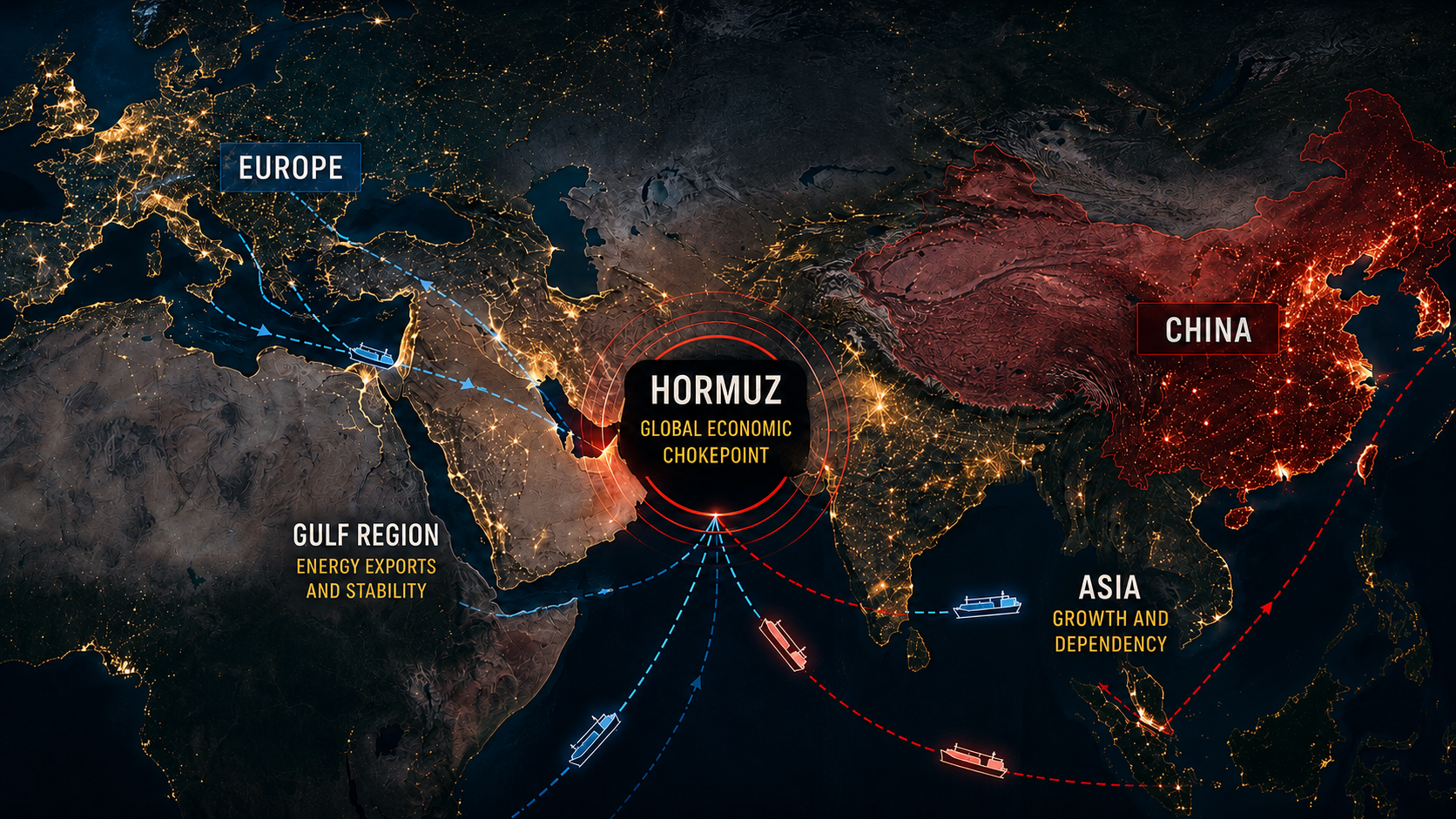
This Chokepoint Check assesses the current pressure on the Strait of Hormuz, the Bab al-Mandab, and critical water, power, port, and energy infrastructure across the Gulf region. The focus is not only on whether a shipping route remains geographically open, but also on whether transport, supply, insurance coverage, and site operations remain operationally viable.
Individual large tankers are passing through the strait, but no reliable operational normalisation has emerged.
On July 31, two VLCCs carrying approximately two million barrels of crude oil each exited the Strait of Hormuz. However, only four outbound commodity vessels had been recorded in total by the reporting cut-off; on the previous day, just three transits were recorded. Iranian media also reported that the Revolutionary Guards had stopped two tankers and forced four others to change course. This operational account had not initially been fully and independently verified.
Transit remains higher than in Hormuz, but is increasingly shaped by military coalitions and political clearances.
On July 30, 29 commodity vessels passed through the Bab al-Mandab, including two VLCCs, two Suezmax tankers, and six Aframax tankers. Saudi Arabia simultaneously announced a new multinational maritime defence coalition. Representatives from 43 states and the European Union participated in the consultations; 14 states, including Turkey, Pakistan, Egypt, Sudan, and Djibouti, formally backed the initiative.
The attack in Damietta has brought Egypt’s gas and Suez infrastructure into the escalation zone.
Egypt confirmed that a drone had caused the fires aboard the gas vessels Energos Winter and Gaslog Salem at the Mediterranean port of Damietta. One tank aboard the Energos Winter was reportedly damaged, and both vessels could remain out of service for an extended period. The Energos Winter has regasification capacity of approximately 450 million cubic feet per day, equivalent to around seven percent of Egypt’s gas consumption and 16 percent of national LNG regasification capacity.
On July 30, the Egyptian government confirmed that a drone had caused the fire aboard the US-owned floating storage and regasification unit Energos Winter. The fire spread to the Gaslog Salem. No injuries or fatalities were reported. One tank aboard the Energos Winter was reportedly damaged.
The attack opens a new maritime and energy-related escalation layer near the Suez Canal. This is particularly relevant because Egypt and the SUMED/Suez route are increasingly serving as an alternative system for oil and gas flows affected by blocked or unsafe Gulf chokepoints. No responsible conflict party has yet been confirmed.
An extended outage would reduce Egypt’s available LNG regasification buffer during peak summer demand. LNG traders, industrial operators, and energy buyers may face lower system resilience, greater use of replacement fuels, and higher spot market and insurance risks.
Verification status: confirmed for the drone attack, the fires aboard two vessels, the absence of casualties, and the possibility of extended unavailability. The identity of the attacker remains unclear. Reuters, July 30, 2026 · substantive government confirmation with continued operational relevance on July 31
The VLCCs Spain B and Noble exited the Strait of Hormuz on July 31. Each vessel is carrying approximately two million barrels of crude oil. They were among a total of four recorded commodity vessels that departed on Friday. Iranian media also reported that two tankers had been stopped by the Revolutionary Guards and that four others had changed course.
The two successful VLCC passages are a limited operational relief signal, but not a normalisation. Total visible traffic remains exceptionally low and predominantly outbound. Reported vessel stoppages and course changes indicate that Iran may still exercise effective access control.
Individual cargoes are again reaching the global market, but charterers and energy buyers cannot derive reliable export plans from these isolated movements. Waiting times, route changes, clearance risks, and the immobilisation of large tankers remain major cost and supply drivers.
Verification status: confirmed for the two VLCC passages, cargo volumes, and visible Kpler transit data. Iranian reports regarding stopped or redirected tankers were initially only partially confirmed. Reuters, July 31, 2026
Two regional officials stated that recent attacks on Saudi Arabia had been carried out jointly by Houthi forces and Iraqi armed groups operating from Iraqi territory. The operations were reportedly conducted under the supervision of Iran’s Revolutionary Guards. Targets included oil facilities in Saudi Arabia’s Eastern Province.
This represents a qualitative development in the so-called Axis of Resistance: the groups are no longer operating merely in parallel under Iranian support, but are increasingly training and conducting operations together. Iraq is therefore becoming a launch area for attacks on Gulf states and their critical infrastructure.
Risks to energy facilities, pipelines, airports, and project sites are expanding across the Iraq-Saudi border region. Companies must prepare for counterstrikes, airspace disruption, border restrictions, and declining state control over regional security conditions.
Verification status: partially confirmed. Saudi Arabia attributes the attacks to Iran-aligned Iraqi groups; two regional officials describe a joint operation with the Houthis under Iranian supervision. Iraq is investigating the allegations. Reuters, July 30, 2026 · immediately relevant previous-day operational development
Saudi Arabia announced a multinational maritime defence coalition to protect the Bab al-Mandab, the Gulf of Aden, and international trade and energy routes. Representatives from 43 states and the European Union attended the meeting. Fourteen states formally backed the initiative.
The announcement shows that Saudi Arabia no longer views the Red Sea risk as a limited Houthi problem, but as an international security challenge. Political cohesion remains limited, however: Oman and the United Arab Emirates were not among the states officially listed as supporters.
An effective coalition could improve escort capacity, intelligence coverage, and response capabilities. In the short term, however, its creation increases military density, introduces differing rules of engagement, and may lead to new reporting, control, and routing requirements for commercial vessels.
Verification status: confirmed for the announcement, participant numbers, planned Saudi leadership, and the 14 states formally supporting the initiative. Rules of engagement, force levels, and the operational start date remain open. Reuters, July 30, 2026 · previous-day decision with immediate impact on July 31
Italy’s defence minister confirmed on July 31 the deployment of approximately 400 air force personnel to Saudi Arabia, Kuwait, and Bahrain. The mission includes Eurofighter aircraft for airspace defence, radar systems, and a counter-drone system.
An EU and NATO state is therefore not only politically, but operationally involved in regional air defence. The mission strengthens the defensive capacity of the Gulf states, but also increases the risk that European forces and infrastructure may become Iranian targets or objects of deterrence.
Improved air defence can help protect airports, facilities, and operating sites. At the same time, the likelihood of military alert states, short-notice airspace controls, and additional security requirements for personnel, air cargo, and critical facilities is increasing.
Verification status: confirmed for personnel levels, deployment locations, and the officially stated air-defence capabilities. Reports of an additional Italian-French SAMP/T system were not officially confirmed and have therefore not been presented as fact. Reuters, July 31, 2026
A drone hits gas vessels in Damietta; tankers are stopped or redirected in Hormuz.
Regasification, vessel planning, passage control, and maritime security come under pressure.
Gas vessels are taken out of service, Hormuz remains thinly trafficked, and military escort activity increases.
LNG reserves, tanker capacity, insurance risks, and energy prices remain under pressure.
Hormuz remains extremely thinly trafficked despite two VLCC passages. Two tankers were reportedly stopped and four others forced to change course. A new multinational maritime coalition is being prepared in the Red Sea.
Military Passage Control and International Counter-MobilisationA drone damaged two gas vessels at the port of Damietta. At the same time, cross-border attacks are targeting Saudi oil facilities and European states are increasing their air-defence presence in the Gulf.
Gas, Port, and Energy Infrastructure Affected Across Multiple StatesIn addition to Hormuz and the Bab al-Mandab, the Suez and Damietta redundancy route is now also under military pressure. Iran-aligned groups are coordinating across borders, while third countries are deploying additional naval and air-defence capabilities.
Triple Route Exposure and External Military Integration ConfirmedEscalation signals clearly outweigh de-escalation indicators. Compared with July 29, the decisive change is not only the situation in Hormuz, but the extension of the crisis to Egypt’s gas and Suez infrastructure. The primary corridor, the southern alternative route, and the northern redundancy route are therefore all under military pressure at the same time. In parallel, Iran-aligned militias are networking across Yemen and Iraq, while Saudi Arabia and European states are building new maritime and air-based defence structures. Individual successful transits do not reduce the overall risk: the operational environment remains critical and is increasingly shaped by international military presence.
Notice: This assessment was prepared with the support of our Geo AI. AI systems can make mistakes. This analysis serves as a source-based radar for potential escalation signals and does not replace comprehensively verified intelligence, security, insurance, or investment advice. In a dynamic environment, the status, source situation, and risk assessment may change at short notice.
Independent of the subject covered in this article, this separate Executive Briefing provides an in-depth analysis of another critical risk domain affecting European companies.
The 27-page Executive Briefing “Black Swan Risk Mapping for Europe’s Next Mobility and Infrastructure Shock” examines how geopolitical, infrastructural and administrative developments that are currently viewed in isolation could reinforce one another.
Based on the GFDD Framework™, the report shows how these dynamics could affect operational continuity, access to critical resources and the strategic resilience of companies.
The briefing includes a structured systemic-shock analysis and a directly applicable Business Exposure Checklist for CEOs, CFOs, COOs, investors and strategy teams.
You are currently viewing a placeholder content from X. To access the actual content, click the button below. Please note that doing so will share data with third-party providers.
More Information