Executive Intelligence. Industrial Risk. Geopolitics.
Strategic Sparring
for Decision-Makers
Risk intelligence across technology, law, markets and power dynamics.


Verdeckte Geschäftsrisiken, strategische Widersprüche und kritische Abhängigkeiten frühzeitig erkennen.
Kostenlose Analyse starten →
Verdeckte Machtstrukturen, Führungsrisiken und organisatorische Blockaden frühzeitig erkennen.
Kostenlose Analyse starten →
Geopolitische Risiken, globale Abhängigkeiten und kritische Lieferkettenrisiken frühzeitig erkennen.
Kostenlose Analyse starten →
Identify hidden business risks, strategic contradictions and critical dependencies at an early stage.
Start Free Analysis →
Identify hidden power structures, leadership risks and organizational blockers at an early stage.
Start Free Analysis →
Identify geopolitical risks, global dependencies and critical supply-chain vulnerabilities at an early stage.
Start Free Analysis →
Verdeckte Geschäftsrisiken, strategische Widersprüche und kritische Abhängigkeiten frühzeitig erkennen.
Kostenlose Analyse starten →
Verdeckte Machtstrukturen, Führungsrisiken und organisatorische Blockaden frühzeitig erkennen.
Kostenlose Analyse starten →
Geopolitische Risiken, globale Abhängigkeiten und kritische Lieferkettenrisiken frühzeitig erkennen.
Kostenlose Analyse starten →
Identify hidden business risks, strategic contradictions and critical dependencies at an early stage.
Start Free Analysis →
Identify hidden power structures, leadership risks and organizational blockers at an early stage.
Start Free Analysis →
Identify geopolitical risks, global dependencies and critical supply-chain vulnerabilities at an early stage.
Start Free Analysis →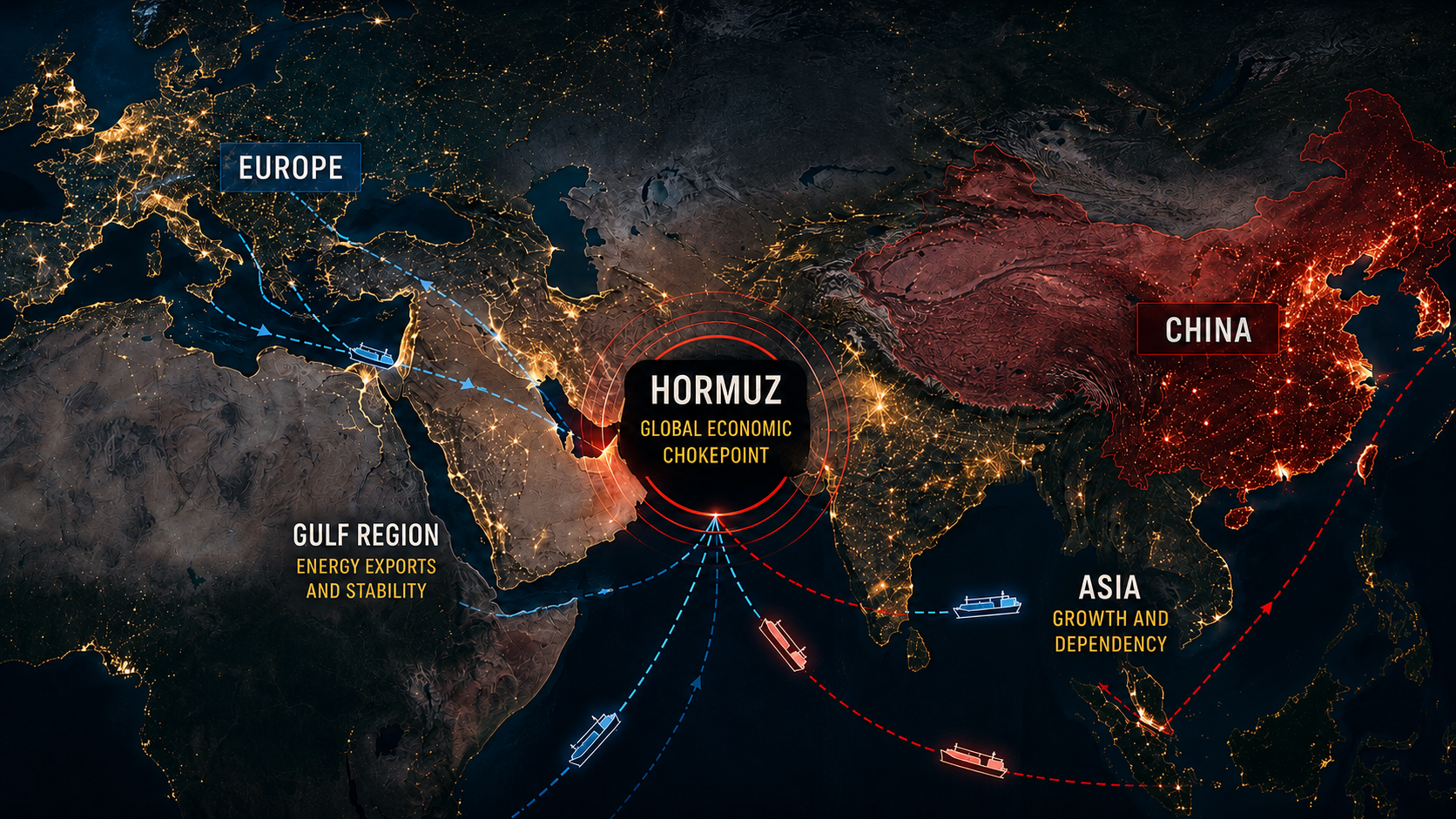
This Chokepoint Check assesses current pressure on the Strait of Hormuz, Bab al-Mandab and the Gulf region’s critical water, power, port and energy infrastructure. The analysis focuses not only on whether a shipping route remains geographically open, but also on whether transport, supply, insurance coverage and site operations remain operationally viable.
A new strike on a commercial vessel undermines expectations of an imminent operational normalisation.
On August 4, a cargo vessel reported being struck by an unknown projectile approximately 37 kilometres northeast of Al-Khasab in Oman. The United Kingdom Maritime Trade Operations agency, UKMTO, recorded the incident. In parallel, the number of visible commodity-vessel transits through Hormuz on Monday fell to six, comprising three tankers and three bulk carriers. All recorded vessels used the Iranian route. Seven transits had been recorded on the previous day.
The southern gateway to the Red Sea remains passable, but neither normalised nor reliably predictable.
On Monday, 20 commodity vessels passed through Bab al-Mandab, including 12 tankers and eight bulk carriers. Twelve vessels exited the Red Sea, while eight entered it. Traffic therefore remains significantly higher than in Hormuz, but below the levels recorded on previous days. Shipping companies continue to respond cautiously to the Houthi threat. Individual Saudi large tankers altered their routes or passed through high-risk areas with their AIS transponders switched off.
No sufficiently confirmed new physical attack on Gulf infrastructure was identified for August 4, but the operational targeting risk remains.
Iran continues to pursue a pressure strategy that encompasses not only US military targets, but also trade routes and the energy infrastructure of regional partner states. The new vessel strike in Hormuz demonstrates that civilian transport capacity can still be directly affected. At the same time, no confirmed political agreement exists that would reliably exclude attacks against refineries, export terminals, LNG facilities, ports, power plants or desalination facilities.
On August 4, a cargo vessel reported being struck by an unknown projectile approximately 37 kilometres northeast of Al-Khasab in Oman. The United Kingdom Maritime Trade Operations agency, UKMTO, recorded the incident. At the reporting cut-off, it had not been conclusively established which conflict party was responsible for the strike.
The incident is the strongest operational signal of the day. It demonstrates that the announced political easing has not yet created a secure shipping corridor. Even without a full closure, the continuing risk of projectile attacks is sufficient to deter shipping companies, insurers and crews from transiting the strait.
Operators must prepare for renewed route cancellations, security reviews, higher war-risk premiums and reduced vessel and crew availability. Even undamaged vessels may be tied up operationally by delays, inspections and new clearance procedures.
Verification Status: confirmed regarding the report of a vessel strike and the location provided by UKMTO. The type and origin of the projectile, as well as the responsible conflict party, remain unclear. Associated Press, August 4, 2026
Trump stated that talks with Iran were under way and described the situation as Tehran’s final opportunity to agree to a deal. Iran’s Foreign Ministry explicitly contradicted this account on August 4. It stated that neither ongoing nor planned talks with Washington existed. Iran said it was holding discussions only with Oman regarding safe shipping routes through Hormuz.
The public denial weakens the basis of the US pause in attacks. It remains unclear whether indirect contacts are taking place through mediators or whether Washington is already presenting political preparations as negotiations. The conflicting statements increase the risk of miscalculation and an abrupt return to US military action.
Companies cannot base decisions on the expectation of a rapid agreement. Charter contracts, energy procurement, flight planning and personnel rotations should continue to account for a scenario involving renewed US strikes and Iranian retaliation.
Verification Status: confirmed regarding the contradictory public statements issued by the United States and Iran. It remains unclear whether confidential contacts exist through Oman, Qatar or other mediators. Reuters, August 4, 2026
According to Kpler data, only six visible commodity vessels passed through the Strait of Hormuz on Monday. These comprised three tankers and three bulk carriers. Seven transits had been recorded on Sunday. All registered vessels used the Iranian route through the strait.
The figures do not indicate a reopening, but a further contraction in visible traffic. Concentration along the Iranian route increases Tehran’s de facto monitoring and control capabilities. Vessels operating with disabled transponders may increase the absolute number, but do not change the lack of transparency and predictability.
Export volumes cannot be reliably inferred from political reopening announcements. Charterers, traders and industrial buyers must prepare for limited transport capacity, irregular loading windows, higher security costs and extended procurement lead times.
Verification Status: confirmed regarding the visible Kpler transit data. Vessels with disabled AIS may not be reflected in the figures, which therefore do not constitute a complete record of all actual transits. Reuters, August 4, 2026
Two tankers carrying Saudi crude oil exited the Red Sea over the weekend. The Suezmax tanker Lesvos carried approximately one million barrels, while the VLCC Desh Vaibhav carried around two million barrels. Both vessels passed through high-risk sections with their AIS transponders temporarily switched off. A tanker carrying Russian naphtha instead rerouted around the Cape of Good Hope.
The transits demonstrate that Bab al-Mandab is not fully closed. However, disabled transponders and the rerouting of other tankers show that the route is not operating normally. The Russian naphtha shipment also links Red Sea risk with the energy and sanctions flows associated with the Russia-Ukraine conflict.
Shipping companies must choose between higher attack risk on the direct route and longer, more expensive voyages around Africa. This increases journey times, bunker costs, fleet utilisation and insurance expenditure. Safe passage by individual tankers does not create reliable export planning.
Verification Status: confirmed regarding cargoes, vessel movements and the rerouting of the tanker carrying Russian naphtha. The specific security reasons behind individual AIS deactivations cannot be established fully and independently. Reuters, published August 3, 2026 and immediately operationally relevant on August 4
Current regional assessments describe Iran’s approach as a graduated pressure campaign. Tehran is using restricted shipping through Hormuz, Houthi threats in the Red Sea and the exposure of Saudi and other regional energy assets to increase the cost of the conflict for the United States and its partners.
Iran does not need to impose a complete closure of a chokepoint to achieve strategic impact. Repeated isolated attacks, insecure passage conditions and low transit volumes are sufficient to generate economic pressure. Tehran is therefore seeking to enter future negotiations not from a position of military weakness, but as an indispensable security actor in Hormuz.
Companies are affected not only by individual attacks, but by persistently elevated uncertainty. Investment decisions, transport contracts and insurance conditions must account for the possibility that maritime stability itself becomes subject to political negotiation and may be withdrawn at any time.
Verification Status: confirmed regarding the underlying operational pressure elements. The interpretation of these elements as a coordinated negotiating strategy is an analytical assessment based on current Iranian actions, threats and chokepoint operations. Reuters, August 3, 2026 · current strategic assessment with immediate relevance on August 4
A cargo vessel is struck in Hormuz, while Houthi threats and maritime uncertainty persist at Bab al-Mandab.
Vessels use controllable routes, deactivate AIS or reroute entirely around Africa.
Hormuz records only six visible transits, while tankers and crews remain tied up for longer periods.
Transport costs, delivery times, war-risk premiums and energy supply remain structurally strained despite falling market prices.
A commercial vessel was struck by an unknown projectile in Hormuz. Visible transit fell to six commodity vessels. In the Red Sea, tankers are operating with AIS disabled in some cases or rerouting around Africa.
Physical attack risk and economically unreliable passage confirmedNo sufficiently confirmed new physical attack on a Gulf refinery, pipeline, LNG facility, power plant or water installation was identified for August 4. However, Iran’s existing target designation of energy infrastructure has not been withdrawn and remains operationally relevant.
No new physical damage confirmed, but a continuing concrete targeting risk remainsHormuz and Bab al-Mandab remain constrained at the same time. Washington and Tehran are contradicting one another regarding the status of negotiations. Russian energy flows are being drawn into the chokepoint crisis through rerouting, while Oman, Qatar and Pakistan continue diplomatic mediation.
Simultaneous maritime disruption, diplomatic uncertainty and cross-theatre linkageEscalation signals once again clearly outweigh de-escalation signals. Compared with August 2, the situation has shifted from a fragile political pause in attacks back towards an operationally intensified chokepoint crisis. The decisive issue is not only the new vessel strike, but the combination of declining Hormuz transit, Iranian control over the route being used and the open contradiction between Washington and Tehran regarding alleged negotiations. Bab al-Mandab remains passable, but continues to be used under elevated risk conditions. The US pause in attacks is currently preventing a wider military escalation, but it does not provide reliable security for shipping, energy supply, insurance coverage or site operations.
Note: This assessment was produced with support from our Geo-AI. AI can make mistakes. The analysis is intended as a source-based radar for potential escalation signals and does not replace fully verified intelligence, security, insurance or investment advice. In rapidly evolving situations, status, source availability and risk assessments may change at short notice.
This Chokepoint Check assesses the current pressure on the Strait of Hormuz, Bab al-Mandab and the Gulf region’s critical water, power, port and energy infrastructure. The analysis focuses not only on whether a shipping route remains geographically open, but also on whether transport, supply, insurance coverage and site operations remain operationally viable.
The full reopening of the strait is now part of the possible peace framework, but has not yet been confirmed operationally.
US President Donald Trump stated that further US strikes would be suspended for the time being after regional mediators had presented key elements of a possible agreement. One central element is expected to be the full reopening of the Strait of Hormuz. Iran had not publicly and formally accepted the described framework by the reporting cut-off. At the same time, traffic through the strait remains well below normal levels due to Iranian intervention, military risk and restricted insurability.
The US-Iran pause in attacks does not automatically remove the Houthi threat in the Red Sea.
There has been no confirmed withdrawal of the announced Houthi blockade against Saudi Arabia and no reliable normalisation of shipping traffic through Bab al-Mandab. The current negotiating framework is focused primarily on the US-Iran confrontation and the Strait of Hormuz. Saudi Arabia’s planned multinational maritime defence coalition therefore remains relevant. As long as Houthi operations, military escort measures and elevated war-risk requirements remain in place, the route is geographically open but not operationally stable.
Iran is extending its deterrence threat to the energy infrastructure of states that support new US strikes.
Iran warned that, in the event of another US wave of attacks, it would target not only US military assets but also energy fields and critical facilities in supporting states. This places refineries, export terminals, pipelines, LNG facilities, power plants and desalination plants across the Gulf states directly within the military deterrence framework. The US pause in attacks reduces the immediate risk, but does not remove this target designation. Saudi Arabia’s intervention against a new major offensive was driven to a significant degree by concern over such retaliation.
On August 2, Trump stated that further US attacks on Iran would be suspended for the time being. According to Trump, regional states had developed the key elements of a possible agreement. These are expected to include the full reopening of the Strait of Hormuz, a return to negotiations and limits on Iran’s nuclear and missile capabilities.
The decision reduces the immediate risk of a new wave of attacks and subsequent Iranian retaliation. However, it does not represent a definitive end to hostilities. The US military option remains available and is now tied to the rapid conclusion of an agreement. Iran had not initially confirmed the framework publicly.
The short-term risk of new air strikes, regional airspace closures and retaliatory attacks is declining. However, companies cannot yet infer a normalisation of energy supply, shipping, insurance or personnel mobility. Crisis response and evacuation plans should remain active.
Verification Status: confirmed regarding Trump’s statement and the temporary suspension of the planned attacks. Partially confirmed regarding the content of the possible negotiating framework. No final agreement or Iranian acceptance has yet been established. Reuters, August 2, 2026
Iran stated that, in the event of new US attacks, it would also target the energy fields and critical infrastructure of states providing military support to Washington. The threat follows US preparations for a new wave of attacks and is therefore directed indirectly at Saudi Arabia, Kuwait, Bahrain, Qatar, Jordan and other regional US partners.
Tehran is attempting to make regional access to bases, airspace, intelligence and logistics more difficult for the United States. Gulf states are being warned that their support for Washington could produce not only military costs, but direct economic and societal consequences. The threat expands the escalation from military targets to civilian supply systems.
Export terminals, refineries, pipelines, LNG facilities, power plants, desalination plants and energy-dependent ports remain particularly exposed. Operators must prepare for higher security costs, business interruption, additional insurance requirements and possible restrictions affecting personnel and suppliers.
Verification Status: confirmed as an official Iranian threat. Specific targeting decisions or newly initiated attack operations have not been confirmed. The designation remains operationally relevant due to previous attacks against regional energy and military infrastructure. Associated Press, August 2, 2026
Saudi Crown Prince Mohammed bin Salman warned Trump about the consequences of a new comprehensive US attack operation. Saudi Arabia feared that Iran could respond by attacking energy assets and critical infrastructure across the Gulf region. Following the conversation, Trump temporarily suspended the planned wave of attacks.
Saudi Arabia is using its military, energy and economic influence to constrain the US escalation decision. Riyadh is not protecting Iran, but its own infrastructure, oil production and regional stability. The kingdom is also signalling to Washington that support is not unlimited when Saudi Arabia itself could become a principal target.
The intervention temporarily reduces the risk of major attacks on Gulf infrastructure. At the same time, it shows that US access to regional bases and logistical support depends on the risk assessment of host governments. Companies must therefore monitor political shifts among Gulf states as an operational location factor.
Verification Status: largely confirmed regarding Saudi security concerns, mediation and the subsequent suspension of US attacks. Details of US targeting plans remain partly based on information from government sources. Associated Press, August 2, 2026
The US mission in Saudi Arabia issued a new security alert on August 1. US citizens were advised to exercise heightened caution due to the tense regional situation. The mission warned of unpredictable escalation, possible flight cancellations, temporary airspace closures and further travel disruption.
The alert indicates that the US government continues to anticipate the possibility of a rapid deterioration despite the newly announced pause in attacks. Saudi Arabia remains particularly exposed due to its military facilities, energy infrastructure and support for regional defence operations.
International companies must prepare for short-notice changes affecting flight schedules, business travel, personnel rotations and access to critical sites. Aviation, energy, logistics, construction projects and maintenance services relying on international personnel are particularly exposed.
Verification Status: confirmed through the official security alert issued by the US mission. The alert describes an ongoing operational risk, not the confirmed implementation of a new airspace closure. U.S. Mission Saudi Arabia, August 1, 2026 · immediately operationally relevant on August 2
On August 1, the US Embassy in Amman advised US citizens to avoid travel to military bases and military facilities in Jordan. The embassy referred to Iranian attacks against US military locations and warned that Iran or Iran-aligned groups could target further US interests abroad.
Jordan is becoming more visible as a distinct arena of the US-Iran conflict. The country serves as a transit, logistics and deployment hub for Western forces and is situated between Israel, Iraq, Syria and Saudi Arabia. Attacks on military sites there expand the conflict beyond the traditional Gulf and chokepoint theatres.
Companies must prepare for security zones, road controls, short-notice flight changes and restricted access to areas near military facilities. Personnel and cargo movements between Jordan, Iraq, Israel and the Gulf states remain particularly vulnerable to disruption.
Verification Status: confirmed regarding the official security alert and the instruction to avoid military facilities. The August 1 alert remains immediately operationally relevant on August 2 due to the continuing regional attack capability. U.S. Embassy Amman, August 1, 2026
New US strikes are prepared; Iran threatens regional supporting states with attacks on their energy assets.
Gulf states constrain military support; shipping companies, airlines and operators maintain heightened security measures.
Hormuz has not yet been confirmed as fully reopened; aviation, port and energy operations remain vulnerable to disruption.
Insurance premiums, tanker capacity, energy prices and delivery times depend on a pause in attacks that may be reversed at any time.
The full reopening of Hormuz forms part of a possible negotiating framework, but has not yet been confirmed operationally. Shipping traffic remains constrained. At Bab al-Mandab, the Houthi threat and international military counter-mobilisation continue.
Political reopening prospect without confirmed maritime normalisationIran is explicitly threatening attacks against energy fields and critical infrastructure in supporting states. Security alerts for Saudi Arabia and Jordan show that regional military, transport and utility systems continue to be regarded as exposed.
Energy and utility infrastructure remains part of the military retaliation frameworkThe US decision on military action is directly linked to Saudi risk assessments, Iranian chokepoint control and the vulnerability of regional energy assets. Jordan is emerging as an additional conflict theatre, while Qatar and Oman remain involved as mediators.
Military strategy, chokepoints and regional energy supply are systemically interconnectedCompared with July 31, the immediate risk of a new major US wave of attacks has declined. This is a substantive change because Saudi Arabia used its influence to prevent an imminent escalation. However, no reliable de-escalation has yet been established. Iran has not demonstrably and formally accepted the described negotiating framework, Hormuz has not been confirmed as fully reopened and the Houthi threat at Bab al-Mandab persists. At the same time, Tehran is threatening regional supporting states with attacks on their energy infrastructure. Overall risk therefore remains critical: the region is in a fragile negotiating pause whose failure could reactivate the prepared military escalation.
Note: This assessment was produced with support from our Geo-AI. AI can make mistakes. The analysis is intended as a source-based radar for potential escalation signals and does not replace fully verified intelligence, security, insurance or investment advice. In rapidly evolving situations, status, source availability and risk assessments may change at short notice.
Independent of the subject covered in this article, this separate Executive Briefing provides an in-depth analysis of another critical risk domain affecting European companies.
The 27-page Executive Briefing “Black Swan Risk Mapping for Europe’s Next Mobility and Infrastructure Shock” examines how geopolitical, infrastructural and administrative developments that are currently viewed in isolation could reinforce one another.
Based on the GFDD Framework™, the report shows how these dynamics could affect operational continuity, access to critical resources and the strategic resilience of companies.
The briefing includes a structured systemic-shock analysis and a directly applicable Business Exposure Checklist for CEOs, CFOs, COOs, investors and strategy teams.
You are currently viewing a placeholder content from X. To access the actual content, click the button below. Please note that doing so will share data with third-party providers.
More Information